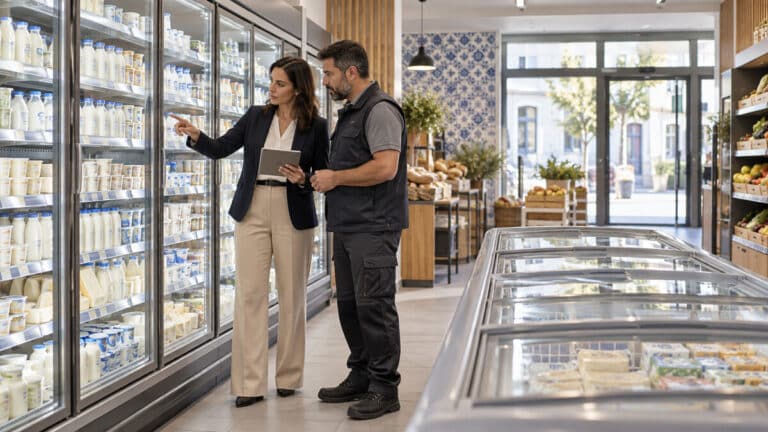

Estonia has a compact but technically strong commercial refrigeration market. Supermarkets, convenience stores, foodservice operators and food manufacturers rely on a mix of Baltic subsidiaries of international groups and local refrigeration specialists.
Five companies stand out for direct supermarket and food-retail relevance: Epta Baltics, Beijer Ref Estonia, Kryos, Külmakeskus and MNTron System.
They serve different parts of the market. Epta Baltics focuses on complete retail refrigeration systems and after-sales support. Beijer Ref Estonia supplies refrigeration equipment, components and CO2 technology. Kryos designs, installs and maintains refrigeration systems across Estonia. Külmakeskus combines equipment supply with cold-room construction and service. MNTron System is a newer Estonia-based supplier focused on commercial display refrigeration for retail.
: Estonia supports a genuine Top 5 commercial refrigeration shortlist without padding. Epta Baltics and Beijer Ref Estonia offer the broadest international-group capability. Kryos and Külmakeskus bring long local operating histories. MNTron System adds a newer specialist focus on supermarket display refrigeration.
Top supermarket refrigeration companies in Estonia
| Company | Estonian base | Main focus | Key strength |
|---|---|---|---|
| Epta Baltics | Estonia / Baltic region | Commercial refrigeration systems | Design, installation, service and remote monitoring |
| Beijer Ref Estonia | Saku and Tartu | Refrigeration equipment, components and CO2 systems | Large international refrigeration group |
| Kryos | Tallinn and Tartu service network | Design, installation and maintenance | Operating since 1995 |
| Külmakeskus | Tallinn | Commercial refrigeration and cold rooms | Operating since 1999; 60+ represented brands |
| MNTron System | Tallinn | Retail display refrigeration | Island freezers, upright coolers and multidecks |
Why commercial refrigeration matters in Estonia
Commercial refrigeration is a major technical system in Estonian grocery retail.
It keeps chilled and frozen products safe, affects shelf life and can account for a large share of electricity use in supermarkets.
Estonia’s own greenhouse-gas inventory identifies supermarkets as one of the major commercial refrigeration applications in the country. That matters because refrigerant choice, leakage and system efficiency are now environmental as well as operating-cost issues.
Estonia’s supermarket market includes Coop, Selver, Maxima, Rimi, Prisma, Lidl and several smaller chains. Different formats need very different refrigeration designs.
A hypermarket may use central CO2 refrigeration with hundreds of metres of cabinets. A convenience store may use smaller remote or plug-in systems. Foodservice counters, frozen food, dairy and fresh meat all require separate temperature zones.
How we selected the five companies
We excluded generic HVAC companies unless refrigeration was clearly central to their business.
The five companies had to show:
- commercial refrigeration capability;
- a real Estonian operating presence;
- food-retail, supermarket or commercial-food relevance;
- installation, service, equipment or engineering depth;
- current operations in 2026.
There is no public audited national ranking of refrigeration suppliers by Estonia-only revenue. We therefore do not invent market-share percentages.
1. Epta Baltics
Epta Baltics is one of the strongest refrigeration names for supermarket projects in Estonia and the wider Baltic region.
The company forms part of Epta Group, one of the world’s major commercial refrigeration businesses.
What does Epta Baltics provide?
Epta Baltics designs, installs and supports refrigeration systems for food retail.
Its offering includes:
- refrigerated display cabinets;
- freezer cabinets;
- refrigeration plant;
- store refrigeration design;
- installation;
- maintenance;
- remote monitoring;
- cabinet modernisation;
- energy optimisation.
This full-lifecycle approach is important for supermarket groups because equipment selection and long-term service cannot be separated easily.
History and group background
Epta has decades of experience in commercial refrigeration and operates internationally across food retail and foodservice.
Its Baltic business combines local engineering with technology and products from the wider Epta group.
In 2023, Epta and Viessmann Refrigeration Solutions combined major commercial refrigeration activities. Epta later expanded again through the acquisition of Hauser. That makes the group’s current product and engineering base broader than older market comparisons may show.
Estonian presence
Epta Baltics operates in Estonia as part of its Baltic regional structure and provides local contact and support for Estonian projects.
The company’s current Baltic site describes it as a market leader in commercial refrigeration technology for the Baltic food-retail sector.
Revenue, employees and valuation
Epta does not publish Estonia-only revenue or employee numbers for its Baltic operation in the public material reviewed.
Using global Epta figures as Estonian market figures would be misleading.
The company is privately held, so there is no public stock-market valuation.
Market share
A verified percentage share of Estonia’s supermarket refrigeration market is not publicly disclosed.
Why Epta matters to supermarkets
Epta’s strongest point is system integration.
Large retailers need cabinets, plant, controls and service to work together. Epta can support the complete chain from store planning to maintenance and remote monitoring.
That makes it particularly relevant to national chains and major store refurbishments.
2. Beijer Ref Estonia
Beijer Ref Estonia is one of the country’s leading refrigeration-equipment wholesalers and technical suppliers.
The business began operating in Estonia in 1997 under the name Külmakomponentide OÜ.
History
The company started with a relatively small operation in Tallinn.
As demand grew, it moved into larger premises and expanded its product range.
In 2005, the company opened a second office in Tartu to serve southern Estonia.
It now operates as part of Beijer Ref, a large international refrigeration group with operations across Europe and other regions.
Head office and branches
Beijer Ref Estonia’s main operation is in Tänassilma, Saku municipality, near Tallinn.
It also has a Tartu operation, giving the company stronger geographic coverage across Estonia.
What does Beijer Ref Estonia sell?
The company supplies:
- refrigeration components;
- compressors;
- heat exchangers;
- controls;
- refrigeration units;
- CO2 systems;
- heat-pump products;
- air-conditioning equipment;
- industrial refrigeration equipment.
Its position is different from a turnkey contractor. Beijer Ref is especially strong as a technology, components and equipment supplier to installers and end users.
CO2 refrigeration
Beijer Ref’s own-production portfolio includes SCM Frigo transcritical CO2 booster systems.
These systems are designed specifically for commercial and industrial refrigeration.
SCM Frigo’s CO2 equipment covers capacities from approximately 1 kW up to 1 MW.
This makes Beijer Ref highly relevant to supermarkets moving away from high-GWP refrigerants.
Employees and revenue
Beijer Ref Estonia describes its local team as relatively small and highly specialised.
A current official Estonia-only employee total and 2025 revenue figure were not published on the company’s public page reviewed for this article.
We therefore do not estimate them.
Valuation and market share
Beijer Ref AB is publicly listed, so the parent company’s market value changes daily.
That global market capitalisation is not the value of Beijer Ref Estonia.
No verified percentage share of the Estonian commercial refrigeration market is publicly disclosed.
Why Beijer Ref matters
Refrigeration contractors depend on reliable components and spare parts.
Beijer Ref’s value comes from its wide product portfolio, technical expertise and local stock/support model.
For supermarkets, this matters indirectly as well as directly because the installer may build a system around Beijer Ref-supplied components.
3. Kryos
Kryos is one of Estonia’s longest-established local refrigeration specialists.
The company says it has operated in the market since 1995.
What does Kryos do?
Kryos designs, imports, installs and maintains refrigeration equipment and heat-pump systems.
Its core services include:
- refrigeration-system design;
- equipment supply;
- installation;
- commissioning;
- preventive maintenance;
- repair;
- heat-pump systems.
The company describes refrigeration as its principal activity rather than a side service.
Service network
Kryos has developed a maintenance network covering all of Estonia.
Its larger maintenance centres are in Tallinn and Tartu.
This matters because refrigeration breakdowns cannot wait for normal planned maintenance windows.
A supermarket may need urgent service in the evening or during a weekend to protect chilled stock.
Technical expertise
Kryos states that its executive employees have specialised technical education.
That engineering depth is important in refrigeration because system design errors can remain hidden until peak summer temperatures or high store loads expose them.
Employees and revenue
Kryos does not publish a current 2025 revenue figure or current workforce total on the public company page reviewed.
We therefore leave those figures as not publicly disclosed.
Valuation and market share
Kryos is privately held and does not publish a company valuation.
No reliable national refrigeration-market percentage is publicly available.
Why Kryos matters to supermarkets
Kryos’s strongest advantage is local lifecycle support.
Retailers need a supplier that can maintain the system years after installation, not only design it on opening day.
Its national maintenance network gives it a practical advantage for multi-site customers.
4. Külmakeskus
Külmakeskus is another long-established Estonian refrigeration business.
The family company has operated since 1999.
What does Külmakeskus supply?
The company sells and installs commercial refrigeration and professional kitchen equipment.
Its refrigeration range includes:
- refrigerators;
- freezers;
- refrigerated counters;
- display coolers;
- walk-in refrigeration;
- cold rooms;
- freezer rooms;
- ice machines;
- industrial refrigeration equipment.
Brands and product range
Külmakeskus says it represents more than 60 brands in Estonia.
Its current online catalogue contains hundreds of commercial refrigeration products.
This breadth can be useful for smaller retailers and foodservice businesses that need standard equipment quickly rather than a custom central refrigeration plant.
Complete projects
The company also provides:
- design;
- equipment selection;
- installation;
- maintenance;
- cold-room construction;
- freezer-room construction.
This means it can move beyond simple equipment retail when a customer needs a more complete project.
Head office
Külmakeskus operates from Tallinn and supplies customers across Estonia.
Revenue and employees
Current official 2025 revenue and workforce figures were not published on the company’s own public information reviewed here.
Third-party databases contain estimates and filings, but we do not use weak estimates when the primary company material does not support them.
Valuation and market share
Külmakeskus is privately held.
No public valuation or reliable national market-share percentage is available.
Why Külmakeskus matters
Its strongest fit is flexibility.
Not every grocery business needs a national-chain refrigeration integrator.
Independent food stores, bakeries, convenience stores and foodservice businesses may need equipment, installation and local service from one supplier.
5. MNTron System
MNTron System is the newest company in this ranking.
The Estonia-based business focuses specifically on commercial display refrigeration for supermarkets and other food retailers.
Head office
MNTron System is based at Pärnu maantee 105 in Tallinn.
The company is registered in Estonia under registry code 17425301 and is a member of the Estonian Chamber of Commerce and Industry.
What does MNTron supply?
Its range includes:
- island freezers;
- upright coolers;
- glass-door coolers;
- multideck display cabinets;
- supermarket refrigeration equipment;
- bespoke retail units.
The product range is designed around display as well as cooling performance.
Retail focus
MNTron positions itself directly around supermarkets, convenience stores, food retailers and commercial businesses.
That narrow positioning makes it relevant even though the company is much younger than Kryos or Külmakeskus.
History
MNTron is a recently established Estonian company.
Because it does not have decades of operating history, buyers should evaluate its references, warranty process and service arrangements carefully.
Employees, revenue and valuation
Current employee count, 2025 revenue and company valuation were not publicly disclosed in the primary material reviewed.
Market share
No market-share figure is public.
Why MNTron matters
It shows that Estonia’s refrigeration market is still attracting new specialist suppliers.
Its focus on supermarket display equipment can be useful for retailers looking for standardised cabinet solutions or alternatives to larger multinational suppliers.
How do Estonia’s refrigeration companies compare?
| Company | Best fit | Main advantage |
|---|---|---|
| Epta Baltics | Large supermarket projects | Full system design, products and service |
| Beijer Ref Estonia | Equipment, components and CO2 systems | Broad technical portfolio and international group |
| Kryos | Design, installation and maintenance | 30+ years of local experience |
| Külmakeskus | Independent retail, foodservice and cold rooms | Wide equipment range and local service |
| MNTron System | Display refrigeration | Retail-focused cabinet portfolio |
Which refrigerants are important in Estonia?
Commercial refrigeration is changing quickly across Europe.
Retailers are moving away from higher-GWP HFC refrigerants because regulation and environmental targets are tightening.
Two natural refrigerants are especially important:
- CO2, or R744: widely used in central supermarket systems;
- propane, or R290: widely used in self-contained cabinets.
Estonia already has supermarkets using CO2 technology. Rimi stores in Estonia have used CO2-based refrigeration with modern display cabinets.
Beijer Ref’s SCM Frigo range also shows how transcritical CO2 has become a mainstream commercial option rather than an experimental system.
Why energy efficiency matters
Refrigeration runs continuously.
That makes electricity one of the biggest lifetime costs of the system.
Efficiency depends on:
- compressor technology;
- cabinet doors;
- fan motors;
- LED lighting;
- controls;
- defrost;
- condensing temperature;
- heat recovery;
- store temperature;
- maintenance.
A cheap cabinet can become expensive if it consumes significantly more energy over ten years.
What should supermarkets check before choosing a refrigeration supplier?
- Project type: central system, distributed system or plug-in?
- Refrigerant: is it future-proof under EU regulation?
- Energy model: what annual consumption is expected?
- Service network: can the supplier respond outside Tallinn?
- Spare parts: are common components held locally?
- Remote monitoring: can alarms be detected before product is lost?
- Heat recovery: can rejected heat support store heating?
- Cabinet efficiency: doors, lighting and fan design matter.
- Reference stores: ask for similar Estonian projects.
- Lifecycle cost: include service and electricity, not only installation.
How important is maintenance?
Maintenance is critical.
Dirty heat exchangers, poor refrigerant charge, worn seals and failed sensors can increase energy use before a complete breakdown occurs.
Supermarkets should track:
- temperature alarms;
- compressor runtime;
- refrigerant leaks;
- door condition;
- defrost cycles;
- energy trends.
Remote monitoring can turn maintenance from reactive repair into early intervention.
How does refrigeration affect food waste?
Temperature stability affects shelf life.
A system that repeatedly allows chilled food to warm can shorten usable life even if the product never reaches a dangerous temperature.
That means better refrigeration can reduce:
- write-offs;
- quality complaints;
- markdowns;
- recalls caused by temperature failures.
Refrigeration is therefore part of both sustainability and margin management.
What is CO2 refrigeration?
CO2 refrigeration uses carbon dioxide as the refrigerant.
In supermarkets, transcritical CO2 systems can serve chilled and frozen cases from a central plant.
The technology requires specialist design and commissioning because operating pressures are higher than many traditional refrigerants.
However, it offers very low global-warming potential and is now widely adopted across European food retail.
What is R290 refrigeration?
R290 is propane.
It is used extensively in self-contained commercial refrigeration cabinets.
R290 has very low global-warming potential and can offer good energy efficiency.
Because propane is flammable, equipment design, charge limits and servicing procedures are important.
Which company is the largest refrigeration supplier in Estonia?
There is no audited market-wide ranking by Estonia-only refrigeration revenue.
Epta and Beijer Ref are the largest international groups represented in this list.
Kryos and Külmakeskus are long-established Estonian specialists.
Without directly comparable local refrigeration turnover from all five companies, naming one as the largest local supplier would be speculative.
Which company has the longest local history?
Kryos has operated in Estonia since 1995.
Beijer Ref Estonia began in 1997, while Külmakeskus was established in 1999.
These companies therefore have more than 25 years of local refrigeration experience.
Which companies offer complete supermarket systems?
Epta Baltics has the clearest large-scale complete supermarket proposition, covering design, equipment, installation, monitoring and service.
Kryos can also design, install and maintain refrigeration systems.
Külmakeskus provides complete refrigeration projects for smaller commercial and foodservice environments.
Which company is strongest for components?
Beijer Ref Estonia has the strongest dedicated wholesale and component-supply position in this shortlist.
Its range includes compressors, controls, refrigeration units, heat exchangers, refrigerants and CO2 technology.
What is changing in Estonia’s refrigeration market?
Four changes matter most:
1. Natural refrigerants
CO2 and propane continue to replace high-GWP refrigerants.
2. Energy monitoring
Retailers increasingly want real-time system data rather than waiting for equipment to fail.
3. Heat recovery
Waste heat from refrigeration can support space heating or hot water.
4. Cabinet efficiency
Glass doors, improved fans, better insulation and smart controls reduce electricity use.
These changes connect refrigeration with the wider Estonian retail technology market, because monitoring and controls are becoming part of store data infrastructure rather than isolated engineering equipment.
How does Estonia compare with other Baltic markets?
Estonia is smaller than many European grocery markets, but its retailers are technically advanced.
Baltic refrigeration suppliers often work across Estonia, Latvia and Lithuania because the three markets are geographically close and share similar retail technologies.
For supermarket groups operating across the Baltics, regional supplier capability can simplify standards and maintenance.
Frequently asked questions
Does Estonia use CO2 supermarket refrigeration?
Yes. CO2 systems are already used in Estonian supermarket projects.
Which Estonian company builds cold rooms?
Külmakeskus builds cold and freezer rooms. Kryos and other engineering contractors also work on commercial refrigeration systems.
Can Beijer Ref install a full supermarket?
Beijer Ref’s core role is equipment and components. Full installation is often carried out by refrigeration contractors using products from suppliers such as Beijer Ref.
Does Epta operate directly in Estonia?
Yes. Epta Baltics operates across the Baltic region and provides Estonian commercial refrigeration support.
Which company is best for small food stores?
Külmakeskus and MNTron can be strong options where the need is standard commercial refrigeration equipment rather than a large central system.
Which supplier has the widest Estonia-wide service network?
Kryos explicitly states that its maintenance network covers the whole of Estonia, with larger service centres in Tallinn and Tartu.
What is the best refrigerant for an Estonian supermarket?
There is no single answer. CO2 is common for larger central systems, while R290 is widely used in plug-in cabinets. Store size, climate, system design and service capability all matter.
How long should commercial refrigeration last?
Service life depends on equipment quality, operating conditions and maintenance. Major systems should be assessed on lifecycle cost rather than purchase price alone.
Can refrigeration systems reduce heating costs?
Yes. Heat-recovery systems can reuse waste heat from refrigeration for store heating or hot water when correctly designed.
Why are supermarket doors appearing on more chilled cases?
Doors reduce warm-air infiltration and can cut energy use significantly, although retailers must balance energy savings with shopper access and merchandising.
Editor’s Note: Company capabilities and operating history were checked against current official sources.