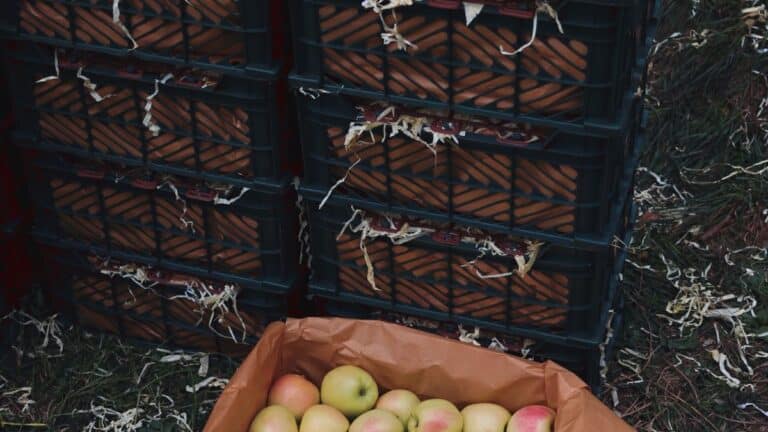

Estonia’s commercial apple growers include Halika Õunatalu, Vasula Aed, Aakre Aed, Morna Talu, Kadastiku Õunaaed, Arkna Agro, Kaasiku Mahetalu and Saaremaa Õunad. Jaanihanso is also an important apple-orchard operation but mainly uses its fruit for cider. For supermarket sourcing, the strongest direct evidence of table-apple supply comes from businesses with their own orchard and retail statements, notably Halika, Vasula and Aakre. The list below is a buyer shortlist, not a claim that all nine are large export packers or that cider-apple production equals fresh-apple retail supply.
Updated 10 November 2026. Estonia’s public business data provides useful dated tax turnover and workforce snapshots, but company sales, taxable turnover, orchard output and market share are different measures. The figures here are from the 2025 registered sector summary and the third quarter of 2026 where stated. The current import and crop environment also matters: Estonian public broadcaster ERR reported that local apple prices face tough competition from Poland and Italy.
Estonian apple companies: turnover, staff and orchard locations
Figures are for the named legal entity and year stated. The 2026 Q3 staff number is a quarter-end payroll snapshot, not an annual average or a harvest-season headcount. Kadastiku changed its financial year-end, so its most recently filed 2024-labelled accounts cover a longer period ending May 2025. They must not be compared as a standard twelve-month 2025 result.
| Grower | Latest annual turnover | Staff | Location |
|---|---|---|---|
| Halika Õunatalu | €256,227 | 14 Q3 2026; five in 2025 annual sector listing | Põlva County |
| Vasula Aed | €164,407 | 13 Q3 2026; ten in annual-company listing | Tartu County |
| Aakre Aed / Uus Taim | €71,118 Uus Taim; €33,609 Maigold (2025) | 4 and 3 Q3 2026; three and one in annual data | Tartu County |
| Morna Talu | €44,381 | 1 Q3 2026 | Viljandi County |
| Kadastiku Õunaaed | €347,785 (accounts labelled 2024; period to May 2025) | 1 Q3 2026 | Saaremaa |
| Arkna Agro | €40,658 | 2 Q3 2026 | Lääne-Viru County |
| Kaasiku Mahetalu | €25,130 | 1 Q3 2026 | Tartu County |
| Saaremaa Õunad | €10,644 | No Q3 2026 staff figure in published ranking | Saaremaa |
| Jaanihanso | €549,799 total company turnover (2025; mainly cider and other activities) | 4 employees (2026 Q3) | Pärnu County |
1. Halika Õunatalu / Taluõun
Halika Õunatalu is a commercial apple farm in Räpina municipality. Its own orchard business sells domestic apples and juice, while the company’s 2025 annual report shows a profitable agricultural enterprise. Unlike general trading businesses, Halika is a named source of Estonian-grown fruit.
- Annual revenue: €256,227 (2025), up 32.7% on 2024.
- Employees: Five employees reported in the 2025 company-sector listing; 14 on the 2026 third-quarter tax payroll snapshot.
- Headquarters and facilities: Halika, Saareküla, Räpina municipality, Põlva County; farm and orchard business rather than a chain of retail branches.
- History: The legal company Halika Õunatalu OÜ was registered on 16 November 2010. Orchard and fruit-business activities are recorded under EMTAK 01241.
- Ownership: Lauri Kasvand is listed as the 100% shareholder and is associated with the farm’s management.
- Products: Apples for Estonian customers and related fruit-processing activities, including registered juice manufacturing.
- Latest developments: The 2025 annual accounts recorded net profit of €112,737. ERR’s 2026 reporting discussed pricing pressure and weather difficulties affecting local apples, including comments from grower Lauri Kasvand.
Halika offers a stronger direct fruit-growing proposition than a trading-only directory entry. Its 2025 revenue covers company activities and should not be equated with the sales value of supermarket-grade apples. For a retail contract, orchard output, variety, grade and winter storage are the key additional measures.
2. Vasula Aed
Vasula Aed is a fruit-growing cooperative in Tartu County with 33 hectares of apple orchards. Its distinction between newer table-apple blocks and older orchards used for processing is relevant to retail buyers seeking fresh-grade fruit.
- Annual revenue: €164,407 (2025).
- Employees: 10 staff in the 2025 annual-company sector listing; 13 in the Q3 2026 payroll snapshot.
- Headquarters and facilities: Lähte tee 3, Vasula, Tartu County, Estonia; its farm describes 33 hectares of orchards.
- History: The cooperative was founded on 5 August 1992 and formally entered the business register on 16 January 1998. Its 2025 accounts recorded €164,407 turnover and a €16,460 loss, following €139,783 revenue and €3,152 profit in 2024. Its current orchards include younger commercial plantings and older orchards devoted partly to juice and jam.
- Ownership: Vasula Aed is an Estonian commercial cooperative (tulundusühistu). Peeter Värnik has served as a registered management board member since January 2015.
- Products: More than 50 apple varieties. The company describes 15 hectares of younger commercial orchards and 18 hectares of older orchards, much of the latter used for juice or jam.
- Latest developments: The 2025 cooperative accounts show €164,407 turnover, up from €139,783 in 2024, but a €16,460 net loss, reversing the previous year’s €3,152 profit. The company’s storage facilities are commercially relevant for winter distribution.
Its orchard scale is unusually well described. Separate fresh retail grades from fruit destined for processing, and distinguish seasonal harvest volume from what is available after long-term storage.
3. Aakre Aed / Uus Taim and Maigold Grupp
Aakre Aed markets fruit from a commercial orchard project established in 2003. The orchard brand involves two independent legal companies, Uus Taim and Maigold Grupp. The producer names Coop, Selver and Prisma among its retail customers.
- Annual revenue: €71,118 for OÜ Uus Taim and €33,609 for OÜ Maigold Grupp (2025; separate legal companies).
- Employees: Uus Taim three and Maigold Grupp one in 2025 annual-company sector data; Q3 2026 payroll snapshots separately recorded four and three respectively.
- Headquarters and facilities: Oona tee 7, Aakre village, Elva municipality, Tartu County; one common orchard brand, not two independent brands.
- History: The orchard project began in 2003 with its first apple trees. The businesses now describe about 20,000 trees and around 30 cultivars.
- Ownership: Aakre Aed is a shared trading brand used by two separately owned legal entities. OÜ Uus Taim, established on 30 January 2008, is 100% owned by Krista Tiirmaa. OÜ Maigold Grupp, registered on 7 December 2005, is 100% owned by Neeme Univer. Both companies are registered at Koolitalu in Aakre village.
- Products: Primarily table apples, including Krista, Auksis, Liivika, Liivi kuldrenett and Antei, plus apples for juice.
- Latest developments: The growers’ own published retail list includes Coop, Selver, Prisma, Stockmann and the Tallinn and Tartu Kaubamaja department stores. Grant-funded investment has supported planting, trellising and orchard equipment.
Retail outlets are particularly important evidence of market fit. The two company sales figures should remain separate, because the brand’s orchard presentation does not establish one consolidated audited company.
4. Morna Talu OÜ
Morna Talu is a mixed orchard business in Viljandi County, growing apples, pears and plums. Its own farm website identifies approximately 9,000 low-growing fruit trees and records the first modern plantings in 2008. The company also earns revenue outside fruit growing.
- Annual revenue: €44,381 in the 2025 filed annual accounts, up from €36,060 in 2024. The reported operating breakdown includes €20,089 from pome and stone fruit, €13,133 from drinks retail, €4,925 from other fruit and berries, and €3,175 from property activity.
- Employees: One employee in the 2025 filed-account record and one in the Q3 2026 payroll snapshot. A sector-directory extract showing zero uses a different employee definition.
- Headquarters and facilities: Veski, Morna village, Mulgi municipality, Viljandi County. Its own website describes roughly 9,000 fruit trees.
- History: Morna Talu OÜ was established on 1 April 2008 and uses the website mornatalu.ee. Its 2025 annual report was filed on 8 June 2026. The company reported €44,381 sales, up 23.1% year on year, €2,420 profit and one employee. Its own farm history describes modern planting beginning in 2008. The farm says commercial apple cultivation in Morna village dates back to the early nineteenth century. The present company previously used the names Morna Aed OÜ and Lastricato Group OÜ, as shown by the Estonian register. It started planting its own modern orchards in 2008 and reports around 9,000 dwarf-rootstock fruit trees.
- Ownership: Estonian private limited company owned by Danel Mets (75%), Romet Mets (15%) and Andres Mets (10%).
- Products: Apples, pears and plums, as described on the farm’s own website; a regional orchard and not a national retail branch network.
- Latest developments: 2025 company revenue rose from the 2024 figure and the business recorded €2,420 net profit in the 2025 accounts-based sector comparison.
Morna is a potential regional grower rather than a documented national supermarket packer. A small company can still be relevant to a seasonal contract, but the buyer needs actual available apple tonnage and fruit grading before equating the register entry with retail readiness.
5. Kadastiku Õunaaed OÜ
Kadastiku Õunaaed is a commercial apple producer on Saaremaa with direct evidence of distribution into national supermarket chains. The grower says its orchard business dates to 2004 and currently has two orchards covering more than 11 hectares. Its site describes itself as Saaremaa’s largest apple orchard.
- Annual revenue: €347,785 turnover and €121,221 profit in the accounts labelled 2024, covering 1 January 2024 to 31 May 2025. The next accounting period (1 June 2025–31 May 2026) was due for filing by 30 November 2026 and had not been submitted in the register examined.
- Employees: One reported in 2025 annual company records and one in the third-quarter 2026 tax payroll snapshot.
- Ownership: Since 13 May 2026, Andres Aav and Anne Aav each hold 50%; both serve on the management board.
- Established: 13 August 2004.
- Registered orchard: Kadastiku, Suurna village, Saaremaa; the online shop also identifies a warehouse/contact point at Viiase tee 26, Salme.
- Facilities: Two orchards over 11 hectares, with registered property records showing five properties in October 2026; property count is not an orchard count.
- Products: Table apples in 1 kg labelled packs, loose apples in 5 kg or 10 kg cartons, and Tehumardi brand apple, apple-pear and apple-aronia juices.
- Retail distribution: The producer lists larger Selver, Rimi and Prisma stores; Stockmann; selected Coop branches; and Kuressaare and Muhu Coop Konsum outlets as seasonal stockists.
- Recent developments: Ownership and management changed in May 2026. The company describes investment support for 5,000 apple-tree seedlings and orchard machinery.
Its published retail packaging and supermarket distribution make Kadastiku a relevant fresh-apple supplier, not simply an unqualified agricultural register entry. The company also accepts direct and online orders during its seasonal sales period. Distribution availability varies by retailer and harvest.
6. Arkna Agro OÜ
Arkna Agro is a registered agricultural enterprise in Arkna village, Lääne-Viru County. Its registered economic activities include both pome/stone-fruit production and other berry farming. Neither a nationwide apple-packing operation nor a national retailer contract is evidenced by these register categories.
- Annual revenue: €40,658 (2025), up from €24,453 in 2024.
- Employees: One in 2025 annual-company ranking; two in the 2026 Q3 payroll snapshot.
- Headquarters and facilities: Arkna mõis, Arkna village, Rakvere municipality, Lääne-Viru County. This is the registered company address; separate orchard parcels and packing facilities are not enumerated in the annual financial report.
- History: Arkna Agro OÜ was registered on 2 May 2013 and operates from Arkna village in Lääne-Viru County. Annual accounts record five employees in 2013, six in 2018 and one in 2025, indicating a much smaller current reported workforce than earlier in its history.
- Ownership: Estonian private company wholly owned by Olle Saare, who is also its managing board member.
- Products: Registered for pome/stone-fruit growing (EMTAK 01241) and other berry growing (01251); company sales figures cover its business as a whole, not individual fruit crops.
- Latest developments: The 2025 filed accounts show €40,658 revenue generated in Estonia, €59,946 operating and annual profit, €637,494 in total assets and €519,965 equity. Profit improved from a €16,131 annual loss in 2024. Operating profit exceeds annual sales, so the result cannot be interpreted as a margin on apple sales alone.
A supermarket buyer should establish which crops are currently grown and where they are packed. Company accounts identify an economic operator; they do not themselves demonstrate an ability to supply high-volume graded apples.
7. Kaasiku Mahetalu OÜ
Kaasiku Mahetalu is a small organic-oriented producer in Soeküla, Tartu County, with a direct-to-consumer shop. Its recorded landholding includes a 23,799-square-metre agricultural parcel, although the whole parcel should not be counted as planted apple orchard. Its own website lists table apples, juice and organic fruit snacks, making the company’s products more specific than an agricultural classification alone suggests.
- 2025 revenue: €25,130, compared with €26,840 in 2024 and €39,828 in 2023.
- Employees: One in the 2025 annual company record and one in the Q3 2026 payroll snapshot.
- Founded: 3 September 2009.
- Ownership: Ago Kaasik and Kairi Järv-Kaasik each own 50%; Ago Kaasik serves on the management board.
- Farm location: Jõevälja-Kaasiku, Soeküla, Tartu municipality, Tartu County. This is the recorded farm/company address, not a claim of several orchards.
- Products: The farm website offers table apples including the Veteran variety, apples for jam, pasteurised organic apple juice in glass bottles and fruit-berry rolls. It also advertises organic apples by weight.
- Commercial format: The online shop lists a ten-kilogram minimum order for certain table apples and a six-litre minimum for juice. Displayed web prices are retail offers rather than a binding wholesale quotation.
- Recent business figures: The 2025 sector records show a net loss of €22,076, following a €23,843 loss in 2024. These losses are company financial results, not evidence of poor product quality.
Kaasiku’s published product selection makes it relevant to niche organic fruit and locally produced apple juice. Buyers should distinguish fresh table-fruit supply from value-added processed foods. Its retail shop provides evidence of commercial activity, but not the size of its contracted supermarket deliveries.
8. Saaremaa Õunad OÜ
Saaremaa Õunad is a small registered fruit-growing and beekeeping company based in Asva village on the island of Saaremaa. Its accounts allow a more precise breakdown than simply describing it as an apple producer.
- 2025 revenue: €10,644 in total, including €9,364 from fruit growing and €1,280 from beekeeping. The business also reported €4,083 operating profit in 2025.
- Employees: Zero in the 2025 annual company record and zero in its Q1 2026 tax return; this does not exclude owner work or seasonal labour.
- Founded: 7 November 2017, originally operating under the name Asvamäe PM OÜ.
- Registered site: Veskimäe, Asva village, Saaremaa municipality, Saare County.
- Ownership: Kena OÜ has owned 100% since 3 July 2025; Tiina Kiiker is the managing board member.
- Products: Pome and stone-fruit growing and beekeeping; the filed activity split does not specify the exact quantity of table apples.
- Latest activity: Its 2025 turnover was €10,644 and operating profit €4,083. Third-quarter 2026 taxable turnover was €518; the company was not on the October 2026 tax-debtor list.
The fruit-growing and beekeeping split helps buyers understand the company’s scale. It should not be portrayed as a national supermarket packer or as having a network of branches. Its registered farm address identifies the company, not additional production sites.
9. Jaanihanso orchard and cider house
Jaanihanso uses an organic orchard and traditional local apple varieties for cider production. It is a beverage manufacturer, not a conventional supermarket table-apple packer. Its company sales should therefore be compared with cider producers rather than fresh-fruit suppliers.
- Annual revenue: €549,799 total legal-entity turnover in 2025, up 4.4% from €526,390 in 2024; €405,895 from cider and other fermented-fruit beverages, not fresh table-apple sales.
- Employees: Four employees in the third quarter of 2026 tax payroll record.
- Headquarters and facilities: Registered office in Tallinn; cider house and orchard at Õuna, Kaelase village, Põhja-Pärnumaa, Pärnu County; six hectares and more than 6,200 apple trees.
- History: The farm’s origins date to the 18th century. Professional cider-making began in 2013 and organic certification dates to 2016.
- Ownership: OÜ JAANIHANSO was registered on 22 January 2002 and is 100% owned by Alvar Roosimaa, its management board member. Its principal registered activity is production of cider and other fermented fruit beverages.
- Products: Cold-pressed, locally sourced apple cider made from traditional Estonian apple varieties; not primarily a supermarket table-apple packer.
- Latest developments: 2025 net profit rose to €81,822 from €24,885 in 2024. In Q3 2026 the company reported €206,451 taxable turnover, 32.1% above the comparable quarter a year earlier. Its orchard statement describes five to six principal traditional apple varieties and onsite cold pressing.
The cider-making business earns most of its turnover from drinks, not fresh apples. Jaanihanso is included as a processing-apple business, not as an equivalent competitor to fresh-table-apple suppliers. Its presence demonstrates the different commercial destinations for the national harvest. This distinction matters when comparing orchard acreage and supermarket fresh produce capacity.
Why local apples remain expensive in Estonian stores
Public broadcaster ERR reported in February 2026 that some Estonian retailers stock cheaper Polish or Italian apples rather than domestic fruit. Its report quoted a supermarket manager saying imported apples were available near €0.99 per kilogram while organic Estonian apples were selling for much more. These are reported shelf examples, not a national average price. They illustrate a real constraint: a smaller local orchard cannot necessarily match the scale, labour costs and packing efficiency of larger European exporters.
Halika grower Lauri Kasvand told ERR that difficult weather had affected the sector and that only one of the previous five harvests had been especially good. Local growers identified mechanisation and investment as factors that could help reduce costs. For buyers, this means realistic harvest forecasts, written storage arrangements and differentiated positioning are important. A product advertised as local should not be replaced by imported fruit without clear disclosure.
The 2025 apple harvest also suffered from cold spring conditions and rainy weather. Some regions and varieties were affected differently, according to ERR. Buyers should not assume all farms share the same yield or storage performance, even where they are within the same country.
How to buy local apples for Estonian supermarket shelves
Start with a consumer proposition. Local origin may be valued enough to support a higher shelf price, but the retailer needs honest forecasting and a clear delivery period. Supply contracts may also involve Slovakia’s apple producers when buyers source across borders. Buyers should discuss varieties, grade and expected shelf life before asking for a national year-round price. Domestic fruit may be available in autumn and during a limited winter-storage period rather than continuously.
For each shortlisted orchard, request a list of varieties and a realistic calendar of harvest and storage releases. Similar seasonal planning affects apple producers in Latvia, another Baltic supply market. Agree colour, size, firmness, bruising and decay tolerances. Confirm whether the supplier has its own controlled storage or relies on third parties. A cooler that holds fruit after harvest is not necessarily a certified long-term controlled-atmosphere system.
Small growers may use several sales channels, including farmers’ markets, direct farm shops, juice processing and selected grocery outlets. This matters when comparing producer arrangements with Slovenian apple producers or wider fresh produce suppliers in Serbia. A high proportion of the harvest might already be committed to those channels. Ask for the volume genuinely available for a new retailer rather than basing plans on annual tree count alone.
Retail buying priorities for Estonian apples
- Table apples versus processing: Aakre has confirmed supermarket distribution; Jaanihanso focuses on cider; Vasula sells fruit from both modern and older orchards.
- Harvest and storage: Compare reliable winter availability and packing quality, not only acres or tree count.
- Company scale: Separate annual statutory sales from quarterly taxable turnover and seasonal headcount.
- Local price competition: Consider whether a domestic origin premium can withstand imported fruit pricing.
- Regional logistics: Island suppliers must account for consolidation and transport off Saaremaa.
How financial information should be used
Estonia publishes useful registry and tax information, but it is easy to misinterpret. The sector table’s 2025 turnover may not equal a company’s full consolidated statutory revenue. A 2026 third-quarter taxable-turnover figure is only that quarter, not a full financial year. A staff count recorded at the end of September does not measure the number of harvest workers employed during summer.
Aakre provides a particularly useful example: the shared orchard brand involves two named legal entities, Uus Taim and Maigold Grupp. Their tax figures should not be treated as independent competitor shares or automatically consolidated without checking the underlying accounts. Buyer concentration should be evaluated using the actual owners and growing sites.
Company-level taxable-turnover percentages do not measure each farm’s share of Estonia’s national table-apple market. The percentage of tax turnover shown by the industry directory is the share of reporting businesses within that sector dataset, not the farm’s share of all Estonian apple sales or supermarket shelves.
Processing apples versus table apples
Fruit grown for juice and cider can have different variety, size and cosmetic expectations from supermarket dessert apples. Vasula identifies a substantial older orchard section oriented to processing. Jaanihanso explicitly makes cider from local organic apples. Both activities matter economically, but a retailer should not assume that processing tonnes are available for fresh produce.
When a grower offers a mixed harvest, agree what proportion meets the contracted retail grade and how the rest will be marketed. A transparent system can reduce wasted fruit without misleading consumers. Packaging must identify any relevant origin or organic claims correctly.
Can small growers support a supermarket contract?
A smaller orchard can provide a distinctive local product for a regional or seasonal programme. It may have limited warehouse infrastructure, scarce available labour or less frequent deliveries. The right arrangement could involve a producer organisation or logistics partner. Buyers should still know who owns and controls each batch, who carries insurance and how a recall would be handled.
A trial in selected shops can test actual consumer demand and replenishment reliability. Set a defined volume and duration rather than expecting a small farm to supply all branches immediately. Compare waste, shelf price and customer response, not only the purchase cost per kilogram.
Frequently asked questions
Which Estonian growers supply apples to supermarkets?
Aakre Aed identifies sales through Coop, Selver, Prisma and other Estonian stores. Halika and Vasula are established commercial apple farms. Current distribution agreements and availability must be confirmed with each producer.
How big is Vasula Aed’s orchard?
Vasula Aed’s website describes 33 hectares of apple growing and more than 50 varieties, split between newer and older orchard areas.
Are Maigold Grupp and Uus Taim independent Aakre brands?
Both companies operate under the Aakre Aed orchard brand. They should not be double counted as separate market groups without confirming their actual relationship and trading entities.
Do apple sector turnover figures measure apple sales?
Not necessarily. Sector tax data may include related activities and are not identical to audited revenue from fresh apples. A farm’s market share requires comparable product volumes and national sales data.
Editor’s Note: The profiles draw on Estonian e-Business Register filings and Estonian Tax and Customs Board workforce records, as reproduced by company-record services, together with producer websites for Halika, Vasula, Aakre, Morna and Jaanihanso, and ERR reporting on local apple prices and harvest conditions. Annual company sales, quarterly taxable turnover and seasonal payroll snapshots have different reporting scopes. Jaanihanso is identified as a cider maker, not a fresh-table-apple packer.
Company-level financial and payroll data: Estonian EMTAK 01241 register-derived annual company figures, Infomasin Q3 2026 Estonian Tax and Customs Board workforce data, and producer statements for orchard scale.