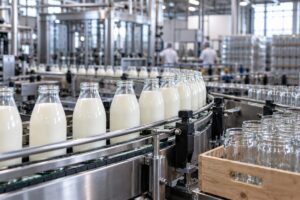


Sweden’s packaging industry moves into 2026 under mixed conditions. Demand for fibre-based innovation continues to strengthen. This is especially true as retailers and brand owners look for recyclable alternatives.
At the same time, two forces are putting pressure on margins:
- Oversupply in parts of the European board market
- The regulatory shift driven by the EU Packaging and Packaging Waste Regulation (PPWR)
Energy prices remain uneven. Most leading producers are heavily export-oriented, and currency fluctuations continue to influence reported revenue.
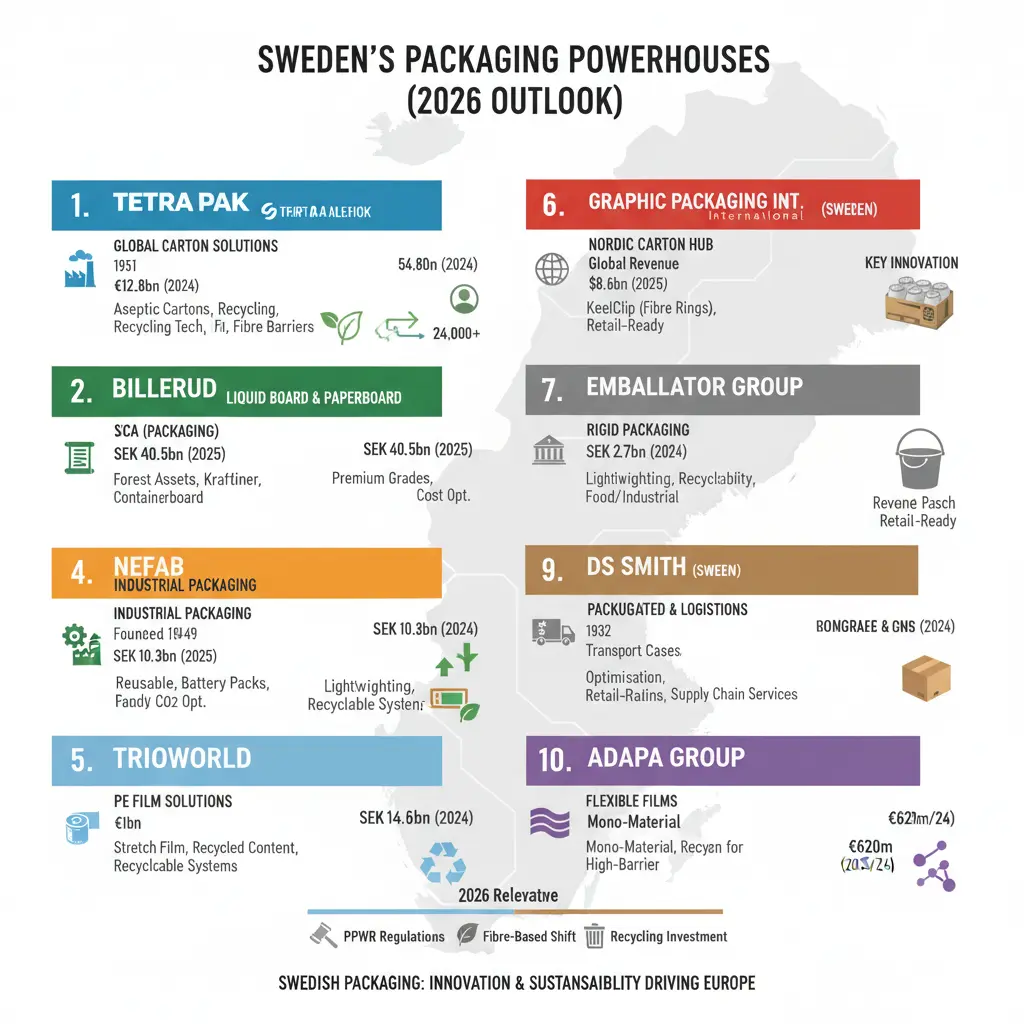
The ranking below reflects the latest publicly available FY2024–FY2025 financial data. This includes 2025 year-end results released in early 2026 where applicable.
Final Revenue Ranking (Latest Reported FY)
| Rank | Company | Revenue (Latest FY) | Core Strength | Swedish Hubs |
|---|---|---|---|---|
| 1 | Tetra Pak | €12.8bn (2024) | Aseptic carton systems | Lund |
| 2 | Billerud | SEK 40.5bn (2025) | Liquid board & cartonboard | Gävle, Gruvön, Karlsborg |
| 3 | SCA (Packaging) | SEK 20.4bn (2025) | Kraftliner & containerboard | Obbola, Munksund |
| 4 | Nefab | ~SEK 10.3bn (2025 run-rate) | Industrial eco-packaging | Jönköping |
| 5 | Trioworld | ~€1bn (2024) | Flexible plastic film | Smålandsstenar |
| 6 | Graphic Packaging International | $8.6bn (2025 global) | Folding cartons | Lund (legacy AR ops) |
| 7 | Emballator Group | ~SEK 2.7bn (2024) | Metal & plastic rigid packs | Ulricehamn |
| 8 | DS Smith (Sweden ops) | FY2024 basis | Corrugated packaging | Mariestad, Värnamo |
| 9 | Boxon Group | ~SEK 1.6bn (2024) | Packaging logistics & labels | Helsingborg |
| 10 | adapa Group | ~€620m (2023/24) | Flexible food packaging | Landskrona |
Group-level revenues are used where Swedish operations are core. Currency conversions reflect average FY exchange levels.
1. Tetra Pak
Tetra Pak was founded in 1951 in Lund. It remains Sweden’s largest packaging-linked business by revenue.
Revenue: €12.8bn (2024)
Employees: 24,000+
Core categories:
- Aseptic cartons
- Filling equipment
- Processing systems
- Recycling technologies
Lund remains a global R&D centre for beverage carton systems.
2026 relevance:
- Ongoing work on fibre-based barrier materials
- Efforts to reduce or remove aluminium layers in liquid cartons
- Recycling infrastructure investment across Europe
Tetra Pak defines dairy and beverage packaging across Nordic and EU retail chains.
2. Billerud
Billerud was founded in 1855. It is one of Europe’s leading producers of liquid carton board and specialty paperboard.
Revenue: SEK 40.5bn (FY2025)
The earlier SEK 43.5bn peak reflected stronger market conditions.
In 2025, weaker European demand and lower board prices reduced net sales.
Key pressures:
- Oversupply in European cartonboard
- Reduced Asian liquid board volumes
- Price compression in standard grades
Core categories:
- Liquid carton board
- Folding box board
- Kraft paper
- Containerboard
Strategic direction:
- Focus on premium specialty grades
- Fibre-based barrier innovation
- Cost optimisation amid demand slowdown
This demand pressure adds credibility to Sweden’s “dual-speed” packaging economy in 2026.
Billerud’s September 2026 report preview puts the emphasis on reducing material without sacrificing protection. GTN examines the buyer checks behind its packaging lightweighting warning, including damage rates and delivered cost.
3. SCA (Packaging Segment)
SCA is the structural backbone of Sweden’s fibre-based export model.
Revenue: SEK 20.4bn (2025)
Unlike converters, SCA owns forest assets.
This vertical integration secures fibre supply and energy input.
Obbola mill:
- One of the most advanced kraftliner facilities globally
- Significant recent expansion investment
Core packaging exposure:
- Kraftliner
- Containerboard
- Packaging paper
SCA benefits directly from long-term fibre substitution trends.
4. Nefab
Nefab was founded in 1949. It focuses on engineered industrial packaging.
Revenue: ~SEK 10.3bn (2025 run-rate)
Core categories:
- Reusable transport packaging
- Fibre-based industrial solutions
- Wood and protective systems
Growth drivers:
- Electrification supply chains
- Battery packaging requirements
- Lifecycle CO₂ optimisation
Industrial packaging demand remains structurally strong despite FMCG volatility.
5. Trioworld
Trioworld specialises in polyethylene film solutions.
Revenue: ~€1bn (2024)
Core focus:
- Stretch film
- Agricultural film
- Industrial film
- Recycled-content solutions
Flexible plastics face regulatory scrutiny under PPWR.
Trioworld’s strategic response:
- Higher PCR integration
- Development of recyclable film systems
Volume pressure remains visible in parts of the flexible segment.
6. Graphic Packaging International (Sweden Operations)
Graphic Packaging’s global revenue stands at $8.6bn (FY2025).
Swedish significance: the AR Packaging acquisition consolidated Lund as a Northern European carton hub.
Key innovation:
- Fibre-based “KeelClip” systems replacing plastic multipack rings
- Retail-ready carton packaging
This places Swedish operations at the centre of fibre substitution efforts in beverage packaging.
7. Emballator Group
Emballator was founded in 1906. It produces rigid packaging for food and industrial use.
Revenue: ~SEK 2.7bn (2024)
Core categories:
- Plastic buckets
- Metal containers
- Industrial rigid packs
Strategic direction:
- Lightweighting
- Improved recyclability
Rigid packaging remains essential for niche food and industrial segments.
8. DS Smith (Sweden)
DS Smith operates corrugated facilities across Sweden.
Group revenue basis: FY2024 reporting.
Core categories:
- Corrugated transport cases
- Retail-ready packaging
- E-commerce solutions
Corrugated demand links to private label and distribution efficiency.
9. Boxon Group
Boxon was founded in 1932. It operates where packaging production and logistics meet.
Revenue: ~SEK 1.6bn (2024)
Core functions:
- Packaging optimisation
- Labels
- Supply chain packaging services
Boxon acts as a systems integrator rather than a raw material producer.
10. adapa Group (formerly Schur Flexibles)
Formerly Schur Flexibles, the company now operates as adapa Group.
Revenue: ~€620m (2023/24 public reporting)
adapa repositioned its strategy after restructuring that followed 2022 financial irregularities.
Focus:
- Mono-material flexible films
- Design for Recycling (D4R) solutions
- High-barrier recyclable laminates
Flexible packaging faces structural adjustment in 2026 due to PPWR compliance.
Structural Themes in 2026
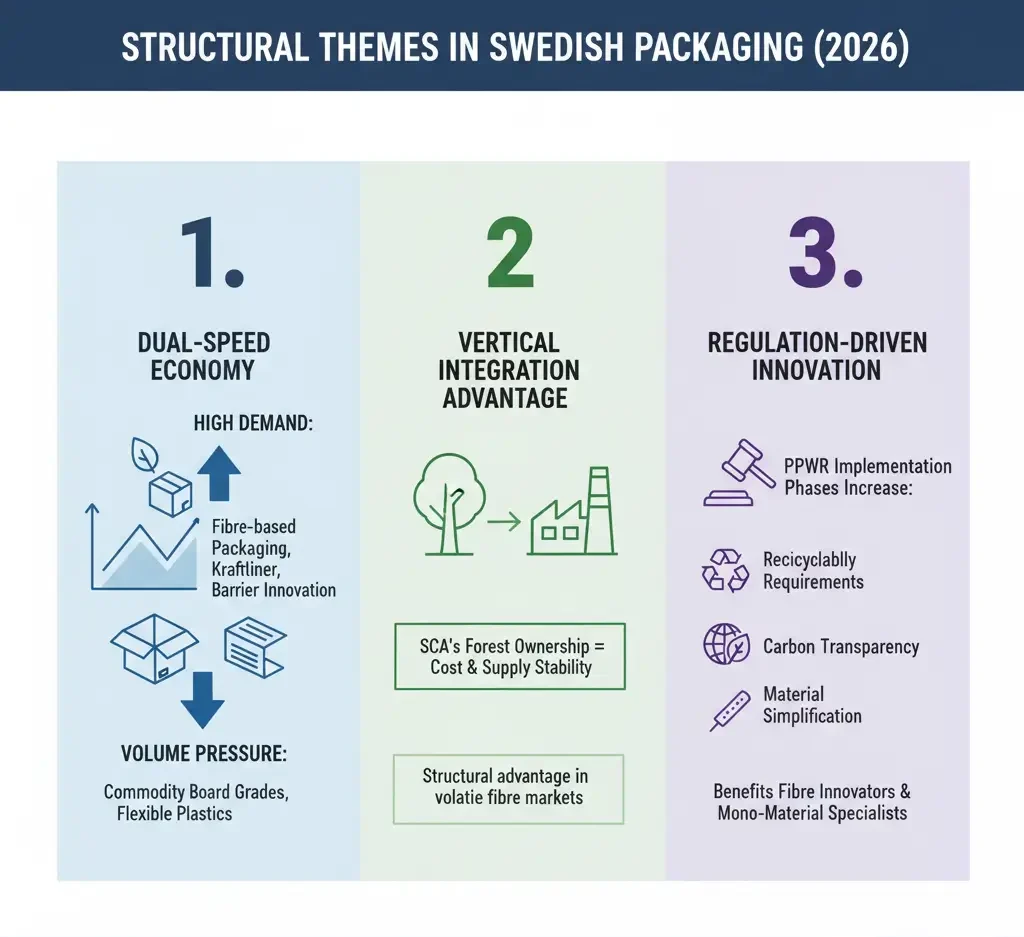
1. Dual-Speed Economy
High demand:
- Fibre-based packaging
- Kraftliner
- Barrier innovation
Volume pressure:
- Commodity board grades
- Certain flexible plastic applications
2. Vertical Integration Advantage
SCA’s forest ownership provides cost and supply stability.
This is a structural advantage in volatile fibre markets.
3. Regulation-Driven Innovation
PPWR implementation phases increase:
- Recyclability requirements
- Carbon transparency
- Material simplification
This benefits fibre innovators and mono-material specialists.
Frequently Asked Questions
What is the largest packaging company in Sweden?
Tetra Pak ranks first, with revenue of €12.8bn in 2024. It was founded in 1951 in Lund and employs 24,000+ people.
Why did Billerud’s revenue fall in 2025?
Weaker European demand and lower board prices reduced net sales to SEK 40.5bn. The earlier SEK 43.5bn peak reflected stronger market conditions.
How is PPWR affecting Swedish packaging companies?
PPWR raises recyclability, carbon transparency and material simplification requirements. This benefits fibre innovators and mono-material specialists, while flexible plastics face more scrutiny.
Conclusion
Sweden’s packaging industry in 2026 is defined by structural transition rather than expansion.
Fibre-based leaders retain strategic advantage.
Flexible producers are adapting under regulatory pressure.
Vertical integration and energy resilience shape competitive positioning.
For Sweden supermarket operators, packaging performance is now directly tied to private label strategy, recyclability compliance and cost control.
At the same time, Sweden private label growth continues to reinforce demand for:
- Fibre-based formats
- Simplified material structures
- Retail-ready design aligned with EU regulation
Revenue leadership remains concentrated among carton and board producers, with global scale anchored in Swedish engineering.
Editor’s Note : All financial figures are based on publicly available FY2024–FY2025 company reports and disclosures, including 2025 year-end reports released in early 2026. Currency conversions reflect approximate average exchange rates.
As of Q1 2026, the Swedish packaging sector is navigating a dual-speed economy. It combines strong demand for sustainable fibre innovation with volume pressure in traditional flexible plastics during final PPWR implementation phases.