
Romania’s packaging companies sit at the core of supermarket logistics, FMCG manufacturing, beverage production, and export distribution. Corrugated board plants support national retail supply chains.
Metal can facilities anchor beverage volumes. Recycled fibre and PET processors are increasingly shaped by the national Deposit-Return System (SGR) and the EU Packaging and Packaging Waste Regulation (PPWR).
In 2026, revenue scale alone no longer defines leadership.
Industrial capacity, material integration, recycling exposure, and multi-site operational presence determine structural influence across the Romanian packaging ecosystem.
The ranking below reflects FY2024 publicly reported revenue of the primary Romanian legal entity only. No aggregation of group subsidiaries has been applied.
All revenues are reported in RON.
FY2024 Revenue Ranking
| Rank | Company (Legal Entity) | FY2024 Revenue (RON) | Primary Segment |
|---|---|---|---|
| 1 | Canpack Romania SRL | ~850–900 million | Metal beverage cans |
| 2 | Rondocarton SRL | 648.3 million | Corrugated packaging |
| 3 | DS Smith Packaging SRL | 431.6 million | Corrugated packaging |
| 4 | Ambro SA | 429.7 million | Paper & corrugated |
| 5 | Vrancart SA | 395.6 million | Paper & corrugated |
| 6 | Smurfit Westrock Romania SRL | ~350–400 million | Paper-based packaging |
| 7 | Romcarton SA | 285.9 million | Corrugated packaging |
| 8 | Romcarbon SA | 225.6 million | Plastics & flexible packaging |
| 9 | VPK Packaging SRL | 212.9 million | Corrugated packaging |
| 10 | Green Pack SRL | 186.8 million | Recycled PET packaging |
This table reflects single legal entities registered in Romania.
No combined turnover from related paper mills or affiliated SRLs has been included.
What Defines Packaging Leadership in Romania in 2026?
Three measurable indicators define structural influence:
- Domestic industrial footprint (number of production sites)
- Material integration (paper mill, recycling loop, aluminium sourcing)
- Supermarket and FMCG exposure (transport packaging, beverage supply, protein packaging)
Corrugated packaging dominates structurally. Metal and recycled PET are gaining strategic weight due to regulatory shifts.
Company Profiles
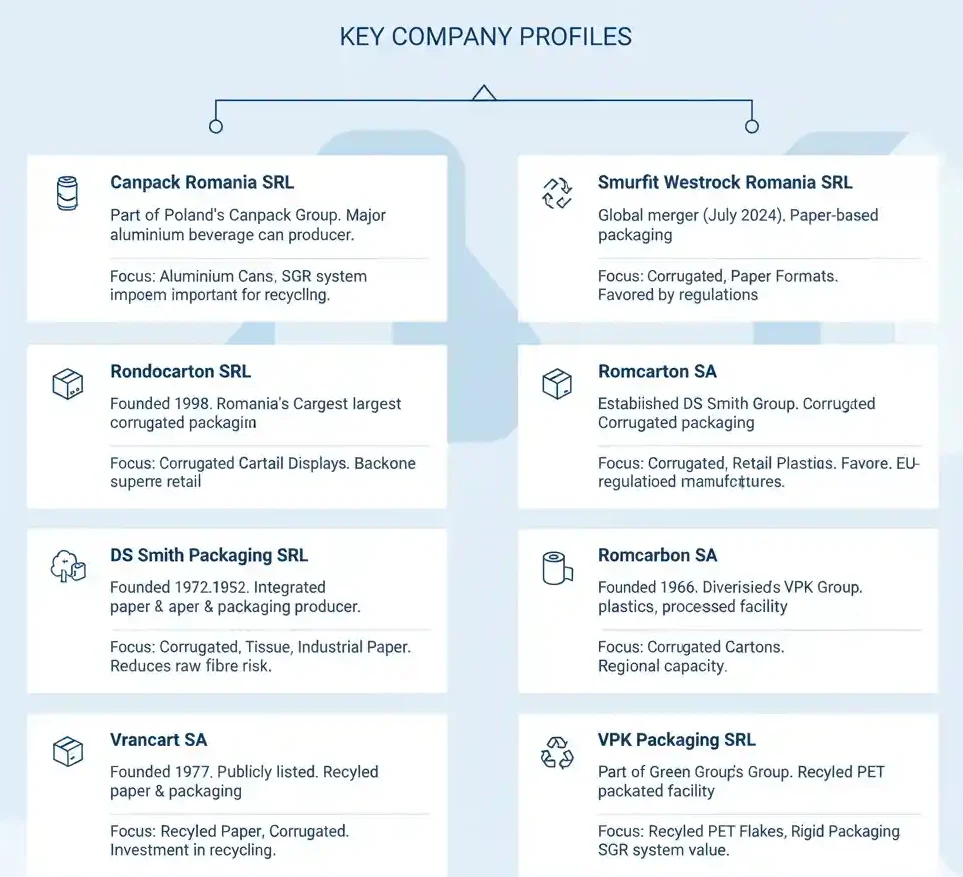
1. Canpack Romania SRL
Canpack Romania operates as part of the Poland-origin Canpack Group, founded in 1992. The Romanian facility is one of the group’s major beverage can production sites.
Core categories:
- Aluminium beverage cans
- Metal packaging solutions
The company operates a high-automation production plant serving multinational beverage producers in Romania and export markets.
The aluminium can segment remains capital intensive but stable, supported by beverage demand.
The SGR system increases the strategic importance of aluminium loop recovery. Material control now influences industrial leverage.
2. Rondocarton SRL
Founded in 1998, Rondocarton is one of Romania’s largest domestically active corrugated producers.
Core categories:
- Corrugated transport cartons
- Shelf-ready packaging
- Retail display formats
The company operates three production plants. Its industrial footprint supports supermarket logistics networks and FMCG manufacturers requiring stable secondary packaging supply.
Corrugated remains the backbone of retail distribution in Romania.
3. DS Smith Packaging SRL
DS Smith Packaging SRL represents the corrugated conversion entity of the UK-origin DS Smith Group (founded 1940).
Core categories:
- Corrugated packaging
- Retail-ready formats
- Industrial transit packaging
The reported 431.6 million RON reflects the packaging entity only. The larger paper mill (DS Smith Paper Zărnești SRL) is not included to avoid aggregation distortion.
The entity serves supermarket distribution centres and FMCG producers requiring high-volume corrugated solutions.
4. Ambro SA
Established in 1952 in Suceava, Ambro SA has evolved into a vertically integrated paper and packaging producer.
Core categories:
- Corrugated board
- Tissue paper
- Industrial paper products
Ambro combines paper production with packaging conversion. This reduces exposure to raw fibre volatility and strengthens cost stability.
Its packaging division supports supermarket transport and private label distribution formats.
5. Vrancart SA
Founded in 1977, Vrancart SA is a publicly listed Romanian paper and packaging manufacturer.
Core categories:
- Recycled paper
- Corrugated packaging
- Tissue products
Vrancart operates significant recycled fibre capacity. The corrugated segment supports FMCG manufacturers and supermarket distribution systems.
Investment in recycling infrastructure aligns with circular economy requirements.
6. Smurfit Westrock Romania SRL
Following the global merger in July 2024, Smurfit Westrock Romania SRL operates as part of the consolidated paper-based packaging group.
Core categories:
- Corrugated packaging
- Paper-based transport formats
The Romanian legal entity contributes to both domestic retail supply and export packaging networks.
Paper-based packaging benefits from regulatory pressure favouring recyclable materials over certain plastic formats.
7. Romcarton SA
Established in 1991, Romcarton SA operates within the corrugated packaging sector.
Core categories:
- Transport cartons
- FMCG packaging formats
While smaller in revenue compared to multinational operators, Romcarton maintains operational relevance for mid-sized manufacturers and regional contracts.
8. Romcarbon SA
Founded in 1956, Romcarbon SA is a diversified plastics processor.
Core categories:
- Flexible packaging films
- Polymer processing
- Industrial plastics
Flexible packaging remains essential for protein, dairy, and fresh produce categories. However, EU PPWR regulation is exerting structural pressure on plastic formats.
Romcarbon’s long-term direction will depend on recycled content integration and compliance adaptation.
9. VPK Packaging SRL
Part of Belgium-based VPK Group (founded 1935), VPK Packaging SRL operates a Romanian corrugated facility.
Core categories:
- Corrugated transport cartons
The Romanian plant contributes to regional corrugated capacity. It supports supermarket and FMCG supply networks in specific geographic zones.
10. Green Pack SRL
Green Pack SRL operates within Romania’s Green Group recycling structure (founded 2002).
Core categories:
- Recycled PET flakes
- PET-based rigid packaging
With 186.8 million RON turnover in 2024, Green Pack is smaller in revenue but strategically important.
The SGR system increases PET loop control value. Recycled material availability now shapes industrial positioning more than pure revenue scale.
Market Structure Analysis
Romania’s packaging market structure continues to be defined by corrugated dominance, with six of the top ten companies operating primarily in this segment.
This concentration reflects the expansion of the Romania supermarket network, the country’s role as a regional FMCG manufacturing base, and sustained export logistics demand.
Corrugated board remains the primary secondary packaging format across Romania’s retail ecosystem. It underpins transport, shelf-ready, and distribution packaging requirements.
SGR and Circular Integration
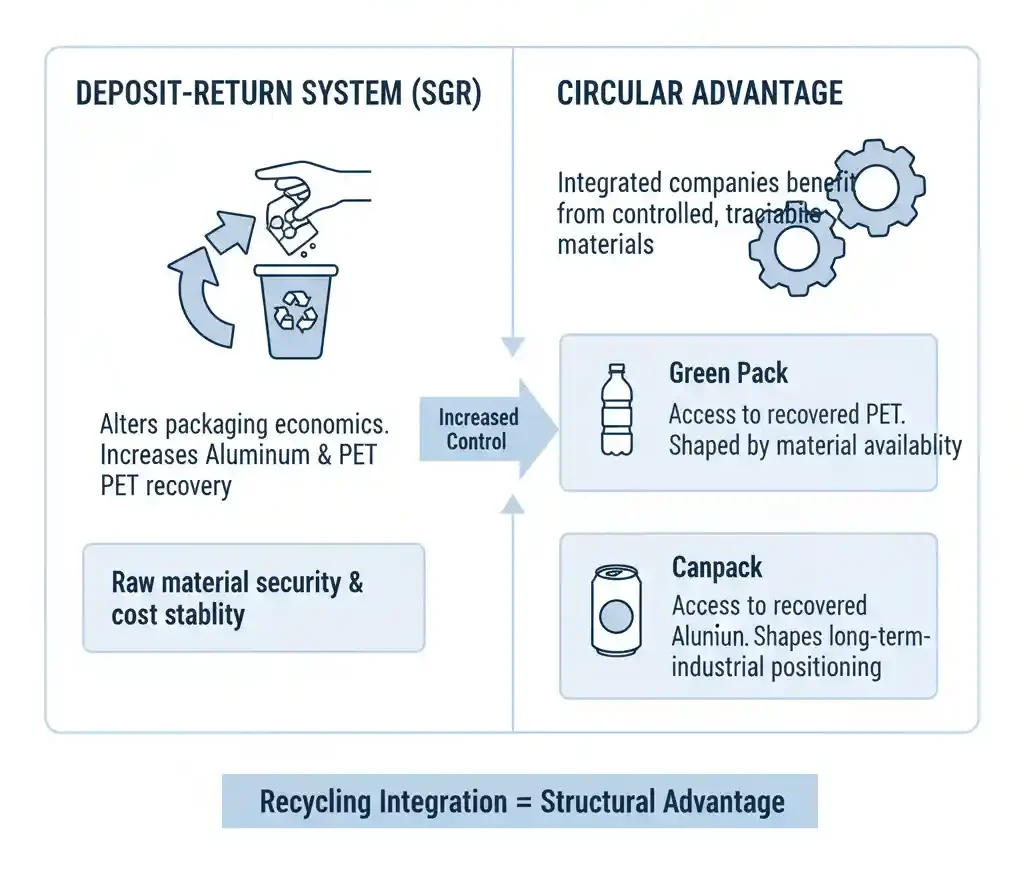
Romania’s national Deposit-Return System (SGR) has significantly altered the economics of packaging materials. Aluminium and PET recovery rates now directly influence raw material security and cost stability.
Companies integrated into recycling loops hold structural advantages as material availability becomes more controlled and traceable.
Green Pack and Canpack benefit from this shift in different ways and at different scales. Access to recovered PET and aluminium increasingly shapes long-term industrial positioning.
Regulatory Pressure and Plastic Transition
In 2024–2025, the Romanian packaging sector has operated under sustained cost pressure.
Labour expenses have continued to rise across industrial segments. Energy prices, although stabilised compared with peak volatility, remain above long-term historical averages.
As a result, many producers have faced margin compression despite nominal revenue growth.
Packaging remains a capital-intensive industry. Investment in automation and operational efficiency is increasingly a structural requirement rather than a discretionary upgrade.
Energy and Labour Cost Pressure
2024–2025 results show:
- Labour costs rising across industrial sectors
- Energy prices stabilised but above historical norms
- Margin compression despite revenue growth
Packaging remains capital-intensive. Automation and efficiency upgrades are becoming necessary rather than optional.
Industry Outlook 2026–2028
Between 2026 and 2028, Romania’s packaging industry is expected to focus on three areas:
- Continued optimisation of corrugated production capacity
- Expansion in recycled PET processing
- Sustained capital investment in automation
Integration with supermarket private label logistics is likely to deepen as retailers demand more reliable and compliant supply structures.
In this environment, industrial capacity will carry more weight than branding.
Companies operating multiple facilities or maintaining control over raw material and recycling loops will be better positioned to manage cost volatility and regulatory pressure.
Frequently Asked Questions
Which is the largest packaging company in Romania by revenue?
Canpack Romania SRL ranks first on FY2024 revenue, at roughly 850–900 million RON. Rondocarton SRL follows with 648.3 million RON.
Does the ranking include group subsidiaries?
No. It reflects the primary Romanian legal entity only. No combined turnover from related paper mills or affiliated SRLs has been included.
Why does corrugated dominate the ranking?
Six of the top ten companies operate primarily in corrugated. Corrugated board is the main secondary packaging format across Romania’s retail ecosystem.
Conclusion
The top packaging companies in Romania by FY2024 revenue reflect a market structurally led by corrugated board production.
The market is supported by concentrated metal beverage can manufacturing and increasingly shaped by circular material integration.
Revenue scale determines ranking position, but industrial capacity ultimately determines long-term resilience.
As the Romania supermarket network continues to expand and EU regulatory requirements tighten, packaging infrastructure remains a core pillar of supply stability. This is particularly true as Romanian private label programmes increase demand for reliable, compliant, and nationally distributed packaging solutions.
Editor’s Note: This article is based exclusively on publicly available FY2024 financial reports and Romanian company disclosures. Revenues are reported in RON. No group-level aggregation has been applied.