
Australian fruit and vegetables had a combined local value of about A$13.3 billion in 2024/25. That is A$7.3 billion in fruit excluding wine grapes and A$6.0 billion in vegetables, according to the Australian Bureau of Statistics (ABS). Growers supply supermarkets, greengrocers, foodservice and exporters directly or through wholesalers. Sydney, Melbourne, Brisbane, Adelaide and Perth have central wholesale markets.
For grocery buyers, three questions matter most. Which growing regions can keep shelves stocked? Which suppliers can deliver the right grade and ripeness? And what does the produce cost by the time it reaches the distribution centre? This guide separates farm production, wholesale trading and retail demand so the figures can be used for the right decision.
How big is the Australian fresh produce market?
| Measure | Value | Period and source |
|---|---|---|
| Fruit, excluding wine grapes | A$7.3bn | 2024/25 local value, ABS |
| Vegetables | A$6.0bn | 2024/25 local value, ABS |
| Fruit and vegetables combined | About A$13.3bn | 2024/25, calculated from the two rounded ABS figures |
| All horticulture, including wine grapes | A$19.5bn | 2024/25 local value, ABS |
| Horticulture production forecast | A$18.8bn | 2026/27 forecast, ABARES September 2026 outlook |
| Horticulture export forecast | A$4.4bn | 2026/27 forecast, ABARES September 2026 outlook |
The A$13.3bn figure is the sum of two rounded ABS categories. It measures the local value of fruit and vegetables, which can include crops sold for uses beyond the fresh aisle. It is a useful production benchmark. A supermarket sales estimate would measure what customers pay in a defined retail channel. An export figure records overseas trade. Those numbers can cover the same produce at different stages and should be read separately.
The ABS reports A$19.5bn for wider horticulture, including wine grapes, in 2024/25. Hort Innovation’s 2024/25 handbook reports A$18.4bn in horticulture production value under its own coverage. ABARES forecasts A$18.8bn in horticulture production and A$4.4bn in horticulture exports in 2026/27. Compare changes within the same dataset before drawing a conclusion about growth. A larger dollar figure can reflect higher prices, a change in the crop mix or more output.
Where are Australia’s major wholesale fruit and vegetable markets?
Sydney Markets, Melbourne Market, Brisbane Markets, South Australian Produce Market and Perth Markets are five major wholesale hubs for fresh fruit and vegetables. Growers, agents and wholesalers use these markets to supply independent grocers, supermarkets, restaurants and other buyers. Check each operator’s trading hours and entry rules before visiting.
| Wholesale market | Location | Good fit |
|---|---|---|
| Sydney Markets | Flemington, New South Wales | Sydney wholesale fruit and vegetable sourcing and order consolidation |
| Melbourne Market | Epping, Victoria | Wholesale sourcing for Victorian retail and foodservice |
| Brisbane Markets | Rocklea, Queensland | Queensland-based wholesaling and regional distribution |
| South Australian Produce Market | Pooraka, South Australia | Adelaide wholesale supply and local consolidation |
| Perth Markets | Canning Vale, Western Australia | Western Australian wholesale sourcing and distribution |
A wholesale market can help a buyer test a new variety, combine several lines on one order or cover an unexpected shortage. A supermarket programme with fixed volume and packaging specifications may need scheduled deliveries and a growing plan agreed before planting. Independent grocers often buy through wholesalers because they can order a wide mix without contracting each grower separately.
These are central trading markets. A public farmers’ market is a different route, where visitors can buy from stalls and individual producers. People looking for local retail markets use the phrase Australia fresh produce market in a different sense from commercial buyers. If your aim is to buy for a business, ask about trade access, minimum orders, transport and credit terms when you contact the market.
What Australians are buying in 2026
The International Fresh Produce Association surveyed 751 Australian consumers in 2026. In that survey, 36% said they were eating more fruit and vegetables than a year earlier, up from 29% in the association’s 2024 survey. At the same time, 42% reported buying fewer items overall because of budget pressure. These are survey responses. They describe what the people surveyed said, rather than the volume sold across all Australian shops.
For grocery teams, those findings suggest a practical question. Can customers see why a line is worth its price? Put the unit, pack weight and intended use where shoppers can read them quickly. Offer a smaller pack where shoppers need a lower price at the till. Give loose produce enough space if customers want to buy only what they will use. Measure the margin after spoilage, markdowns and labour before expanding a line.
For products sold as ripe and ready to eat, order to the expected pace of sales. A tray of firm avocados and a ready-to-eat display serve different needs. The same applies to mixed berry punnets and a large value pack. Test the format in stores with similar turnover and use the same price window when comparing results. Check the product again at the end of the day when the display has been handled and replenished.
Key Australian fresh produce categories
| Crop | 2024/25 local value | What to check before buying |
|---|---|---|
| Potatoes | A$1.2bn | Variety, size, intended use, storage and defect tolerances |
| Table grapes | A$874.9m | Variety, sugar and firmness targets, bunch weight and shelf life |
| Bananas | A$719.4m | Ripeness at receipt, ripening capacity and backup supply |
| Avocados | A$718.7m | Variety, maturity, firmness at delivery and ready-to-eat volumes |
| Leafy salad vegetables | A$685.3m | Harvest-to-cooling time, cold chain and condition through the sale window |
| Tomatoes | A$639.3m | Protected or field-grown supply, size mix and continuity by week |
Potatoes were among the highest-value vegetable categories in the 2024/25 ABS release. Table grapes had a higher reported local value than bananas or avocados in that dataset. That comparison is about dollars at the production stage. If the decision is what to put on promotion, ask for the latest available crop and wholesale volumes by grade. A high annual value gives little guidance on the fruit available in a particular week.
Berries and leafy salads
Both lines can lose condition quickly. Ask when produce is harvested and how soon it is cooled, packed and loaded. For berries, inspect moisture, bruising and mould across more than one punnet from the same delivery. For leafy greens, check wilting, pack condition and date coding at receipt and again near the end of the sale window. Discuss how claims will be assessed if a load arrives within temperature range but deteriorates unusually quickly.
For a new line, ask the supplier to provide samples from the actual farm and packhouse that will supply the programme. A trial batch can perform well when it is sent separately by a faster route. Run at least part of the trial with normal commercial storage and freight so you can judge how the product will reach stores.
Citrus and table grapes
Compare varieties, sizes and growing regions by week. In citrus, it matters whether customers are buying for juicing, snacking or cooking. Table grapes need a specification for berry size, firmness and defects, with a separate agreement for bunch weight if the grapes are sold in a fixed-weight pack. Ask when a supplier switches between growing areas and whether the change affects pack or grade availability.
When domestic and export orders use the same crop, confirm how volumes will be allocated during a short harvest. Build a second approved origin or variety into the plan where the product allows it. Tell merchandising teams in advance if a change affects the display name, pack weight or price point.
Bananas and avocados
Supply starts with harvest maturity and continues through ripening, dispatch and store handling. Ask where the fruit is ripened, who tests it and what is expected when it reaches the distribution centre. Confirm what happens if a shipment arrives early or late. A buyer should be able to tell whether a delay has used up part of the expected sale window.
A promotion can fail even if the full order reaches stores. For example, a ready-to-eat avocado promotion needs enough fruit at the intended firmness throughout the event. Check expected daily sales, ripening capacity and how often stores receive deliveries. Agree what can be supplied at a firmer stage for shoppers who want fruit for later in the week.
Glasshouse vegetables
Protected cropping can help suppliers plan volumes for tomatoes, cucumbers and capsicums. Availability still depends on crop rotations, production conditions and packhouse capacity. Request weekly estimates by crop, size and grade. If a supplier gives a single annual volume, ask how much of it is available during your highest-demand weeks and which site can cover any shortfall.
Separate display requirements from the product requirements. A snack tomato pack may need a narrow size range and good colour consistency. A loose cooking tomato can suit a different grade. A specification should explain which variation is acceptable in each line and how the packhouse reports a change before dispatch.
Five fresh produce companies supplying Australia
This comparison covers different types of supplier. It includes large growers, diversified produce groups and a protected-cropping specialist. The companies disclose different operating figures. Use the dated numbers to judge scale and compare their capabilities against the product you need.
| Company | Revenue or workforce disclosed | Operations buyers can verify |
|---|---|---|
| Costa Group | A$1.358bn group revenue in CY2022, historic. 11,156 group FTE and 5,157 Australian FTE in its 2025 sustainability report. | Berries, mushrooms, glasshouse tomatoes, citrus and avocados. Its owner lists about 7,200 planted hectares in Australia, about 40 hectares of glasshouses and three mushroom facilities. |
| Perfection Fresh | 750 FTE and 28 sites in its 2022/23 statement. Current company page says it works with more than 500 grower partners. Recent comparable turnover unverified. | Farming, branded ranges, wholesale, retail, foodservice and exports. Two Wells glasshouse operations in South Australia form part of its history. |
| Fresh Produce Group | Comparable recent group revenue and headcount unverified. | Farm locations disclosed in Queensland, Tasmania, Victoria, Western Australia and New South Wales, with growing, wholesale, packing and ripening capabilities. |
| Premier Fresh Australia | Comparable recent group revenue and headcount unverified. | Trading and service locations listed in Melbourne, Sydney, Adelaide and Perth. Farm listings include sites in Queensland, the Northern Territory and Victoria. |
| Flavorite | Comparable recent group revenue and headcount unverified. Its FY2025 report lists 682 new seasonal roles, separate from other new jobs. | Protected cropping with a 14,400 square metre packing and logistics facility under development at Tatura in the FY2025 report. |
Costa Group
Costa grew into a large Australian produce business across five core categories. A consortium led by Paine Schwartz Partners took control in 2024. The A$1.358bn figure is from calendar 2022, when Costa published results as a listed company. The 2025 sustainability report separately gives its workforce in full-time equivalents. The figures measure different periods and include operations outside Australia where labelled.
In October 2026, Costa marked ten years of operations in Yunnan and reported about 600 hectares in China. That update describes its international berry business. For Australian tenders, ask which domestic farms and packhouses will supply the order, how volumes shift between regions and which categories have a backup facility.
Perfection Fresh
Antonio and Mary Simonetta started Perfection Fresh at the Sydney Wholesale Markets in 1978. The business later merged with the D’Vine Ripe operation at Two Wells in 2014. Its current company profile says it works with more than 500 grower partners. That describes its network, while the older FTE and site figures describe the period covered by its workforce statement.
In June 2026 it announced the winners of the food photography award it sponsors through Broccolini. That is an update about brand marketing, with no implications for production capacity. Buyers comparing branded produce should ask about farm origin, packaging, promotion support and the ability to repeat the same volume week to week.
Fresh Produce Group
Robert Nugan established Fresh Produce Group in 1991. The company lists growing, importing, exporting, wholesale, ripening and pre-packing among its activities. Its farms page lists berry operations in Queensland and Tasmania, grape farms in Victoria and Western Australia, and citrus in New South Wales.
Its current site describes the first stage at the Fruitico farm in Hamel, Western Australia, as 75 hectares of grape planting. The August 2026 edition of Produce Plus also covered Smart Berries’ evolving blueberry offer. Ask what each site can deliver now, as plantings and published estate size do not establish the volume available to promise on a particular date.
Premier Fresh Australia
Premier traces its roots to family greenhouse production in Mildura in the 1940s. It lists packing, temperature-controlled distribution, ripening and wholesale market trading among its operations. Its operating directory lists facilities including Innisfail in Queensland, Lambells Lagoon in the Northern Territory and Lancaster in Victoria.
Premier’s public site documents its current operations. A recent dated expansion or financial update was not verified for this guide. Ask which trading site or packhouse owns the order, whether it can consolidate mixed products, and how it maintains temperature records if the route passes through several facilities.
Flavorite
Flavorite traces its glasshouse operation to the Millis and Nichol families in 1994. Its FY2025 report says the first stage of the 14,400 square metre Tatura packing and logistics facility was complete and the second stage had started. The 682 figure is new seasonal roles reported in that year. It should be read separately from permanent staffing and total headcount. Produce Plus reported that Flavorite won its 2026 Marketer of the Year award.
For a tomato or cucumber programme, ask which growing site, packhouse and freight lane will serve it. Confirm whether the retailer needs branded packs, loose produce or a private-label specification. Compare the supplier’s forecast with the packhouse’s ability to fill the required pack formats during a peak week.
How Australian supermarkets and wholesalers buy fresh produce
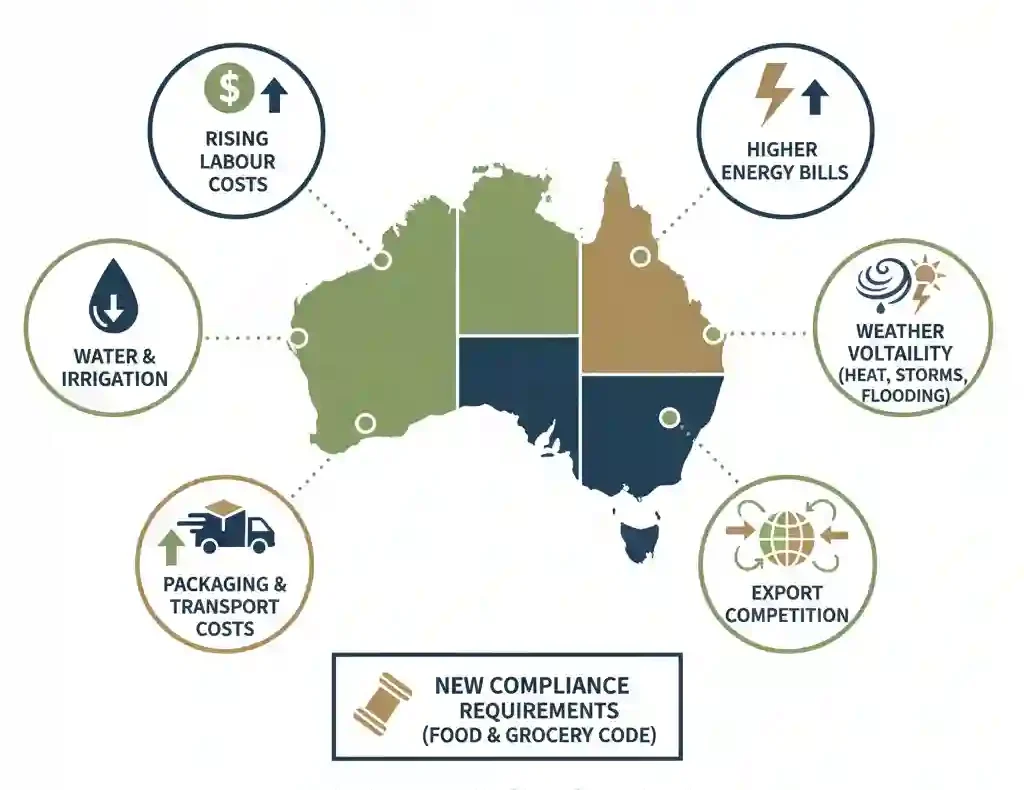
The largest supermarkets in Australia buy across fresh produce categories with their own volume, quality and delivery requirements. Many orders depend on weekly availability and grade. At the start of a programme, agree a forecast, who updates it, and what happens when the crop or expected sales change. A forecast helps a grower plan labour and planting. The purchase terms determine which volumes are committed.
In its March 2025 supermarkets inquiry, the ACCC recommended more detail for fresh produce suppliers about how seasonal forecasts are prepared. The recommendation reflects the financial decisions growers make before harvest. For direct grocery supply, check whether the Food and Grocery Code applies to the retailer and agreement. For covered grower–trader transactions, the Horticulture Code is a separate regime. The Australian government launched a review of that code in January 2026.
When comparing routes, a central wholesaler can combine products from several growers and supply smaller orders. A direct agreement can give the buyer closer control over variety, packaging and weekly volumes. The economics depend on order size, delivery points and how quickly stock moves. Ask each supplier to state what is included in the price. A delivered quote and a wholesale-market quote can leave different transport and handling costs with the buyer.
Imports, exports and Australia’s growing seasons
Australian produce supply changes by crop and region. Southern and northern growing areas can supply at different points in the year, and greenhouse crops can provide a more planned flow in some categories. For a national buying programme, request a weekly calendar with the main growing region, reserve region and packhouse. Weather, freight and grade shortages can move the dates. Update the calendar before building promotions around it.
For example, Sydney Markets has reported early-season Darwin mangoes and Australian asparagus in September. Its February guide lists grapes, mangoes and nectarines among summer options. These examples describe typical market windows. Ask your wholesaler what is arriving this week and where it was grown before planning a display or ordering for a promotion.
Before importing fresh fruit or vegetables into Australia, check the Department of Agriculture’s BICON system for the exact commodity and origin. A counter-seasonal offer is useful only if the product can enter Australia under the applicable conditions and still meet the shelf-life target after freight and inspections. Confirm any treatment, permit, certification or inspection requirements for that shipment before making a commitment.
ABARES forecast A$4.4bn of horticulture exports in 2026/27 in its September 2026 outlook. That covers wider horticulture. For an individual export programme, confirm that the destination accepts the specific commodity and origin. Check the importer’s specification and expected remaining shelf life. The same product may need a different pack, label or maturity target for a longer journey.
A fresh produce buying checklist
- Set the product specification. Agree on variety, grade, shape, size, maturity and packaging. Define which defects are acceptable and how they will be measured.
- Map the growing weeks. Ask for the origin, weekly volume, packing site and backup route. Mark the weeks when two regions overlap or neither has enough supply.
- Compare the full delivered cost. Use the same unit and delivery point. Include freight, ripening, packaging and likely losses. Check that the quoted grade and pack match.
- Trial the actual route. Use a normal dispatch, follow the product through a distribution centre and inspect it on the shelf. Agree what receipts or temperature records will be reviewed.
- Set a review date. Track orders filled, late loads, rejections, markdowns and customer complaints. Agree who will act when a measure moves outside the agreed range.
Look for strong technical support when the product depends on consistent stock records, traceability or retail forecasting. A fast reply about a late delivery can prevent a gap on the shelf. Good data also lets a buyer trace one affected batch without treating the whole delivery as the same lot.
Questions about the Australian fresh produce market
How much is the Australian fresh produce industry worth?
ABS figures put the combined local value of fruit excluding wine grapes and vegetables at about A$13.3bn in 2024/25. It is a production measure that can include other crop uses. The value of fruit and vegetables sold at supermarkets uses a different measure.
What are the biggest fresh produce companies in Australia?
Costa Group, Perfection Fresh, Fresh Produce Group, Premier Fresh Australia and Flavorite are major suppliers serving different parts of the market. Costa reports broad growing operations. Flavorite specialises in protected cropping. A national revenue ranking would need comparable current accounts for each company.
Where do Australian retailers buy fresh fruit and vegetables?
Retailers buy through direct grower and packer agreements, supply companies and wholesale markets. The main markets include Sydney, Melbourne, Brisbane, Adelaide and Perth. The route depends on order volume, season and how much consolidation or ripening the retailer needs.
What fruit and vegetables are in season in Australia?
Season depends on state, variety and weather. Use your local market’s calendar for a shopping trip. For buying across several regions, ask growers for current weekly availability, because the changeover between origins can shift year to year.
Editor’s note, 16 November 2026. Updated with ABS figures, the ABARES outlook, 2026 shopper research and company disclosures.