
FRUIT LOGISTICA has opened entries for its 2027 Innovation Award, giving fresh produce and technology exhibitors until 31 October 2026 to submit new products for assessment by the international trade audience in Berlin.
The award will again be divided into Fresh Produce and Technology categories. Applicants must be confirmed exhibitors at FRUIT LOGISTICA 2027, and eligible innovations must have been on the market for no more than 12 months.
The application itself is free for official exhibitors. Shortlisted products will be displayed in the Innovation Zone during the trade show from 3 to 5 February 2027, where visitors will vote for the winners.
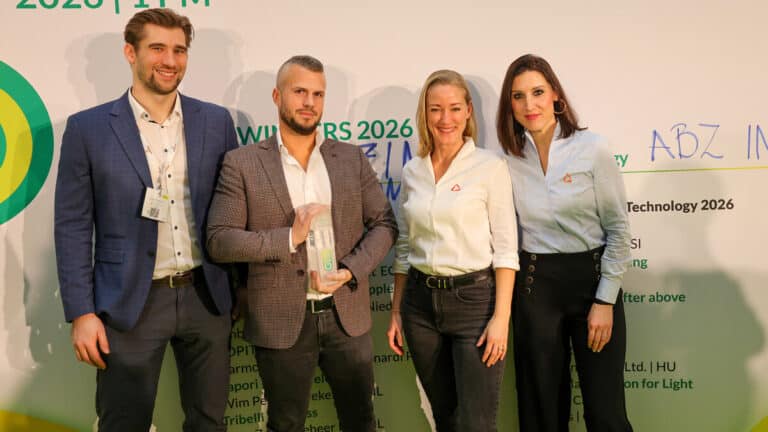
The new entry window was highlighted through the experience of Hungary’s ABZ Innovation, which won the 2026 Technology award with its L50 agricultural spraying drone.
The L50 uses LiDAR to build a three-dimensional view of its surroundings, helping it detect obstacles and follow terrain across orchards, vineyards and uneven fields. ABZ says the 50-litre machine can cover up to 24 hectares per hour.
That specification addresses a practical constraint for growers. Ground machinery can be delayed when wet soil prevents access, while a drone can apply crop treatments without entering the field or creating tramline losses.
However, buyers assessing spraying technology need more than headline coverage rates. Tank refill time, battery swaps, payload limits, approved chemical use, operator training, weather thresholds and local aviation rules all affect achievable productivity.
ABZ founder and chief commercial officer Gyula Török said: “Growers are no longer asking whether the technology works. They are asking how to make it part of their daily routine.”
The manufacturer has moved to support that transition with a new production facility in Szentendre, Hungary. Independent reporting on the September expansion put investment at €7 million and indicated capacity of about 2,000 drones a year on one shift, rising to 3,500 on two shifts.
ABZ says it is responding to demand across more than 40 markets. That scale could improve availability, spare-parts support and training coverage, but procurement teams should still test local service capacity rather than treating factory output as proof of operational readiness.
For fresh produce businesses, total cost of ownership will be more useful than the purchase price alone. A credible comparison should include labour, operator certification, batteries, maintenance, transport, insurance, application accuracy and downtime during the main crop-protection window.
Retailers and importers also have an interest in the technology because spray records, residue compliance and crop continuity sit upstream of supermarket specifications. Better access after rain may reduce treatment delays, but the commercial case depends on controlled application and auditable operating data.
FRUIT LOGISTICA’s visitor-led judging gives suppliers a route to demonstrate these points to growers, packers and buyers. GTN’s comparison of FRUIT LOGISTICA and Fruit Attraction explains the different sourcing roles of Europe’s two major produce exhibitions, while our guide to the most important trade shows for supermarket buyers places the Berlin event in the wider procurement calendar.
The 2027 award is therefore more than a product-visibility exercise. Shortlisted suppliers will need to show that an innovation can move from a trade-show demonstration into repeatable use under commercial production conditions.
ABZ’s progression from a visitor-voted award to expanded manufacturing provides one model, but the next entrants will be judged on whether their products solve measurable problems for the produce supply chain.
By the 31 October deadline, the strongest submissions are likely to be those that combine a clear technical advantage with service, compliance and cost evidence that buyers can test after the show.
Editor’s note: This article is based on FRUIT LOGISTICA’s 28 September 2026 interview and award information. Grocery Trade News added independent analysis of procurement, scale and adoption risks.