
The Dutch FMCG market is highly competitive, but revenue still shows where real scale and influence sit. The challenge in ranking FMCG brands is that individual brand revenues are rarely reported publicly, while parent companies report full group revenue. For that reason, this ranking focuses on the Dutch-headquartered FMCG companies and brand owners with the largest FY2025 revenues, with structural importance in supermarkets used as a secondary ranking factor.
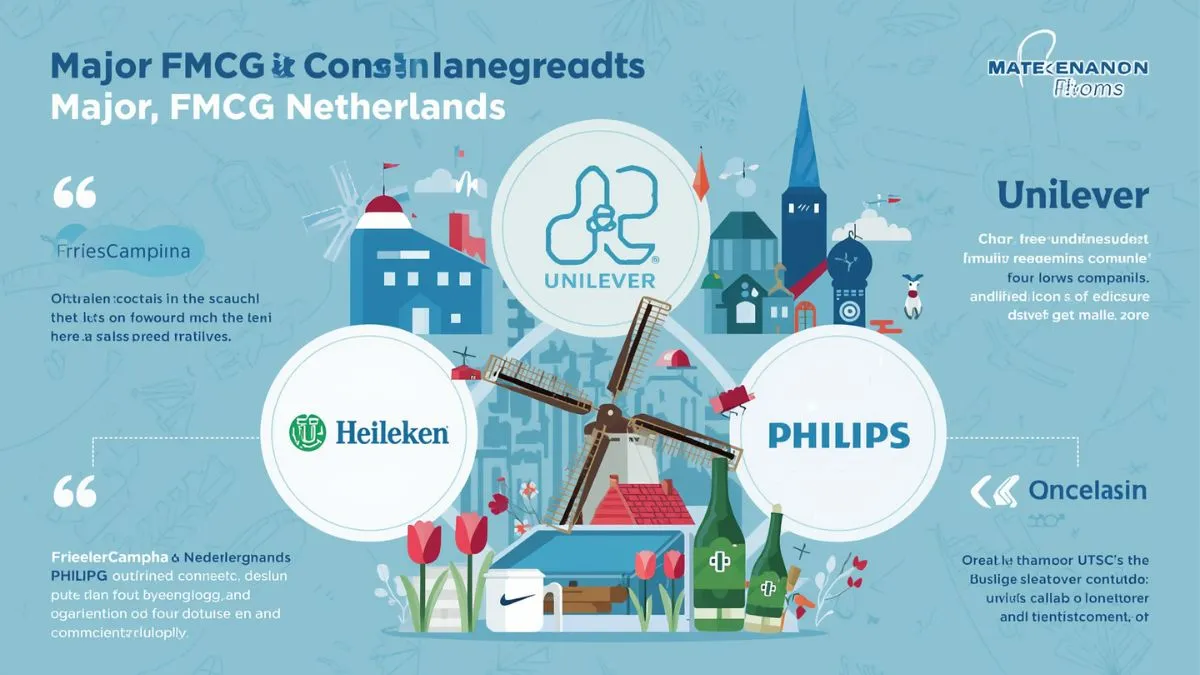
This gives a realistic picture of the companies that actually shape supermarket shelves, private label production, food ingredients, and consumer goods categories in the Netherlands in 2026. The companies covered in this ranking include Unilever, HEINEKEN, FrieslandCampina, JDE Peet’s, dsm-firmenich, Refresco, Perfetti Van Melle, Royal Cosun, Rituals, and Corbion.
At a Glance — Top 10 FMCG Companies Netherlands
| Rank | Entity (HQ) | FY Revenue | Key Impact |
|---|---|---|---|
| 01 | Unilever | €50.5bn | Multi-category FMCG leader |
| 02 | HEINEKEN | €34.3bn | Beverage and beer leader |
| 03 | FrieslandCampina | €13.4bn | Dairy supply chain leader |
| 04 | JDE Peet’s | €9.9bn | Coffee category leader |
| 05 | dsm-firmenich | €9.0bn | Ingredients and formulation |
| 06 | Refresco | €6.0bn | Private label beverages |
| 07 | Perfetti Van Melle | ~€4bn | Confectionery and impulse |
| 08 | Royal Cosun | ~€3.2bn | Sugar, potato, ingredients |
| 09 | Rituals | ~€2.4bn | Premium personal care |
| 10 | Corbion | ~€1.27bn | Food preservation ingredients |
01 — Unilever
Founded: 1929
HQ: London / Rotterdam
FY Revenue: €50.5bn (FY2025)
Employees: ~128,000
Core Segments
- Beauty & Wellbeing
- Personal Care
- Home Care
- Nutrition
- Ice Cream
Operational Relevance
Unilever is one of the most structurally important FMCG suppliers to Dutch supermarkets, even though it operates globally. Its product portfolio covers multiple essential supermarket categories including sauces, margarine, soups, ice cream, deodorants, and household cleaning products. In retail terms, Unilever is not a single-category supplier — it is a shelf-space controller across multiple aisles, which gives it negotiating power with major Dutch retailers such as Albert Heijn, Jumbo, and Lidl.
Unilever’s scale also allows it to operate category management partnerships with retailers, meaning it does not just supply products — it often helps retailers manage entire categories such as ice cream or dressings. This changes the relationship from supplier to strategic partner, which is a major reason the company remains at the top of the FMCG structure in the Netherlands.
Another major factor is distribution infrastructure. Unilever operates large-scale European distribution and production networks, and the Netherlands functions as a key logistics and corporate hub. Rotterdam remains one of the most important FMCG logistics gateways in Europe, and companies like Unilever benefit directly from that infrastructure.
The Analyst’s View
Unilever is restructuring its portfolio toward higher-margin categories such as beauty, personal care, and premium nutrition, while spinning off or separating slower-growth food segments (notably ice cream restructuring announced in 2025). This signals a long-term shift: Unilever is moving from a traditional food FMCG company toward a beauty, wellbeing, and premium consumer goods company.
For Dutch supermarkets, this matters because it changes shelf economics. Retailers may see fewer low-margin Unilever food SKUs and more premium-positioned products, which affects pricing, promotions, and private label competition.
So What? (Market Impact)
Unilever’s strategy typically sets the tone for pricing, promotion cycles, and category trends across Europe. When Unilever pushes price increases, sustainability packaging changes, or reformulation, the rest of the FMCG market often follows. That is why it ranks number one — not just because of revenue, but because of structural influence over supermarket categories.
[BOLD DATA CALLOUT]
Unilever operates in 190+ countries and manages 400+ brands, making it one of the most diversified FMCG portfolios supplying European supermarkets.
02 — HEINEKEN
Founded: 1864
HQ: Amsterdam
FY Revenue: €34.3bn (FY2025)
Employees: ~85,000
Core Segments
- Beer
- Cider
- Non-alcoholic beverages
- Ready-to-drink beverages
- Premium and craft beer
Operational Relevance
HEINEKEN is not just a beverage company — it is a distribution powerhouse. In the Netherlands and across Europe, HEINEKEN operates one of the largest beverage distribution networks, supplying supermarkets, bars, restaurants, and events. This dual-channel presence (retail + horeca) gives the company extremely strong brand visibility and volume stability.
In supermarket terms, beer is a high-volume category that drives foot traffic and promotional cycles. Large beer suppliers like HEINEKEN play a key role in weekly promotions, seasonal campaigns, and event-based retail sales (summer, football tournaments, holidays). This makes HEINEKEN strategically important to retailers beyond just shelf space — it is part of traffic generation.
Another important factor is premiumisation. The European beer market has been shifting toward premium and alcohol-free beer, both areas where HEINEKEN has invested heavily. Alcohol-free beer in particular has become a major supermarket category in the Netherlands, and HEINEKEN 0.0 is one of the leading products in that segment.
The Analyst’s View
HEINEKEN’s strength is not just beer — it is distribution control and brand power. The company owns a portfolio of international, regional, and craft brands, allowing it to occupy multiple price tiers within the same category. That strategy protects shelf space and reduces risk from private label competition.
However, beer consumption in Europe is relatively mature, meaning growth comes from premium products, non-alcoholic beverages, and emerging markets rather than volume growth in Western Europe. HEINEKEN’s strategy reflects this shift.
So What? (Market Impact)
For supermarkets, HEINEKEN is a category anchor supplier. Beer promotions are often used to drive store traffic, and large suppliers like HEINEKEN play a central role in retail promotion calendars. That gives the company influence over pricing cycles and promotional timing in the beverage category.
Executive Insight
- Alcohol-free beer is one of the fastest-growing beverage categories in Europe.
- Premium beer margins are higher than standard lager.
- Large beverage suppliers control promotion timing in supermarkets.
- Distribution scale is HEINEKEN’s biggest competitive advantage.
03 — FrieslandCampina
Founded: 1871 (cooperative origins)
HQ: Amersfoort, Netherlands
FY Revenue: €13.4bn (FY2025)
Employees: ~22,000
Core Segments
- Dairy products (milk, yogurt, cheese, butter)
- Infant nutrition
- Ingredients and nutrition
- Foodservice dairy
- Consumer dairy brands
Operational Relevance
FrieslandCampina is one of the most structurally important food suppliers in the Netherlands because dairy is a core supermarket category. Milk, cheese, yogurt, and butter are not optional categories for retailers — they are daily-consumption products with high purchase frequency. That makes FrieslandCampina a volume driver rather than a niche supplier.
The company operates as a farmer-owned cooperative, which is important in supply chain terms. It controls large parts of the dairy supply chain from farm to processing to branded products and ingredients. This vertical integration gives the company supply stability, which is critical for supermarkets because dairy is a high-turnover category with strict freshness requirements.
FrieslandCampina also operates strongly in private label production alongside branded products. This dual role — brand owner and private label supplier — makes the company strategically important to retailers who want both branded and own-brand dairy products from the same supply base.
The Analyst’s View
The European dairy market is under pressure from cost inflation, sustainability regulations, and changing consumption patterns (plant-based alternatives). FrieslandCampina has been restructuring operations, focusing more on high-margin segments such as infant nutrition, specialised ingredients, and premium dairy, while optimising its standard milk business.
This is a common strategy in European dairy: move away from low-margin liquid milk and focus on value-added dairy and ingredients. Companies that successfully shift to ingredients and specialised nutrition tend to perform better financially over time.
So What? (Market Impact)
For Dutch supermarkets, FrieslandCampina is a category stabiliser. Retailers depend on large dairy suppliers to maintain stable supply and pricing in essential food categories. Any production change, milk price change, or cooperative restructuring directly affects supermarket dairy pricing and private label sourcing.
[BOLD DATA CALLOUT]
The Netherlands is one of Europe’s largest dairy exporters, and companies like FrieslandCampina are key suppliers not only to Dutch supermarkets but to international retail markets.
04 — JDE Peet’s
Founded: 2015 (merger of Jacobs Douwe Egberts and Peet’s)
HQ: Amsterdam, Netherlands
FY Revenue: €9.9bn (FY2025)
Employees: ~21,000
Core Segments
- Roast and ground coffee
- Coffee capsules
- Instant coffee
- Professional coffee systems
- Tea (selected markets)
Operational Relevance
JDE Peet’s is one of the most powerful companies in the European coffee category, and coffee is one of the highest-margin dry grocery categories in supermarkets. Unlike fresh food, coffee has long shelf life, strong brand loyalty, and high repeat purchase rates, which makes it extremely valuable to retailers.
The company owns multiple major coffee brands across different price levels, which allows it to occupy large amounts of shelf space within supermarkets. In retail strategy terms, this is called “category blocking” — when one supplier controls multiple shelf positions through different brands.
JDE Peet’s also operates in both retail and out-of-home coffee (offices, hotels, restaurants), which strengthens brand recognition and supports supermarket sales. This multi-channel presence is similar to HEINEKEN’s dual retail and horeca strategy, but applied to coffee.
The Analyst’s View
The global coffee market has been heavily affected by green coffee price volatility, climate risks, and supply chain disruptions. Large companies like JDE Peet’s are better positioned than small roasters because they can hedge commodity prices, operate global sourcing networks, and manage long-term supply contracts.
Another major trend is the shift toward coffee capsules and premium coffee systems, which have higher margins than traditional ground coffee. JDE Peet’s has invested heavily in this segment, which supports profitability even when raw coffee prices increase.
So What? (Market Impact)
Coffee is a margin category for supermarkets, and large coffee suppliers influence retail pricing, promotion frequency, and category profitability. JDE Peet’s plays a major role in how the coffee shelf is structured in Dutch supermarkets, especially in capsules and premium coffee.
Executive Insight
- Coffee is a high-margin supermarket category.
- Capsule systems increased category profitability.
- Commodity price volatility favors large coffee companies.
- Brand loyalty in coffee is stronger than in many other grocery categories.
05 — dsm-firmenich
Founded: DSM (1902), Firmenich (1895), merged 2023
HQ: Maastricht (NL) / Geneva (CH)
FY Revenue: €9.0bn (FY2025)
Employees: ~30,000
Core Segments
- Taste, texture, and flavour systems
- Nutrition and health ingredients
- Vitamins and supplements
- Fragrance and beauty ingredients
- Food and beverage formulation systems
Operational Relevance
dsm-firmenich is not a supermarket brand in the traditional sense, but it is one of the most important upstream FMCG companies in Europe. The company develops ingredients, flavour systems, preservation systems, and nutrition solutions that are used by major food and beverage brands. In simple terms, many FMCG products sold in supermarkets contain systems developed by companies like dsm-firmenich.
This makes the company structurally important in the FMCG supply chain rather than visible on shelves. It operates at the formulation level — helping create plant-based products, fortified foods, reduced-sugar products, and functional nutrition. These are some of the fastest-growing categories in European supermarkets.
Another key area is reformulation. As governments introduce sugar reduction targets, sustainability requirements, and nutrition guidelines, FMCG companies rely on ingredient companies to reformulate products without changing taste or shelf life. This is where dsm-firmenich plays a major role.
The Analyst’s View
The real power in FMCG is often not at the brand level but at the ingredient and formulation level. Companies like dsm-firmenich influence what products get developed, how long they last on shelves, and whether they meet new health and sustainability regulations.
As European regulation around sugar, salt, sustainability, and functional nutrition becomes stricter, ingredient companies are becoming more important in the value chain. This is why dsm-firmenich ranks high despite not being a traditional supermarket shelf brand.
So What? (Market Impact)
If you see “high protein,” “reduced sugar,” “plant-based,” or “functional food” products in supermarkets, there is a strong chance companies like dsm-firmenich were involved in developing the formulation. That gives the company indirect but very real influence over future supermarket product development.
[BOLD DATA CALLOUT]
Ingredient and formulation companies influence thousands of supermarket products without their name appearing on packaging.
06 — Refresco
Founded: 1999
HQ: Rotterdam, Netherlands
FY Revenue: €6.0bn (FY2025)
Employees: ~14,000
Core Segments
- Soft drinks manufacturing
- Fruit juice production
- Bottled water
- Private label beverages
- Contract manufacturing for global brands
Operational Relevance
Refresco is one of the most important private label and contract beverage manufacturers in Europe. Unlike companies such as HEINEKEN that own consumer brands, Refresco produces beverages for retailers’ private label products and for major global beverage brands.
This means many supermarket own-brand soft drinks, juices, and bottled water products are produced by companies like Refresco. Private label beverages are a major category in European supermarkets because they offer higher margins for retailers compared to branded products.
Refresco operates a large network of production facilities across Europe and North America, which allows it to produce drinks close to retail markets, reducing transport costs and improving supply chain efficiency. Beverage production is highly logistics-driven because drinks are heavy and expensive to transport over long distances.
The Analyst’s View
Private label beverages have grown significantly in Europe over the past decade, especially during periods of inflation when consumers switch from branded products to cheaper retailer brands. Companies like Refresco benefit from this trend because they produce those private label products.
Refresco’s business model is based on scale and efficiency rather than brand marketing. It focuses on manufacturing, logistics, and supply chain contracts rather than advertising and consumer branding. This makes it less visible to consumers but very important to retailers.
So What? (Market Impact)
Refresco is one of the key companies enabling supermarket private label beverage strategies. As retailers expand their own-brand ranges to improve margins and compete with global brands, manufacturers like Refresco become more important in the supply chain.
Executive Insight
- Private label beverages are margin drivers for supermarkets.
- Beverage production depends heavily on logistics efficiency.
- Retailers increasingly outsource beverage production.
- Private label growth benefits contract manufacturers like Refresco.
07 — Perfetti Van Melle
Founded: 2001 (Perfetti + Van Melle merger)
HQ: Breda, Netherlands / Milan, Italy
FY Revenue: ~€4bn (FY2025 est.)
Employees: ~18,000
Core Segments
- Sugar confectionery
- Chewing gum
- Mints
- Candy and impulse products
- Seasonal confectionery
Operational Relevance
Perfetti Van Melle operates in the impulse category — a small but extremely important part of supermarket retail. Confectionery, gum, and mints are high-margin products that are often placed near checkouts, promotional aisles, and seasonal displays. These products are not bought in large volumes per purchase, but margins are high and purchases are frequent.
Impulse categories behave very differently from core grocery categories. Sales are heavily influenced by shelf placement, packaging, promotions, and visibility rather than necessity. That means strong brands dominate this category because impulse buying is brand-driven.
Perfetti Van Melle operates globally recognised confectionery brands and has strong distribution across European supermarkets, convenience stores, and petrol stations. This multi-channel presence increases product visibility and keeps volumes high.
The Analyst’s View
Impulse categories are often overlooked in FMCG analysis, but they are extremely profitable per square meter of shelf space. Supermarkets carefully manage checkout space, and only high-margin, high-turnover products are placed there. Companies that dominate checkout areas have a strategic advantage.
Perfetti Van Melle’s strength is brand recognition and global distribution. Private label is weaker in impulse categories compared to categories like milk, pasta, or canned food, which protects branded confectionery companies from retailer competition.
So What? (Market Impact)
Perfetti Van Melle is important not because it controls large supermarket categories, but because it controls high-margin impulse space. In retail economics, checkout space is some of the most valuable space in the entire store.
[BOLD DATA CALLOUT]
Impulse products generate very high revenue per square meter, which is why checkout shelf space is tightly controlled by major brands.
08 — Royal Cosun
Founded: 1899
HQ: Breda, Netherlands
FY Revenue: ~€3.2bn (2025 prelim.)
Employees: ~4,600
Core Segments
- Sugar production
- Potato processing
- Plant-based ingredients
- Food ingredients
- Agricultural supply chain
Operational Relevance
Royal Cosun is an agricultural cooperative that operates across multiple parts of the food supply chain, including sugar, potato products, and plant-based ingredients. Companies like Cosun are positioned between farmers and FMCG producers, making them important upstream suppliers.
One of Cosun’s most important subsidiaries is Aviko, a major producer of potato products such as fries and frozen potato products supplied to retail and foodservice. Potato products are a major supermarket category across Europe, especially frozen foods.
Cosun is also investing heavily in plant-based ingredients and food innovation, particularly through its ingredients division. This connects the company to the growing plant-based food category in Europe.
The Analyst’s View
Agricultural cooperatives like Cosun play a stabilising role in the food supply chain because they connect farmers directly to food manufacturers and retailers. This structure improves supply security and price stability, especially in key commodities such as sugar and potatoes.
The company’s move into plant-based ingredients is strategically important because it moves Cosun from commodity agriculture into higher-margin food ingredients and food technology sectors.
So What? (Market Impact)
Royal Cosun sits at the raw material and ingredient level of the FMCG supply chain. That means changes in sugar prices, potato harvests, or plant-based ingredient demand directly affect food manufacturers and ultimately supermarket product pricing.
Executive Insight
- Agricultural cooperatives stabilise food supply chains.
- Potato and frozen food categories remain strong in Europe.
- Plant-based ingredients are a growth area.
- Upstream suppliers influence food prices indirectly.
09 — Rituals
Founded: 2000
HQ: Amsterdam, Netherlands
FY Revenue: ~€2.4bn (FY2025)
Employees: ~10,000
Core Segments
- Body care
- Skincare
- Home fragrance
- Wellness products
- Gift sets
Operational Relevance
Rituals is not a traditional supermarket FMCG company, but it is a fast-growing consumer brand group operating in personal care and home products. While the company primarily operates through its own retail stores and e-commerce, it still competes within the broader FMCG personal care and home fragrance market.
The company represents a major trend in FMCG — premiumisation. Instead of competing in mass-market supermarket shelves, Rituals focuses on premium products, gifting, and brand experience. This is a different FMCG strategy compared to traditional high-volume supermarket brands.
However, Rituals still competes with supermarket categories such as body wash, skincare, and home fragrance, particularly as supermarkets expand premium personal care ranges.
The Analyst’s View
Rituals shows how FMCG is splitting into two strategies:
- High-volume supermarket FMCG
- Premium direct-to-consumer FMCG
Companies that successfully build premium brands often achieve higher margins than traditional supermarket FMCG companies, even if volumes are lower.
So What? (Market Impact)
Rituals represents the premium end of FMCG and shows how consumer spending is shifting toward premium personal care and wellbeing products. This affects how supermarkets design premium private label ranges to compete with premium brands.
10 — Corbion
Founded: 1919
HQ: Amsterdam, Netherlands
FY Revenue: ~€1.27bn (FY2025)
Employees: ~2,300
Core Segments
- Food preservation
- Lactic acid
- Bakery ingredients
- Meat preservation solutions
- Biobased ingredients
Operational Relevance
Corbion operates in food preservation and food ingredient solutions. Its products are used to extend shelf life, improve food safety, and maintain food quality. This is particularly important in bakery, meat, and packaged food categories.
Shelf life is a major issue in supermarket supply chains because food waste reduction is a major cost-saving area for retailers. Companies that develop preservation technologies indirectly help supermarkets reduce waste and improve margins.
Corbion also operates in biobased materials and sustainable food solutions, which connects the company to the sustainability transition in food and packaging.
The Analyst’s View
Food preservation technology is becoming more important as supermarkets try to reduce food waste, extend shelf life, and improve supply chain efficiency. Companies like Corbion operate behind the scenes but play a critical role in modern food systems.
So What? (Market Impact)
If shelf life increases, supermarkets lose less money from expired products. That makes preservation technology companies strategically important even if consumers never see their brand.
[BOLD DATA CALLOUT]
Food waste reduction is one of the biggest profit improvement areas for supermarkets, and preservation technology plays a major role in that.
Industry Outlook — Netherlands FMCG Market 2026
The Dutch FMCG market is not dominated by retailers alone. It is shaped by large multinational suppliers, agricultural cooperatives, ingredient companies, and private label manufacturers that operate across different parts of the supply chain. This structure is important because it explains how products reach Netherlands supermarkets and how pricing, sourcing, and product development decisions are made.
If you map the structure of the FMCG market in the Netherlands, it looks like this:
Global brand owners — Unilever, HEINEKEN
Food producers — FrieslandCampina, JDE Peet’s
Ingredients & formulation — dsm-firmenich, Corbion
Private label manufacturing — Refresco
Agricultural supply — Royal Cosun
Impulse brands — Perfetti Van Melle
Premium FMCG — Rituals
This structure shows that the Netherlands is not just a consumer market. It is a production, ingredients, and export hub for the European food and consumer goods industry. Many of these companies supply products not only to Netherlands supermarkets, but also to retailers across Germany, Belgium, France, and other European markets. The country plays a major role in private label manufacturing, food ingredients, and beverage production for European retail chains.
The Netherlands private label sector is particularly important in beverages, dairy, and processed foods, where contract manufacturers and food producers work directly with supermarket groups to produce retailer-owned brands. This means the Dutch FMCG industry is closely connected to supermarket strategy, not just brand manufacturing.
Executive Insight — Dutch FMCG Structure
- The Netherlands is a major FMCG export and production hub.
- Netherlands supermarkets depend heavily on large FMCG suppliers and cooperatives.
- Netherlands private label manufacturing is highly developed, especially in beverages and dairy.
- Ingredient companies play a major role in new product development and reformulation.
- Dairy, beverages, and coffee remain core FMCG categories in Dutch retail.
- Premium FMCG is growing alongside private label across European supermarkets.
Editor’s Note: This ranking is based on company-level FMCG revenue and structural importance in the Dutch supermarket and consumer goods supply chain. Because individual brand revenues are not always disclosed, the ranking reflects the parent companies behind major FMCG brands operating in the Netherlands.