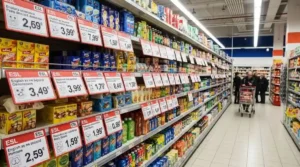


Austria’s supermarket shelves look simple on the surface. Private label milk, juice, meat, and ready meals sit side by side with national brands. But behind that shelf is a tight, highly controlled supply system where only a handful of manufacturers actually produce the volume. Retailers control the label, but production power sits elsewhere. This ranking breaks down the companies that quietly run that system — from dairy giants to beverage exporters — and explains how they shape Austria’s private label market in 2026.
Private label manufacturing in Austria refers to the production of retailer-owned products by third-party companies. These manufacturers operate dual-track models, producing both their own brands and contract goods for supermarket chains, often accounting for a significant share of total output.
Austria Private Label Manufacturers 2026
| Rank | Entity/Country | FY Revenue | Key Impact |
|---|---|---|---|
| 01 | Rauch Fruchtsäfte (AT) | €1.7B+ | Beverage PL leader across Europe |
| 02 | Berglandmilch (AT) | €1.3B | Dairy backbone for national retailers |
| 03 | Marcher Fleischwerke (AT) | €600M+ (est.) | Core meat supply chain operator |
| 04 | NÖM AG (AT) | €550–600M | Innovation-led dairy PL supplier |
| 05 | Hubers Landhendl (AT) | €500M+ | Poultry category dominance |
| 06 | Hermann Pfanner (AT) | €390–400M | Export-driven beverage co-packing |
| 07 | S. Spitz GmbH (AT) | ~€300M (est.) | Multi-category contract manufacturing |
| 08 | Adolf Darbo (AT) | €150–200M | Premium PL spreads and exports |
| 09 | Maresi Austria (AT) | €200M+ | Niche PL distribution and supply |
| 10 | HANDL TYROL (AT) | €180M+ | Premium cured meat specialist |
[BOLD DATA CALLOUT]
Austria’s private label penetration is among the highest in Central Europe, with retailers like SPAR and REWE relying heavily on domestic manufacturers to secure supply stability and margin control.
1. Rauch Fruchtsäfte (Austria)
Founded: 1919
HQ: Rankweil, Austria
FY Revenue: €1.7B+
Employees: ~2,700
Core Segments
- Fruit juices and concentrates
- Energy drinks and soft beverages
- Private label beverage production
- Global export supply
Operational Relevance
Rauch Fruchtsäfte is the single most important private label beverage manufacturer in Austria. Its production footprint extends far beyond domestic demand, supplying supermarket chains across Germany, Central and Eastern Europe, and beyond. The company operates high-volume filling lines that allow retailers to scale private label juice and energy drink ranges quickly without investing in production.
What sets Rauch apart is its ability to combine own-brand visibility with deep contract manufacturing. While consumers recognise its branded products, a significant portion of its capacity is allocated to retailer-owned labels. This dual-track model allows Rauch to maintain high utilisation rates across production facilities.
The Analyst’s View
Rauch wins because of scale and export integration. Beverage private label is a volume game, and Rauch has built the infrastructure to dominate it. Its partnerships with global brands also strengthen its technical capabilities, giving it an edge over smaller regional bottlers.
The risk, however, lies in margin pressure. As retailers push private label pricing down, manufacturers like Rauch must continuously optimise efficiency to maintain profitability.
Executive Insight
- Austria’s beverage private label market is export-driven, not just domestic
- Scale players like Rauch define pricing benchmarks for retailers
- Smaller bottlers struggle to compete on cost and volume
2. Berglandmilch (Austria)
Founded: 1995 (cooperative structure)
HQ: Wels, Austria
FY Revenue: ~€1.3B
Employees: ~1,900
Core Segments
- Milk and dairy processing
- Yogurt and cheese production
- Private label dairy supply
- Cooperative-based sourcing
Operational Relevance
Berglandmilch is the backbone of Austria’s dairy private label system. It processes milk from thousands of farmers and converts it into products that fill supermarket shelves under retailer-owned brands. From basic milk to yogurt and cheese, Berglandmilch supplies the core of everyday grocery consumption.
Its cooperative structure gives it a unique advantage. By controlling sourcing at scale, it ensures consistent supply — a critical factor for retailers managing high private label penetration. The company’s integration into supermarket supply chains makes it indispensable.
The Analyst’s View
Berglandmilch dominates because dairy is the foundation category of private label. Retailers compete heavily on milk pricing, and that requires a stable, high-volume supplier. Berglandmilch delivers that reliability.
The challenge is margin sensitivity. Dairy is one of the most price-pressured categories, and manufacturers must balance farmer payments with retailer demands.
[BOLD DATA CALLOUT]
Dairy and beverages account for a significant share of private label volume in Austria, making companies like Berglandmilch and Rauch central to supermarket strategy.
3. Marcher Fleischwerke (Austria)
Founded: 1976
HQ: Villach, Austria
FY Revenue: ~€600M+ (estimated)
Employees: ~2,000
Core Segments
- Fresh meat processing
- Sausages and processed meats
- Ready-to-cook and convenience products
- Private label supply for retail chains
Operational Relevance
Marcher Fleischwerke operates at the center of Austria’s meat private label system. Unlike dairy or beverages, meat supply chains are more complex, requiring strict control over sourcing, processing, and logistics. Marcher provides that structure at scale, supplying supermarket chains with fresh and processed meat products under private label branding.
Its role is not just production — it is supply chain execution. Meat categories require consistent quality, traceability, and fast distribution. Marcher’s processing network allows retailers to maintain shelf availability while managing pricing in one of the most sensitive grocery categories.
The company also plays an important role across Austria fresh produce and chilled food logistics, where supermarkets increasingly depend on reliable cold-chain operations and regional sourcing efficiency to keep fresh categories competitive.
The Analyst’s View
Marcher’s strength is operational depth. Meat private label is less about branding and more about trust and compliance. Retailers depend on suppliers who can meet strict safety standards while delivering volume.
The risk is volatility. Feed costs, animal supply, and regulatory pressure can shift quickly, making margins harder to control than in packaged goods.
Executive Insight
- Meat private label is operationally intensive, not just manufacturing
- Supply reliability matters more than brand perception
- Processors like Marcher anchor retailer pricing strategies
4. NÖM AG (Austria)
Founded: 1905
HQ: Baden, Austria
FY Revenue: ~€550–600M
Employees: ~800
Core Segments
- Dairy products (milk, yogurt, desserts)
- Functional and protein drinks
- Private label dairy production
- Export-focused innovation
Operational Relevance
NÖM AG plays a different role compared to Berglandmilch. While Berglandmilch focuses on volume, NÖM operates in higher-value dairy segments, including functional products and premium yogurt categories. This makes it a key partner for retailers looking to expand private label beyond basic offerings.
Its production capabilities allow it to develop more advanced dairy products, supporting the shift toward healthier and protein-focused ranges. For retailers, this is critical as private label moves from price-driven to value-driven positioning.
The Analyst’s View
NÖM wins through innovation and category depth. As private label evolves, retailers need suppliers who can deliver more than basic milk. NÖM fills that gap by offering differentiated products that still fit within private label pricing structures.
However, this positioning comes with higher costs. Competing in premium segments requires continuous investment in product development and processing technology.
[BOLD DATA CALLOUT]
Private label in Austria is no longer limited to low-cost basics. Growth is increasingly driven by premium and functional categories, where suppliers like NÖM play a key role.
5. Hubers Landhendl (Austria)
Founded: 1973
HQ: Pfaffstätt, Austria
FY Revenue: ~€500M+
Employees: ~900
Core Segments
- Poultry processing
- Fresh chicken products
- Ready-to-cook poultry meals
- Private label retail supply
Operational Relevance
Hubers Landhendl is the dominant poultry supplier within Austria’s private label system. Chicken has become a key protein category for supermarkets, driven by pricing, versatility, and consumer demand for lean meat options. Hubers operates across the full chain — from farming partnerships to processing — ensuring consistent supply for retailer brands.
Its strength lies in category focus. Unlike diversified meat processors, Hubers specialises in poultry, allowing it to optimise production efficiency and maintain stable output volumes. For retailers, this translates into dependable shelf availability in a fast-moving category.
The Analyst’s View
Hubers wins because poultry is one of the most price-sensitive and high-turnover categories in supermarkets. Retailers need suppliers that can deliver volume without disruption, and Hubers provides that consistency.
The challenge is margin pressure. Poultry pricing is tightly controlled, and any fluctuation in feed or energy costs can quickly impact profitability.
Executive Insight
- Poultry is one of the fastest-moving private label categories
- Specialised suppliers outperform diversified processors in efficiency
- Retailers rely on consistent volumes to stabilise pricing
6. Hermann Pfanner Getränke GmbH (Austria)
Founded: 1856
HQ: Lauterach, Austria
FY Revenue: ~€390–400M
Employees: ~1,000
Core Segments
- Fruit juices and iced teas
- Beverage contract filling
- Private label production
- Export-driven distribution
Operational Relevance
Hermann Pfanner Getränke GmbH is one of Austria’s most important beverage exporters, and a major private label partner for retailers across Europe. While it operates its own brand portfolio, a large share of its business is built on contract manufacturing and co-packing for supermarket chains.
Pfanner’s strength lies in its ability to serve multiple markets efficiently. Its production facilities are designed for flexible output, allowing it to supply both branded and private label beverages at scale. This flexibility makes it a key player in retailer supply chains beyond Austria.
The Analyst’s View
Pfanner competes on export reach and production flexibility. Unlike purely domestic suppliers, it operates as a cross-border manufacturing partner, giving retailers access to consistent product quality across multiple markets.
However, competition is intense. Larger players like Rauch dominate volume, while smaller co-packers compete on niche segments. Pfanner must balance scale with agility to maintain its position.
[BOLD DATA CALLOUT]
Austria’s private label beverage sector is heavily export-oriented, with companies like Pfanner supplying retailer brands across Germany and Central Europe.