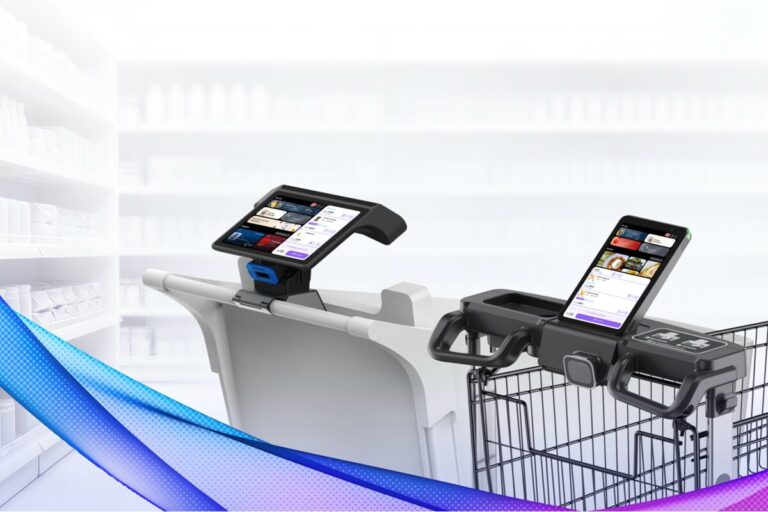

Smart shopping carts are moving from supermarket trials into larger commercial deployments. The strongest systems now do far more than scan products. They combine computer vision, weighing, checkout, loyalty, navigation, retail media and store analytics.
Five companies stand out in 2026: Instacart Caper, Shopic, Cust2Mate, Hanshow with shopreme, and Veeve.
They use different technical models. Caper and Cust2Mate offer purpose-built smart carts. Shopic can turn a normal trolley into a smart cart with a clip-on device. Hanshow and shopreme combine connected cart hardware with store infrastructure and retail media. Veeve offers both smart carts and a connected screen that can be attached to existing trolleys.
: Instacart Caper has the strongest current grocery deployment base among the five. Shopic is especially strong in retrofit computer-vision technology. Cust2Mate is scaling through major multi-thousand-cart contracts. Hanshow and shopreme bring smart carts into a wider digital-store ecosystem. Veeve combines smart cart checkout with a lighter retrofit screen model.
Top smart cart companies for supermarkets
| Company | Smart cart model | Main strengths | 2026 scale indicator |
|---|---|---|---|
| Instacart Caper | Purpose-built AI cart | Computer vision, scales, loyalty, ads, checkout | Live across 10+ retailers with continued US, UK and Australian rollout |
| Shopic | Clip-on smart-cart device | Computer vision, checkout, navigation, retail media | Deployments with major European grocery retailers |
| Cust2Mate | Purpose-built and modular smart carts | Checkout, retail media, data and large fleet deployments | 3,000-cart Super Sapir order and 4,000-cart Carrefour Israel agreement |
| Hanshow / shopreme | Connected smart-cart ecosystem | Navigation, checkout, loss prevention and retail media | New integrated solution launched at NRF Europe 2026 |
| Veeve | Full cart and retrofit connected screen | Personalisation, coupons, navigation and pay-on-cart | Deployed with major US retailers including Albertsons |
What is a smart shopping cart?
A smart shopping cart is a trolley fitted with digital technology that helps the customer shop and, in many cases, pay without using a conventional checkout.
Depending on the system, the cart can use:
- cameras;
- computer vision;
- barcode scanners;
- weighing scales;
- touchscreens;
- location sensors;
- loyalty login;
- payment terminals;
- AI product recognition;
- anti-theft controls.
The shopper adds products to the cart. The system builds the basket digitally as they move through the store.
More advanced carts also show:
- running spend;
- promotions;
- shopping lists;
- product locations;
- personalised recommendations;
- retail media ads.
The result is a shopping device that can become a checkout, loyalty terminal, navigation system and digital advertising screen at the same time.
Why supermarkets are investing in smart carts
Traditional checkout is one of the biggest friction points in grocery.
Retailers want to:
- reduce queues;
- improve checkout capacity;
- use labour more efficiently;
- increase loyalty engagement;
- understand in-store behaviour;
- sell retail media;
- personalise offers;
- reduce the gap between online and physical shopping.
Smart carts address several of those problems in one device.
They also create new challenges.
A supermarket has to manage:
- cart charging;
- hardware damage;
- shrink;
- produce weighing;
- age-restricted products;
- customer training;
- POS integration;
- payment compliance;
- Wi-Fi and networking;
- cleaning and maintenance.
The best smart cart is therefore not simply the most impressive demo.
It is the system that works reliably during everyday supermarket trading.
How we selected the five companies
GTN already covers individual smart-cart launches, including Hanshow’s latest technology. This comparison has a different search intent.
We selected suppliers with:
- real supermarket deployments or signed commercial rollouts;
- current smart-cart technology in 2026;
- checkout or basket-recognition capability;
- grocery-specific customer evidence;
- technology beyond a simple tablet attached to a trolley.
Experimental university projects and general trolley manufacturers were excluded.
1. Instacart Caper
Caper is one of the most commercially advanced smart-cart platforms in grocery.
Instacart acquired Caper AI in 2021 and has since integrated the technology into its wider Connected Stores platform.
How does Caper Cart work?
Caper combines:
- cameras;
- AI product recognition;
- a digital scale;
- touchscreen;
- location data;
- loyalty integration;
- payment;
- cart-management software.
The customer can scan or place products into the trolley while the system tracks the basket.
Fresh produce can be weighed directly in the cart.
The screen shows a running total and can guide shoppers around the store.
Computer vision
Caper uses sensor fusion rather than relying on one input.
Its AI combines camera data with information from the digital scale and other sensors.
Instacart has also integrated NVIDIA Jetson edge-computing hardware into Caper Carts.
Processing data on the cart reduces latency when products are added or removed.
Retailer deployments
Caper has been deployed with grocery retailers including:
- Wakefern / ShopRite;
- Schnucks;
- Geissler’s;
- Bristol Farms;
- Weis Markets;
- Coles in Australia;
- Morrisons in the UK;
- other independent and regional grocers.
Instacart says the technology is live across more than 10 retailers.
UK expansion
Morrisons became the first UK retailer announced for Caper Carts.
The first deployment began in 2026 with the potential for wider rollout.
Customer engagement
Instacart reports several usage indicators for Caper.
These include:
- a Net Promoter Score above 70;
- 97% loyalty login rates in relevant deployments;
- around 30 minutes of average screen engagement during a shopping trip.
These are company-reported metrics and should be assessed alongside retailer-specific results.
Retail media
Caper’s screen can display:
- location-based advertising;
- digital coupons;
- personalised offers;
- gamified promotions;
- product recommendations.
This turns the trolley into a retail media surface.
That matters because shoppers are making purchase decisions while the screen is directly in front of them.
Shrink prevention
Smart-cart checkout creates loss-prevention risk if products are not recognised correctly.
Caper therefore includes cart verification, alerts and management tools for store staff.
Company scale and ownership
Caper is part of Instacart, which is publicly listed.
Caper itself does not report separate revenue, employee numbers or a standalone valuation after the acquisition.
Using Instacart’s total market capitalisation as the value of Caper would be misleading.
Why Caper leads this list
Its strongest advantage is commercial maturity.
The technology has moved beyond isolated pilots and is being rolled out by several major grocery businesses across multiple countries.
2. Shopic
Shopic takes a different approach.
Instead of requiring a supermarket to replace all of its trolleys, Shopic’s Shop-E device attaches to a standard shopping cart.
How Shopic works
The clip-on system uses:
- computer vision;
- AI;
- a touchscreen;
- on-device processing;
- store-location technology.
It detects products as shoppers add or remove them from the trolley.
The live basket total appears on the screen.
Customers can pay through the smart-cart experience and bypass a conventional checkout process.
Retrofit advantage
The retrofit model is important.
Shopping trolleys are relatively cheap mechanical assets and can be replaced frequently.
Shopic separates the expensive smart technology from the trolley itself.
The device can be removed and returned to a charging shelf at the end of the shopping trip.
Retail deployments
Shopic has worked with retailers including:
- Conad cooperative operations in Italy;
- Dimar / Mercatò;
- other international grocery groups.
The company describes its solution as one of the more mature computer-vision smart-cart systems in the market.
Retail media
Shopic uses the cart screen as a digital advertising channel.
Promotions can respond to:
- the shopper’s location;
- basket content;
- loyalty information;
- current promotions.
Store analytics
The same sensors that identify products can create data on:
- shopping routes;
- product interactions;
- store heat maps;
- basket behaviour;
- inventory signals.
This makes Shopic a store-intelligence platform as well as a checkout technology.
Loss prevention
Shopic has expanded its computer-vision technology into self-checkout loss prevention.
This can help validate transactions and detect possible scan errors.
Revenue, employees and valuation
Shopic is privately held.
Current annual revenue, current employee totals and a current independent valuation are not publicly disclosed in the primary sources reviewed.
Why Shopic matters
The retrofit design can lower deployment friction.
A retailer can keep its existing trolley fleet and add intelligence through the clip-on device.
3. Cust2Mate
Cust2Mate is the smart-retail technology business of A2Z Cust2Mate Solutions Corp.
Unlike many smart-cart companies, it is backed by a publicly listed parent company.
Smart-cart platform
Cust2Mate combines:
- AI product recognition;
- cameras;
- barcode scanning;
- touchscreen;
- checkout;
- security tools;
- retail media;
- store data.
The company also offers modular smart-cart designs that can make deployment easier across different trolley formats.
Cart sizes
Cust2Mate has developed several cart sizes for different retail environments.
Large hypermarkets need more basket volume than urban supermarkets or pharmacies.
The company’s technology can also include produce scales for products sold by weight.
Major 2026 deployments
Cust2Mate entered 2026 with several significant commercial agreements.
These include:
- a 3,000-cart order from Super Sapir valued at around US$30 million;
- a 4,000-cart strategic agreement with Carrefour Israel valued at around US$50 million over five years;
- planned availability at selected Migros stores in Türkiye;
- additional deployments in Central America and other markets.
These agreements move smart carts towards fleet-level deployment rather than small technology trials.
Recurring-revenue model
Cust2Mate does not only sell hardware.
Some contracts include monthly fees covering:
- carts;
- charging stations;
- software;
- management dashboards;
- maintenance;
- support.
This creates recurring revenue and gives the retailer ongoing technical support.
Retail media
Cust2Mate also treats the cart as a media platform.
Advertising can be sold on the screens while the shopper moves through the store.
This can help offset some technology cost if retailer media revenue is strong enough.
Company scale
A2Z Cust2Mate Solutions Corp is publicly listed on Nasdaq.
Smart-cart revenue and corporate financial data are reported through public filings.
The market capitalisation changes with the share price and should not be treated as a fixed valuation.
Why Cust2Mate matters
The strongest evidence is deployment scale.
Orders measured in thousands of carts create operational learning that smaller pilots cannot provide.
4. Hanshow / shopreme
Hanshow is already a major name in electronic shelf labels and digital store infrastructure.
In September 2026 it announced a new smart-cart solution developed with shopreme and Lucky Cart.
Why the partnership matters
Instead of treating the smart cart as a standalone device, the partners connect:
- shopping journey;
- in-store navigation;
- checkout;
- loss prevention;
- retail media;
- store data;
- digital shelf infrastructure.
This is strategically different from simply adding a screen to a trolley.
Hanshow’s role
Hanshow brings digital-store infrastructure and its Store Digital Twin platform.
The company already works with major retailers around the world through electronic shelf labels and store digitalisation.
shopreme’s role
shopreme specialises in scan-and-go and self-checkout journey technology.
Its software can support:
- mobile self-checkout;
- smart carts;
- exit control;
- store journey orchestration.
Lucky Cart’s role
Lucky Cart contributes retail media and shopper engagement.
This adds personalised promotions and advertising to the cart experience.
2026 launch
The combined smart-cart platform was launched around NRF 2026: Retail’s Big Show Europe in Paris.
The system combines AI shopping assistance, navigation, self-checkout and multi-layer loss prevention.
Existing GTN coverage
GTN has already reported on Hanshow’s smart-cart technology. This comparison places that product against the wider supplier market rather than repeating the launch news.
Revenue and employee data
Hanshow is a large private retail-technology company, while shopreme and Lucky Cart are separate specialist businesses.
A combined smart-cart revenue figure does not exist publicly and would be misleading to estimate.
Why the partnership matters
Hanshow can potentially connect smart carts with technology already installed elsewhere in the store.
That can make the smart cart part of a wider digital infrastructure strategy.
5. Veeve
Veeve is a Seattle-based smart-cart technology company focused on grocery.
The company offers two main approaches: full smart carts and a connected screen that can be attached to existing trolleys.
Full smart cart
Veeve’s full cart includes:
- touchscreen;
- computer vision;
- produce weighing;
- payment;
- product search;
- store navigation;
- coupons;
- personalisation.
Customers can complete checkout directly on the cart.
Computer vision
Veeve says its vision technology focuses on the inside of the cart rather than using facial biometrics.
Products can be recognised through visual features and other signals.
Connected Screen
Veeve also offers a retrofit screen model.
The device brings:
- digital promotions;
- product location;
- coupons;
- retail media;
- checkout capability;
to conventional trolley fleets.
Retail deployments
Veeve has worked with retailers including Albertsons and Metropolitan Market.
The company highlights deployment with major retail brands rather than purely laboratory pilots.
Company-reported results
Veeve has published performance indicators from deployments, including larger baskets and high customer satisfaction.
These are company-reported metrics and should be validated by retailers during procurement.
Revenue and valuation
Veeve is privately held.
Current annual revenue and independent valuation are not publicly disclosed.
Why Veeve matters
The company offers retailers a choice between purpose-built carts and lighter retrofit technology.
That can help chains test the business case before committing to a large hardware fleet.
How the five smart cart platforms compare
| Company | Hardware approach | Strongest differentiator |
|---|---|---|
| Caper | Purpose-built cart | Commercial grocery deployment and Instacart ecosystem |
| Shopic | Clip-on retrofit | Computer vision without replacing trolley fleet |
| Cust2Mate | Purpose-built / modular | Large multi-thousand-cart agreements |
| Hanshow / shopreme | Connected digital-store cart | Integration with wider store infrastructure and retail media |
| Veeve | Full cart and retrofit screen | Flexible hardware model and personalisation |
What should supermarkets check before buying smart carts?
Do not buy based on the demo alone.
- Recognition accuracy: how often does the cart identify the correct product?
- Produce weighing: how are loose fruit and vegetables handled?
- Shrink: how does the system detect unscanned or hidden items?
- Payment: can shoppers pay directly on the cart?
- Loyalty: can the cart identify the customer?
- POS integration: how much custom work is required?
- Battery: can carts remain operational through a full trading day?
- Charging: how much floor space is needed?
- Maintenance: who repairs broken screens, cameras and wheels?
- Cart loss: what prevents expensive carts leaving the site?
- Customer adoption: what percentage of shoppers actually use them?
- Accessibility: can older and disabled customers use the system easily?
Smart carts versus self-checkout
Both aim to reduce checkout friction, but they move the checkout to different places.
Self-checkout still requires the shopper to reach a fixed station.
Smart carts build the transaction during the shopping trip.
Potential smart-cart advantages include:
- no unloading and rescanning at the front end;
- running basket total;
- personalised promotions in the aisle;
- navigation;
- retail media;
- shopping list integration.
Self-checkout is usually much cheaper per station.
The supermarket therefore has to prove that the extra value of the cart justifies the hardware cost.
What about shrink?
Shrink is one of the most important questions.
A smart cart must distinguish between:
- a product added to the basket;
- a product removed;
- an item hidden beneath another;
- loose produce;
- personal belongings;
- children sitting near the basket.
Computer vision helps, but no system should be assumed to eliminate theft.
Retailers should compare shrink rates before and after deployment.
Why produce weighing matters
Grocery is harder than general merchandise because many products are priced by weight.
A smart cart needs a reliable process for:
- apples;
- bananas;
- tomatoes;
- onions;
- other loose produce.
Caper, Cust2Mate and Veeve all provide approaches to on-cart weighing.
Can smart carts increase basket size?
Suppliers report that they can.
The theory is simple.
A screen can show shoppers:
- related products;
- coupons;
- recipes;
- location-based promotions;
- loyalty offers.
But retailers should ask for controlled test results rather than relying only on vendor claims.
Smart carts and retail media
The cart screen can become one of the most valuable in-store advertising surfaces because it travels with the shopper.
An advertiser can potentially reach a customer:
- in the relevant aisle;
- after a related product enters the basket;
- before checkout;
- during a long shopping trip.
This connects smart carts with the wider grocery retail media platform market.
How smart carts use AI
AI is mainly used for:
- computer vision;
- product recognition;
- personalisation;
- loss prevention;
- recommendations;
- store analytics.
The key is speed.
If the system takes several seconds to recognise every product, the shopping experience becomes frustrating.
Edge processing is therefore important for several vendors.
Purpose-built cart or retrofit?
This is one of the biggest procurement decisions.
Purpose-built carts
Advantages:
- integrated hardware;
- better sensor design;
- cleaner customer experience;
- built-in scales and payment.
Disadvantages:
- higher hardware cost;
- larger asset replacement requirement;
- more expensive damage or loss.
Retrofit systems
Advantages:
- reuse existing trolleys;
- lower deployment friction;
- smart device can be upgraded separately.
Disadvantages:
- may have fewer integrated sensors;
- mounting and charging become separate issues.
How much do smart carts cost?
Most vendors do not publish a simple supermarket price list.
Commercial models can include:
- hardware purchase;
- monthly software fees;
- leasing;
- managed service;
- retail media revenue share;
- maintenance agreements.
Cust2Mate’s large public contracts show that fleet deployments can involve tens of millions of dollars.
Retailers should calculate total cost per store and per transaction rather than cost per cart alone.
What is the ROI calculation?
A supermarket should model:
- labour savings;
- basket-size change;
- retail media revenue;
- customer adoption;
- shrink;
- maintenance;
- hardware replacement;
- software fees;
- checkout-space savings.
The technology only works economically if the benefits exceed the full lifecycle cost.
How many carts does a store need?
Not every trolley has to be smart.
Some retailers start with a mixed fleet.
The correct number depends on:
- store traffic;
- average basket size;
- adoption rate;
- trip duration;
- charging time.
A large supermarket may need dozens or hundreds.
What happens when the cart fails?
The retailer needs a fallback.
The customer should be able to:
- transfer the basket;
- complete payment elsewhere;
- receive staff support;
- continue shopping without losing basket data.
Failure recovery should be part of the pilot test.
Which smart cart company is the largest?
There is no clean apples-to-apples revenue comparison.
Caper is owned by publicly listed Instacart.
Cust2Mate is part of publicly listed A2Z Cust2Mate Solutions.
Shopic and Veeve are private.
Hanshow is a large private global retail technology company working with shopreme and Lucky Cart.
By grocery rollout visibility, Caper currently has one of the broadest commercial footprints.
Which company has the biggest announced cart order?
Cust2Mate has announced several major fleet agreements, including 4,000 carts for Carrefour Israel and 3,000 for Super Sapir.
Which system is easiest to retrofit?
Shopic’s Shop-E is specifically designed to clip onto existing carts.
Veeve also offers a connected screen designed for existing trolley fleets.
Which platform is strongest for retail media?
All five are moving towards retail media.
Caper, Shopic, Cust2Mate and the Hanshow/shopreme/Lucky Cart platform all explicitly position the cart screen as an advertising channel.
Which smart carts are active in Europe?
Shopic has European grocery deployments, Caper entered the UK with Morrisons, Cust2Mate is expanding into Türkiye and other markets, and Hanshow/shopreme launched its latest solution in Europe in 2026.
How do smart carts connect with electronic shelf labels?
The strongest future model may connect cart navigation and promotions with digital shelf infrastructure.
Hanshow is especially well positioned here because it already supplies electronic shelf labels and other digital-store technology.
What happens next?
Smart carts are moving into a harder phase.
The technology has already proved that it can work.
The next questions are commercial:
- Can it scale?
- Will customers use it repeatedly?
- Can shrink stay controlled?
- Can retailers generate enough advertising and labour value?
- Can the hardware survive daily store use?
Vendors that answer those questions will move from pilots to standard store infrastructure.
Frequently asked questions
What is the best smart cart for supermarkets?
There is no universal best option. Caper has strong grocery deployment scale, Shopic offers a low-friction retrofit model, Cust2Mate is scaling large fleets, Hanshow connects carts with wider store technology, and Veeve offers both full-cart and retrofit options.
Can smart carts weigh produce?
Yes. Several leading systems include integrated scales for fruit and vegetables sold by weight.
Can shoppers pay on the trolley?
Yes. Leading smart-cart platforms support on-cart or integrated checkout.
Do smart carts prevent theft?
They include loss-prevention controls, but no system eliminates shrink. Retailers need audits, computer vision and staff exception processes.
Do smart carts replace self-checkout?
They can reduce reliance on self-checkout, but many retailers will operate both systems together.
Can existing supermarket trolleys be upgraded?
Yes. Shopic and Veeve offer retrofit-style systems, while other vendors focus more on purpose-built carts.
Do smart carts show advertising?
Yes. Retail media is becoming a central part of smart-cart economics.
Are Caper Carts available in the UK?
Morrisons became the first announced UK retailer for Caper, with rollout beginning in 2026.
How do customers identify themselves?
Systems can use loyalty login, phone number, retailer app or guest shopping depending on the deployment.
Are smart carts suitable for small stores?
Potentially. Smaller cart formats and retrofit devices can work in urban stores, but aisle space and economics need to be tested.
Editor’s Note: Deployment figures and product capabilities were checked against current vendor information.