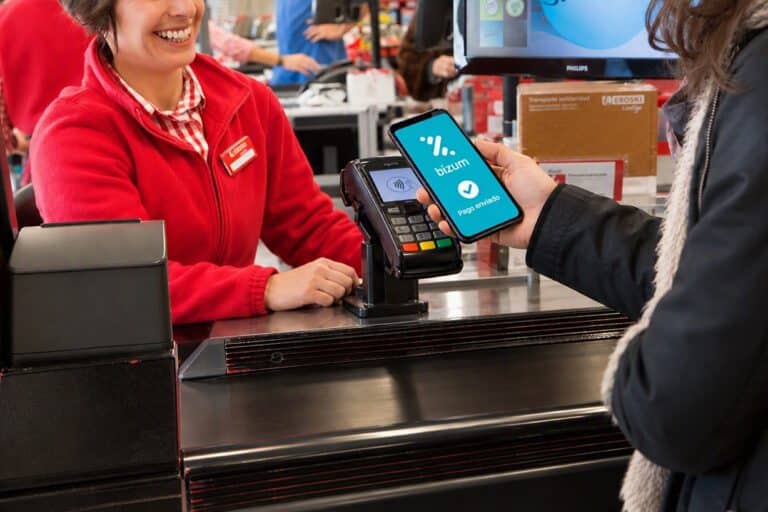

EROSKI has introduced in-store Bizum payments at Caprabo supermarkets in Catalonia, starting a phased rollout across its Spanish food retail network. The announcement, published on 20 October, makes bank participation a condition of wider availability.
The service will extend progressively across mainland Spain and the Balearic Islands. Customers need a bank that has enabled in-store Bizum payments. The initial programme covers food stores and excludes Forum Sport and petrol stations.
EROSKI has not published a completion date or the number of stores enabled. That leaves an important distinction for commercial teams: availability at Caprabo does not yet mean coverage across every group banner or location.
As one of Spain’s major cooperative supermarket groups, EROSKI brings a substantial retail network to the rollout. Its operational challenge is to make the additional payment option consistent across the locations and banks taking part.
The group says Bizum fits into the normal checkout process without changing cashiers’ operating procedures. Enrique Monzonis, its director of innovation and technology, said the aim was to give customers another payment choice as their habits change.
For store operators, the commercial test will be completed transactions, exceptions and the time taken to resolve them. Payment acceptance, refunds, cancelled purchases and end-of-day reconciliation all need to work reliably before a new option can deliver an operational benefit.
EROSKI has provided no transaction-fee comparison, checkout-speed measurements or sales-uplift data. Retailers assessing the model should therefore separate the convenience proposition from any assumption that it reduces payment costs or labour requirements.
A useful comparison would measure the total cost per completed basket, including processing charges, support and reconciliation work. A lower headline fee would offer limited value if payment failures or manual interventions increased. These are evaluation criteria for the rollout, rather than results reported by EROSKI.
The introduction adds a payments development to the wider investment in digital checkout and store operations in Spain. EROSKI reported €21.14 million of innovation and development spending in 2025, up 35% on 2024, and plans more than €100 million of broader technology investment across 2024–2026. That programme spans automation, digitalisation and data; it is not a budget for Bizum alone.
For FMCG suppliers and category managers, the announcement offers no change to listing terms, promotional funding or ordering arrangements. Its relevance sits at the point of purchase: whether an additional payment method helps customers complete their shop consistently.
The next milestones will be additional banks enabling the service and EROSKI confirming wider store availability. Those developments, followed by evidence on transaction performance and operating cost, will show how far the Caprabo launch can translate into a repeatable model across the group.
Editor’s Note: Based on EROSKI’s announcement dated 20 October 2026, translated from Spanish. Grocery Trade News added analysis of rollout dependencies, payment costs and store operating requirements.