
Luxembourg grocery stores can evaluate local till and back-office providers such as LUXPOS, OAshi, SPV, Niwela, Prosys and Erpwecan, alongside international specialists shopreme and Vusion. Not all eight provide the same service: some target independent food shops, some focus on hospitality or accounting, and the international firms specialise in self-checkout or electronic shelf labels. The correct shortlist depends on store size, integration requirements and verified local service coverage.
Research reviewed 1 November 2026. Headquarters and proven Luxembourg operations are distinguished from vendors that merely advertise international availability. Exact company turnover, employees, number of supermarket installations and market share are marked undisclosed where reliable like-for-like figures could not be verified. This is a buyer decision guide, not an invented ranking of eight Luxembourg-based software companies.
Retail technology providers: capabilities at a glance
| Provider | Role for grocery | Local status |
|---|---|---|
| LUXPOS | Till, barcode scanning, weighed sales, stock, payments, loyalty and VAT | Local software; point of sale for grocery and convenience |
| OAshi | Custom checkout, stock scanning, inventory, warehouse and branch management | Luxembourg-based custom POS and multi-store workflows |
| SPV Luxembourg | POS installation, payment terminals, printers, maintenance and hardware advice | Local POS equipment and installation specialist |
| Niwela | Cash and card checkout, stock alerts, item variants and reports | Luxembourg-oriented POS for smaller merchants |
| Prosys / WebRCS | POS software, installation, training, support and hardware | Local POS and support; primarily hospitality-facing |
| Erpwecan | Mercator business management, invoicing, accounting and commercial workflows | Luxembourg business software and commerce management |
| shopreme | Scan & Go, self-checkout, smart carts, mobile scanning and POS integration | International enterprise self-checkout; Luxembourg deployment not confirmed |
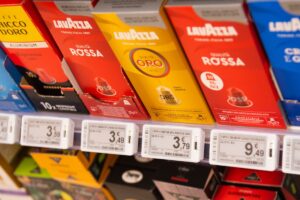
| VusionGroup / Vusion | Electronic shelf labels, cloud price updates and connected-store systems | International electronic shelf label supplier; local installation to verify |
A large supermarket should not use a basic restaurant POS recommendation as proof of enterprise readiness. Equally, an electronic shelf label vendor cannot replace the core till, stock or payment processing system without an agreed integration architecture.
1. LUXPOS — grocery buyer suitability
LUXPOS explicitly presents a grocery-and-convenience-store product for Luxembourg. Its product page describes barcode scanning, produce sold by weight, food and non-food VAT rates, stock monitoring, supplier orders and label printing. The company also advertises card payments and loyalty functions. That is more relevant to independent grocers than a generic restaurant till package with no scale connection.
The platform describes cloud operation, support for browsers and mobile devices, and accounting workflows adapted to Luxembourg. Its own pricing and feature claims are commercial descriptions, not independently audited performance. No verified 2025 company revenue, payroll headcount or number of supermarket customers was established for this guide. Those fields remain undisclosed.
Buyers should test connections with the actual scale, scanner, label printer and card terminal in their store. Ask about offline trading, backup data, VAT mapping, price changes and historic sales exports. For chains, demand a live demonstration of central product-master updates across several branches; a statement that a platform supports multiple sites is not enough.
Verified category: Local software; point of sale for grocery and convenience. Main offer: Till, barcode scanning, weighed sales, stock, payments, loyalty and VAT. Operating-base context: Luxembourg-built platform; specific legal entity and registration should be checked. Comparable 2025 supplier revenue, workforce, customer store count and Luxembourg retail market share: not verified for this profile.
2. OAshi — grocery buyer suitability
OAshi operates a Luxembourg company and markets tailored point-of-sale software for Luxembourg and Germany. Its official page includes retail checkout, mobile scanning, inventory management, multi-store structures and warehouse workflows. A published address in Wasserbillig provides local business evidence, but the website does not establish how many supermarkets currently use the system.
The platform presents integration of existing devices and older-data migration as selling points. These could matter when upgrading a local grocery chain that cannot stop trading to replace its entire POS network. However, buyers should confirm in writing which integrations are in production, how migration is tested and who is liable if transaction totals do not reconcile.
OAshi deserves evaluation where a shop has unusual workflows, wholesale accounts, service counters or multiple stock locations. It should not be assumed that a bespoke system automatically supports self-checkout, electronic shelf labels or loyalty-card APIs. Request real references, a sample migration plan and a priced support commitment before selecting it.
Verified category: Luxembourg-based custom POS and multi-store workflows. Main offer: Custom checkout, stock scanning, inventory, warehouse and branch management. Operating-base context: Wasserbillig, Luxembourg. Comparable 2025 supplier revenue, workforce, customer store count and Luxembourg retail market share: not verified for this profile.
3. SPV Luxembourg — grocery buyer suitability
SPV is a Luxembourg point-of-sale specialist serving merchants and hospitality customers. Its website advertises POS installation, maintenance, receipt printers, payment-terminal rental and related equipment. It has a public contact address in Steinfort. This suggests a useful partner for small grocery operators who need someone to install and maintain till equipment rather than buy a software licence with no local technician.
SPV’s services describe transaction equipment and support, but they do not provide verified proof of advanced supermarket-specific functions such as promotions across hundreds of stores or shelf-label synchronisation. Sales turnover, headcount, installed store count and retail-specific certifications were not confirmed. Buyers must request these details instead of inventing them.
A convenience-store buyer should ask SPV which POS software it supplies, what happens when a terminal fails at peak time, and whether replacement printers and scales are locally stocked. Hardware ownership, warranty, payment-acquirer contract and monthly software charges should appear separately in the quote.
Verified category: Local POS equipment and installation specialist. Main offer: POS installation, payment terminals, printers, maintenance and hardware advice. Operating-base context: Steinfort, Luxembourg. Comparable 2025 supplier revenue, workforce, customer store count and Luxembourg retail market share: not verified for this profile.
4. Niwela — grocery buyer suitability
Niwela describes a till system marketed to Luxembourg retail, hospitality, events and clubs. Its public features include payments, product and category management, simple stock movements, low-stock warnings and sales reports. These are practical starting functions for a small independent retailer that currently relies on manual stock sheets.
The supplier describes configurable devices and remote support. Its website also emphasizes club and event use, so a supermarket buyer should not assume supermarket-level functionality without a specific demonstration. We did not verify a Luxembourg company-registration number, 2025 revenue, employee count or named grocery-chain deployment.
Before considering Niwela for a food shop, test barcode and weighted-product sales, mixed tax rates, discounts, refund permissions, supplier deliveries and reconciliation to card payments. Require written confirmation that the system can maintain prices correctly when many SKUs change at once. Small-store suitability is different from nationwide checkout readiness.
Verified category: Luxembourg-oriented POS for smaller merchants. Main offer: Cash and card checkout, stock alerts, item variants and reports. Operating-base context: Marketed for Luxembourg; precise registered head office requires confirmation. Comparable 2025 supplier revenue, workforce, customer store count and Luxembourg retail market share: not verified for this profile.
5. Prosys / WebRCS — grocery buyer suitability
Prosys publishes Luxembourg contact details and markets the WebRCS POS system. The supplier advertises installation, training, support and hardware. Its stated target customers include cafés, bars, bakeries, restaurants and food trucks. A bakery or food-to-go operator may find this relevant, while a full grocery supermarket should not treat those references as evidence of a grocery ERP or large self-checkout network.
The company lists a local office and telephone number. That is useful when a buyer values local support, but the available website content does not confirm a large number of supermarket installations, retail-specific 2025 turnover or employee headcount. These data are not published in a form we could verify.
A store with a substantial prepared-food or café counter may investigate WebRCS alongside its main till system. Ask whether product prices, vouchers, stock and payments can be reconciled across the foodservice and grocery parts of the store. If the product cannot manage weighed produce or central retail promotions, use it only where its actual capabilities fit.
Verified category: Local POS and support; primarily hospitality-facing. Main offer: POS software, installation, training, support and hardware. Operating-base context: Godbrange, Luxembourg. Comparable 2025 supplier revenue, workforce, customer store count and Luxembourg retail market share: not verified for this profile.
6. Erpwecan — grocery buyer suitability
Erpwecan describes decades of software support for Luxembourg businesses and merchants. Its site discusses the Mercator management platform, accounting and commercial workflows. It is better viewed first as a business-management or back-office candidate than as a confirmed supermarket checkout vendor. This distinction stops buyers from asking an accounting product to solve price-label accuracy at the shelf.
Mercator functionality presented by Erpwecan includes configuration for invoicing, banking and business administration. A grocery operator may need to connect these processes to purchasing, inventory and point-of-sale systems. However, we did not verify specific supermarket rollouts, current annual revenue, employee numbers or a tested grocery integration with every third-party POS.
Ask for a process map showing data moving from purchase order to goods receipt, stock valuation, checkout and accounting. Check whether the partner can integrate your supplier invoicing format and whether a new version will require paid consultancy. The key procurement question is which core system owns product, price, stock and VAT data.
Verified category: Luxembourg business software and commerce management. Main offer: Mercator business management, invoicing, accounting and commercial workflows. Operating-base context: Wiltz, Luxembourg. Comparable 2025 supplier revenue, workforce, customer store count and Luxembourg retail market share: not verified for this profile.
7. shopreme — grocery buyer suitability
shopreme is an international self-service technology provider serving grocery chains. Its official materials describe mobile Scan & Go, smart-cart systems, employee supervision, loss prevention, checkout integrations and a central data hub. It references active European grocery programmes, including REWE and Penny, and in March 2026 described an integrated self-checkout pilot at V-Markt in Munich.
The company later described a smart-cart pilot with Auchan Romania in an October 2026 update. That demonstrates a type of regional capability, but not that a Luxembourg grocer has contracted shopreme. We found no reliable public basis for claiming Luxembourg headquarters, local annual revenue, employee count or a named Luxembourg customer. Any local deployment and support need to be confirmed directly.
For large-format grocers or discount chains, shopreme is relevant if the goal is to integrate scan-and-go with an existing retailer POS rather than replace all tills. An RFP should cover barcode security, age-restricted products, digital receipts, payment reversals, fraud controls, device management, customer adoption and store staff procedures. Demand an integration proof of concept before estate-wide rollout.
Verified category: International enterprise self-checkout; Luxembourg deployment not confirmed. Main offer: Scan & Go, self-checkout, smart carts, mobile scanning and POS integration. Operating-base context: International supplier; not presented as a Luxembourg-headquartered company. Comparable 2025 supplier revenue, workforce, customer store count and Luxembourg retail market share: not verified for this profile.
8. VusionGroup / Vusion — grocery buyer suitability
Vusion markets electronic shelf labels and connected-store infrastructure, helping retailers synchronise shelf and checkout prices. Its publicly documented projects include major UK grocers. In October 2025 the company announced an agreement covering Morrisons supermarkets, and a 2026 statement detailed a wider European rollout for JYSK. These are useful references for scale, but they are not Luxembourg customer references.
A supermarket with frequent promotions could evaluate electronic labels to reduce manual replacement of paper shelf tickets. The value depends on accurate product-master data, good integrations, robust wireless coverage, label battery life and a clear exception process when the POS and the display disagree. Hardware purchase cost alone is not a complete project budget.
We could not verify that Vusion maintains a Luxembourg-specific registered subsidiary, headcount or local revenue figure. Buyers should request a named installer, maintenance SLA, local certification and current rollout contacts. The company is listed as an international technology option available for investigation, not as evidence of a completed Luxembourg supermarket deployment.
Verified category: International electronic shelf label supplier; local installation to verify. Main offer: Electronic shelf labels, cloud price updates and connected-store systems. Operating-base context: International supplier; not claimed as Luxembourg headquartered. Comparable 2025 supplier revenue, workforce, customer store count and Luxembourg retail market share: not verified for this profile.
2026 Luxembourg supermarket technology: what is actually happening
In May 2026 Lidl Luxembourg introduced Scan & Go trials in Dudelange, Strassen and Windhof. Shoppers could scan with the Lidl Plus application and pay at self-checkouts. Retail reporting also described AI-enabled produce scales that recognise fruit and vegetables and print barcodes. The pilot is a real example of Luxembourg demand for new checkout journeys, not evidence that the international vendors above supplied Lidl’s hardware or software.
Lidl said the test could extend to its Luxembourg store network by early 2027. That is an announced plan, not confirmation of a completed nationwide rollout as at November 2026. Buyers considering similar projects should ask what changes in staffed checkout demand, staff training, shrinkage management and accessibility would follow from their own store layout.
Electronic shelf labels and centrally managed price updates are another trend. International supplier case studies are useful technical references, but a successful rollout in Britain does not automatically establish local installation teams in Luxembourg. Ask for a local-language project manager and support contract before relying on an overseas headline.
How to select technology for a small grocer versus a supermarket chain
An independent grocery store with a few checkout stations usually needs barcode scanning, weighed fruit and vegetable sales, card and cash reconciliation, correct Luxembourg VAT and simple inventory. Shortlisting LUXPOS, OAshi, SPV or another demonstrably grocery-capable local integrator may be sensible. Test the features using the store’s real goods rather than product marketing screens.
A multi-branch retailer needs a master product catalogue, consistent promotions, supplier orders, near-real-time stock movements, user permissions and audit logs. It must prove that discounts, age checks, loyalty rules and refund controls work across all tills. The ability to show a price on a website is not proof that the correct price reaches every shelf label, app and checkout terminal.
Large self-checkout projects should consider shopper journeys and shrink controls. A retailer may integrate an international provider such as shopreme with its current POS while retaining local servicing for hardware. ESL projects involve the central system, labels, access points and installation. Always assign responsibility for a broken integration contractually.
A grocery RFP: questions every supplier should answer
Request a diagram of all connected systems: POS, ERP, stock, price engine, scale, label printer, payment gateway, loyalty platform and ecommerce. State which vendor owns each interface and what happens when network access is lost. Offline payment acceptance, transaction queues and price updates require detailed demonstrations, not assumptions.
Ask for current customer references at a store size similar to yours, hardware reliability statistics, incident response hours, languages supported, data-export format and a data-protection agreement. Ensure software hosting, telemetry, backups and access permissions comply with applicable European privacy law. A supplier’s reference to GDPR is a claim to verify against contract and implementation.
Calculate five-year total cost: terminals, scanners, scales, printers, shelf labels, subscription, software upgrades, connectivity, implementation, training, card-processing fees, spares, service visits and termination costs. Put fixed and variable costs on separate lines. A cheap till licence can become expensive when every interface requires bespoke work.
Pilot in a representative store, including the busiest hour. Simulate multiple VAT rates, weighed produce, returned goods, lost Wi-Fi, expired offers, staff changes and a payment reversal. Require a clean reconciliation between shelf price, receipt and back-office reporting. Only expand when error rates and service outcomes meet agreed acceptance criteria.
Revenue, headquarters and customer counts: how to avoid false comparisons
The eight technology providers have different corporate footprints. LUXPOS and other local providers advertise Luxembourg-facing products, while international firms sell across Europe. A claim of thousands of international stores must not be described as thousands of stores installed in Luxembourg. A domestic office address is not evidence of major supermarket market share.
Private software companies may not publish a usable standalone 2025 turnover or employee count. We do not substitute estimates from parent companies or web directory ranges. For procurement qualification, ask for the exact contracting entity, annual accounts if available, support team capacity and insured business continuity arrangements. Supplier revenue is a risk indicator, not proof of product quality.
Frequently asked Luxembourg grocery technology questions
Who provides POS software specifically for grocery shops? LUXPOS has a public grocery-specific page covering barcode scanning, produce scales and differing VAT rates. OAshi advertises multi-store POS and inventory workflows. Other local specialists require demonstrations to establish full supermarket suitability.
Which providers offer self-checkout and electronic shelf labels? shopreme advertises self-checkout and smart-cart technology, while Vusion offers electronic shelf labels. Their Luxembourg deployment and local service arrangements should be verified. The existence of international references alone does not establish a Luxembourg supermarket installation.
Does Lidl’s 2026 self-checkout pilot prove one of these companies supplied it? No. The public coverage confirms a retailer deployment, not the identity of every technology vendor. Do not attribute a Lidl contract to an unrelated supplier without first-party evidence.
Where can buyers compare the grocery market? Read the Luxembourg supermarket chains guide for retailer context, the Slovenia retail technology guide for another local-market comparison, and our electronic shelf label supplier overview for the specialist hardware category.
Final buyer recommendation
Choose the system that demonstrates the functions your grocery operation needs with your real stock, taxes, payments and support requirements. Local POS providers, commerce software specialists and international shelf or self-checkout platforms are not interchangeable. Document the contracting entity, integrations, service coverage and five-year cost before agreeing to an estate-wide rollout.
Editor’s Note: This guide checks supplier-owned product pages and market developments published through 1 November 2026, including Luxembourg retail reports on Lidl’s May 2026 Scan & Go pilot and current manufacturer information from Vusion and shopreme. Company presence and customer references are separated from unverified assumptions about local contracts. The comparison is editorial and is not a paid ranking.