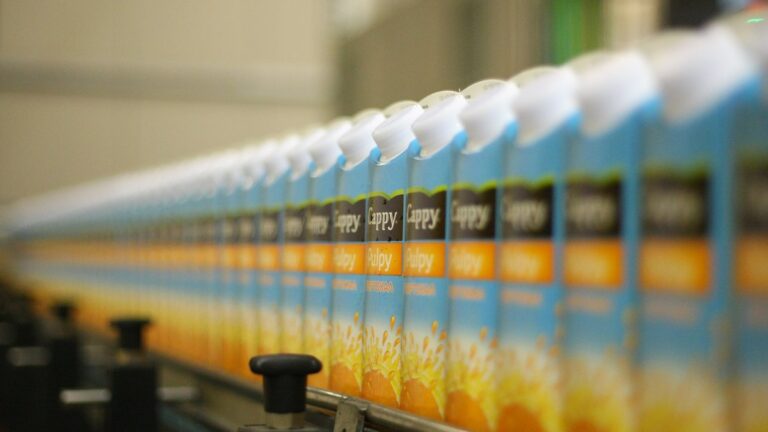

Cartons on a Cappy juice processing line. Representative photograph by Biso via Wikimedia Commons, CC BY 4.0. Cropped.
Nine food manufacturers in Moldova offer private-label production or packing for retail brands. Orhei-Vit makes juices and preserves. SAPICO and Belmar supply sauces and condiments. Paninella, Meltin Factory and MOTIKO cover different frozen ranges. Packline, Moara de Familie and Monicol add retail-ready nuts, seeds, dried fruit and wheat flour.
Orhei-Vit is the largest business among the manufacturers with comparable 2025 sales in this article. The company reported MDL 717.8 million in sales through its Moldovan legal entity. At the smaller end, specialist producers offer more focused ranges, from frozen mochi to custom flour blends. The figures below show company scale. Contract volumes depend on the factory and product.
Moldova private-label suppliers compared
| Company | Buyer category | Location | Reported sales or operating scale | Employees | Private-label evidence |
|---|---|---|---|---|---|
| Orhei-Vit | Juices, preserves, fruit puree | Chișinău; branches reported in Orhei, Căușeni and Briceni | MDL 717.8m, 2025 | 385, 2025 | Own private-label offer for drinks and canned foods |
| SAPICO / IMCOMVIL GRUP | Snacks, mayonnaise | Chișinău | MDL 366.2m, 2025, IMCOMVIL GRUP | 206, 2025, same entity | Own private-label development and manufacture offer |
| Paninella | Dumplings, pizza, pickles | Chișinău | MDL 60.1m, 2025 | 74, 2025 | Producer listing explicitly offers custom private label |
| Belmar / STA Interterm | Mayonnaise, ketchup, margarine, vinegar | Bălți | MDL 17.6m, 2025, STA Interterm | 21, 2025, same entity | Producer listing offers custom-made products |
| Meltin Factory | Frozen coated fruit | Chișinău | About 500,000 units sold since launch, reported September 2026 | Approximately 40 reported in September 2026 | Own website offers private label and co-development |
| MOTIKO / SweetsFlav | Frozen mochi desserts | Chișinău | MDL 212,000, 2024 | 5, 2022 | Producer listing offers custom private label |
| Packline / Balance | Nuts, seeds and dried fruit | Chișinău | MDL 27.09m, 2025 | 19, 2025 | Own-label packing and processing |
| Moara de Familie | Wheat flour blends and retail packs | Măgdăcești, Criuleni | MDL 113.23m, 2025 | 10, 2025 | Dedicated own-brand flour and export service |
| Monicol | Walnut kernels, dried fruit and own-label packs | Nimoreni area, near Chișinău | MDL 229.0m, 2025 | About 200, 2026 | Private-label packaging on request; factory of about 4,800 m² listed in a producer profile |
These figures are legal-company sales, not private-label contract turnover. They also reflect different product categories and company structures. A purchasing team should verify which registered company will manufacture, invoice and insure its particular order. Market shares cannot be calculated from this mixed table. Other European production networks include Slovenia’s private-label manufacturers and Luxembourg’s own-label food producers.
Where Moldova’s own-label food is made
Chișinău is home to several company offices and production operations. Bălți is the base for Belmar, while Orhei-Vit lists three branches outside its Chișinău headquarters. Manufacturers may pack different products at different sites. The factory address on the order should match the address on the certification and traceability documents.
1. Orhei-Vit: juices, purees and canned foods
What it makes: Orhei-Vit is a direct option for own-brand fruit juice, nectar, canned vegetables, fruit preserves and purees. Its official private-label page invites partners to bottle juice and make canned products under the buyer’s brand, offering discussion of Tetra Pak, glass and canned formats. This is stronger evidence of a contract service than finding a juice brand on a supermarket shelf.
History: The manufacturer traces its origins to the Orhei canning factory established in 1945. Its current website reports headquarters in Chișinău and three branches in Orhei, Căușeni and Briceni, together with agricultural and distribution operations. The history of a business and the incorporation year of its current legal company are separate facts; the registry entry for Orhei-Vit SRL was established much later.
Scale and numbers: A registry-linked 2025 company profile for Orhei-Vit SRL (IDNO 1003606004176) reports MDL 717.8 million in sales, MDL 49.5 million net profit and 385 employees. The company says its portfolio exceeds 200 items and that it can process up to 100 million kilograms of raw materials a season. The 100-million-kilogram figure is the company’s stated seasonal capacity; the group and its sales mix may also differ from the legal entity’s accounts.
Buyer questions: Which factory will produce the chosen pack? What fruit percentage, sugar specification, origin and minimum order are available? Are all packaging materials cleared for the actual product? Ask for pasteurisation or sterilisation parameters, shelf-life validation, traceability, food-contact documents and a commercial-run sample. Orhei-Vit lists HACCP and quality certifications on its own website, but buyers must check expiry dates and exact line scope.
Orhei-Vit’s trade programme included SIAL Paris in October 2026. Its exhibitor listing covered juices, baby food, canned fruit and vegetables, and semi-finished products. Retailers can distinguish finished own-label food from concentrate or purée supplied as an ingredient.
2. SAPICO: snacks and mayonnaise production
What it makes: SAPICO produces and sells snack and condiment brands including YAW!, Le Mezon and Holy Chefs. More importantly for buyers, it separately promotes a private-label service from recipe development and pack design to manufacture and export. This makes it worth contacting for own-brand savoury snacks or mayonnaise.
Production footprint: SAPICO’s website reports 15,000 square metres of production and warehouse space, with seven lines, claimed capacity of up to 4,000 tonnes of snacks and 10,000 tonnes of mayonnaise annually, and exports to more than 25 countries. These are public company statements, not evidence that the full capacity is available for a new retailer or that every category is produced in the same plant. Ask for a current equipment list and line allocation.
2025 finances: The Moldovan company directory entry for IMCOMVIL GRUP SRL (IDNO 1003600160027), which displays sapico.md as the business website, reports MDL 366.2 million sales, MDL 32.8 million net profit and 206 employees in 2025. It gives a company registration date in 2004. Because trading brands can cover different operations, SAPICO should confirm the contracting and manufacturing legal entity before a buyer relies on those figures.
Quality and product work: Its website displays an IFS figure of 96.10, with TÜV Austria mentioned. A score alone is not sufficient compliance evidence. Request the valid certificate, standard version, scope and manufacturing site. For snacks, specify oil, seasoning tolerance, allergens, date code, packet gas mix and expected shelf life. For mayonnaise, verify ingredients, emulsification stability and the relevant microbial controls. Formula ownership should be clear if a buyer funds custom development.
Retail fit: SAPICO’s explicit service and quoted industrial capacity make it a logical first enquiry for sizeable snack or mayonnaise programmes.
SIAL Paris listed SAPICO as a Moldovan exhibitor in October 2026, in Hall 8. The exhibitor record is dated evidence of its export-facing sales activity alongside the manufacturing capacity published by the company.
3. Paninella: frozen prepared foods and pickles
Product offer: A Moldovan producer listing states that Paninella makes customised private-label dumplings, pizza, pickles and pickled snacks. Its own products include bakery and frozen prepared items. It suits a buyer planning freezer or preserved-food categories, not one looking for a specialist drink bottler.
History and sites: The company was founded in 1997 and operates in Chișinău, where the producer listing identifies premises on Columna Street. The same listing describes approximately 2,100 square metres of production space. Treat that as the described site, not a complete audited footprint for any associated businesses or additional factories.
Financial record: Paninella SRL (IDNO 1003600167381) reported 2025 revenue of MDL 60.12 million, net profit of MDL 2.02 million and 74 employees according to registry-linked data. Its 2024 revenue was MDL 47.43 million. Those are company figures, not sales under buyer-owned labels. They can help a retailer consider scale and supplier resilience without pretending to measure category dominance.
Due diligence: For frozen dumplings and pizza, obtain full recipes, allergen controls, cooking validation, origin information where relevant, blast-freezing records, frozen warehouse conditions and a transport-temperature protocol. For pickles, confirm recipe acidity, process validation, closure integrity and tests supporting the proposed shelf life. The finished sample must come from the commercial line intended for the buyer.
Retail fit: Paninella offers a distinctive, documented route for prepared frozen food and preserved vegetables. Request exact pack formats and realistic lead times; the listing does not establish national private-label market share.
Paninella’s official contact page names 170 Columna Street at the Tracom industrial park in Chișinău. The registered company and the production contact use the Paninella name. Confirm the specific line for frozen foods or preserved vegetables when specifying an order.
4. Meltin Factory: frozen fruit snacks and co-development
Company scale. Moldova’s Public Services Agency lists Meltin Factory SRL (IDNO 1015600039247) at 801 Șoseaua Muncești, Chișinău, following a February 2026 address filing. Invest Moldova reported about 40 direct employees, around 500,000 units sold since launch and nearly €800,000 invested by September 2026. The planned total investment was €1 million to €1.1 million.
Specialism: Meltin Factory focuses on frozen and chocolate-coated fruit snack concepts. Its website offers private-label or licensed forms of its products to retailers, plus collaborative recipe and pack development. That is more suitable for a differentiated premium frozen launch than a conventional bulk chilled-food tender.
Operations and history: The business identifies itself as Meltin Factory SRL in Chișinău. Reports dated 18–19 September 2026 say French entrepreneurs Kevin Wiessler and Nicolas Dimitrescu founded the project in Moldova and developed own brands NUBO and KIZZ. The company website highlights batch traceability, HACCP-based process controls, labelling support and products for retail and foodservice. The manufacturing address and line-specific certification should be checked before approval.
Commercial scale: Invest Moldova’s September 2026 update gives the latest operating snapshot for the project. Reported unit sales cover the period since launch.
Buying terms: Confirm chocolate and fruit ingredient origins, frozen chain temperatures, coating stability, allergens, traceability, launch volumes and intellectual-property ownership. Ask whether an exclusive flavour requires a formulation development fee or a minimum annual volume. A successful prototype still needs commercial production validation and transport tests.
Retail fit: This is an innovation-led option. Its recent expansion plans are useful context, not proof of a free production slot or financial results.
Meltin Factory SRL’s registration dates to November 2015. The factory expansion is a later development. September 2026 reporting identified France as the first export market for the frozen-fruit operation.
5. MOTIKO: frozen mochi desserts
Offer: MOTIKO appears in a Moldovan producer listing under SweetsFlav LLC. It describes frozen mochi desserts that can be customised, and explicitly says private-label services are available. The listing dates the business to 2014 and places it in Chișinău. It also mentions craft ice cream for local sale; that does not mean the ice-cream line is automatically available for overseas private-label orders.
Export and production: The producer profile names several international markets, including Romania, Hungary, Czechia and Germany. Buyer teams should establish which products reached those markets, whether the proposed label and recipe can be shipped legally to the intended destination, and which entity will act as exporter. A listed brand shop is not itself a food factory; request the real production address and site certificates.
Key checks: Frozen dessert quality depends on texture after storage and defrosting, product shape, filling stability and consistent freezer temperatures. Specify serving size, rice-wrapper texture, permitted fillings, dairy and nut allergen controls and retailer food-safety requirements. An optional vegan formulation needs validation of ingredient sourcing and shared-line segregation, not just a marketing statement.
Company scale. SweetsFlav SRL (IDNO 1013600025657) was registered in September 2013. Sirius B2B lists approximately MDL 212,000 in 2024 revenue and an approximately MDL 199,000 net loss for 2025. Datero lists five employees in 2022. The brand’s local producer profile dates MOTIKO to 2014 and lists a Chișinău retail shop on Albișoara Street.
The producer directory lists export markets in Central and Eastern Europe. The legal entity’s size has changed between filings. Datero reports MDL 6.73 million in net sales in 2022 and MDL 850,296 in 2023, so the earlier sales figure should be read in its own year.
6. Belmar: sauces and condiments
Offer: A Moldovan producer listing associates the Belmar brand with STA Interterm SRL and says custom-made private-label goods are offered. The product range includes mayonnaise, ketchup, margarine and vinegar. This is a useful route for a buyer developing a focused condiment or dressing range.
History: The public producer profile gives Bălți as the location and 1999 as its founding year. Registry records for STA Interterm (IDNO 1004602000797) show company registration in January 1997. These dates refer to different types of business history and should not be merged into a single unsupported claim about every Belmar operation.
Financial information: Registry-linked figures give STA Interterm revenue of MDL 17.61 million and 21 employees for 2025. This is the named legal entity, not necessarily total revenue of all related brands or factories. A buyer should request a current company extract, financial statements and confirmation of the actual food-processing operator.
Buying terms: For mayonnaise, ask about acidity, oil specification, allergen controls, emulsion stability and packaging seals. For ketchup and vinegar, agree testing parameters, preservative use, label claims, case sizes and product shelf life. Check that any certificate presented is current and covers the exact facility, product and process.
Retail fit: Belmar can complement SAPICO in a condiment procurement exercise, but its custom-product listing is not a guarantee that every formulation or pack size can be accepted at commercial scale.
STA Interterm’s 2025 figures include about MDL 164,000 in net profit. The producer catalogue lists wine vinegar alongside mayonnaise, ketchup and margarine. These products have different production and quality checks even when they share the Belmar brand.
7. Packline / Balance | Nuts, seeds and dried fruit
Company scale. Packline SRL (IDNO 1003600110756) lists its business address at 21/4 Petricani Street, Chișinău. Data2B reports MDL 27.09 million in net sales, MDL 2.46 million in net profit and 19 employees for 2025.
Packline sells its own products under Balance and publishes a separate private-label offer. Its services include processing, size grading, contract packing and wholesale ingredients. The food categories include nuts, dried fruits and seeds.
For a retailer’s nut or seed mix, agree the ingredient percentages, grade, pack size and permitted variation before approving the first order. Ask which site does the processing and packing, how the line handles allergens and whether each ingredient can be traced to its original batch.
Packline was registered on 17 October 2003, according to Data2B. Its 2025 filing shows 19 employees. The same company directory separately lists 20 staff in its September 2026 snapshot.
8. Moara de Familie | Wheat flour blends and retail packs
Company scale. The mill names FPC Ghenven-Service SRL (IDNO 1003608004974) as its operator. The business was established in 1998 and gives its production address as 90 Nicolae Milescu Spătarul Street, Măgdăcești, Criuleni district. Indice reports MDL 113.23 million in 2025 revenue. The 2025 company record lists 10 employees.
Moara de Familie publishes a dedicated private-label service for wheat flour. It offers tailored blends, customer-branded packs, preparation for larger orders and export documentation. Its catalogue describes blends with protein, gluten, moisture and grind set to match the project.
A retailer launching plain flour needs to agree performance across typical home uses. A bakery procuring flour for bread or laminated pastry may need tighter protein and dough-handling targets. Ask the mill to give tolerances and explain how it maintains the agreed blend when wheat lots change.
Send the desired bag size and sales market in the first brief. Agree language, pack strength, batch identification and pallet configuration before the pilot. Request a specification and sample from the proposed blend, then check results against the same use cases as the current product.
The 2025 company record lists MDL 6.56 million in net profit and 10 employees. Indice places Ghenven-Service second by total revenue in its 2025 milling-category comparison.
9. Monicol | Walnut kernels, dried fruit and own-label packs
Company scale. Monicol was founded in 2001. Indice reports MDL 229.0 million in 2025 revenue and MDL 3.9 million net profit. Reporting from Moldova Business Week 2026 placed the Nimoreni processor’s workforce at about 200. The company lists its AmCham Moldova Green Award among its 2025 milestones.
Monicol processes and exports walnuts and dried fruit. Its packaging page says its Fruit2go range can also be packed under a customer’s brand on request. The company describes its own processing and orchard operations. A producer profile gives a processing area of approximately 4,800 square metres near Chișinău.
For walnuts, specify halves or pieces, size grade, moisture, permitted defects and the remaining shelf life on arrival. For dried plums or a mixed fruit line, agree the size range, permitted ingredients and how the factory controls variation between crops.
Before ordering retail packs, ask which pack sizes are available, whether organic claims apply to the exact product and packing line, and how the batch can be traced to its raw materials. Pack integrity matters for both shelf life and the appearance of loose product on shelf.
Monicol’s published equipment capacity includes more than 3,000 tonnes of walnuts. Its Fruit2go range gives retailers an existing reference for pack presentation and product grading. The plant’s output and the amount available to one contract depend on crop quality, processing schedules and pack sizes.
Which Moldovan factory makes each product?
| Product to source | First approach | What to verify |
|---|---|---|
| Juice, nectar or bottled puree | Orhei-Vit | Pack line, juice recipe, plant and shelf life |
| Mayonnaise or snacks | SAPICO; Belmar for focused condiments | Recipe and allergen controls, pack minimums |
| Frozen dumplings, pizza or pickles | Paninella | Frozen chain, cooking and food-safety processes |
| Frozen chocolate-coated fruit | Meltin Factory | Allergens, intellectual property and freezer logistics |
| Frozen mochi | MOTIKO | Texture tests, validated shelf life and export scope |
Start with the category specialist. A larger revenue figure does not improve a supplier’s suitability for a completely different food line. Send the same clear specification to two or three qualified companies and compare each reply on product match, factory evidence and end-to-end costs.
Compare total landed cost rather than factory price
Factory-gate prices may omit laboratory testing, packaging artwork, translation, border documents, freight, chilled storage and pallet distribution. Ask the supplier to state the agreed Incoterm, currency, payment schedule and who pays if a shipment is delayed. The cheapest ex-factory quote is not always the cheapest product delivered in saleable condition to a supermarket distribution centre.
For a fair comparison, calculate cost per saleable retail unit after transport, likely wastage, duties where applicable, pallet charges and promotions. Check whether mixed pallets are accepted and whether minimum order quantities are specified per recipe, print design or delivery. A high-volume product may need a dedicated slot weeks ahead; a small pilot may require a setup charge or a limited range of pack designs.
Do not assume that a factory’s brand recipe can be copied with a new label. Agree ingredient specifications, nutritional claims, allergen declarations and barcode ownership. A new product size or ingredient can require renewed laboratory checks and different shelf-life evidence.
Food safety and contract manufacturing checks
A website displaying IFS, FSSC 22000, ISO 22000 or another mark is a starting point, not final approval. Obtain the actual certificate, audit date, validity period, issuing body, factory address and product scope. Confirm that the relevant line and product are covered, not merely another site or process belonging to the company.
- Review a recent quality audit and corrective-action log.
- Request traceability and mock-recall records for a finished commercial batch.
- Check allergen risk, cleaning validation and retained-sample arrangements.
- Request test reports that support the proposed shelf life and storage temperature.
- Match label translations, nutrition declarations and import documentation to the destination.
- Agree procedures for substitutions, rejected batches and an emergency recall.
Imported meat, dairy and composite products can have very different rules from juices or shelf-stable preserves. Consult the current regulations of the importing market for the exact item. There is no single general certificate allowing every Moldovan food to enter every destination country.
What the revenue and employee figures do not tell you
Revenue figures here are reported in Moldovan lei (MDL) for a defined legal entity and fiscal year. Sales are not the same as profit; neither is the same as output tonnage or the value of contracts sold under retailers’ names. The figures also cover different product categories, which makes a revenue-based industry ranking inappropriate for this specific procurement question.
Company sales measure the legal business across its activities. Private-label manufacturing share would require a separate breakdown of contract sales across the whole category.
Employee totals help estimate organisational scale only when the date and reporting company match. A public headcount may cover administrative and logistics roles as well as production. Store or branch counts for manufacturers are not the same measure as supermarket store counts. Ask how many sites and production lines actually serve the proposed product.
The buyer request for quotation checklist
Send one structured brief that states the precise category, composition, serving size, proposed annual demand, pilot volume, target retail price, packaging format, launch geography and required certificates. Include preferred delivery cadence, languages for the pack and any retailer or importer-specific rules. A clear brief makes responses comparable and reduces the risk of unquoted extras.
Ask the manufacturer to return a price per unit and per pallet; line-specific minimum order; tooling or artwork fees; sample cost; expected lead time; payment terms; certificate pack; labelling responsibilities; and a named technical contact. Ask which design or recipe rights the buyer owns. Specify who will pay for a failed laboratory test or recall, and how retained samples will be handled.
For frozen foods, state storage temperatures and the acceptable time outside the freezer at loading and unloading. For drinks, include fruit content, pack material, fill volume and pasteurisation method. For mayonnaise, describe oil type, acidity, allergens and target viscosity. Technical precision saves weeks of back-and-forth and prevents comparing fundamentally different goods.
Export and supply continuity from Moldova
Assess the product’s customs classification, rules of origin when relevant, documentation, preferred freight route and agreed exporter of record. A statement that a product is made in Moldova does not establish that it meets any particular preferential tariff or food-import requirement. Check product-by-product rather than relying on broad promotional claims.
Confirm how the factory will respond to shortages of fruit, edible oil, dairy ingredients, cocoa, packaging or freezer transport. Record acceptable ingredient alternatives and a rule that formulation changes require retailer approval. A supplier should not make a hidden substitution simply to meet a dispatch date.
For a freezer-line product, audit handoffs between the plant, haulier, consolidation facility and buyer warehouse. For ambient packs, audit seals, pallet protection and heat exposure. Reliability matters as much as quoted capacity, especially during the first months of a private-label launch.
Herbal infusions and other own-label leads
An October 2026 Enterprise Europe Network listing describes a Moldovan herbal and fruit infusion producer offering own-label blends. It reports 20 products and annual capacity of 20 tonnes, with individual tea bags and 50 g packs. The public profile leaves the company unnamed. Importers can ask the network for the producer’s identity and confirm the actual blending and packing site.
FMCG Moldova brings buyers and suppliers together through a commercial hub. Its site is a route to supplier introductions. The manufacturing company, site and product scope still need to appear on the contract. Nearby Romanian producers can also appear in searches for Moldovan suppliers. Vascar’s plant is in Romania, so it falls outside this list.
Frequently asked questions
Which Moldovan food makers explicitly offer private label?
Orhei-Vit, SAPICO and Meltin Factory describe private-label services on their websites. Producer directories identify custom offers for Paninella, MOTIKO and Belmar. Packline and Moara de Familie publish own-label services. Monicol offers custom packing for walnuts and dried fruit. Minimum runs depend on the product and pack format.
Who can make own-brand juice in Moldova?
Orhei-Vit offers juice bottling and preserved-food manufacturing under a customer brand, including different pack formats.
Are the nine companies the biggest manufacturers in Moldova?
No. They are a documented buyer-fit shortlist. Other larger processors may make branded food or offer additional services, but they are not included here without an explicit product-relevant custom-manufacturing offer.
Which companies offer frozen products?
Paninella lists frozen dumplings and pizza; Meltin Factory develops frozen coated fruit; MOTIKO offers frozen mochi. They are not interchangeable suppliers, and each needs separate validation.
What are their minimum order quantities and market shares?
Minimum quantities depend on line, recipe and pack. The comparison uses total company sales and production figures because private-label sales are reported separately only where available. Request written MOQ quotations and avoid unsupported percentages.
What is changing in Moldovan own-label food?
Moldova’s offer now spans long-established juice and preserve lines as well as products such as frozen coated fruit and custom flour blends. An October 2026 report by dVO said Meltin Factory was pursuing further European expansion and identified private label as part of that plan. Its progress will help show whether newer frozen lines can follow Moldova’s established ambient products into more retail markets.
Reporting sources: Company product pages and catalogues, Moldovan producer listings, registry-linked 2025 company figures, Enterprise Europe Network’s October 2026 producer listing and dVO’s October 2026 Meltin Factory coverage.