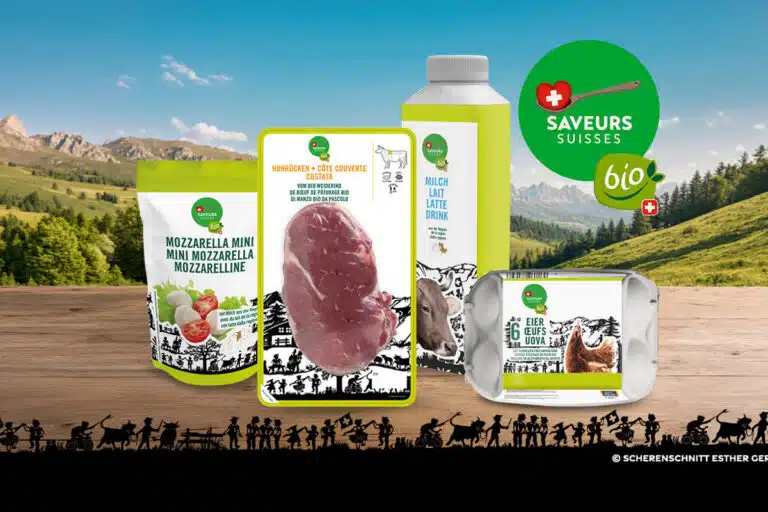

Aldi Suisse will move its “retour aux sources” organic products into the Saveurs Suisses umbrella brand from 2027, ending the separate supply streams behind the existing programme.
The retailer announced the change on 26 November. The transition affects a programme involving around 370 farms across dairy, meat, fruit and vegetable production.
The announcement puts milk-processing economics at the centre of the decision. Aldi says the agricultural model worked, but keeping supplies separate became disproportionately expensive as volumes increased.
Why Aldi is retiring the segregated model
Launched in 2022, “retour aux sources” grew from about 24 products to more than 60. Aldi Suisse says almost 50 million products have been sold.
The programme combined organic production with additional requirements under the Prüf Nach! standard. Its dairy offer included milk from livestock systems without antibiotics or concentrate feed.
Antibiotic treatment was still permitted when necessary for animal welfare. However, milk or meat from a treated animal could no longer enter the programme.
Those additional requirements created a distinct sourcing proposition. They also required participating milk to remain separate during collection and processing.
Swiss agricultural newspaper Schweizer Bauer reported on 16 November that participating dairy farmers received a 10 Rappen premium per kilogram of milk, equivalent to CHF0.10/kg. That is a reported producer premium, rather than a processing-cost figure disclosed in Aldi’s latest announcement.
The distinction matters. Aldi has identified segregation costs as a problem, but has not published a breakdown showing the contribution of farmer premiums, collection, processing or production scheduling.
For processors supplying Switzerland’s supermarket market, the change raises a practical question: how much complexity can be removed while retaining a clearly differentiated organic offer?
Bio Suisse Knospe versus Saveurs Suisses BIO
Aldi says the new Saveurs Suisses BIO range will meet standards equivalent to the Bio Suisse Bud, known as Knospe in German.
That wording does not, by itself, confirm that every product will carry the Bud certification mark. Nor does it establish that every additional requirement from the outgoing programme will continue.
| Area | Retour aux sources (2022–2026) | Saveurs Suisses BIO (from 2027) |
|---|---|---|
| Organic standard | Organic requirements plus additional Prüf Nach! approval; Bio Suisse certification was reported as a dairy-programme prerequisite. | Aldi states Bio Suisse Bud-equivalent standards. Product-level certification and pack marks should be checked. |
| Antibiotic rules | Dedicated antibiotic-free livestock programme; products from treated animals excluded. | The announcement does not confirm continuation of the same dedicated programme. |
| Dairy feed rules | Milk programme excluded concentrate feed. | No equivalent additional feed commitment specified in the announcement. |
| Supply-chain segregation | Separate goods streams supported the programme’s additional requirements. | Existing separate streams will no longer be maintained. |
For buyers comparing Swiss private-label ranges, organic status, livestock requirements and physical segregation should be assessed separately.
A change to the supply-chain model does not automatically describe every change to the finished product. Equally, similar branding should not be taken as proof that the underlying specification remains identical.
What the shift means for suppliers and buyers
The commercial significance extends beyond replacing one name on a pack. Manufacturers will need clear specifications for the new range. Retail buyers will need to understand which commitments apply across Saveurs Suisses BIO and which remain specific to individual products.
Earlier reporting by Schweizer Bauer, citing Foodaktuell, put the milk stream at around six million kilograms and identified Zentralschweizer Milchproduzenten (ZMP) as collector, with processing at Emmi in Suhr, Aargau, and its subsidiary Biedermann in Bischofszell, Thurgau; the newspaper also recorded 36 dairy farms on Bio Fair Schweiz’s membership list.
Those dairy figures describe one part of the programme, rather than all 370 farms across its product categories.
For dairy suppliers, the outstanding questions include collection arrangements, processing allocation and future payment terms. Aldi has not announced whether the reported 10 Rappen/kg premium will continue, change or end under individual agreements.
The retailer says it is organising the transition with the parties involved and will handle existing agreements responsibly. It remains open to economically viable approaches to reducing antibiotic use developed with other market participants.
Combining volumes could offer opportunities to simplify processing. However, Aldi has not quantified potential savings or said how any benefit would be shared between farmers, processors, the retailer and shoppers.
The gradual rollout begins in 2027. Product specifications, supplier agreements and final packaging will show how the revised model translates into the organic range on shelf.
Editor’s note: This article is based on Aldi Suisse’s announcement dated 26 November 2026, its published programme requirements, ProCert’s Prüf Nach! factsheet and Swiss agricultural reporting on the dairy premium and processing arrangements. Grocery Trade News has added analysis of sourcing economics, certification and supplier implications.