
Germany’s grocery sector is one of the most competitive in Europe.
By 2025, seven groups dominate: EDEKA, REWE, Lidl, Aldi, Kaufland, Netto Marken-Discount, and Globus. Together they account for almost all retail food turnover in the country.
The story behind the German grocery market share 2025 is about balance — between discounters and full-range supermarkets, between price pressure and sustainability, between local loyalty and European expansion.
Editor’s Note: This article is based on verified company data and trade reports from EDEKA, REWE Group, Schwarz Group (Lidl and Kaufland), Aldi Nord and Aldi Süd, Netto Marken-Discount, and Globus. All figures refer to 2024 financials reported in 2025, with store counts and employment data drawn from official updates and sector publications.
Edeka And Rewe Lead The German Grocery Market Share In 2025
EDEKA holds its position as Germany’s number-one food retailer.
The group’s 2024 revenue reached about €75 billion, including its discount banner Netto Marken-Discount. That total came from more than 10,800 stores across every state in Germany, from small village markets to large urban formats.
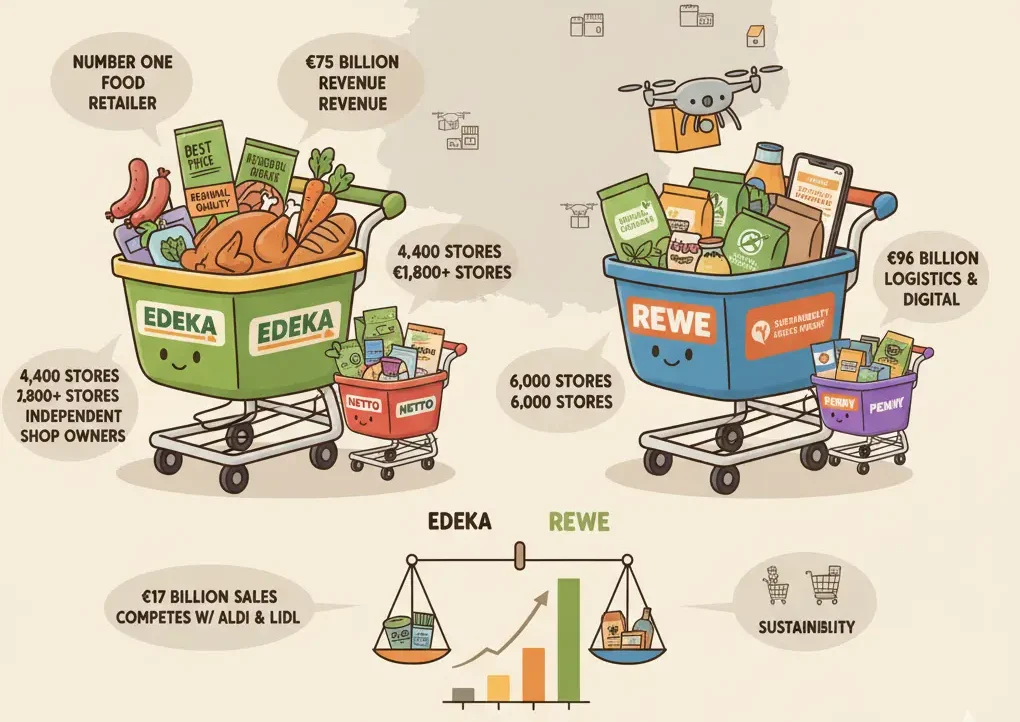
EDEKA’s structure gives it an edge: thousands of independent shop owners operate under the cooperative umbrella, supported by regional warehouses and a national buying arm. This decentralized model keeps the company close to local consumers while still benefiting from national scale.
Netto Marken-Discount continues to play a key role. With roughly 4,400 stores and annual sales above €17 billion, it provides EDEKA with price reach that directly competes with Aldi and Lidl. In 2025, Netto has been updating stores, reducing packaging, and expanding its organic and private-label ranges.
REWE Group remains the other major pillar of the German grocery market share 2025.
Its combined operations across REWE supermarkets, PENNY discounters, and convenience formats deliver more than €96 billion in annual external revenue. REWE runs about 6,000 stores in Germany and continues to invest heavily in logistics and digital systems.
Both groups have found ways to grow despite discounter pressure.
EDEKA focuses on regional quality and freshness — especially local meat, bakery, and produce. REWE leans on convenience, urban delivery, and sustainability. Each now offers multiple private-label tiers, from value to premium organic, matching consumer demand for choice without confusion.
Aldi And Lidl Continue To Expand Across Europe
Discounter power defines the German grocery market share 2025.
Aldi and Lidl shape price expectations for the whole industry. They continue to expand abroad while maintaining deep penetration at home.
Lidl operates over 3,200 stores in Germany and more than 12,600 globally. Its parent company, the Schwarz Group, reported worldwide sales of around €175 billion in 2024, making it one of the largest retail groups on the planet. Lidl’s success rests on constant efficiency gains — simplified assortments, modern warehouses, and rapid category updates.
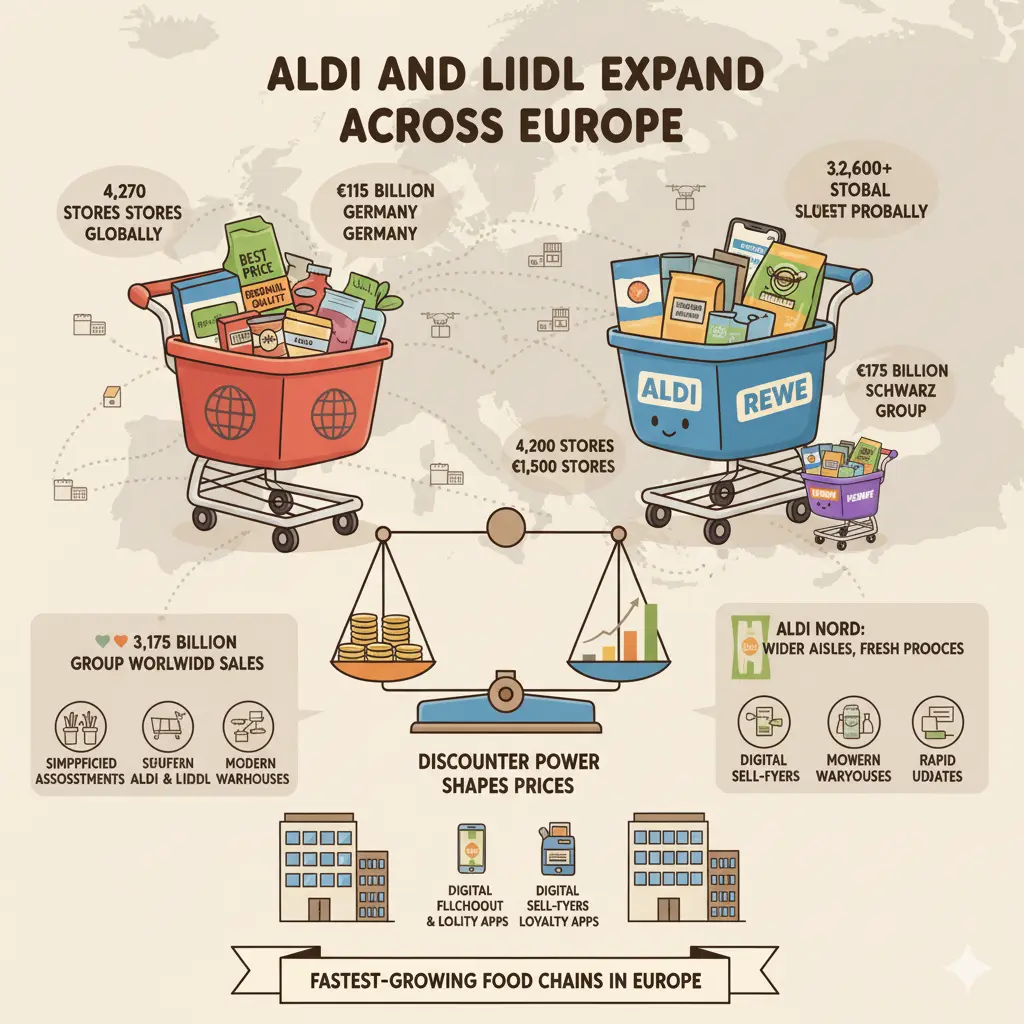
Aldi’s model remains equally strong. The combined Aldi Süd and Aldi Nord networks include roughly 4,270 stores in Germany. Aldi Süd runs modernized stores with wider aisles and fresh produce islands, while Aldi Nord is revamping its layout and logistics. Together, they represent over €115 billion in global revenue.
For consumers, the difference between the two discounters is less visible than before. Both now carry more premium private-label products, regional items, and ready-to-eat lines. Their investment in digital flyers, self-checkout, and loyalty apps shows how discounters are evolving from pure price players to full-service retailers.
Across Europe, Aldi and Lidl remain the fastest-growing food chains. Their German base serves as both a testing ground for innovation and a benchmark for operational performance.
Kaufland And Globus Target Omnichannel Growth
Kaufland, also part of the Schwarz Group, sits between supermarket and hypermarket. It operates roughly 780 stores in Germany and continues to expand in Central and Eastern Europe. Kaufland generated around €35 billion in revenue in 2024, benefiting from its broad range and competitive pricing.
In 2025, Kaufland’s strategy focuses on omnichannel integration. Its app and online shop now connect weekly offers, loyalty points, and home delivery. The chain’s larger stores allow it to promote non-food categories — a contrast to the small footprint of most discounters.
Globus remains a regional powerhouse with around 65 hypermarkets in Germany.
Its format blends grocery, household goods, and in-store restaurants, keeping high levels of shopper loyalty. Annual sales are estimated between €7 billion and €10 billion. Globus is also active in sustainability — cutting plastic, investing in reusable systems, and expanding local sourcing programs.
While Globus cannot match the scale of Schwarz or EDEKA, it benefits from strong family ownership and a clear market identity: traditional service and quality at fair prices. The brand’s combination of food retail and dining continues to attract loyal customers in its core regions.
German Grocery Leaders By Numbers (2024 Data Reported In 2025)
| Retailer | 2024 Revenue (€bn) | Estimated Market Position | Stores in Germany | Employees (Group) |
|---|---|---|---|---|
| EDEKA (incl. Netto Marken-Discount) | 75.3 | 1st | 10,859 | 413,000 |
| REWE Group (REWE, PENNY, nahkauf) | 96.0 (group) | 2nd | ~6,000 | ~380,000 |
| Lidl (Schwarz Group) | 132.1 (group) | 3rd | ~3,247 | 376,000 |
| Aldi (Nord & Süd) | ~117.6 (global) | 4th | ~4,270 | ~291,000 |
| Kaufland (Schwarz Group) | 35.2 | 5th | ~782 | 157,000 |
| Netto Marken-Discount (EDEKA) | 17.6 | 6th | ~4,400 | 88,500 |
| Globus | ~7–10 | 7th | ~65 | ~34,000 |
These figures underline the high concentration of the German grocery market share 2025.
The top four players control the majority of national turnover, with regional operators and independents making up the rest. For suppliers, it means fewer but more powerful buyers.
The Dominance Of Discounters
Discounter stores continue to define German food retail.
By the end of 2024, they accounted for roughly half of total grocery spending — an unmatched share in Western Europe. Lidl, Aldi, Netto Marken-Discount, and PENNY remain the most important price anchors for consumers.
Value remains the top priority for households. Although inflation has eased since its 2022 peak, shoppers still trade down where possible. That environment favors discounters’ efficiency and private-label strength.
At the same time, these chains are modernizing fast. Store designs now include bakery counters, improved lighting, and more branded goods. Lidl’s fruit and vegetable sections look increasingly like those of full-range supermarkets. Aldi has invested in local dairy and bakery sourcing to differentiate quality without losing its price advantage.
The discounter model itself has matured.
German shoppers no longer see it as a compromise — it is simply the normal way to buy groceries. This mindset shapes competition for every retailer, including EDEKA and REWE.
Sustainability Defines Investment Priorities
Sustainability has moved from marketing to operations.
In 2025, every major retailer in Germany publishes annual climate and packaging reports, and most have set 2030 or 2040 carbon targets.
EDEKA and REWE continue to lead with supplier audits, organic farming programs, and regional partnerships. REWE’s private-label “REWE Bio” and EDEKA’s “GUT&GÜNSTIG” ranges now include lower-emission products with simplified packaging.
The Schwarz Group has expanded its recycling and renewable-energy divisions. Lidl and Kaufland operate some of Europe’s largest solar-roof networks and are investing in logistics efficiency to cut emissions per pallet. Aldi is testing deposit systems for reusable boxes and beverage containers, while Netto Marken-Discount has introduced nationwide recycling points in cooperation with packaging suppliers.
For shoppers, the biggest visible changes are paperless receipts, refill stations, and more local products on shelves. Sustainability no longer feels niche — it has become an everyday expectation.
Retail Technology Shapes The Next Phase
Digitalization is a core part of the German grocery market share 2025 story.
Retailers are automating warehouses, using predictive ordering, and expanding online services.
REWE’s delivery business now covers most major cities, offering both home delivery and click-and-collect. EDEKA’s partnerships with regional online platforms help smaller independents enter e-commerce. Lidl’s app integrates loyalty points, recipes, and digital receipts. Aldi is testing smart shelf labels and hybrid checkout systems.
Technology also reshapes logistics.
Warehouse robotics, AI forecasting, and electric truck fleets improve cost control while supporting sustainability targets. With labor costs rising, automation has become a competitive requirement rather than an option.
At the same time, supermarkets use digital engagement to reinforce loyalty.
Lidl Plus, REWE App, Aldi App, and Netto’s loyalty platform each offer tailored coupons and digital flyers. These systems gather valuable data on shopping behavior, which feeds directly into pricing and assortment planning.
What This Means For Suppliers And Brands
For suppliers, the German grocery market share 2025 creates both opportunity and pressure.
Large chains expect cost transparency, sustainability data, and speed. Smaller producers benefit from regional sourcing programs — especially through EDEKA’s independent store owners and REWE’s regional partnerships — but must still compete on efficiency.
Private-label manufacturing continues to expand. German retailers now control much of their own sourcing, packaging, and branding. For many producers, supplying a retailer’s own brand is more stable than fighting for branded shelf space.
Innovation cycles are getting shorter. Retailers launch new private-label lines almost monthly, driven by data from apps and loyalty programs. That pace forces suppliers to be agile and ready to scale production quickly.
Outlook For 2026
Looking ahead, growth in Germany’s grocery sector will remain modest.
Volume sales are stable, and price competition will stay intense. Expansion abroad — particularly in Eastern Europe for Lidl, Kaufland, and Aldi — will remain key to overall profit growth.
Domestically, the main battlegrounds will be technology, private label, and sustainability. EDEKA and REWE will continue modernizing local stores and logistics. Discounters will push automation and online convenience. Globus will hold its position with strong in-store service and fresh-food quality.
The German grocery model remains admired worldwide for its efficiency and consumer trust. Its 2025 balance of value, innovation, and responsibility sets the tone for Europe’s broader retail evolution.