
Germany is one of the hardest grocery markets for new suppliers to enter.
Large retailers run structured buying systems, strict onboarding, and detailed category reviews.
For many manufacturers and exporters, finding supermarket buyer contacts Germany is the first challenge.
This guide explains how buying teams work, how suppliers can approach them, and the best trade fairs to meet retail decision-makers in person.
It also links naturally to Trade Events Germany, Supermarket Suppliers Germany, and your /contact/ page for follow-ups.
Supermarket Buyer Contacts Germany: How Procurement Works
German grocery retailers use a category management model.
Buyers are responsible not just for purchasing, but also for pricing, range planning, promotions, and supplier negotiations.
Most buyers sit inside large group headquarters:
EDEKA – regional cooperatives + national buying through EDEKA Zentrale
REWE Group – central buying in Cologne, supported by regional structures
Schwarz Group (Lidl, Kaufland) – highly centralised buying
Aldi Nord & Aldi Süd – strict, centralised category teams
Netto Marken-Discount – category managers based in Maxhütte-Haidhof
Globus – combination of central and local buying
Buyers typically work inside small category teams.
Each team covers one product area: fresh produce, meat, bakery, beverages, dry grocery, personal care, household, frozen, or non-food.
What Buyers Do Inside German Supermarkets
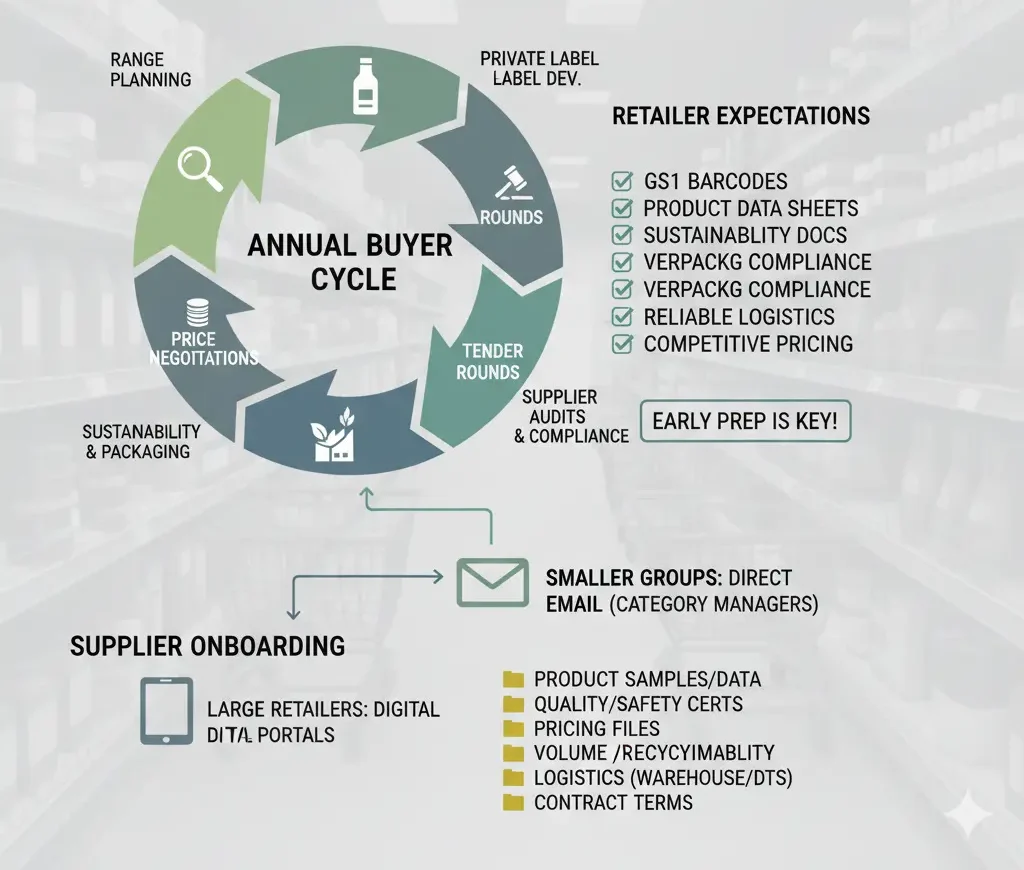
Buyers in Germany follow a predictable annual cycle:
Range planning
Private label development
Tender rounds
Price negotiations
Promotional planning
Sustainability and packaging checks
Supplier audits and compliance
Most grocery retailers in Germany expect:
GS1 barcodes
Detailed product data sheets
Sustainability documentation
Packaging compliance (VerpackG)
Reliable logistics partners
Competitive pricing
This makes early preparation essential for anyone searching for supermarket buyer contacts Germany.
Supplier onboarding
Onboarding processes vary by retailer, but typically include:
Product samples and data sheets
Quality and safety certifications
Pricing files
Volume commitments
Packaging details and recyclability compliance
Logistics arrangements – warehouse or direct-to-store
Contract terms
Large retailers use digital supplier portals.
Smaller regional groups may request direct email contact with category managers.
For deeper background on the supplier landscape, see Supermarket Suppliers Germany, which explains the main producers and private-label manufacturers across the country.
Steps To Approach German Retail Buyers
Germany’s retail sector does not respond well to cold emails.
Buyers receive hundreds of supplier messages every week.
To break through, suppliers must follow a structured process.
1. Understand the retailer’s format
Every chain has a different price position and assortment strategy.
Suppliers should study:
Discounters (Aldi, Lidl, Netto Marken-Discount)
Full-range supermarkets (EDEKA, REWE)
Hypermarkets (Kaufland, Globus)
Each format works with different packaging, pack sizes, and price architecture.
Aldi and Lidl prefer compact ranges and private label.
EDEKA and REWE accept more branded products and regional suppliers.
2. Prepare a German-standard product file
Before contacting any buyer, prepare:
EAN barcode
Nutritional table in German
Ingredients in German
Transport packaging specs
Shelf life
Minimum order quantities
Suggested retail price range
Recommended placement (category flow)
Sustainability information (plastic, recyclability, energy use)
Buyers will not move forward without complete documentation.
3. Show logistics capability
Germany has strict delivery rules.
Retailers require dependable logistics partners capable of servicing national or regional warehouses.
Suppliers should clarify:
EU warehouse location
Delivery frequency
Pallet formats
Lead times
Transport certifications
If logistics are unclear, buyers will not open discussions.
4. Use the correct contact method
Most supermarket buyer contacts Germany are not publicly listed.
However, suppliers can reach buyers through:
Supplier onboarding portals
Central procurement email addresses
Regional offices (EDEKA and REWE cooperatives)
Introductions through trade fairs
Brokerage agents
Service providers who specialise in German retail entry
Direct cold messaging to named buyers is discouraged.
Success rates are higher through structured introductions.
5. Match your offer to market demand
German buyers focus on:
Strong margin
Proven sales performance
Clear differentiation
Private label capability
Sustainability benefit
Packaging reduction
Competitive shelf price
Suppliers should highlight only the points that matter.
Long presentations rarely work.
6. Follow up professionally
If a buyer asks for more data:
Respond fast
Keep everything short
Provide updated documents
Avoid over-selling
Once a buyer is interested, they will request samples and start internal checks.
7. Build long-term trust
German retail prefers long-term supply partners.
Buyers expect:
Transparent pricing
Consistent quality
Reliable delivery
Commitment to sustainability
Suppliers who perform well often expand into multiple categories or private label lines.
For direct communication support, you can direct readers to your /contact/ page.
Trade Fairs As Entry Points For Suppliers
Trade fairs are the easiest places to meet decision-makers in person.
Most supermarket buyer contacts Germany attend these events for discovery and sourcing.
Below are the top fairs where German retail buyers are consistently active.
ANUGA – Cologne
The world’s leading food and beverage fair.
Almost all German retailers visit ANUGA to find new suppliers, compare categories, and review private-label manufacturers.
Good for:
Branded suppliers
Private label factories
Exporters entering the German market
Packaging and logistics partners
PLMA – Amsterdam
Even though it takes place in the Netherlands, German buyers attend in high numbers.
PLMA is the main sourcing event for private label across Europe.
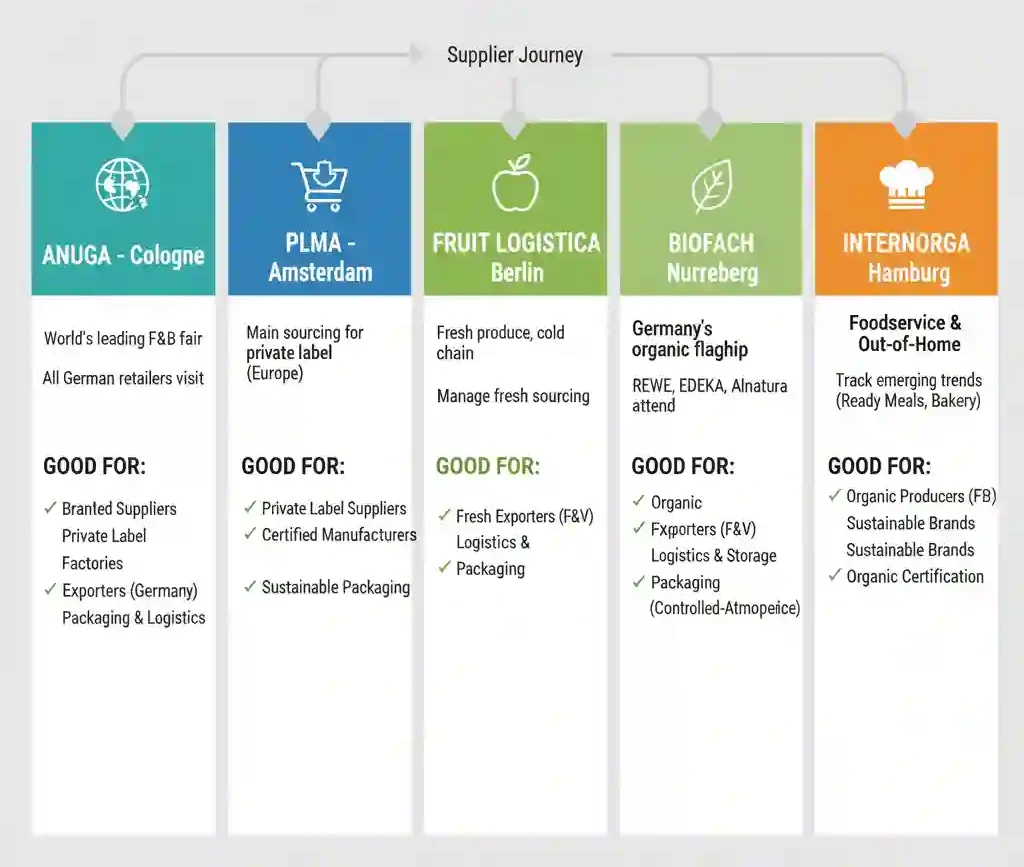
Good for:
Private label suppliers
Manufacturers with strong certifications
Sustainable packaging innovations
Fruit Logistica – Berlin
Focused on fresh produce, cold chain, and global exporters.
German supermarket buyers attend to manage fresh-category sourcing.
Good for:
Fresh fruit and vegetable exporters
Logistics and storage providers
Controlled-atmosphere packaging suppliers
BioFach – Nuremberg
Germany’s flagship organic trade fair.
Buyers from REWE, EDEKA, Dennree, and Alnatura attend every year.
Good for:
Organic food and beverage producers
Sustainable brands
Organic certification specialists
Internorga – Hamburg
Focused on foodservice and out-of-home.
Retail buyers visit to track emerging trends, especially ready meals and bakery.
Why Trade Events Are Effective
German retail buyers prefer meeting suppliers face to face.
A short meeting at ANUGA or PLMA gives buyers a better sense of:
Your product quality
Your packaging
Your pricing
Your scale
Most early contracts in Germany start with conversations at trade fairs.
For more industry context, readers can visit Trade Events Germany, which provides full coverage of retail and packaging exhibitions.
How To Build A Strong First Impression
Suppliers looking for supermarket buyer contacts Germany should prepare the following before any fair or email:
Clear product samples
Simple price file
1–2 page company profile
Sustainability certifications
Packaging information
Short pitch (30 seconds)
German buyers value clarity, not long speeches.
If the offer is strong, they will follow up.
Working With Agents And Distributors
Some suppliers prefer to work through market-entry specialists.
These companies already know buyer structures and can help with:
Translating documents
Presenting products
Arranging meetings
Managing onboarding
Agents are common in:
Fresh produce
Ethnic foods
Beverages
Non-food household items
Frozen foods
When choosing an agent, suppliers should check:
Commission structure
Existing retail clients
Logistics capability
Category experience
Reference suppliers
Regional Buying Structures In Germany
EDEKA
A mix of regional cooperatives shapes the buying landscape:
Hamburg, Nord, Südwest, Hessenring, Rhein-Ruhr, and more.
Some products are bought centrally through EDEKA Zentrale.
Others are sourced by regional organisations.
REWE Group
A central buying team in Cologne runs most categories.
Some regional adjustments exist, but decision-making remains centralised.
Schwarz Group (Lidl, Kaufland)
Highly centralised procurement.
Suppliers usually deal with category managers at group level.
Aldi Nord & Aldi Süd
Both groups have their own buying offices.
They specialise in private label and seasonal tenders.
Globus
Combination of central procurement and local buying for store-specific assortments.
Understanding these structures helps suppliers target the right level for their product.
Final Guidance For Suppliers
Germany is a disciplined retail market.
Buyers expect professionalism, strong documentation, and competitive pricing.
Finding supermarket buyer contacts Germany becomes easier when suppliers:
Prepare full data
Show clear differentiation
Use the right trade fairs
Follow buying procedures
Build long-term credibility
For support connecting with retail teams, readers can reach out through your /contact/ page.