
Inflation across Europe eased again in October, slipping to 2.1% in the euro area and 2.5% in the wider EU — its closest position to the ECB’s 2% target since summer. But for supermarket groups, manufacturers and buyers, the headline number hides a more complicated story.
Food remains one of the biggest contributors to inflation in Europe. And when you compare this with the UK’s latest figures — still sitting around 3.8% — it becomes clear that Europe and Britain are now travelling on two different inflation paths.
For grocery retail, this divergence matters. It shapes pricing, promotions, private label strategy, shopper confidence and how suppliers prepare for annual negotiations.
Why The EU headline Is Falling — But Supermarket Shelves Tell A Different Story
On paper, inflation in the euro area looks almost back to pre-crisis normality. Energy no longer drives the index, goods are stabilising, and services are now the largest contributor to headline CPI.
But food tells a different story:
- Food, alcohol and tobacco remain one of the strongest positive contributors to inflation.
- Fresh produce, dairy, oils and bakery categories continue to post higher-than-headline increases across many EU markets.
- Price sensitivity remains elevated, especially among lower-income households and younger families.
For retailers, this means:
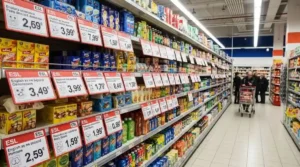
Headline inflation is falling, but the supermarket experience hasn’t cooled at the same pace.
As one retailer described it this week:
“Shoppers don’t buy CPI. They buy fruit, bread, cheese and meat — and those prices still feel elevated.”
EU vs UK: Two Inflation Stories Shaping Two Different Retail Environments
Euro area: 2.1% inflation — nearing stability
- Lower energy costs
- Moderating goods inflation
- Services rising gently
- Food still warm, but off its peak
Retailers in France, Italy, Portugal and Austria are beginning to shift from “cost pass-through” strategy to “margin rebuild” strategy.
United Kingdom: 3.8% inflation — still elevated
The UK continues to report higher inflation than much of Europe:
- Food inflation remains sticky, especially in fresh categories
- Services inflation is significantly higher than the EU average
- Housing-related costs keep overall CPIH elevated
- Labour, logistics and packaging costs still feed through the FMCG supply chain
- Retail promotions are aggressive, compressing margins further
This puts UK supermarkets under more pressure to defend value perception.
It also strengthens private label at the expense of national brands.
Western Europe vs Eastern Europe: The pricing divide inside the EU
Western Europe (France, Italy, Belgium, Portugal)
- Headline inflation close to 1–2%
- Political focus on food affordability remains high
- Retailers lean heavily on loyalty apps, digital coupons and private label architecture
- Little room left for major price increases
- National brands face tougher negotiations because “inflation justification” is no longer acceptable
Central & Eastern Europe (Romania, Estonia, Latvia, Hungary)
- Inflation still significantly above the EU average
- Small visible price cuts carry disproportionate impact on shopper perception
- Discounters and mid-tier private label continue to gain share
- Local suppliers outperform multinationals in several categories due to agility and cost structure
- Prominent use of price-freeze campaigns and “inflation-breaker baskets”
Why food inflation remains structurally higher than headline inflation
Even as overall inflation stabilises, food remains expensive because of:
- Commodity price swings (cocoa, sugar, feed, grains)
- Weather-driven impacts on produce yields
- High labour costs in agriculture, logistics and processing
- Higher packaging costs linked to environmental regulation
- Transport and border delays affecting cross-EU supply chains
- Ongoing volatility in dairy and poultry supply
- Increased supplier financing costs post-2023 interest rate rises
Food categories behave differently:
Fresh
Most volatile. Weather, disease and feed costs push prices up quickly.
Ambient
Cooling, but still above the long-term trend.
Frozen
More stable, increasingly used by shoppers to manage budgets.
Bakery & dairy
Remain sensitive to grain and livestock costs.
Household & cleaning
Still priced higher than pre-2022, partly due to packaging and chemicals costs.
Supermarket Strategy Shifts: The Post-Inflation Playbook
Grocery retail is now transitioning from the high-inflation phase to a “margin rebuild with caution” phase. That means:
1. Private label remains the strongest lever
- Value tiers anchor price perception
- Premium tiers rebuild margin quietly
- Retailers expand “only here” ranges to escape direct brand comparison
- Shoppers retain private label loyalty even as inflation cools
2. More surgical promotions
- Less blanket discounting
- More personalised offers via apps
- Multi-buy strategy shifting toward higher-margin categories
- Retailers increasingly analyse promotion ROI before committing spend
3. Harder supplier negotiations
Retailers now ask:
“If inflation is down, why are your prices not following?”
Manufacturers face pressure to prove:
- cost-input justification
- brand value justification
- promotional effectiveness
- ability to support category growth
Private label volume shifts remain a negotiation tool — visibly so in dairy, bakery, chilled ready meals and household categories.
4. Discounters continue to shape market pricing
Especially in Germany, Poland, Romania, Portugal and Spain.
Their stable price architecture forces mainstream supermarkets to defend value messaging more aggressively.
Country Snapshots: How Key Markets Are Reacting
Germany
Price sensitivity remains high, and mainstream chains must compete harder against Aldi and Lidl’s permanent low-price messaging.
France
With inflation near zero, negotiations will remain tense. Expect pressure on suppliers and a focus on everyday affordability.
Spain & Portugal
Food inflation still slightly warmer than the headline rate. Private label remains extremely strong, and household budgets remain tight.
CEE markets
Retailers leverage high inflation to launch aggressive value campaigns. Even tiny price reductions create strong shopper reactions.
What Matters For Supermarkets Heading Into 2026
1. Food vs headline inflation gap
If food stays hotter than CPI, private label penetration rises further.
If the gap closes, brands regain some volume.
2. Real income recovery
Shoppers still buy cautiously. High-price categories (meat, indulgent bakery, premium dairy) will remain volume-sensitive.
3. Supply chain stress points
Packaging rules, energy fluctuations and cross-border constraints can reintroduce inflation quickly.
4. The UK lag factor
Higher UK inflation means British retailers face another year of intensified price competition — and more pressure on margin recovery than their EU counterparts.
5. Category restructuring
Retailers will rebalance ranges across value, core and premium tiers to match new shopper behaviour.
Bottom line
Europe is entering a “low headline, high food pressure” environment.
The UK is entering a “higher headline, higher food pressure” environment.
For supermarkets, this means:
- Private label will remain central to pricing architecture
- Promotions will become smarter, not deeper
- Supplier negotiations will tighten across all markets
- Shopper caution continues into 2026
- Margin rebuild will depend on mix, not price rises
- Retailers must tailor strategies country-by-country — inflation is no longer a single European story
Inflation may be stabilising. But for grocery retail, the real work begins now.
Editor’s Note: This analysis is based on the latest publicly available inflation data from Eurostat, ONS (UK), and national statistical agencies across the EU. All figures refer to October 2025 unless otherwise stated. Our interpretation reflects market conditions, retailer commentary and GTN’s independent assessment of trends shaping Europe’s grocery and FMCG sectors.