
FMCG growth in Switzerland remains steady but restrained as the market moves into 2025. Expansion is expected to stay in low single-digit territory, shaped more by pricing effects and premium mix than by strong volume growth. Inflation has eased compared with earlier peaks, but its impact on everyday spending behaviour is still visible across grocery categories.
The Switzerland FMCG market 2025 reflects a mature, high-income economy where shoppers are cautious but not defensive. Consumers continue to spend on food and household essentials, yet they scrutinise value more closely than before. Quality, origin and trust remain decisive, while impulse-led growth is limited. This creates a market that rewards consistency and clarity rather than rapid innovation cycles.
Unlike more price-sensitive European markets, Switzerland’s FMCG sector is defined by stability. Growth comes slowly, but margins are better protected, and category shifts tend to be structural rather than short-term.
Market maturity and spending behaviour
Switzerland’s FMCG market is highly developed, with limited population growth and well-established retail infrastructure. This maturity naturally caps volume expansion, making value growth the primary lever for both retailers and suppliers.
Households remain willing to pay more for products that clearly justify their price. This applies across food, beverages, and health-oriented categories. At the same time, shoppers have become more selective about everyday upgrades. Price increases that are not linked to visible improvements are increasingly challenged.
The result is a market shaped by cautious confidence. Swiss consumers are not trading down aggressively, but they are also less forgiving of vague premium claims. Transparency around ingredients, sourcing and quality plays a central role in purchase decisions.
Category performance across FMCG
Food and beverages
Food and beverage categories continue to anchor FMCG spending in Switzerland. Core staples remain stable, while premium segments within these categories perform more reliably than mass expansion lines.
Chocolate, coffee and dairy remain particularly resilient. These categories benefit from strong domestic traditions, trusted brands and a consumer base that values consistency. Within beverages, reduced-sugar and functional propositions are gaining shelf space, though growth remains gradual rather than disruptive.
Innovation tends to focus on refinement rather than reinvention. Reformulation, portion control and quality upgrades are more common than bold flavour experimentation.
Fresh and chilled products
Fresh food remains central to Swiss grocery baskets. Local sourcing, seasonal availability and organic credentials carry significant weight, especially in produce, meat and dairy.
However, fresh categories are not immune to price pressure. Rising production and logistics costs have constrained volume growth, particularly in premium fresh segments. Consumers still prioritise freshness and origin, but purchasing patterns show more planning and less spontaneous upgrading.
Retailers play a strong role here, using assortment structure and pricing architecture to balance affordability with quality perception.
Health, wellness and functional lines
Health-oriented FMCG categories continue to outperform the wider market. Protein snacks, fortified foods, supplements and “free-from” ranges benefit from long-standing Swiss interest in nutrition and wellbeing.
This growth is not trend-driven but embedded. Health and wellness products are treated as everyday purchases rather than lifestyle statements. Clean labels, ingredient clarity and credible benefits matter more than novelty.
Premiumisation is particularly visible here, with consumers showing a higher willingness to pay when health benefits are clear and trusted.
Convenience and ready-to-consume formats
Urban lifestyles support steady growth in convenience-focused categories. Ready meals, snackable formats and portion-controlled products continue to expand, though at a measured pace.
Convenience in Switzerland is closely linked to quality expectations. Products positioned as quick solutions still need to meet high standards for taste, freshness and sourcing. Packaging plays a visible role, signalling both practicality and product integrity.
Health and wellness as a structural driver
Health and wellness is not a temporary growth engine in Switzerland; it is a structural feature of the FMCG landscape. Consumers consistently favour products that align with long-term wellbeing, whether through nutritional benefits, cleaner ingredient lists or ethical sourcing.
Organic certification, animal welfare standards and responsible production practices remain influential. However, consumers are increasingly sceptical of vague claims. Brands that cannot clearly communicate value struggle to maintain momentum.
This environment favours suppliers with disciplined portfolios and a clear understanding of what Swiss consumers consider meaningful improvement.
Retail influence and category shaping
Switzerland’s FMCG market is strongly retailer-led. A small number of dominant supermarket groups shape category strategies, influence innovation pipelines and determine how quickly new products reach scale.
Retailers actively manage category balance, ensuring that private label, national brands and premium lines coexist without excessive duplication. Promotions are used selectively, reflecting the market’s resistance to deep discounting as a long-term strategy.
Private label plays a strategic role, particularly in reinforcing quality and trust rather than driving down prices. This mirrors wider private label trends in Europe, where retailer brands increasingly compete on product standards and credibility rather than simple cost advantage.
For suppliers, alignment with retailer priorities is essential. Shelf access depends less on novelty and more on how well products fit existing category logic.
Sustainability expectations across FMCG
Sustainability is no longer a differentiator in Switzerland; it is an expectation. Environmental responsibility, ethical sourcing and packaging efficiency are now baseline requirements across many FMCG categories.
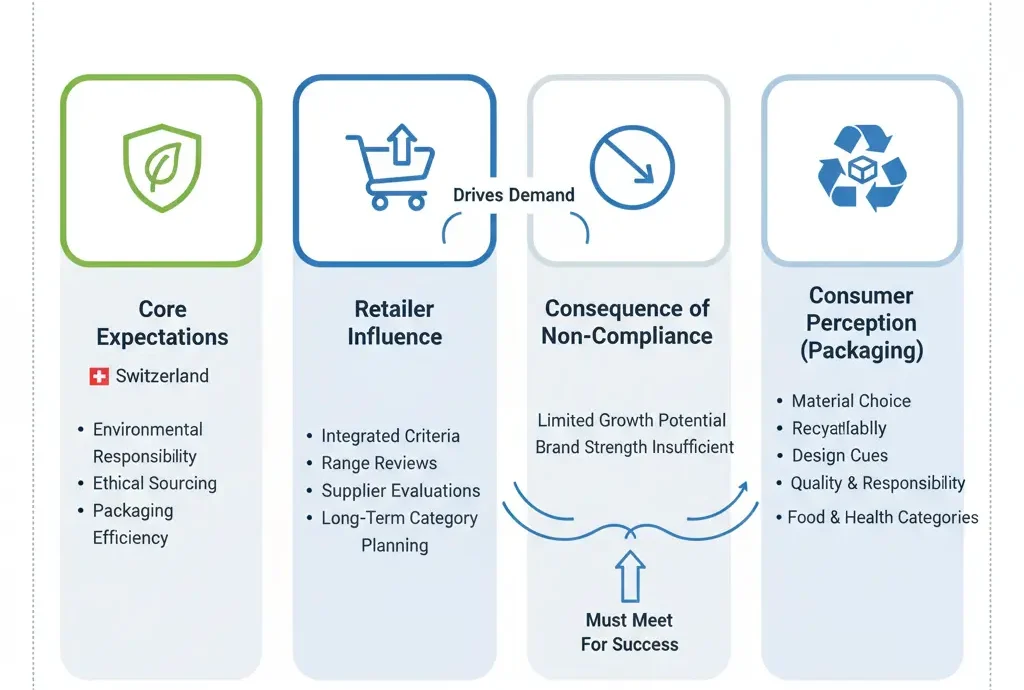
Retailers increasingly integrate sustainability criteria into range reviews and supplier evaluations, reflecting broader supermarket sustainability strategies that influence long-term category planning. Products that fail to meet these expectations face limited growth potential, regardless of brand strength.
Packaging choices are particularly visible to consumers. Materials, recyclability and design cues contribute directly to perceptions of quality and responsibility, especially in food and health-oriented categories.
A-brands and private label: coexistence rather than conflict
The relationship between A-brands and private label in Switzerland is characterised by balance rather than confrontation. A-brands retain strong positions through heritage, trust and consistent quality. Their strategies focus on incremental innovation and brand reinforcement rather than aggressive price competition.
Private label continues to grow steadily, particularly in premium and organic tiers. Retailer brands often mirror A-brand quality cues while offering clearer value propositions. This creates a competitive but stable environment where both sides protect margins.
Switzerland stands out as a market where extreme price wars are rare. The emphasis remains on long-term category health rather than short-term share grabs.
Categories showing relative growth in 2025
Several FMCG segments continue to show stronger momentum within the Swiss market:
Better-for-you snacks
Functional and low-sugar beverages
Organic dairy products
Premium private label food ranges
Convenience-ready meals
These categories benefit from alignment with health, quality and lifestyle expectations rather than promotional intensity.
What this means for FMCG suppliers
Switzerland rewards discipline. Suppliers that succeed tend to focus on clarity, consistency and long-term positioning. Rapid portfolio expansion or trend-driven launches rarely gain traction without retailer backing.
Product development needs to align closely with retailer strategies and consumer expectations. Packaging, sustainability credentials and ingredient transparency are as important as formulation itself.
For international suppliers, Switzerland functions as a defensive growth market. It may not deliver rapid expansion, but it offers stability, credibility and margin protection when approached with the right strategy.
Outlook
The Switzerland FMCG market 2025 will continue to evolve slowly, shaped by premiumisation, health awareness and retailer control rather than dramatic shifts in consumer behaviour. Growth will remain modest, but predictable.
For brands and retailers alike, success depends on understanding that Switzerland values trust over speed, quality over novelty and consistency over disruption. Those who adapt to this reality are best positioned to build durable growth in one of Europe’s most stable FMCG markets.