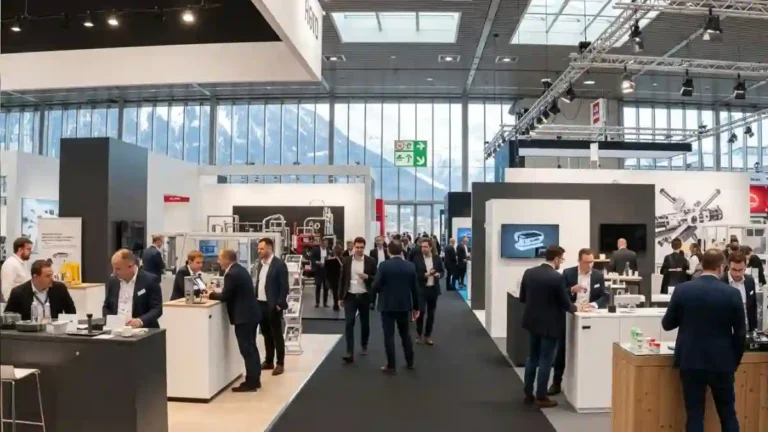

Switzerland plays a quiet but influential role in Europe’s food and retail trade calendar. Its exhibitions are smaller than those in Germany or France. Yet they consistently attract some of the region’s most selective buyers.
Switzerland sits at the crossroads of Central Europe. It has direct trade links with Germany, France, Italy, and Austria. This makes it a key meeting point for premium suppliers, specialist retailers, and brands focused on exports.
Its trade shows tend to be smaller, more focused, and far more deliberate than many high-volume European fairs. For supermarket and retail buyers, Swiss events provide access to suppliers that already operate at a high regulatory and quality standard.
Exhibitors and exporters can use these focused events to test their offers and build trust. They can also start discussions that lead to long-term retail relationships. This planner covers the most relevant food trade shows Switzerland 2025 buyers and exhibitors should consider. It explains when each event fits into sourcing plans. It also gives practical guidance on taking part effectively.
Why Switzerland Matters As A Trade Hub
Switzerland’s importance as a food and retail trade hub is shaped by a combination of geography, purchasing power, and regulatory discipline. Geographically, Switzerland is one of Europe’s most efficient meeting points.
Major retail and sourcing centres across Germany, northern Italy, eastern France, and Austria are reachable within a few hours. This attracts buyers who manage product ranges across borders. It also helps suppliers reach several European markets at one event.
Purchasing power is the second driver. Swiss consumers consistently rank among the highest food spenders in Europe on a per-capita basis.
Premium, organic, and value-added categories perform strongly, and this influences how retailers approach sourcing. Buyers attending Swiss fairs rarely seek the lowest price alone. They assess consistent quality, reliable supply, and long-term fit.
The third factor is standards. Swiss retail operates with strict expectations around traceability, sustainability, and compliance.
Packaging, labelling, and material choices face close checks. Many international suppliers therefore use Switzerland to test their approach. This applies particularly to Packaging in Switzerland and circular economy alignment.
Major Food And Retail Trade Shows In Switzerland (2025–2026)
Below is a verified overview of the core events shaping Switzerland’s domestic food and retail trade calendar. These shows are smaller than Europe’s largest fairs, but they attract a concentrated and decision-oriented audience.
| Event name | Location | Date | Audience focus | Best fit |
|---|---|---|---|---|
| IGEHO | Basel | Nov 15–19, 2025 | Hospitality, retail supply, foodservice | Buyers, exhibitors |
| Gastia | St. Gallen | Mar 23–25, 2025 | Regional food, hospitality | Exhibitors, local buyers |
| ORNARIS | Bern | Aug 17–19, 2025 | Retail goods, gifting, food | Buyers, distributors |
| Slow Food Market Zurich | Zurich | Nov (annual) | Premium, organic, artisanal food | Retail buyers, producers |
Together, these events cover hospitality-linked retail supply, regional sourcing, specialty food, and premium product discovery.
Key Swiss Trade Shows Buyers Should Prioritise
Swiss buyers attend trade shows with very specific objectives. Understanding those priorities is essential.
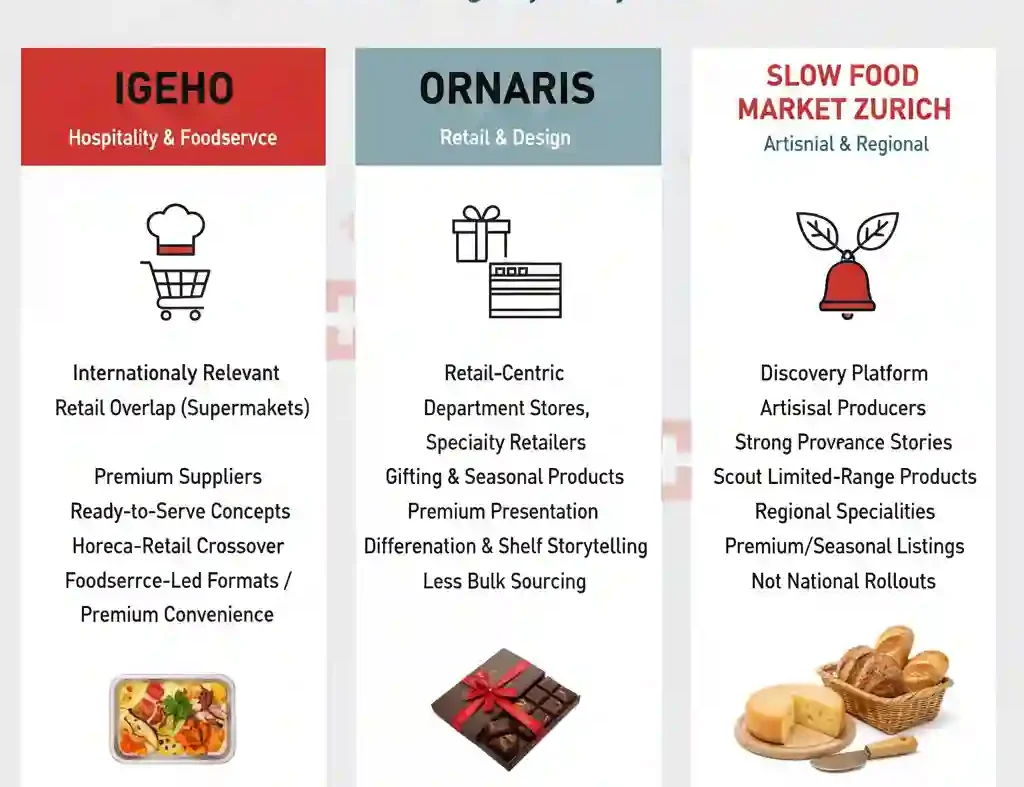
IGEHO remains the most internationally relevant event. Although it is positioned as a hospitality and foodservice exhibition, its retail overlap is significant.
Supermarket buyers attend to find premium suppliers and assess ready-to-serve concepts. They also explore products suited to both hospitality and retail. For buyers managing foodservice-led retail formats or premium convenience ranges, IGEHO is often the most productive Swiss event.
ORNARIS serves a different role. It is more retail-centric and attracts buyers from department stores, specialty retailers, and selected supermarket categories.
Food brands focused on gifting, seasonal products, and premium presentation tend to perform well here. ORNARIS is less about bulk sourcing and more about differentiation and shelf storytelling.
Slow Food Market Zurich is primarily a discovery platform. It attracts artisanal producers and premium food brands. Buyers use it to find smaller suppliers with clear stories about where their products come from.
Retail teams from the Swiss supermarket sector often attend to scout limited-range products, regional specialties, or concepts suitable for premium or seasonal listings rather than national rollouts.
Which Events Work Best For Exhibitors And Exporters
For exhibitors, Switzerland rewards preparation far more than scale or spectacle. International exporters tend to get the best results by using Swiss trade shows to build relationships. Focusing on immediate sales alone is less effective.
Buyers expect exhibitors to arrive with a clear understanding of their target segment, pricing structure, and distribution model. IGEHO works particularly well for suppliers with adaptable formats.
Products that can be positioned across hospitality and retail channels — such as prepared foods, beverages, and premium ingredients — attract broader interest. Buyers often use the event to explore whether a concept can migrate from foodservice into retail shelves.
Exporters in fresh, chilled, and produce-linked categories should be selective. In practice, most sourcing in the Switzerland fresh produce market takes place through direct supermarket programmes, cooperative supply agreements, and international platforms rather than domestic exhibitions.
Swiss fairs in this space are better suited to early discussions, brand positioning, and pilot conversations than immediate volume placement. Regional events such as Gastia can be valuable entry points.
They attract a more local buyer base, allow longer conversations, and often provide clearer feedback. For first-time exhibitors, these shows can be more productive than larger, busier formats.
Practical Tips For Exhibiting In Switzerland
Switzerland uses several languages and values structure and efficiency. Small details can make a big difference.
Stand communication
English is widely used. German dominates in Zurich and Basel, French in western regions, and Italian in Ticino. Even partial translation of materials signals professionalism and cultural awareness.
Product presentation
Simple presentation consistently works better than crowded displays. Swiss buyers value clarity.
Clean layouts, clear claims, and precise specifications are more effective than bold marketing language.
Regulatory readiness
Buyers expect answers on ingredients, sourcing, recyclability, and compliance. Explain how your product meets Swiss and EU requirements. This is often more important than offering very low prices.
Meeting culture
Appointments matter. Walk-up conversations happen, but meaningful discussions usually come from pre-arranged meetings.
Follow-ups are expected to be concise, factual, and prompt.
Related European Trade Fairs Swiss Businesses Also Attend
Swiss buyers and suppliers rarely rely solely on domestic trade shows. Many extend their sourcing and benchmarking across Europe.
ANUGA and Biofach in Germany remain key reference points for organic, private label, and international sourcing. SIAL in Paris attracts Swiss retailers looking to benchmark innovation and global brand activity.
Packaging-focused suppliers often combine Swiss events with German and Italian fairs to compare materials, compliance approaches, and cost structures across markets. For exhibitors, aligning Swiss participation with these larger European shows improves efficiency and strengthens regional visibility.
Final Planning Notes
Switzerland’s trade shows may be smaller than Europe’s largest exhibitions, but their influence is significant. For buyers, they offer focus, access, and high-quality supplier interaction.
For exhibitors, success depends on preparation, cultural awareness, and credibility. Handled correctly, food trade shows Switzerland 2025 are less about scale — and more about trust, positioning, and long-term opportunity.