
Dutch supermarkets did not adopt retail technology early because it looked innovative.
They adopted it because the operating model demanded it.
High labour costs. Compact store formats. Dense urban catchments.
Together, these pressures pushed retailers in the Netherlands to automate faster than most European markets.
By late 2025, self-checkout is no longer a pilot. Electronic shelf labels are no longer optional.
Automation now underpins how Dutch supermarkets manage staffing, pricing, shrink, and queues.
Below are the Top 7 retail tech moves in Dutch supermarkets, based on real operational deployment — not trend lists.
Top 7 Retail Tech Moves In Dutch Supermarkets
1. Self-checkout becomes the default checkout model
The Netherlands crossed a structural threshold in 2025.
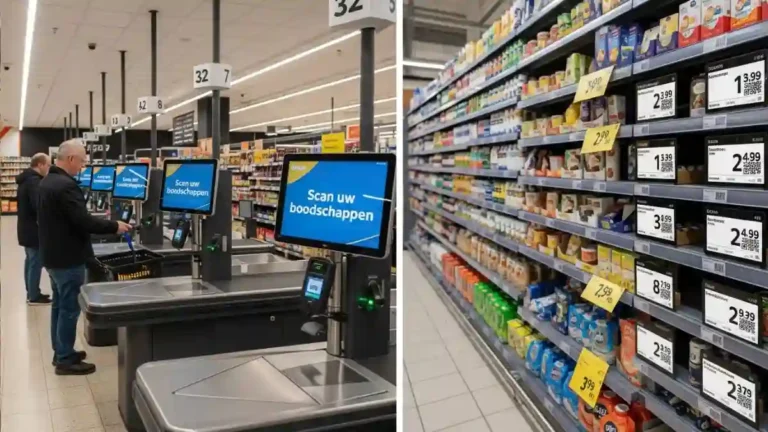
In most supermarkets, self-service checkouts now outnumber staffed lanes.
This shift is not about customer preference alone.
It is a direct response to labour availability and wage pressure.
One staff member can now oversee multiple checkout points.
Queue peaks are flattened without adding headcount.
Stores stay operational during short staffing windows.
This is why self-checkout coverage expanded so quickly across Dutch supermarket market leaders — it solves multiple problems at once.
2. Electronic shelf labels move from trials to infrastructure
Electronic shelf labels (ESL) are no longer treated as a technology project.
In the Netherlands, ESL is increasingly viewed as core store infrastructure, similar to POS or refrigeration systems.
Retailers are rolling out ESL chain-wide to:
Eliminate manual price changes
Reduce pricing errors
Improve promotion execution
Free up store labour for availability and service
What makes the Dutch case different is scale and intent.
ESL is not being installed for novelty — it is being installed to enable what comes next.
3. Automation offsets structural labour pressure
Labour costs in the Netherlands are among the highest in European grocery retail.
Store density leaves little room to “add people” as a solution.
Automation fills the gap.
Beyond self-checkout, Dutch supermarkets rely on:
Automated backroom processes
Smarter replenishment systems
Digitally controlled store tasks
This explains why automation adoption in the Netherlands moved faster than in larger-format markets.
It is not optional.
It is how stores remain viable.
4. Online fulfilment shifts toward automated picking
Dutch grocery e-commerce volumes demand efficiency.
Manual picking alone cannot deliver consistent service levels at scale, especially with tight labour supply.
As a result, supermarkets are investing in:
Automated fulfilment centres
Robot-assisted picking
Optimised order routing
These systems reduce picking time per order and stabilise delivery accuracy.
In a dense market like the Netherlands, where next-day or same-day delivery expectations are high, automation becomes a competitive necessity.
5. Shrink management drives front-end technology choices
Shrink is a persistent operational issue in Dutch supermarkets.
High traffic.
High self-service usage.
Small store footprints.
Retail tech decisions increasingly factor in shrink control, including:
Checkout flow design
Item recognition systems
Integration between POS, ESL, and inventory data
The goal is not surveillance.
The goal is to reduce friction while protecting margin.
This operational reality is often missed in competitor trend lists, but it strongly shapes how technology is deployed on the shop floor.
6. Replenishment and forecasting tools protect availability
Shelf availability is critical in high-frequency shopping markets like the Netherlands.
Retailers invest heavily in systems that:
Predict demand more accurately
Reduce emergency replenishment
Limit overstock and waste
These tools are especially important for fresh and private label ranges, where margins are tight and availability drives loyalty.
Here, technology quietly supports Dutch private label pricing architecture, ensuring entry-level, core, and premium tiers remain consistently available and correctly priced.
7. ESL unlocks the next phase: dynamic pricing
This is the most important forward-looking shift.
Once ESL is installed at scale, pricing becomes flexible by design.
Dutch supermarkets are now positioned to:
Adjust prices more frequently
Improve markdown timing on near-expiry products
Respond faster to cost changes
Fine-tune private label price ladders
This does not mean constant price volatility.
It means controlled, data-driven pricing execution.
ESL becomes the enabler that links store operations, compliance messaging, and margin management — including alignment with Netherlands packaging compliance requirements at shelf level.
Why The Netherlands Moved Faster Than Other Markets
Competitor articles often list the technologies.
They rarely explain why the Netherlands adopted them earlier.
The reasons are structural:
High labour costs make automation economically rational
Compact store formats limit staffing flexibility
Dense urban traffic magnifies queue pressure
High private label penetration increases pricing sensitivity
Retail technology in Dutch supermarkets is not experimental.
It is a response to a tightly constrained operating environment.
What Happens Next
The next phase of retail technology in the Netherlands will be quieter, but more powerful.
Dutch supermarkets are not looking for another device to add to the store.
They are focused on making the systems they already have work together as one operating model.
Electronic shelf labels, self-checkout, replenishment software, inventory data, and pricing logic are increasingly being connected into a single decision loop. When one signal changes, the rest of the system responds automatically.
This is where the real gains sit.
For example, when stock levels fall faster than expected, replenishment systems can flag the issue earlier, while ESL supports faster price adjustments or targeted markdowns. When demand spikes unexpectedly, pricing logic can react without waiting for manual updates. When shrink risk rises in certain categories, checkout flow and shelf presentation can be adjusted with minimal friction.
In practice, this integration reduces the need for reactive store labour.
Staff spend less time correcting prices, chasing stock, or managing queues.
More time is spent on availability, fresh handling, and customer-facing tasks.
Another key area is pricing architecture. As private label continues to anchor Dutch supermarket margins, retailers need tighter control over price ladders. Integrated systems allow entry-level, core, and premium tiers to be adjusted with precision — without breaking consumer trust or compliance requirements.
ESL also plays a growing role in regulatory communication. As packaging rules, deposit systems, and recycling obligations evolve, shelf-level information must stay accurate. Integration ensures compliance updates can be executed at scale, without store-by-store intervention.
The Netherlands is well positioned for this shift because the hard work is already done.
The hardware is installed.
The data flows exist.
What comes next is optimisation — turning connected technology into a calmer, more resilient supermarket operation.
Editor’s note: This article focuses on supermarket operations and retail execution in the Netherlands. It reflects deployment patterns visible across major Dutch grocery chains as of December 2025.