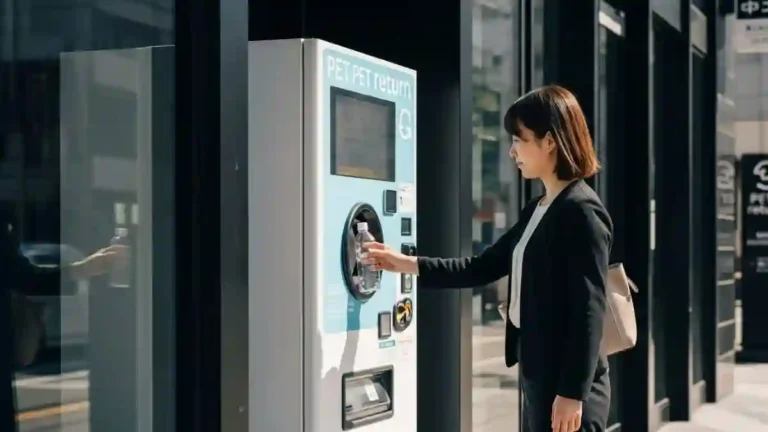

Japan has expanded bottle-to-bottle PET recycling through a new programme covering 134 bank branches across the Kanto region, linking office waste collection directly back into beverage packaging production.
The initiative is being rolled out by MUFG Bank in partnership with Kirin Beverage, with operations starting from June.
The focus is on improving the quality of used PET bottles collected at business sites, where contamination has long been a barrier to efficient food-grade recycling. Bottles collected from offices often contain liquid residue or foreign materials, making them harder to process into new containers.
Under the new system, MUFG branches apply stricter separation rules. Bottles must be fully emptied, with caps and labels removed before collection. The aim is to reduce contamination at source rather than relying on downstream sorting.
Used bottles collected from 58 branches outside central Tokyo are sent to a dedicated processing line designed for low-contamination PET. Compared with conventional mixed-input lines, the process requires less energy and improves material yield, while also reducing CO₂ emissions during recycling.
The recycled PET resin produced through the programme is then supplied back into beverage manufacturing, including use in new drink bottles produced by Kirin and other beverage companies. This closes the loop between collection and production without relying on virgin plastic.
From a systems perspective, the project highlights how Japan packaging models are increasingly extending beyond households, using large office networks as controlled collection points where sorting behaviour and logistics can be standardised.
For manufacturers operating across Japan FMCG, access to cleaner recycled PET supports long-term packaging targets while reducing exposure to fluctuations in virgin resin supply.
MUFG has indicated it will continue reviewing collection methods and transport routes to further reduce environmental impact. The bank is also exploring additional uses for materials such as labels that are not yet fully recycled.
Kirin Beverage plans to promote the model to other corporate partners, with the aim of expanding bottle-to-bottle recycling across a wider range of business sites.
The programme reflects a broader shift in Japan’s recycling strategy, where commercial locations are being integrated more directly into circular packaging systems, rather than relying solely on household collection streams.