
For much of the past few years, fresh produce supply has felt persistently unstable. Prices moved quickly, seasonal gaps appeared without warning, and retailers were often forced to adjust plans mid-season as weather, logistics, or labour issues disrupted supply.
More recently, that sense of constant disruption has eased. Shelves are generally fuller, ranges look more consistent, and seasonal transitions are happening with fewer visible shocks. For shoppers, the experience feels calmer. For retailers, the system appears to be working again.
Yet the underlying unease has not disappeared.
Buyers, suppliers, and consumers are now asking a more nuanced question: if fresh produce supply has stabilised, why does risk still feel so close to the surface?
This article addresses that question directly. It explains what stabilisation actually means in the context of fresh produce, what has genuinely improved across supply chains, where structural risks still sit, and how retailers are quietly managing a system that is more resilient than it was — but still far from secure.
Most readers landing on this topic are not looking for drama.
They already lived through:
Pandemic disruption
Weather-driven shortages
Logistics breakdowns
Sudden price inflation
What they want now is clarity.
Specifically:
Has the system really recovered?
Is volatility behind us?
Or are we just between shocks?
Understanding the current state of fresh produce supply requires separating two ideas that are often blurred together: availability and resilience.
Shelves can look full while the system behind them remains under pressure. Short-term performance does not automatically indicate long-term security, particularly in a category as exposed to weather, logistics, and cross-border trade as fresh produce.
Much of the existing coverage focuses on visible outcomes — shortages, price changes, or weather events — without examining how the system behaves when conditions deteriorate. That distinction matters. Stability today is less about the absence of disruption and more about how effectively disruption is absorbed when it occurs.
The current landscape: what dominates search today
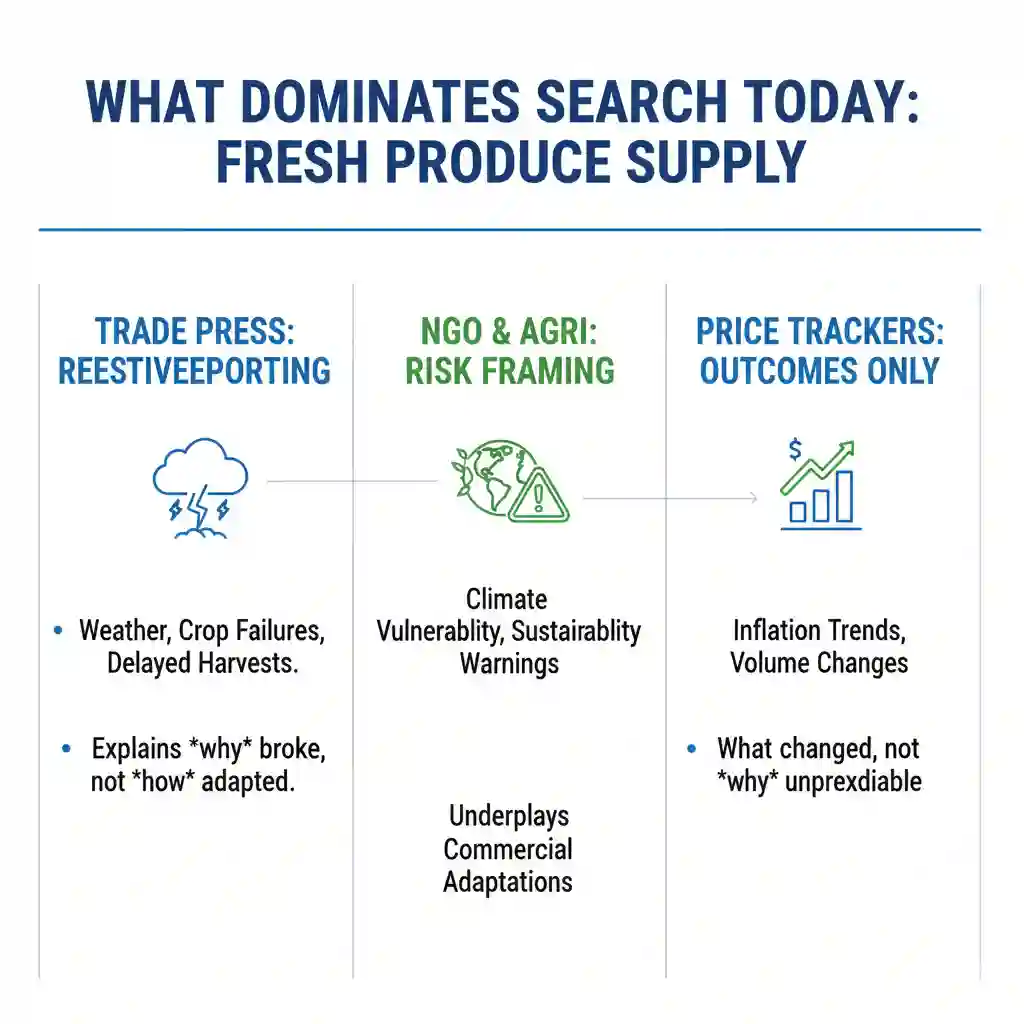
Trade press: reactive by design
Trade publications still dominate search rankings for fresh produce supply topics.
Their focus is typically:
Weather events
Crop failures
Delayed harvests
Extreme conditions
These reports are useful, but reactive.
They explain why something broke, not how the system now absorbs similar stress without breaking.
NGO and agricultural commentary: risk-heavy framing
NGO and agri-sector blogs often frame produce supply through:
Climate vulnerability
Environmental pressure
Long-term sustainability warnings
Much of this analysis is valid.
But it often:
Underplays commercial adaptation
Ignores retail operational changes
Treats fragility as static rather than managed
Price trackers: outcomes without context
Price indices and dashboards show:
Inflation trends
Category movements
Volume changes
They answer what changed, but not why pricing still behaves unpredictably even when supply improves.
What competitors consistently miss
Across almost all existing coverage, the same blind spots appear.
Short-term stability is mistaken for long-term security
A good season is treated as recovery.
A smooth quarter is treated as proof of resilience.
In reality, these are performance windows, not guarantees.
The retail buyer perspective is missing
Most articles speak about retailers, not from their operating reality.
They rarely explain:
How sourcing strategies have changed
How contracts are now structured
How risk is redistributed, not removed
Adaptation is mentioned, not explained
Readers are told that the system has “adapted”.
Very few articles explain how.
That explanation is the missing piece — and the most valuable one.
Clear opening answer: what is actually happening now
Fresh produce supply has stabilised operationally, not structurally.
That single sentence explains the entire situation.
Products are available more consistently.
Disruptions recover faster.
Retail systems are less brittle.
But:
Exposure remains.
Volatility has shifted upstream.
Risk is managed daily, not eliminated.
What “stabilisation” really means in fresh produce
Stabilisation does not mean predictability.
It means the system can function under pressure.
In practical terms, stabilisation shows up as:
Fewer empty shelves during disruptions
Shorter recovery periods after shocks
More substitution across origins and varieties
Better communication across supply chains
The system still bends.
It just breaks less often.
What has stabilised — and why
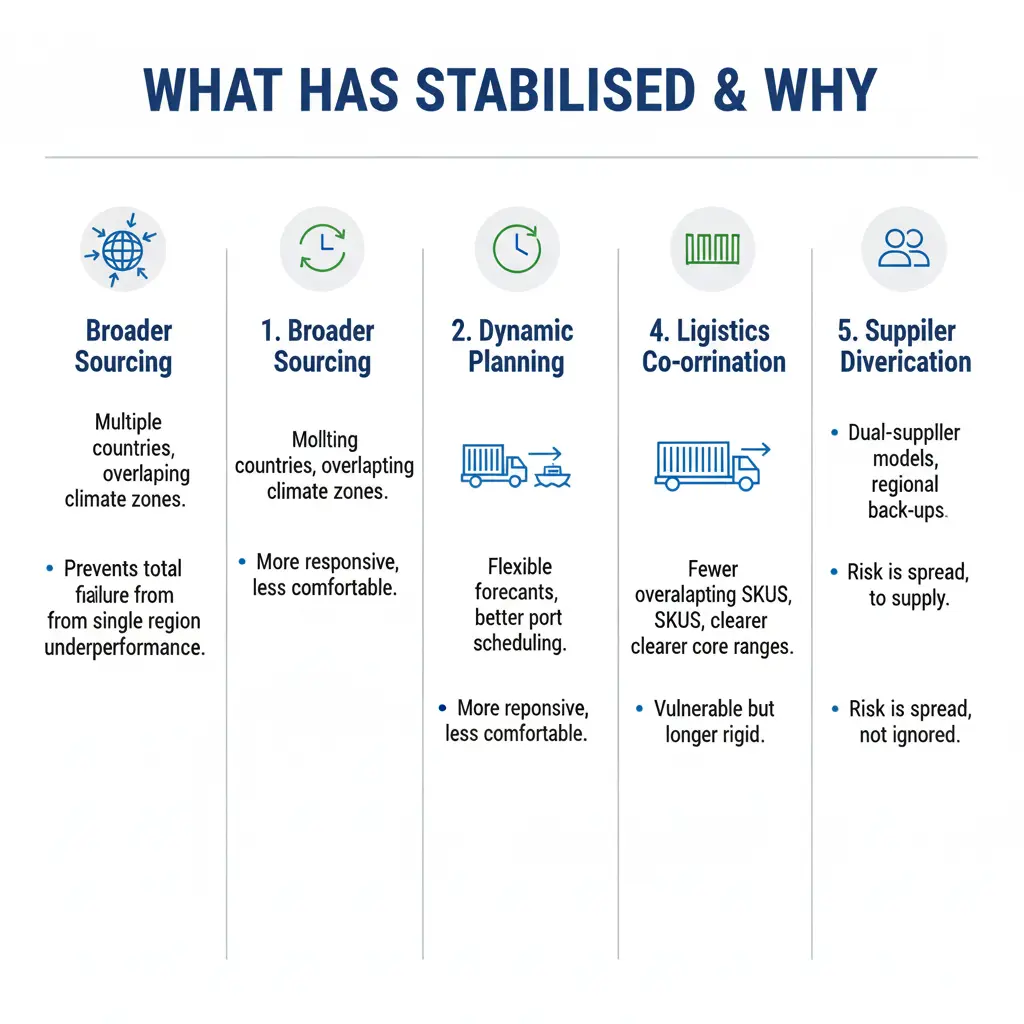
Several structural adjustments have improved day-to-day reliability.
Broader sourcing footprints
Retailers increasingly avoid reliance on a single origin per season.
Instead, the same product may now be sourced from:
Multiple countries
Overlapping climate zones
Parallel growing regions
This does not remove risk — but it prevents total failure when one region underperforms.
More dynamic planning cycles
Annual forecasts are no longer trusted on their own.
Buyers now work with:
Rolling forecasts
Shorter review intervals
Faster reallocation decisions
This makes planning more responsive, even if less comfortable.
Improved logistics coordination
After years of disruption, logistics networks have adjusted.
Key improvements include:
More flexible routing options
Better port scheduling
Stronger contingency planning
Shipping is still vulnerable — but no longer rigid.
Tighter range discipline
Retailers have quietly reduced complexity.
This includes:
Fewer overlapping SKUs
Clearer core ranges
Less duplication across varieties
Simpler ranges are easier to supply under stress.
Supplier diversification
Retailers increasingly avoid single-supplier dependence.
Common strategies now include:
Dual-supplier models
Regional back-up growers
Blended sourcing contracts
Risk is spread, not ignored.
What has not stabilised — and likely won’t
Despite operational improvements, several risks remain unresolved.
Climate volatility
Weather risk is not declining.
It is becoming:
More uneven
More localised
Harder to predict
Forecasting accuracy matters less when variability increases.
Logistics fragility
Transport systems remain exposed to:
Fuel price swings
Labour shortages
Infrastructure bottlenecks
Geopolitical chokepoints
Flexibility helps — but fragility remains.
Geopolitical exposure
Fresh produce crosses borders constantly.
That exposes supply to:
Policy changes
Trade restrictions
Sanctions
Regional instability
These risks are outside retail control.
Input cost pressure
Even with good harvests, growers face:
Energy volatility
Fertiliser costs
Labour expenses
Water constraints
These costs feed directly into pricing.
Labour availability
Seasonal labour shortages persist in many producing regions.
This affects:
Harvest timing
Packhouse throughput
Quality consistency
Stability requires people — and that remains uncertain.
Why price volatility persists despite better supply
This is where many readers feel confused.
Availability no longer guarantees price stability.
Several structural reasons explain why.
1. Risk is now priced in
Buyers assume disruption is possible — even during calm periods.
That changes pricing behaviour.
2. Shorter contracts mean faster price movement
Less long-term fixing means:
More frequent renegotiation
Faster response to cost changes
Greater visible volatility
3. Higher cost baselines remain
Input inflation does not reset quickly.
Even stable supply carries higher embedded costs.
4. Promotions are used more cautiously
Retailers are less willing to:
Over-commit volume
Lock in aggressive pricing
Absorb margin shocks
5. Leaner ranges reduce internal competition
Fewer SKUs mean fewer internal price anchors.
Prices move more freely as a result.
How retailers are adapting — quietly
Most adaptation happens below the headline level.
No campaigns.
No announcements.
Just operational shifts.
Overlapping origin calendars
Supply is planned as layers, not handovers.
This allows:
Earlier switching
Partial substitution
Volume smoothing
Flexible specifications
In some categories, cosmetic standards are adjusted quietly.
This improves:
Yield usability
Waste reduction
Supply continuity
Shoppers rarely notice — which is intentional.
Smaller, smarter commitments
Retailers avoid locking in too early unless necessary.
Optionality is treated as a strategic asset.
Deeper supplier relationships
Fewer suppliers, closer collaboration.
Better data sharing.
Earlier warnings.
Faster adjustment.
Resilience over perfection
The goal is no longer flawless execution.
It is:
Acceptable continuity
Predictable substitution
Rapid recovery
Stability vs risk: a clear comparison
| Area | Improved | Still Exposed |
|---|---|---|
| Shelf availability | ✔ | |
| Origin diversity | ✔ | |
| Forecast agility | ✔ | |
| Climate volatility | ✔ | |
| Logistics shocks | ✔ | |
| Input cost pressure | ✔ | |
| Labour availability | ✔ | |
| Price predictability | ✔ |
What stabilisation does not mean
It does not mean:
The system is safe
Volatility is over
Risk can be ignored
It means:
The system is more adaptive
Retailers are better prepared
Shocks are managed, not eliminated
Closing reality check
Fresh produce supply has not returned to a calm, predictable past.
That past no longer exists.
Instead, the system now operates in a managed-risk environment:
More flexible
Less brittle
Still exposed
The real shift is not the disappearance of risk.
It is the industry’s growing ability to live with it — and keep shelves full while doing so.
That distinction matters more than any headline about stabilisation.