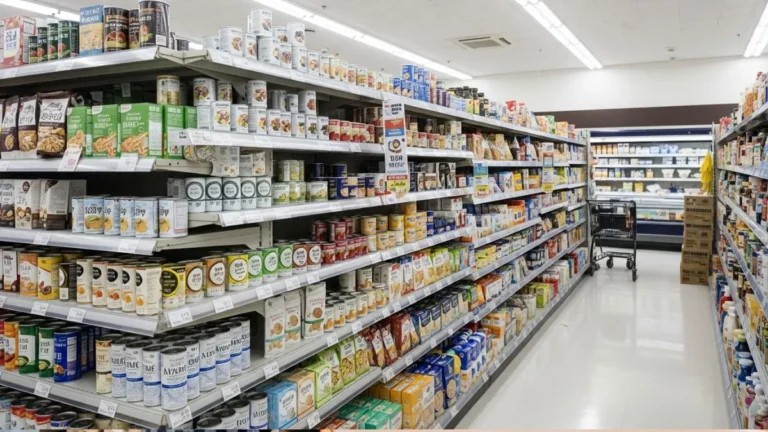

Private label in Asia is growing because retailers want control and stability, not because shoppers are trading down.
Across Asia, private label ranges are expanding. But the reason is often misunderstood.
This is not a repeat of what happened in Europe. It is not mainly about consumers abandoning brands. And it is not driven by price alone.
In many Asian markets, brands are still powerful. Brand loyalty remains strong. In some categories, brands continue to dominate shelf space and marketing spend.
So why is private label still growing?
Because retailers are responding to risk.
Supply risk. Cost volatility. Import dependence. Margin pressure that cannot be solved with promotions alone.
This article explains what is really happening — and why private label in Asia follows a very different set of rules.
Why private label is growing in Asia
Retailers want more control over supply
Import risk and cost swings increased
Strong regional OEM manufacturing supports store brands
Brands still lead many categories, so growth is selective
In Europe, private label grew because shoppers trusted retailers to deliver quality at a lower price. Over time, store brands became normal, even preferred.
Asia is different.
In most Asian markets:
Brands still carry strong trust
Price is not the only decision factor
Status and familiarity matter
Gifting culture influences buying behaviour
This means private label does not replace brands in the same way.
Instead, private label grows quietly. It fills gaps. It stabilises ranges. It gives retailers leverage.
A simple comparison helps explain this difference:
| Region | Main Driver Of Private Label |
|---|---|
| Europe | Value and shopper trust |
| United States | Margin and differentiation |
| Asia | Control and supply resilience |
Private label in Asia is less about winning hearts.
It is more about reducing exposure.
Why Retailers Are Pushing Private Label Now
The timing matters.
Private label existed in Asia before. But it was often limited, cautious, and focused on basics.
What changed is not consumer behaviour first.
What changed is the operating environment.
Retailers now face:
Higher freight costs
Currency volatility
Less predictable imports
Greater pressure on working capital
In this context, private label becomes a tool.
Across many Asia supermarket groups, store brands are used to:
Secure reliable volume
Reduce dependence on single suppliers
Protect margin without aggressive price cuts
This does not require large ranges.
It requires dependable ones.
Private label allows retailers to plan better — even if sales growth is modest.
How Supply Chain Risk Changed Retail Strategy
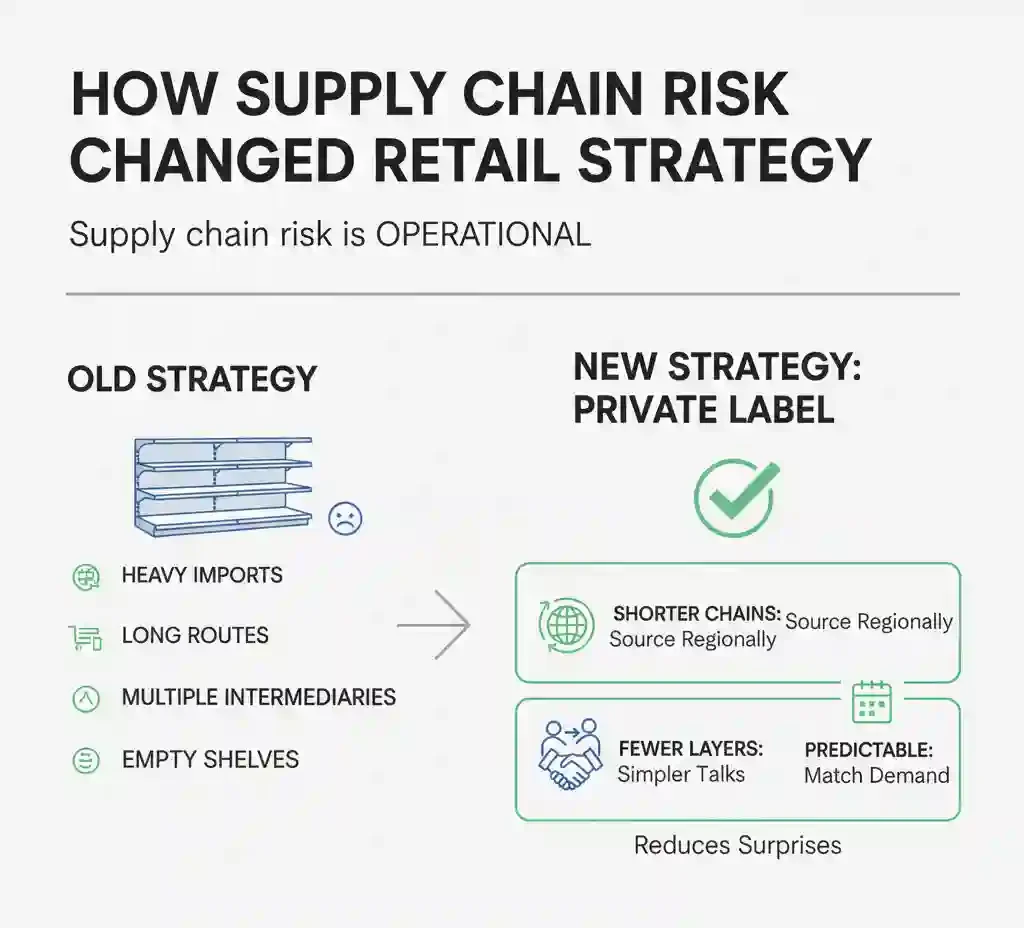
Supply chain risk is not theoretical. It is operational.
Retailers across Asia rely heavily on imports. Many categories depend on long shipping routes, multiple intermediaries, and foreign currencies.
When any of these fail, shelves suffer.
Private label helps in three practical ways:
Shorter supply chains
Retailers can source regionally instead of globally.Fewer decision layers
Negotiations are simpler when the retailer controls the product.More predictable availability
Production can be aligned with demand forecasts.
This does not eliminate risk.
But it reduces surprises.
For retailers, fewer surprises matter more than slightly higher margins.
Why OEM Manufacturing Matters More In Asia
One reason private label can grow at all in Asia is manufacturing structure.
Asia already produces a large share of the world’s FMCG products.
OEM and contract manufacturing are deeply established.
This means:
Factories already meet global quality standards
Production lines are flexible
Multi-client manufacturing is normal
Private label does not require building new capability.
It uses what already exists.
| OEM Factor | Why It Matters |
|---|---|
| Scale | Faster volume ramp-up |
| Experience | Consistent quality |
| Flexibility | Lower risk for retailers |
This is why private label in Asia often looks “quiet”.
There is no need for loud innovation.
Execution matters more.
Why Private Label Growth Looks Uneven Across Asia
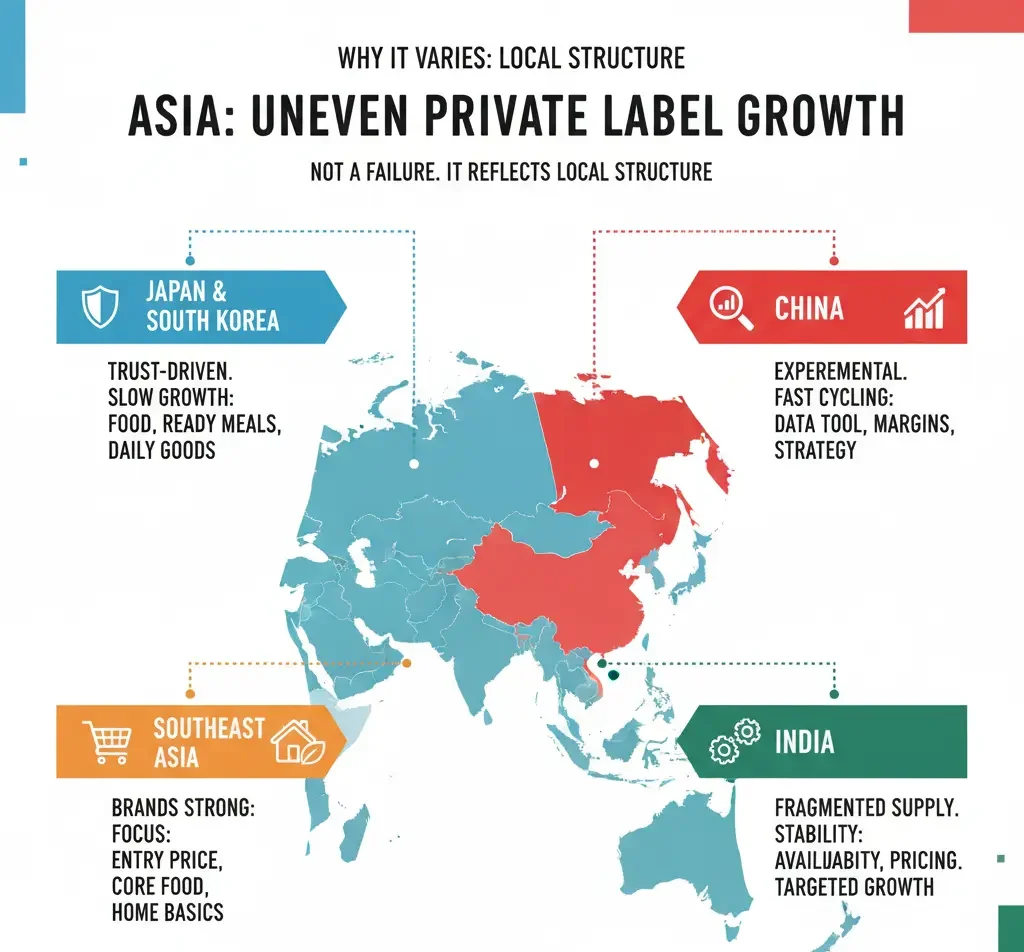
Private label growth is not uniform across the region.
That is not a failure.
It reflects local structure.
Japan And South Korea
These are trust-driven markets.
Shoppers expect high quality.
Retailers move carefully.
Private label grows slowly, often in:
Food staples
Ready meals
Daily-use categories
Ranges stay narrow. Quality control is strict.
China
Private label in China is more experimental.
Large retail platforms test products quickly.
Poor performers are removed fast.
Private label is used as:
A data tool
A margin buffer
A way to control category economics
It is not always visible — but it is strategic.
Southeast Asia
Brands remain very strong.
Private label focuses on:
Entry price points
Core food items
Household basics
Retailers avoid range expansion that could upset key suppliers.
India
India is different again.
Supply chains are fragmented.
Retailers use private label to stabilise availability and pricing, not to displace brands.
Growth is careful and targeted.
Why Private Label Ranges Stay Narrow In Asia
This is one of the most misunderstood points.
Many assume limited private label ranges mean limited ambition.
In reality, narrow ranges are intentional.
Asian retailers keep private label ranges small because:
Fewer SKUs reduce execution risk
Quality control is easier
Brand relationships stay balanced
Inventory exposure is lower
A small range that sells reliably is better than a wide range that underperforms.
In Asia, discipline beats scale.
Why Cheaper Pricing Is Not The Main Goal
Private label is often cheaper.
But cheaper is not the main objective.
In many Asian markets:
Price gaps between brands and private label are modest
Retailers avoid extreme undercutting
Private label sets a value reference, not a race to the bottom
| Role | Brands | Private Label |
|---|---|---|
| Innovation | Lead | Follow |
| Trust | Strong | Growing |
| Price reference | High | Stabilising |
Private label helps retailers anchor value without destroying category economics.
That balance matters.
How Packaging Strategy Reflects Lower Risk Appetite
Packaging tells a story.
Private label packaging in Asia is often conservative.
This is not a design weakness.
It is a risk decision.
Many retailers work closely with an Asia packaging company to:
Keep costs predictable
Ensure compliance across markets
Avoid overstated claims
Common features include:
Simple layouts
Clear labelling
Familiar formats
Packaging is designed to reassure, not excite.
That fits the strategy.
What This Means So Far
By this point, one thing should be clear:
Private label in Asia is not about replacing brands.
It is about building resilience.
Retailers are not chasing trends.
They are managing exposure.
Why Brands Still Control Most Shelf Space In Asia
Private label is growing.
But brands still dominate most Asian supermarket shelves.
This is not a contradiction.
In many Asian markets, brands represent:
Trust built over decades
Familiar taste and quality
Social status, especially in food and gifting
Heavy advertising support
Retailers understand this.
Private label is not used to challenge brands head-on.
It is used to support category stability.
Removing brands would increase risk.
Keeping brands while adding limited private label reduces it.
This balance explains why shelf space shifts slowly, not dramatically.
Why Private Label Growth Is Additive, Not Replacive
A key mistake in private label analysis is assuming replacement.
In Asia, growth is mostly additive.
Private label usually:
Fills entry price gaps
Covers basic daily needs
Supports private value tiers
Brands remain essential for:
Innovation
Premium segments
Emotional connection
This is why retailers protect brand relationships carefully.
Private label growth works best when it does not provoke conflict.
What Successful Private Label Actually Looks Like In Asia
This section matters for readers trying to apply lessons.
Successful private label in Asia is:
Narrow in range
Stable in supply
Quiet in marketing
Consistent in quality
Success is not measured by:
Fast SKU expansion
Loud launches
Frequent redesigns
It is measured by:
Reliable sell-through
Predictable margin
Low operational friction
Retailers value calm performance more than excitement.
Why Premium Private Label Moves Slowly In Asia
Premium private label exists.
But it grows slowly.
This is not because consumers reject quality.
It is because expectations are high.
In many Asian markets:
Premium equals brand reputation
Shoppers are cautious with unknown labels
Trust takes time to build
Retailers therefore move carefully.
Premium private label often appears first in:
Ready meals
Health-led categories
Limited seasonal offers
Even then, volumes remain controlled.
Why Data And Discipline Matter More Than Innovation
Innovation gets attention.
Discipline delivers results.
Asian retailers use private label to:
Test pricing tolerance
Understand demand elasticity
Manage category economics
Data shapes decisions.
Products that do not perform are removed quickly.
Successful lines are kept unchanged for long periods.
This reduces waste and execution risk.
How Retailers Manage Brand Relationships Carefully
Brand relationships remain critical.
Retailers avoid:
Aggressive copycat products
Direct brand displacement
Excessive price undercutting
Instead, private label is positioned:
Alongside brands
At clear value points
Without confusing shoppers
This approach keeps suppliers engaged and shelves balanced.
Why Private Label Will Not Follow A European Path
This is a key conclusion.
Asia will not repeat Europe’s private label journey.
The reasons are structural:
Different consumer expectations
Different retail concentration
Different brand power
Different supply chain dynamics
Private label will grow.
But it will stay selective.
Scale will come through consistency, not speed.
What Happens Next For Private Label In Asia
Looking forward, change will be gradual.
What is most likely:
Slow expansion into adjacent categories
Greater regional sourcing
Better packaging execution, not louder branding
More focus on reliability and margin protection
What is unlikely:
Rapid category takeover
Aggressive brand displacement
Large-scale premium rollouts
Retailers will choose safety over spectacle.
Final Conclusion: Rethinking The Narrative
Private label in Asia is growing.
That much is clear.
But the reason matters.
It is not mainly about price.
It is not driven by consumer rejection of brands.
It is driven by retailers responding to risk.
They want:
Control
Stability
Predictable performance
Private label is one of the few tools that delivers all three.
And that is why its role in Asia will keep expanding — quietly, carefully, and on its own terms.
That growth is supported by a wider trade-show ecosystem, including Anuga Select India 2026 and its 1,100-plus exhibitors, where private-label and food sourcing remain important themes.