
Packaging Companies in Europe operate across very different material systems. Each has its own cost pressures, regulatory exposure and supply risks.
This ranking breaks the market down by four materials:
- Paper
- Plastic
- Metal
- Glass
It shows which suppliers truly matter to retailers, private label programmes and fresh produce supply chains today.
Paper & Fibre Packaging
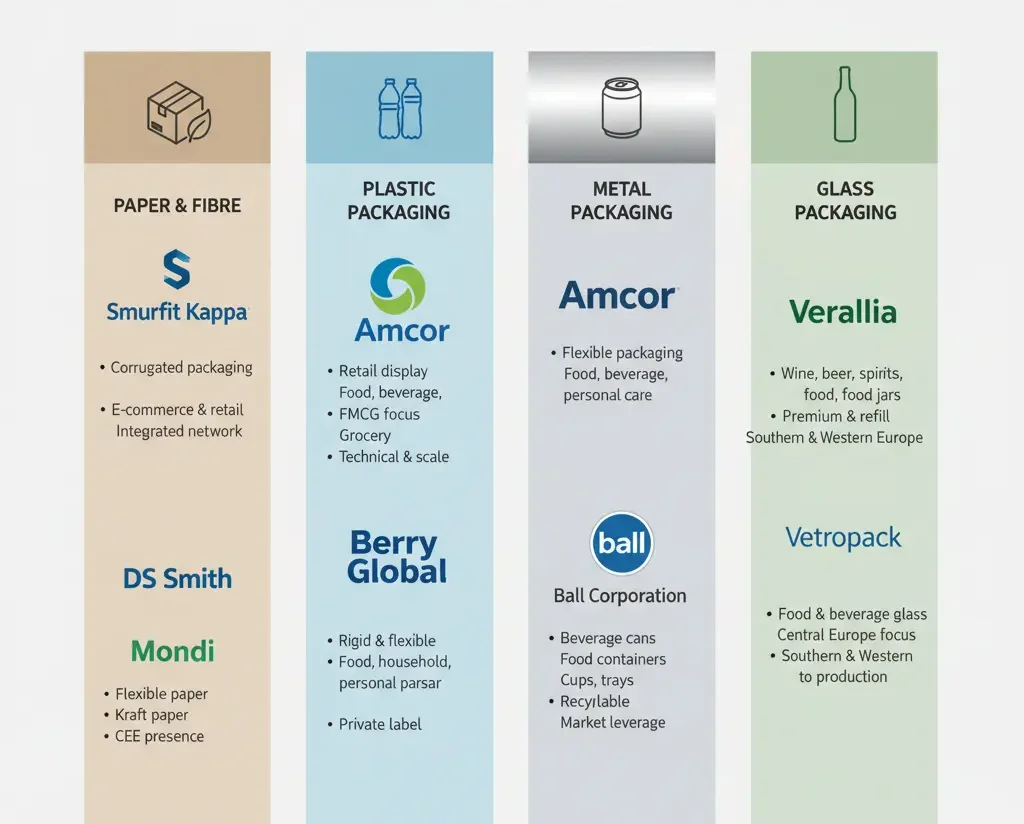
Smurfit Kappa
Smurfit Kappa is Europe’s largest corrugated packaging supplier. It has deep exposure to supermarket-ready packaging, e-commerce boxes and shelf-ready formats across Western and Central Europe.
The company’s scale and integrated paper network make it a critical partner for high-volume grocery and fresh food supply chains.
DS Smith
DS Smith is strong in retail display packaging and fast-moving consumer goods. The company is known for close operational partnerships with major European grocery retailers and private label suppliers.
This matters most where shelf execution and rapid redesign cycles count.
Mondi
Mondi is a major force in paper, flexible paper-based packaging and kraft paper. It has a strong footprint across Central and Eastern Europe.
Mondi plays an important role in balancing cost efficiency with regulatory compliance in fibre-based packaging.
Plastic Packaging
Amcor
Amcor is one of the most influential flexible packaging suppliers in Europe. It serves food, beverage and personal care brands with high-volume, high-complexity packaging.
Amcor’s strength lies in managing technical requirements while scaling compliant designs across multiple markets.
Berry Global
Berry Global is a key supplier of rigid and flexible plastic packaging. It serves food, household and personal care categories, with strong exposure to retailer own brands.
Berry’s breadth makes it especially relevant for private label programmes that need consistency across formats.
Huhtamaki
Huhtamaki is best known for foodservice and consumer packaging. Its products are widely used in European grocery and convenience retail:
- Cups
- Trays
- Flexible solutions
The company sits where on-the-go consumption and supermarket supply meet.
Metal Packaging
Ardagh Group
Ardagh Group is a major European supplier of beverage cans and food containers. It serves soft drinks, beer and canned food categories across multiple markets.
Ardagh’s strength lies in long-term customer contracts. Its capital-intensive production capacity is also difficult to replicate quickly.
Ball Corporation
Ball Corporation holds a strong position in aluminium beverage cans. It benefits from continued demand for recyclable packaging in European drinks retail.
Switching suppliers in this segment is complex. This gives established players significant structural leverage.
Glass Packaging
Verallia
Verallia is Europe’s leading glass packaging producer. It supplies wine, beer, spirits and food jars, with a strong presence in Southern and Western Europe.
Verallia is deeply embedded in premium and refill-ready packaging systems.
Vetropack
Vetropack is a key regional player focused on food and beverage glass packaging. It is particularly strong in Central Europe.
Its footprint is smaller than pan-European rivals. Even so, its closeness to food production hubs makes it strategically important.
Why This Ranking Matters
This segmented view reflects how packaging decisions are actually made in Europe.
Packaging is not bought as a single category. It is sourced by material, because each material behaves differently across cost, regulation, logistics and shelf performance.
Paper, plastic, metal and glass operate under separate supply chains. They face different regulatory pressures and carry very different risk profiles. Treating them as one market hides the real power dynamics.
For buyers, this distinction matters more now than at any point in the past decade.
Cost Pressure Is Material-Specific
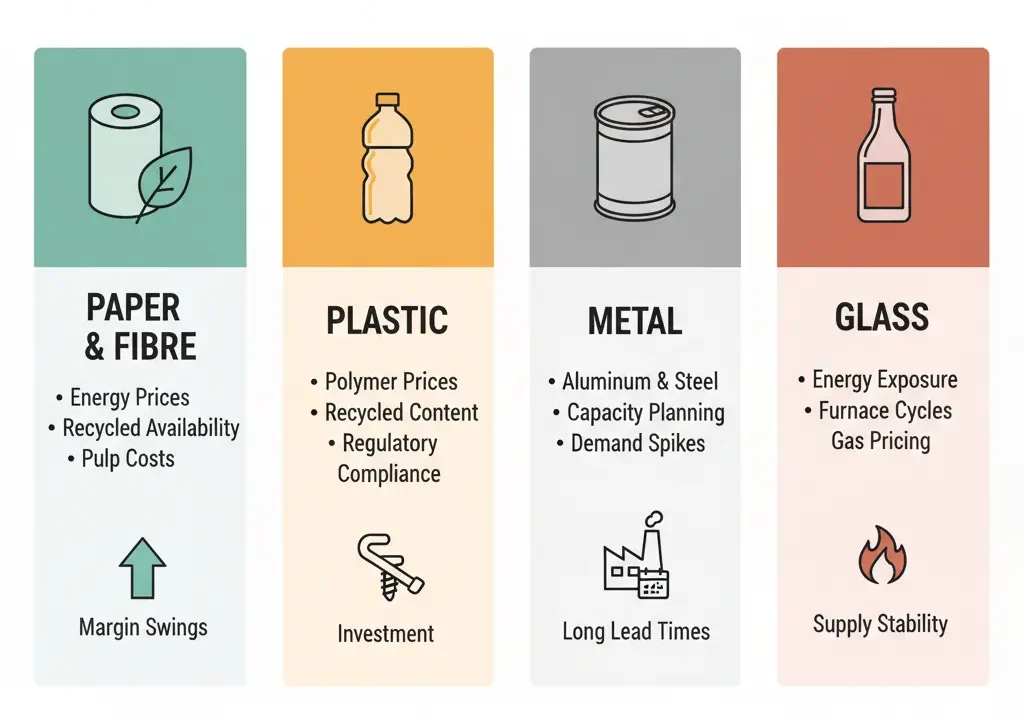
Each material faces its own cost drivers:
- Paper and fibre: highly exposed to energy pricing and recovered paper availability. Even small swings in pulp costs can move margins quickly for suppliers and buyers.
- Plastic: ongoing volatility linked to polymer pricing, recycled content availability and compliance investment, especially as regulatory requirements tighten.
- Metal: sensitive to aluminium and steel pricing and long-term capacity planning. Beverage can demand spikes cannot be solved quickly, because new capacity requires years of investment.
- Glass: some of the highest energy exposure in the sector. Furnace operation, rebuild cycles and gas pricing directly affect supply stability.
Because of this, procurement teams do not compare suppliers across materials. They compare within materials.
Regulation Is Not Uniform Across Materials
EU policy affects each segment differently.
Paper benefits from strong recycling infrastructure. However, it faces growing scrutiny on forestry, fibre sourcing and waste export rules.
Plastic packaging is under the heaviest regulatory pressure. Three factors are reshaping supplier economics:
- Recycled content mandates
- Design-for-recycling requirements
- Extended producer responsibility costs
Metal enjoys strong recyclability credentials but faces capacity constraints and high capital intensity. Glass aligns well with reuse and refill models, but energy intensity remains a structural challenge.
This is why supplier strength must be judged by segment, not by headline revenue.
Europe Private label
For Europe private label, packaging choice directly affects commercial performance.
Private label margins are tighter than branded goods. Packaging is one of the few areas where retailers can still influence cost without changing product quality.
Material decisions affect:
- Unit cost and price stability
- Compliance with retailer sustainability targets
- Shelf readiness
- Transport efficiency
- The speed at which packaging can be redesigned when regulations change
Retailers do not want the biggest packaging company. They want the right material leader, with scale, reliability and flexibility.
That is why paper and plastic specialists often matter more to private label programmes than diversified packaging groups.
Europe Fresh Produce
In Europe fresh produce, packaging plays a different but equally critical role.
Produce packaging must:
- Protect shelf life
- Allow visibility for quality assessment
- Meet recyclability or reuse targets
- Remain cost-effective under high volume
Fresh produce suppliers rely heavily on paper, fibre and flexible plastic, with limited tolerance for supply disruption.
Material choice directly affects food waste rates, transport efficiency, retail presentation and compliance with country-specific packaging rules.
As EU rules tighten and retailers push harder on sustainability, fresh produce packaging decisions are becoming more strategic, not less.
Structural Concentration Is Increasing.
Across all four materials, the number of suppliers able to serve large European volumes is shrinking. Investment requirements are rising, compliance costs are rising, and capacity expansion is slower.
This favours segment leaders rather than generalists. Understanding who controls each material category is essential for retailers, brands and suppliers planning for the next three to five years.
What Buyers And Suppliers Should Do With This Ranking
This ranking is not just descriptive. It is practical.
For fresh produce suppliers
For fresh produce suppliers, the most immediate action is risk management.
Relying on a single packaging supplier within one material category increases exposure to energy shocks, capacity constraints and regulatory delays.
A more resilient approach is to diversify across two material leaders. Ideally, these should have production footprints in different regions of Europe.
Suppliers should also align packaging partners with regulatory readiness, not just price. The EU’s Packaging and Packaging Waste Regulation (PPWR) will tighten requirements on recyclability, reuse and reporting.
Working with suppliers that already invest in compliant designs reduces the risk of rushed redesigns or product disruption.
For retailers and private label teams
For retailers and private label teams, the action is more strategic. Material leaders are not interchangeable.
Choosing the right supplier within each segment directly affects margin stability, redesign speed and long-term compliance.
Frequently Asked Questions
Who is Europe’s largest corrugated packaging supplier?
Smurfit Kappa is Europe’s largest corrugated packaging supplier. It has deep exposure to supermarket-ready, e-commerce and shelf-ready formats.
Which packaging material faces the most EU regulatory pressure?
Plastic packaging is under the heaviest regulatory pressure. Recycled content mandates, design-for-recycling rules and extended producer responsibility costs are reshaping supplier economics.
Why should buyers compare packaging suppliers by material?
Each material behaves differently across cost, regulation, logistics and shelf performance. So procurement teams compare suppliers within materials, not across them.
Why This Changes Procurement Thinking
This ranking shows that procurement strategy in Europe is becoming more material-specific, regulation-led and risk-aware.
Segment leadership decides who can absorb shocks, adapt quickly and support customers through regulatory change without disruption.
Buyers that understand this can:
- Plan sourcing more deliberately
- Avoid last-minute redesigns
- Protect margins in categories where packaging decisions increasingly shape commercial outcomes
Breaking Europe’s packaging market down by material is no longer optional. It is the difference between reacting to change and staying ahead of it.
Editor’s Note: This analysis is based on publicly available information and industry data. Companies are included based on material leadership, scale, and relevance to retail, private label, and fresh produce supply chains.