
Romania’s grocery market in 2026 is defined by four pressures:
- Consolidation.
- Tighter margins.
- Labour cost pressure.
- Rising digital compliance requirements.
Supermarket chains are reducing vendor fragmentation. They are moving toward integrated retail systems that connect checkout, inventory, pricing, logistics and financial reporting.
In this environment, a group of Romanian-founded technology firms plays a structural role. They support grocery operations across the country.
What Is Retail Technology In Romania?
Retail technology in Romania refers to locally developed systems used by supermarkets and FMCG distributors. They manage inventory, pricing, checkout, logistics and financial operations. The systems include:
- POS systems.
- ERP platforms.
- Warehouse management software.
- Retail analytics tools.
- eCommerce infrastructure.
- Store automation systems.
This ranking includes only Romanian-founded companies with operational relevance in grocery retail. Data is based on publicly available company disclosures and FY2024–FY2025 information where available.
Top 10 Retail Technology Companies in Romania (2026)
| Rank | Company | Founded | Core Retail Layer | Scale Indicator |
|---|---|---|---|---|
| 1 | TotalSoft | 1994 | ERP & Retail Core Systems | Regional enterprise software group |
| 2 | Senior Software | 2003 | ERP, WMS & BI | Retail & FMCG integrator |
| 3 | Magister Software | 2002 | POS & Store Management | Grocery-focused POS provider |
| 4 | Zitec | 2003 | eCommerce & Digital Retail Systems | Enterprise software developer |
| 5 | AROBS Transilvania Software | 1998 | Software & IoT Solutions | Publicly listed tech group |
| 6 | SoftOne Romania (local founding team) | 2007 | ERP for SMEs & Retail | Regional ERP presence |
| 7 | Smart ID Technology | 2010 | Warehouse & Mobility Systems | Retail logistics specialist |
| 8 | Freya POS Systems | 2000 | Retail POS Infrastructure | Domestic POS deployments |
| 9 | UCMS by AROBS | 1996 | Workforce & HR Systems | Labour cost management |
| 10 | Transart Business Software | 1997 | ERP & Distribution Software | FMCG distribution focus |
Revenue figures are disclosed within company profiles where publicly available.
Company Profiles
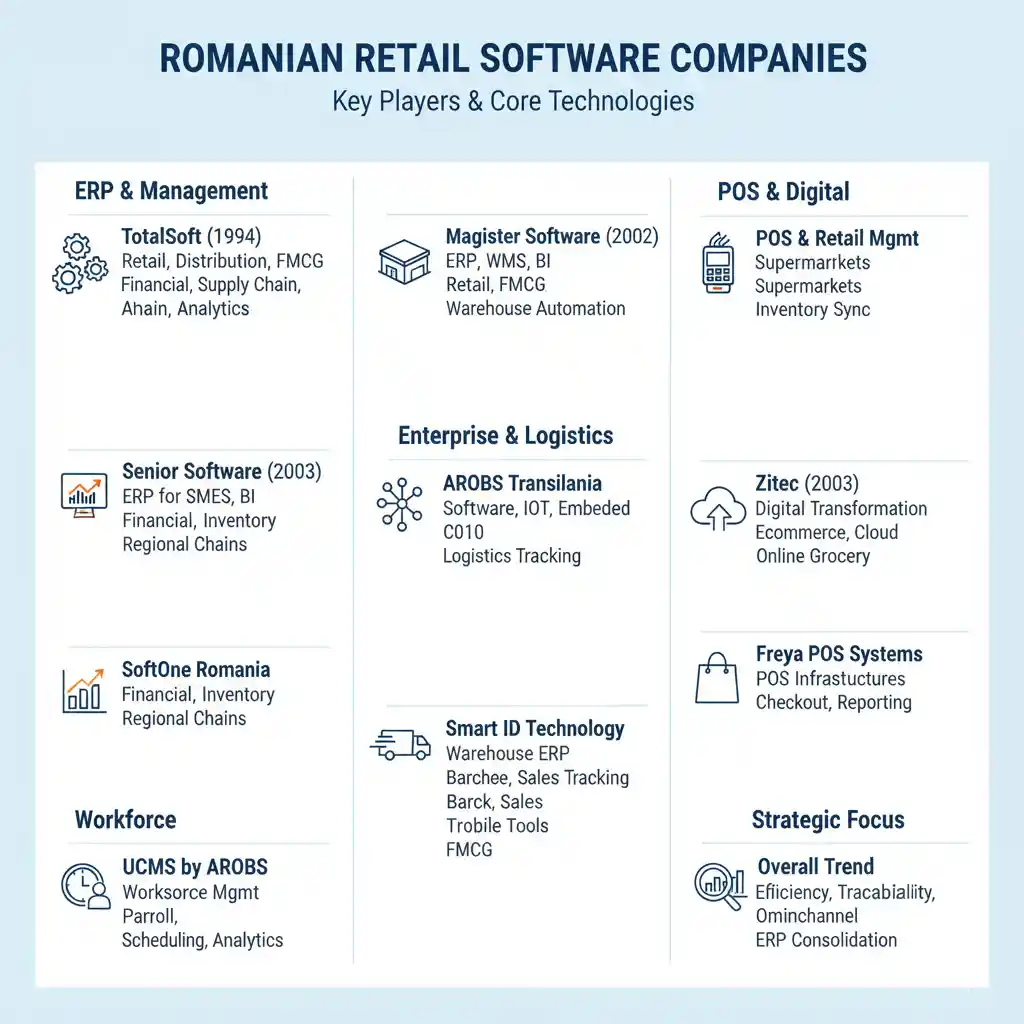
1. TotalSoft
TotalSoft was founded in 1994. It is one of Romania’s longest-standing enterprise software developers.
The company is headquartered in Bucharest. It developed the Charisma ERP platform, widely deployed across retail, distribution and FMCG sectors.
Core Retail Technology Areas:
- ERP systems
- Financial management
- Supply chain management
- Retail analytics
- Inventory control
TotalSoft operates at regional scale across Central and Eastern Europe. The Charisma Retail module integrates financial reporting with stock management and procurement workflows.
In grocery retail, ERP systems are the backbone. They connect store-level POS data with central financial and logistics reporting. TotalSoft’s infrastructure supports inventory valuation, pricing control and supply chain visibility.
Strategically, ERP consolidation reduces system fragmentation in supermarket networks.
2. Senior Software
Senior Software was founded in 2003. It focuses on ERP, business intelligence and warehouse management solutions. The company serves retail, distribution and FMCG clients across Romania.
Core Areas:
- ERP for retail
- WMS (Warehouse Management Systems)
- Business intelligence dashboards
- Supply chain optimisation
Senior Software’s WMS deployments are particularly relevant for grocery distribution hubs.
Margin pressure and compliance standards have made warehouse automation and stock traceability structural requirements. Senior Software supports distribution centres serving supermarkets and FMCG importers.
3. Magister Software
Magister Software was founded in 2002. It is a Romanian POS and retail management developer. It provides store-level systems tailored for supermarkets and convenience chains.
Core Areas:
- POS terminals
- Back-office retail software
- Inventory synchronisation
- Promotions management
Magister is strongly positioned in independent grocery chains and regional supermarket groups.
POS systems are the transactional core of retail. They influence shrinkage control, price accuracy and customer data capture.
4. Zitec
Zitec was founded in 2003. It is a Romanian software engineering company specialising in digital transformation and eCommerce infrastructure.
Core Areas:
- Online grocery platforms
- Systems integration
- Cloud migration
- Retail digitalisation
Romanian supermarkets increasingly add online ordering and fulfilment modules. Zitec supports digital commerce infrastructure. This enables omnichannel grocery retail.
5. AROBS Transilvania Software
AROBS was founded in 1998 in Cluj-Napoca. It is a publicly listed Romanian technology company.
Core Areas:
- Software development
- IoT solutions
- Embedded systems
- Business software
AROBS is broader than retail. It still contributes to logistics tracking and operational digitalisation relevant to FMCG distribution networks.
6. SoftOne Romania
SoftOne Romania was founded locally in 2007. It operates ERP platforms for SMEs and mid-sized retailers.
Core Areas:
- ERP
- Financial management
- Inventory modules
Retail SMEs rely on integrated accounting and stock systems. This is especially true in regional grocery chains.
7. Smart ID Technology
Smart ID was established in 2010. It focuses on warehouse mobility and automation solutions.
Core Areas:
- Barcode scanning systems
- Mobile workforce tools
- Warehouse automation
In grocery logistics, mobility and traceability directly influence spoilage reduction and stock accuracy.
8. Freya POS Systems
Freya develops domestic POS systems deployed in supermarkets and convenience formats.
Core Areas:
- Checkout terminals
- Store back office systems
- Retail reporting tools
POS infrastructure remains critical in price-sensitive grocery markets.
9. UCMS by AROBS
UCMS was founded in 1996. It provides workforce management software, now integrated within AROBS.
Core Areas:
- Payroll
- Workforce scheduling
- Labour analytics
Labour cost management is increasingly material for Romanian supermarket chains.
10. Transart Business Software
Transart was founded in 1997. It develops ERP and distribution software targeting wholesale and FMCG networks.
Core Areas:
- Distribution ERP
- Stock management
- Sales tracking
FMCG distributors serving supermarkets rely on such platforms to manage order flow and route logistics.
Market Structure Impact
Romania’s grocery retail ecosystem is increasingly centralised. Larger chains demand integrated reporting, stock transparency and compliance-ready systems.
This drives ERP consolidation and stronger reliance on structured retail software vendors.
Romanian-founded companies compete by offering local implementation teams, regulatory familiarity and flexible deployment models.
ERP And POS Consolidation Trend
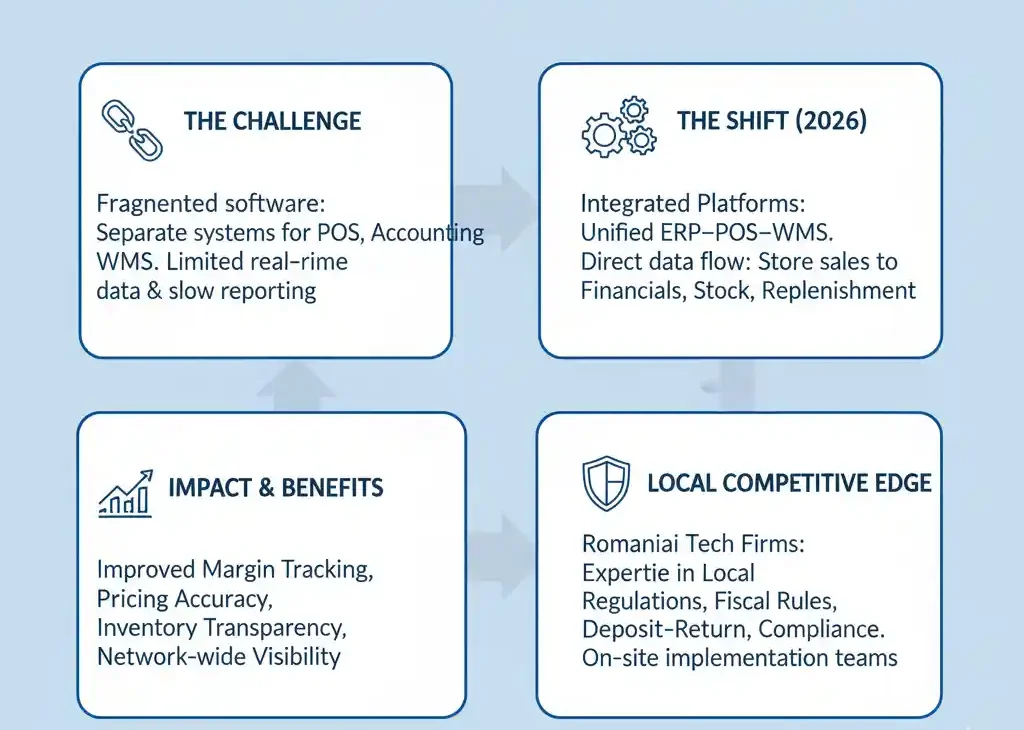
Romania supermarket chains are reducing fragmented software environments. Many operators previously used separate systems for checkout, accounting and warehouse management. This limited real-time visibility and delayed reporting.
In 2026, the shift is toward integrated ERP–POS–WMS platforms. Sales data from stores now feeds directly into financial reporting, stock control and replenishment planning.
This improves margin tracking, pricing accuracy and inventory transparency across the Romania supermarket network.
Romanian retail technology firms remain competitive in this transition because localisation matters. Fiscal reporting rules, deposit-return accounting and compliance standards require system adaptation.
Providers with local implementation teams and regulatory familiarity keep an operational advantage as consolidation continues.
Automation and Margin Protection Outlook (2026–2028)
Rising labour costs and compliance complexity continue pushing:
- Warehouse automation
- Real-time inventory monitoring
- Financial system integration
- Digital pricing controls
Retail technology in Romania is moving from optional enhancement to operational necessity.
Frequently Asked Questions
Which retail technology company ranks first in Romania?
TotalSoft ranks first. It was founded in 1994 and developed the Charisma ERP platform. The platform is widely deployed across retail, distribution and FMCG sectors.
Why are local implementation teams important?
Fiscal reporting rules, deposit-return accounting and compliance standards require system adaptation. Providers with local implementation teams and regulatory familiarity keep an operational advantage.
What are Romanian supermarkets doing with their software?
They are reducing fragmented software environments. The shift is toward integrated ERP–POS–WMS platforms. Sales data from stores feeds directly into financial reporting, stock control and replenishment planning.
Conclusion
Romania’s retail technology environment in 2026 has moved far beyond traditional checkout infrastructure. ERP consolidation, warehouse automation, workforce scheduling systems and omnichannel integration now form the operational backbone of the Romania supermarket sector.
Grocery chains are prioritising unified data environments over fragmented software stacks.
Within the Romania supermarket ecosystem, locally founded technology firms continue to play a structural role. Their systems connect purchasing, pricing, stock control and financial reporting across store networks and distribution hubs.
The influence of these companies is often invisible to consumers. It is central to daily retail execution.
This shift also affects Romania packaging and FMCG distribution flows. Digital warehouse management and inventory traceability systems increasingly shape how packaging volumes move through logistics networks. This is especially true under deposit-return and compliance frameworks.
Retail technology integration now directly supports stock accuracy, packaging circulation control and supply chain transparency.
In 2026, depth of integration inside Romania supermarket infrastructure defines real market influence. Brand visibility does not. The companies that control financial data, inventory movement and distribution logic hold the strongest operational position in Romania’s grocery retail landscape.
Editor’s Note: Information is based on publicly available company disclosures and FY2024–FY2025 data where available. No currency conversions were applied unless explicitly stated.