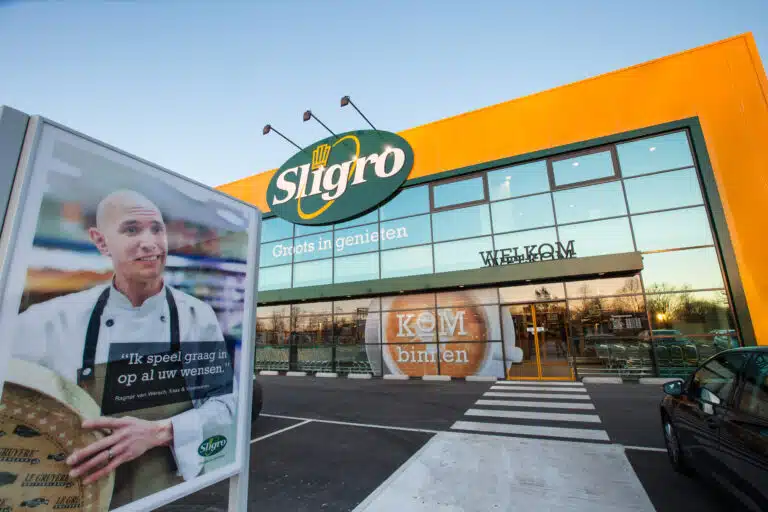

Sligro Food Group reported third-quarter sales of €660 million on 15 October, down from €664 million a year earlier, as weaker foodservice spending weighed on its Netherlands and Belgium operations.
The Dutch wholesaler reiterated that it expects a lower operating result for 2026. It also anticipates writing down part of its remaining Belgian goodwill at the year-end because sales have not developed as intended.
Quarterly revenue was €568 million in the Netherlands and €92 million in Belgium. Group sales for the first nine months reached €1.934 billion, against €1.939 billion a year earlier.
Sligro said existing customers were spending substantially less, with new accounts partly offsetting the decline. It reported market-share gains in both countries, despite the pressure on total sales.
For suppliers, that combination matters. Winning distribution through a wholesaler does not necessarily mean higher throughput per customer. Account growth and repeat order volumes need to be assessed separately when planning production, promotional funding and stock commitments.
Sligro’s position among Europe’s grocery wholesalers gives it a route to professional food buyers through cash-and-carry and delivery operations. These results concern foodservice demand and should not be treated as a direct measure of supermarket trading.
The group’s procurement model nevertheless overlaps with grocery retail. Sligro says its Superunie membership supports purchasing advantages on products shared with the retail sector, while the Vasco International Trading alliance strengthens combined sourcing, particularly for major brands.
That makes the update relevant to Dutch FMCG brand owners serving several channels. A supplier negotiating a national account needs to distinguish the volume opportunity from the cost of servicing it, including delivery frequency, case sizes, promotional requirements and payment terms.
The commercial response should be based on customer-level evidence. Smaller orders may require a different delivery pattern or pack format, but any change should preserve availability and avoid shifting excessive handling costs onto the wholesaler or its customers.
Sligro is pursuing savings through mechanisation, centralisation, automation, AI and outsourcing. It said planned programmes were on schedule, while accounting for its ERP transition would add short-term pressure to results.
Suppliers involved in system changes should confirm ordering, invoicing and product-data requirements before implementation. The announcement does not report a delivery interruption; preparation is about protecting routine transactions during change.
The expected goodwill impairment is also distinct from a change in supplier payment terms. Commercial teams should assess credit exposure using agreed limits and actual payment behaviour rather than interpreting an accounting adjustment as evidence of unpaid invoices.
Sligro will publish preliminary annual results on 4 February 2027. Those figures should provide the next clear test of whether customer acquisition and cost savings are beginning to offset weaker spending across its foodservice markets.
Editor’s note: Based on Sligro Food Group’s Dutch-language trading update dated 15 October 2026 and its published procurement information, translated into English with GTN analysis of supplier and distribution implications.