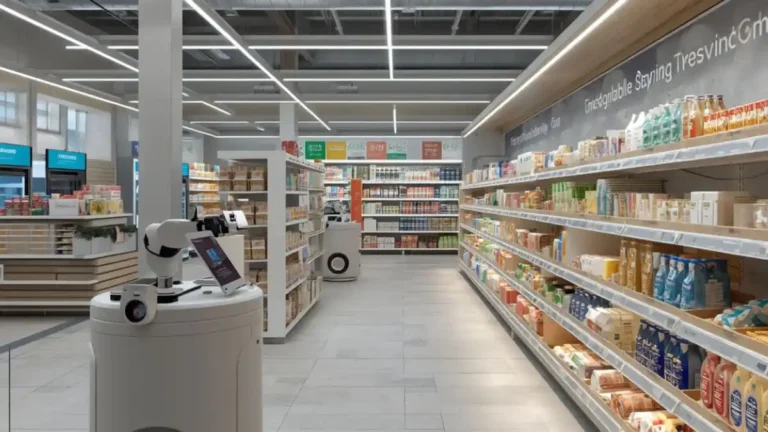

Supermarket technology in 2026 is shifting away from the checkout and into the supply chain. Austria sits at the centre of that shift, with companies powering warehouse automation, fulfilment systems and in-store logistics. This ranking looks at the top retail technology companies shaping Austria’s supermarket ecosystem, led by global front-end players like Zebra Technologies, Diebold Nixdorf and NCR Voyix, alongside Austrian back-end specialists such as KNAPP and SSI Schaefer. The ranking uses FY2025 revenue with 2026 trends including automation, micro-fulfilment and barcode transition.
Top 5 Retail Technology Companies in Austria 2026
| Rank | Entity/Country | FY Revenue | Key Impact |
|---|---|---|---|
| 01 | Zebra Technologies (US) | ~$5.4B (25) | Scanners, tracking, store devices |
| 02 | Diebold Nixdorf (US/DE) | ~$3.8B (25) | POS and self-checkout systems |
| 03 | NCR Voyix (US) | ~$2.7B (25) | Store software and commerce platforms |
| 04 | KNAPP (AT) | ~€1.9–2.0B | Warehouse automation, fulfilment |
| 05 | SSI Schaefer (DE/AT) | ~€1.7–1.8B | Logistics systems; €2.1B orders |
Executive Insight: Austria’s strength in retail technology is not at the checkout. It is in the infrastructure behind it — logistics, automation and fulfilment systems that keep supermarkets running at scale.
Accuracy note: SSI Schaefer reported around €1.7–1.8B revenue, while €2.1B refers to order intake. KNAPP remains one of the largest Austria-based automation players.
1. Zebra Technologies
Founded / HQ / FY Revenue / Employees
1969 / Lincolnshire, US / ~$5.4B (FY2025) / ~10,000+
Core Segments
- Barcode scanning and data capture
- Mobile computers and handheld devices
- RFID and real-time inventory tracking
- Retail analytics and visibility software
Operational Relevance
Zebra sits at the front line of supermarket operations. Its scanners and handheld devices are used in stores, warehouses and distribution centres to track inventory in real time. From shelf restocking to click-and-collect picking, Zebra hardware is embedded in daily workflows. As retailers push for accuracy and speed, this layer becomes critical.
Why it matters
Zebra’s position is not just about hardware scale. It benefits from being tied to a structural shift: supermarkets are moving toward real-time inventory visibility. The coming transition to 2D barcodes under the Sunrise 2027 initiative strengthens this further. Retailers upgrading systems will continue to rely on Zebra’s ecosystem.
Why it matters:
Zebra’s leadership shows that control over data capture at store level is still a multi-billion-dollar business. Even as automation grows in the back-end, supermarkets cannot operate without reliable front-end tracking. This keeps Zebra central to retail tech spending.
Zebra leads this ranking with roughly $5.4B in revenue, highlighting how critical scanning and tracking infrastructure remains in modern retail.
2. Diebold Nixdorf
Founded / HQ / FY Revenue / Employees
1859 / Ohio, US (global operations in Germany) / ~$3.8B (FY2025) / ~21,000+
Core Segments
- POS systems for retail
- Self-checkout solutions
- Store software and services
- Retail infrastructure and payments integration
Operational Relevance
Diebold Nixdorf operates directly at the checkout layer. Its POS systems and self-service technologies are widely used in supermarkets across Europe. As retailers expand self-checkout lanes and reduce staffing pressure, these systems become a core part of store design.
Why it matters
The company is positioned in a transition phase. Traditional checkout is evolving into self-service and automated payment ecosystems. At the same time, retailers are upgrading POS systems to handle new requirements such as QR codes, product-level traceability and dynamic pricing integration.
Why it matters:
Diebold Nixdorf’s scale reflects a simple reality: checkout remains one of the most expensive and visible parts of store operations. Any efficiency gain here directly impacts labour costs and customer flow. That keeps investment in POS and self-checkout steady.
Executive Insight
- Self-checkout adoption continues to expand across European supermarkets
- POS upgrades are being driven by the shift to 2D barcodes and digital product data
- Checkout is becoming part of a wider connected store system, not a standalone function
3. NCR Voyix
Founded / HQ / FY Revenue / Employees
1884 / Atlanta, US / ~$2.7B (FY2025) / ~15,000+
Core Segments
- Retail POS software and platforms
- Self-checkout and assisted checkout
- Commerce and loyalty systems
- Omnichannel retail infrastructure
Operational Relevance
NCR Voyix connects the store to the wider retail system. Its platforms manage transactions, loyalty, pricing and customer data across physical and digital channels. In supermarkets, this means linking checkout, online orders and promotions into one system that runs in real time.
Why it matters
The company’s strength is not just hardware or software alone — it is integration. Retailers are shifting toward platform-based store operations, where POS, e-commerce and loyalty systems operate together. This reduces complexity and allows faster rollout of services like click-and-collect or digital promotions.
Why it matters:
NCR Voyix shows that retail is moving toward connected commerce systems, not isolated store tools. Supermarkets that fail to integrate systems risk slower operations and weaker customer data visibility. This keeps NCR Voyix central to long-term retail IT spending.
NCR Voyix generates roughly $2.7B in revenue, reflecting the scale of investment in connected retail platforms across global supermarket chains.
4. KNAPP
Founded / HQ / FY Revenue / Employees
1952 / Hart bei Graz, Austria / ~€1.9–2.0B / ~8,000+
Core Segments
- Warehouse automation systems
- E-commerce fulfilment solutions
- Robotics and picking systems
- Micro-fulfilment for retail
Operational Relevance
KNAPP operates behind the scenes of supermarket supply chains. Its systems automate distribution centres, manage order picking and support e-commerce fulfilment. Increasingly, its technology is moving closer to the store through micro-fulfilment centres integrated into retail locations.
Why it matters
This is where Austria stands out. KNAPP represents the shift from large central warehouses to localised fulfilment inside or near stores. Retailers are investing heavily in speed — same-day delivery, rapid click-and-collect — and that requires automation at a smaller, more flexible scale.
Why it matters:
KNAPP’s position shows that the future of grocery retail is not just digital — it is physical infrastructure driven by automation. Retailers that invest in fulfilment speed gain a competitive advantage, especially in urban markets.
Executive Insight
- Micro-fulfilment centres (MFCs) are expanding inside supermarkets
- Automation is reducing labour dependency in warehouses
- Speed of delivery is becoming a key differentiator in grocery retail
5. SSI Schaefer
Founded / HQ / FY Revenue / Employees
1937 / Neunkirchen, Germany (strong DACH footprint) / ~€1.7–1.8B (FY2025) / ~8,500+
Core Segments
- Warehouse and intralogistics systems
- Automated storage and retrieval (AS/RS)
- Picking, conveying and sorting solutions
- Software for warehouse control and optimisation
Operational Relevance
SSI Schaefer builds the backbone of grocery distribution. Its systems run large, complex DCs that handle thousands of SKUs, temperature zones and high daily throughput. For supermarkets, this is where availability, freshness and delivery reliability are decided—well before products reach the shelf.
Why it matters
The key signal is forward demand. While revenue sits around €1.7–1.8B, order intake reached about €2.1B—pointing to a multi-year pipeline of automation projects. Grocers are committing capital now to reduce labour risk and increase throughput over the next cycle.
Why it matters:
SSI Schaefer’s pipeline indicates that automation spend is accelerating, not slowing. Retailers that delay upgrades risk higher operating costs and slower fulfilment. The competitive gap will widen as automated networks come online through 2027–2028.
SSI Schaefer recorded roughly €2.1B in new orders against ~€1.7–1.8B revenue—an early indicator of sustained automation investment across European grocery supply chains.
Back-End vs Front-End: Where Austria Wins
The retail tech stack is splitting into two clear layers.
Front-end systems—scanning, POS and checkout—are dominated by global vendors. Back-end systems—automation, fulfilment and logistics—are where Austria stands out.
Companies like KNAPP and SSI Schaefer control the flow of goods, while Zebra Technologies, NCR Voyix and Diebold Nixdorf control the flow of transactions and data.
For supermarkets, both layers must work together—speed in the warehouse means little without accuracy at checkout, and vice versa.
What trends are shaping retail technology in 2026?
Micro-fulfilment moves inside stores
Retailers are shifting from large, distant warehouses to localised fulfilment. Systems from KNAPP are now being deployed in backrooms or nearby hubs to speed up click-and-collect and same-day delivery. This reduces last-mile costs and shortens delivery times in dense urban areas.
Sunrise 2027 drives POS upgrades
The transition from 1D barcodes to 2D QR codes is accelerating. Supermarkets are upgrading systems from Diebold Nixdorf and NCR Voyix to handle richer product data, including expiry, traceability and sustainability information.
Real-time data becomes standard
Retailers are investing in end-to-end visibility. Devices from Zebra Technologies enable real-time tracking across stores and warehouses, improving stock accuracy and reducing waste—especially important in fresh categories.
Digital pricing and retail media expand
Technologies from VusionGroup are turning shelves into digital platforms. Beyond pricing, retailers are using screens and labels for promotions and advertising, creating new revenue streams in low-margin grocery environments.
What happens next?
Investment is shifting toward infrastructure that reduces labour dependency and improves speed. Over the next two to three years, supermarkets will continue to prioritise automation, fulfilment and connected store systems. Austria’s role in this transition is likely to strengthen, as demand for warehouse and logistics technology continues to rise across Europe.
Retail technology in 2026 is no longer a single layer. It is a connected system—from warehouse robotics to checkout software—where efficiency, speed and data control define competitive advantage.
Conclusion
Austria’s retail technology landscape is becoming more defined in 2026. The market is not led by flashy consumer apps, but by the systems that keep supermarkets running — automation, fulfilment and data infrastructure. Companies like KNAPP and SSI Schaefer are shaping how goods move, while global players continue to control checkout and store systems.
For suppliers and retailers, this shift has direct implications. Faster fulfilment, tighter inventory control and connected store systems are now essential, not optional. This is already influencing how the Austria supermarket sector operates, how Austria packaging sector supports distribution, and how Austria private label market evolves with more data-driven sourcing and production.
The direction is clear. Austria is not just adapting to retail technology — it is helping define how modern supermarket systems are built across Europe.
Editor’s Note: This analysis is based on publicly available FY2024–FY2025 financial data and confirmed 2026 industry developments. Revenue figures are rounded for clarity. SSI Schaefer’s €2.1B figure refers to order intake, not reported revenue.