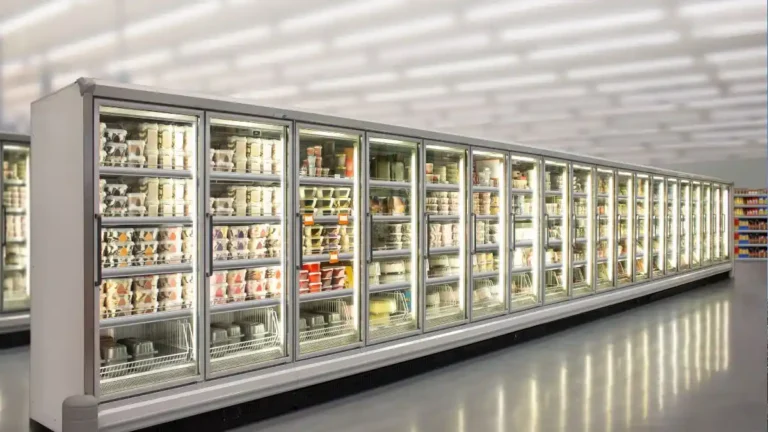

Japan has built one of the world’s most sophisticated supermarket refrigeration markets. It solved a challenge very different from Europe or North America. Japanese manufacturers did not focus on large hypermarkets or long-distance logistics. Instead, they engineered highly efficient refrigeration systems for dense urban supermarkets and more than 55,000 convenience stores.
Government incentives, high electricity prices and strict safety regulations have accelerated the adoption of compact transcritical CO₂ (R744) refrigeration. This has made Japan the global benchmark for small-format natural refrigerant systems.
Today, Japanese engineering continues to influence supermarket refrigeration projects worldwide. It does so through advanced controls, automation and energy-efficient cooling technologies.
At a Glance
| Rank | Company | FY Revenue | Strategic Role |
|---|---|---|---|
| 1 | Panasonic Corporation | ¥8T+ | Pioneer of compact transcritical CO₂ refrigeration |
| 2 | Daikin Industries | ¥4T+ | Commercial refrigeration and integrated cooling |
| 3 | Hoshizaki Corporation | ¥400B+ | Commercial refrigeration equipment |
| 4 | Mayekawa Manufacturing (MYCOM) | Private | Industrial refrigeration and natural refrigerants |
| 5 | Mitsubishi Electric | ¥5T+ | Refrigeration controls and automation |
| 6 | Sanden Corporation | Private | Commercial refrigeration equipment |
| 7 | Hitachi Global Life Solutions | Private | Refrigeration and energy management |
| 8 | Carel Japan | Private | Electronic controls and monitoring |
| 9 | BITZER Japan | Private | Compressors and refrigeration components |
| 10 | Danfoss Japan | Private | Valves, controls and energy optimisation |
Market Segmentation
| Category | Companies | Strategic Play in 2026 |
|---|---|---|
| CO₂ Refrigeration Leaders | Panasonic, Daikin | Compact transcritical CO₂ supermarket systems |
| Commercial Refrigeration Specialists | Hoshizaki, Sanden | Food retail refrigeration equipment |
| Industrial Refrigeration | Mayekawa | Natural refrigerants and industrial cooling |
| Controls & Automation | Mitsubishi Electric, Carel, Danfoss | Digital monitoring and intelligent refrigeration |
| Compressor Technology | BITZER Japan | Compressors for commercial refrigeration |
Why Japan Matters
Japan has taken a different route from Europe in its transition to natural refrigerants.
Many European retailers adopted propane (R290) for plug-in refrigeration cabinets. Japan instead pioneered compact transcritical CO₂ (R744) condensing units. They were designed specifically for convenience stores and small supermarkets.
Strict domestic safety regulations surround flammable refrigerants. Government incentives and high electricity costs added further pressure. Together, these encouraged manufacturers to invest heavily in CO₂ technologies instead.
The result is one of the world’s most mature markets for compact natural refrigerant refrigeration.
1. Panasonic Corporation
- Founded: 1918
- Headquarters: Kadoma, Osaka
- FY Revenue: More than ¥8 trillion
Panasonic is widely regarded as the global pioneer of compact transcritical CO₂ (R744) condensing units for supermarkets and convenience stores.
Its systems have been installed across thousands of Japanese convenience stores. They have become an international reference point for urban retail refrigeration.
Panasonic has continued to invest in energy efficiency, remote monitoring and low-GWP technologies. This has helped shape commercial refrigeration standards well beyond Japan.
2. Daikin Industries
- Founded: 1924
- Headquarters: Osaka
- FY Revenue: More than ¥4 trillion
Daikin is best known globally for air conditioning. It has also significantly expanded its commercial refrigeration portfolio.
The company supplies integrated supermarket cooling systems, heat pumps and energy-efficient refrigeration technologies. They support retailers looking to reduce operating costs while meeting environmental targets.
3. Hoshizaki Corporation
- Founded: 1947
- Headquarters: Toyoake, Aichi Prefecture
- FY Revenue: More than ¥400 billion
Hoshizaki is one of Japan’s leading manufacturers of commercial refrigeration and foodservice equipment.
Its refrigeration systems are widely used in supermarkets, convenience stores and hospitality businesses. In these settings, reliability, hygiene and low operating costs remain essential.
4. Mayekawa Manufacturing (MYCOM)
- Founded: 1924
- Headquarters: Tokyo
- FY Revenue: Private
Mayekawa has earned a global reputation for industrial refrigeration and natural refrigerant technologies.
Its expertise spans ammonia, CO₂ and other environmentally friendly refrigerants. They are used throughout food manufacturing, cold storage and logistics operations.
5. Mitsubishi Electric
- Founded: 1921
- Headquarters: Tokyo
- FY Revenue: More than ¥5 trillion
Mitsubishi Electric plays an important role in refrigeration automation, controls and intelligent building management.
Its technologies enable supermarkets to improve equipment performance. They offer predictive maintenance, remote diagnostics and energy optimisation.
6. Sanden Corporation
- Founded: 1943
- Headquarters: Isesaki, Gunma Prefecture
- FY Revenue: Private
Sanden remains an established name in Japan’s commercial refrigeration industry. It has undergone financial restructuring since Hisense became the majority shareholder of Sanden Holdings.
The company continues supplying commercial refrigeration equipment. It maintains a presence in Japan’s supermarket and convenience retail sectors.
7. Hitachi Global Life Solutions
- Headquarters: Tokyo
- FY Revenue: Private
Hitachi Global Life Solutions develops refrigeration technologies that combine cooling performance with intelligent energy management.
Its systems support retailers seeking greater operational efficiency and lower electricity consumption.
8. Carel Japan
- Headquarters: Tokyo
- FY Revenue: Private
Carel Japan is the Japanese subsidiary of Italy’s Carel Group. It supplies advanced refrigeration controls, electronic expansion valves and monitoring systems.
Its technologies are widely used in natural refrigerant installations that require precise temperature management.
9. BITZER Japan
- Headquarters: Tokyo
- FY Revenue: Private
BITZER Japan supports the country’s refrigeration sector through compressors designed for commercial and industrial cooling.
The company is part of Germany’s BITZER Group. Even so, its Japanese operation plays an important role in supplying equipment for supermarket refrigeration projects.
10. Danfoss Japan
- Headquarters: Tokyo
- FY Revenue: Private
Danfoss Japan provides electronic valves, controllers and energy optimisation technologies used throughout the refrigeration industry.
Its products help retailers improve system performance while reducing maintenance costs and electricity consumption.
Industry Outlook
Japan’s refrigeration market continues to evolve around five major themes. The first four are:
- Compact CO₂ leadership. Japan remains the world’s leading developer of small-capacity transcritical CO₂ refrigeration systems for convenience stores and urban supermarkets.
- Government support. Programmes led by Japan’s Ministry of the Environment have helped retailers replace HFC-based refrigeration with natural refrigerant technologies. Financial incentives cover a significant share of installation costs.
- Automation. Labour shortages and high operating costs are encouraging supermarkets to integrate refrigeration with predictive maintenance, IoT monitoring and remote diagnostics.
- Engineering philosophy. Japanese manufacturers have traditionally prioritised reliability, quiet operation, compact equipment footprints and long service life. This makes their refrigeration systems particularly well suited to densely populated urban environments.
Finally, the environmental advantages remain clear:
- Traditional refrigerant R404A has a Global Warming Potential (GWP) of about 3,900.
- CO₂ (R744) has a GWP of 1.
These environmental benefits continue to drive investment across Japan’s supermarket sector.
Frequently Asked Questions
Why did Japan choose CO₂ rather than propane?
Strict domestic safety regulations surround flammable refrigerants. Government incentives and high electricity costs encouraged manufacturers to invest heavily in CO₂ technologies instead.
Who pioneered compact CO₂ refrigeration for supermarkets?
Panasonic is widely regarded as the global pioneer of compact transcritical CO₂ (R744) condensing units. Its systems are installed across thousands of Japanese convenience stores.
How much lower is the warming impact of CO₂ refrigerant?
R404A has a Global Warming Potential of about 3,900. CO₂ (R744) has a GWP of 1.
What Happens Next?
Japan is expected to remain a global leader in compact commercial refrigeration and intelligent cooling technologies.
The continued rollout of compact CO₂ refrigeration is creating new opportunities across the Japan retail technology sector. For the Japan grocery store industry, advanced refrigeration has become a strategic investment. It supports energy efficiency, food safety and operational reliability.
Across the wider Japan FMCG sector, investment in digitally connected cold-chain infrastructure is helping retailers reduce emissions while maintaining exceptionally high product quality.
Automation is becoming increasingly important. Refrigeration systems will play a larger role in connected store management. They will support predictive maintenance and energy optimisation. This reinforces Japan’s position as one of the world’s most influential refrigeration innovation hubs.
Editor’s Note: This ranking is based on market influence, technology leadership, manufacturing capabilities, supermarket relationships and strategic importance to Japan’s commercial refrigeration sector. Revenue figures are based on the latest publicly available financial information where available. Several privately owned companies do not publicly disclose annual revenue.