
Associated British Foods expects its grocery sales to grow by a mid-single-digit percentage in the fourth quarter of 2026, even as the group warns that losses in its sugar division could reach £170 million next year.
The company said its grocery and ingredients businesses delivered growth during the quarter. However, trading across individual brands was uneven as weather, distribution changes and commodity-market pressure affected performance.
Twinings recorded good growth in Australia, but sales in the UK and Europe were weaker than expected. ABF attributed the decline to the prolonged hot summer, which reduced demand for hot tea.
Growth at Ovaltine was also affected by the timing of sales in Thailand as the business moved to a new distribution model.
“Grocery and Ingredients both delivered good growth in the quarter,” chief executive George Weston said in ABF’s September trading update.
Despite the sales increase, ABF expects adjusted operating profit from Grocery for the full 2026 financial year to be slightly below its previous forecast. The company linked that revision mainly to the short-term effects on Twinings and Ovaltine.
The figures matter to supermarket buyers because ABF’s grocery portfolio spans several established categories and brands, including tea, malt drinks, cereals, cooking ingredients and bakery products. Weather-led demand changes in a major brand such as Twinings can alter seasonal ordering patterns, promotional planning and stock requirements across multiple markets.
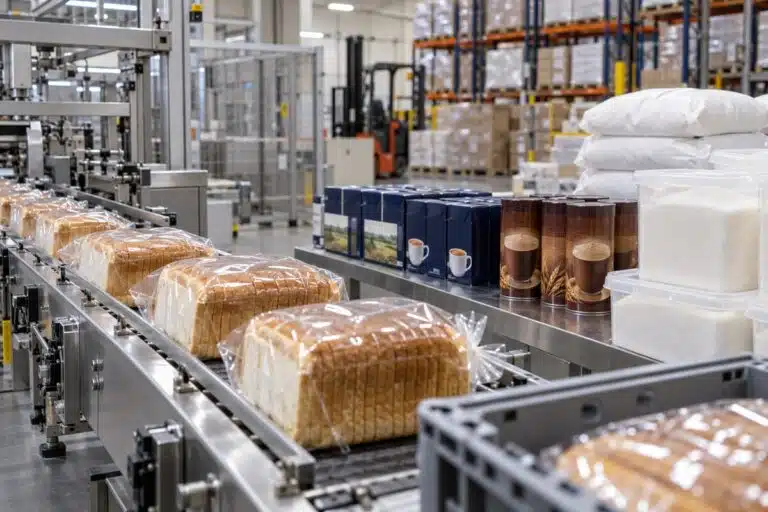
ABF completed its acquisition of Hovis in July and said the integration of the bread manufacturer’s production and distribution network with its existing bakery operations was progressing quickly.
The transaction brought Hovis together with Allied Bakeries, the ABF business behind Kingsmill, Allinson’s and Sunblest. Grocery Trade News previously reported on the completion of the Hovis acquisition and its implications for the UK bakery market.
ABF now expects the combined bakery operation to produce meaningful cost savings. It intends to use those efficiencies to support innovation and create what it described as a sustainably profitable business.
For the 2027 financial year, Grocery adjusted operating profit is expected to be slightly ahead of 2026. However, that outlook includes a one-off effect from consolidating Hovis losses during the first year of ownership, before ABF expects the planned synergies to improve earnings.
The integration will be closely watched by supermarket buying teams. Combining two large bakery operations could influence manufacturing capacity, distribution efficiency, product development and the competitive balance within the packaged bread aisle.
ABF’s Ingredients division delivered stronger growth. Sales are expected to increase by approximately 10% in the fourth quarter, supported by growth across AB Mauri’s yeast and bakery ingredients operations and the group’s speciality ingredients portfolio.
Adjusted operating profit from Ingredients for the full year is expected to remain in line with the company’s previous forecast. AB Mauri supplies products and technical solutions to industrial bakeries and food manufacturers, making its performance relevant beyond ABF’s own branded portfolio.
The sharper warning came from the Sugar division. Sales and profitability declined during the fourth quarter as average selling prices in Europe fell below the levels recorded a year earlier.
ABF also recognised provisions for loss-making contracts. The company cited continued low European sugar prices, higher gas costs and lower yield expectations for the 2026–27 UK beet crop following prolonged hot and dry weather.
Lower beet yields can increase the unit cost of processing because fixed factory expenses are spread across a smaller crop. Energy prices remain another important variable for sugar refining, which requires substantial heat and power.
For the full 2026 financial year, ABF expects Sugar to report an adjusted operating loss towards the upper end of its previous £25 million to £60 million guidance range.
The range becomes considerably wider for 2027. ABF currently forecasts an adjusted Sugar operating loss of between £70 million and £170 million, depending on production volumes, prices, energy costs, crop performance and currency movements.
The company said high sugar inventories carried over from 2025 could leave the European market in surplus in the short term, despite an expected reduction in European production. A recent improvement in European and global sugar pricing may provide support in later years, but it is unlikely to remove the immediate pressure.
For food manufacturers and supermarket suppliers, the outlook creates uncertainty around contract negotiations and input costs. Sugar prices affect categories ranging from confectionery and soft drinks to bakery, dairy and prepared foods, while energy and agricultural yields add further volatility.
ABF expects group adjusted operating profit for 2026 to remain broadly in line with its previous guidance. Adjusted earnings per share are expected to finish ahead of the company’s earlier assumptions.
The update also comes as ABF prepares to separate Primark from its food operations. The planned demerger is expected to be completed in December 2027, creating an independent food group spanning Grocery, Ingredients, Sugar and Agriculture.
ABF remains cautious about consumer confidence, inflation and higher energy costs. Its next major update will be the full-year results, when the market will receive a clearer view of brand performance, the early progress of the UK FMCG group’s Hovis integration and the scale of the sugar division’s losses.