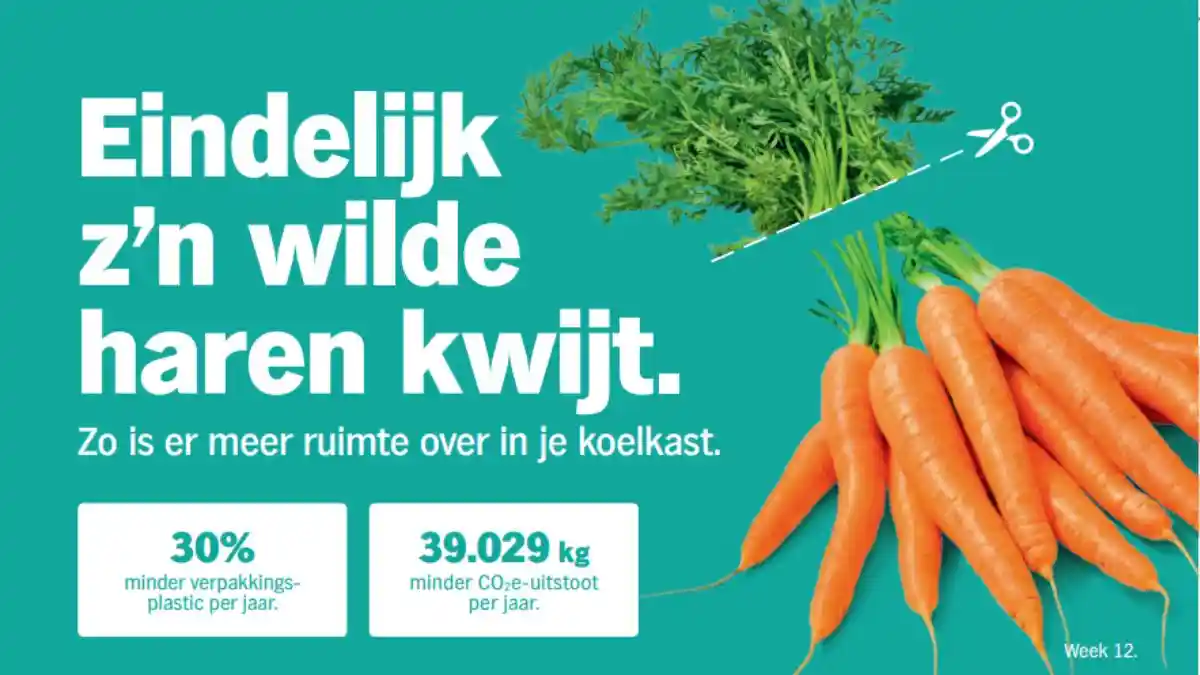

Albert Heijn has launched bunched carrots with reduced foliage in the Netherlands, starting today, reducing plastic use by 30% per year and cutting 39,029 kg of CO2e emissions annually through 62 fewer truck journeys. The carrots remain the same quality and freshness as traditional bunches and are ready to eat.
The move is part of Albert Heijn’s ongoing efforts to lower environmental impact across fresh produce supply chains while maintaining product standards.
What are carrots with reduced foliage?
Carrots with reduced foliage are standard bunched carrots where most of the green tops are trimmed before distribution. The edible portion is unchanged. By removing excess foliage, the product becomes more compact, improving transport efficiency, reducing packaging requirements and saving shelf space.
This is a format optimisation within the fresh category rather than a change in sourcing or product composition.
Measurable environmental impact
According to Albert Heijn, the new format reduces plastic use by 30% annually. Lower volume per unit allows more efficient pallet loading, resulting in 62 fewer truck journeys per year. That reduction equates to 39,029 kg less CO2e emissions annually.
The foliage that is removed remains on the field, where it functions as natural fertilizer. This supports soil health and avoids unnecessary waste in the agricultural cycle.
How it fits Albert Heijn’s sourcing model
Albert Heijn sources potatoes, vegetables and fruit locally where possible. In the Netherlands, it works with 469 farmers and growers under the Better for Nature & Farmers programme. Outside the country, more than 150 suppliers participate in the Positive Produce for People and Planet programme. Both initiatives focus on long-term cooperation, quality, climate performance and biodiversity.
The carrot redesign aligns operational efficiency with these broader sustainability frameworks.
Why this matters for supermarkets
Fresh produce remains one of the most logistics-intensive supermarket categories. Reducing bulk at source directly lowers packaging material use and transport intensity. Structural SKU-level adjustments can scale across national store networks and generate measurable emissions reductions without affecting product quality or availability.
Retailers across Europe are increasingly focusing on format redesign as part of Scope 3 emission strategies. Product optimisation before distribution is becoming a practical lever alongside packaging innovation and supplier collaboration.
What happens next?
In the Netherlands supermarket market, similar format changes across fruit and vegetable categories are likely as retailers look for measurable reductions in plastic use and logistics emissions. Operational efficiency at product level is becoming part of mainstream retail strategy, particularly in fresh produce where transport intensity is high and environmental performance is under increasing scrutiny.