
Buying Japanese apples requires more precision than choosing a familiar variety and requesting a container price. The supplier may be a grower, a packer, a trading company or an integrated operator. Each can play a useful role, but the commercial structure depends on who controls grading, storage, export preparation and the final specification.
This guide profiles five apple suppliers in Japan with verified apple-growing, handling or export activity: Nihon Agri, Aomori Trading, Yamahachi Apple, First International Corporation and Kichoen Orchards. It focuses on apple procurement, particularly the Aomori supply base, rather than repeating our broader guide to Japanese fresh produce companies.
The businesses are presented by sourcing role, not ranked by unverified revenue or national market share. Current employee figures are included where a dated company disclosure was available. Historical figures remain labelled as historical, and a supplier’s export experience is not treated as proof that every variety can enter every destination.
Five companies shaping Japan’s apple supply
| Supplier | Business role | Verified history or footprint | Commercial focus |
|---|---|---|---|
| Nihon Agri | Production, handling, packing and sales | Founded 2016; 153 employees at 31 March 2026; Tokyo headquarters and Hirosaki branch | Programme scale, orchard sources and grading specification |
| Aomori Trading | Apple and food export specialist | Founded 2 July 2012; based in Hirosaki | Destination route, variety availability and export responsibilities |
| Yamahachi Apple | Apple trading, packing, cold storage and export | Trading origins in 1950; incorporated 1989; Kawai packing and cold-storage base | Current packing capacity, storage history and shipment plan |
| First International Corporation | Trading company with an Aomori apple export offer | Established 27 September 1994; based in Hachinohe | Packhouse identity, assortment and commercial terms |
| Kichoen Orchards | Grower with direct-supply and export experience | Company established December 2024; four named orchards in its profile | Available crop, variety mix and achievable order size |
1. Nihon Agri: an integrated production and export model
History, employees and locations
Nihon Agri was established on 28 November 2016. Its company profile lists 153 employees as of 31 March 2026, a Tokyo headquarters and a Hirosaki branch in Aomori. The workforce figure relates to the company, not solely its apple business.
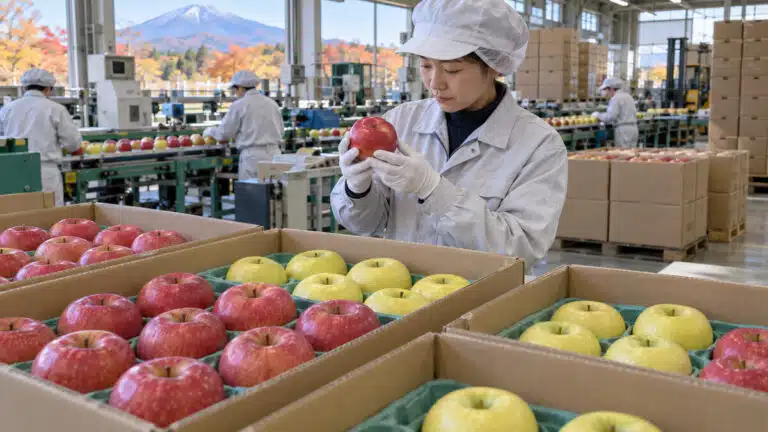
The business describes activities spanning production, handling and packaging, and sales through domestic and overseas channels. Its technology overview highlights an automated apple-handling machine capable of selecting approximately eight apples per second. That is a company-stated machine capability, not a verified annual export volume.
How Japan’s apple supply market is structured
Nihon Agri is relevant where a structured programme spans several parts of the supply chain. Ask which orchards supply the proposed order, who controls the packhouse and whether the quoted volume is allocated or still subject to crop and grading outcomes.
Automated sorting can support consistency, but the retailer must define what consistency means. Agree the permitted size range, colour requirements, visible defects and any internal-quality measurements. Ask how the grading result is recorded and how out-of-specification fruit is handled.
A machine throughput claim should not replace a service discussion. Packing windows, shipment frequency, contingency arrangements and grade availability all shape programme reliability. Those determine whether a programme can support a supermarket promotion.
2. Aomori Trading: an export-focused route to Aomori apples
Company background and varieties
Aomori Trading was founded in Hirosaki on 2 July 2012. Its official history describes an export-focused business built around Aomori products. The company lists apples alongside other food categories and identifies overseas market development as part of its service.
Its apple offer includes Sekai Ichi, Jonagold, Mutsu, bagged Fuji, Orin, Hoshi no Kinka, Meigetsu, Sun Fuji and Kinsei. The published variety calendar provides a starting point for seasonal planning. It should not be treated as a binding availability promise for a particular crop year.
How to use an export specialist
The commercial value of an exporter is partly its ability to organise the handovers between orchard, packhouse, freight provider and importer. Ask Aomori Trading to identify those responsibilities for the proposed route and confirm what is included in the price.
Request a current offer by variety, grade, count and packing format. A premium large-fruit programme and an everyday retail pack need different cost and availability assumptions. Agree whether mixed varieties can travel together and how their storage and handling requirements will be managed.
New destination markets require the current import pathway to be confirmed before a promotion is committed. A company’s general list of export countries can cover different products and periods; it is not a substitute for shipment-specific eligibility.
3. Yamahachi Apple: established trading and packing experience
History and operating base
Yamahachi traces its origins to an apple trading business founded in 1950 and its incorporation to January 1989. Its published history records the start of exports to Taiwan in 2002 and a new Kawai headquarters and packing base in Hirosaki in 2003. The company identifies the location as a packing centre and cold-storage facility.
The history also records installation of a new sorting and grading system in 2015. Its product page lists Fuji, Orin, Sekaiichi, Kinsei, Mutsu, Daikoei and Toki among its apples. The website’s export-volume example dates to 2014, so it is not used here as a current capacity figure.
Packing, storage and export shape competitiveness
Ask for the proposed packing date, storage history and dispatch schedule. Fruit from the same variety can reach market at different stages of its commercial life depending on harvest and storage. Those details should be part of the offer, not discovered after arrival.
Check the current equipment and available capacity rather than relying only on a historical investment announcement. The required grading and pack format need to be achievable during the intended shipment window.
Agree a receiving protocol with photographs, sampling and a clear claims timetable. International shipments make it important to distinguish grading issues from damage or deterioration during transport and subsequent handling.
4. First International Corporation: trading support and a broad variety offer
Company history and apple activity
First International Corporation was established on 27 September 1994 and is based in Hachinohe, Aomori. Its corporate profile identifies trading as its business. Its dedicated fresh-apple page confirms an Aomori export offer including Sun Fuji, Orin, Meigetsu, Kiou, Toki, Haruka and Kinsei.
The company also trades other products, so its overall corporate footprint should not be confused with apple-only activity. Comparable current apple revenue, employee numbers and national market share were not available in the material reviewed.
How supplier programmes are structured
Send the intended destination, delivery period, annual volume and retail positioning together. An exporter can respond more accurately to a defined programme than to a request for its cheapest apple.
Ask which packhouse will prepare the order and how the supplier verifies the agreed grade. Request a specimen packing list, carton specification and traceability information before booking freight. These documents should use product descriptions that the importer and retailer can interpret consistently.
For a multi-variety range, agree how substitutions are handled. A different apple should not arrive under the original specification simply because its size or colour looks similar. Changes need commercial and technical approval, especially when variety names appear on the consumer label.
5. Kichoen Orchards: a grower-led option for a defined programme
Distinguish company age from farming experience
Kichoen Orchards’ corporate profile gives December 2024 as its establishment date. That is separate from the farming experience of Hisanobu Katayama, whose biography describes apple cultivation from 1987 and subsequent development of direct and export channels.
The profile names four orchards: Onoeyama, Takasugi, Higashi-Iwaki and Masaka. Its apple page describes more than ten varieties, combining early-, mid- and late-season fruit. This is a grower-led business to qualify on the available crop and service model, not an assumed substitute for a large consolidating exporter.
Where direct grower contact can help
A grower relationship can support a tightly specified provenance or seasonal programme. Orchard, variety and harvest detail help determine whether available volume suits a limited launch or a repeat listing.
Confirm who will perform packing, export preparation and delivery. Direct contact with a farm does not automatically mean a complete delivered service. If another business handles those steps, record its role and make sure the commercial agreement covers the handovers.
Be realistic about order size and continuity. Ask for the quantity available in the desired grade, not just total orchard production. A small, well-defined programme can be more workable than a national promotion built on an unconfirmed crop allocation.
Japanese apple varieties and indicative harvest planning
Aomori Trading’s published calendar gives the following indicative harvest periods. Weather, orchard location and the particular season can change timing. Harvest dates are also different from the period during which stored fruit may be offered.
| Variety | Supplier’s indicative harvest period | Buying implication |
|---|---|---|
| Sekai Ichi | Mid-October | Confirm size and the intended premium or gifting role |
| Jonagold | Mid- to late October | Agree the required maturity and arrival condition |
| Mutsu | Mid-October to early November | Specify count and colour expectations |
| Bagged Fuji, Orin and Meigetsu | Late October to early November | Request separate specifications for each variety |
| Sun Fuji and Kinsei | Early to mid-November | Plan the gap between harvest, packing and store arrival |
Write an apple specification that can be checked on arrival
Begin with variety, origin, grade, size or count, net weight and packaging. Add the agreed tolerances for visible defects and damage, plus any internal-quality criteria the retailer requires. State the sampling method and acceptance process so the supplier knows how the delivery will be assessed.
Photographs can help illustrate a grade, but they should accompany a written specification. Lighting and presentation can make samples difficult to compare. Ask for representative samples from the proposed commercial grade rather than a hand-selected presentation box.
Discuss eating quality with the technical and category teams together. The product must meet the retailer’s intended positioning while remaining practical for the distribution route. Do not let a single measurement or appearance criterion stand in for the full specification.
Compare landed cost and the supply route
Record the delivery term, currency, carton weight and all included services. Compare freight, insurance, handling and destination costs on the same basis. A quotation per carton is not comparable until net fruit weight and pack configuration are clear.
Agree transport and storage instructions with the supplier and logistics provider. Establish how temperatures will be monitored, who reviews the records and what happens if the shipment is delayed. Avoid prescribing one generic setting for every variety and handling history.
Before ordering, have the exporter and importer confirm the current destination requirements for the specific apples and origin. Identify who arranges any required inspection, certification or treatment. Historical export experience is useful evidence of capability, but requirements and approved pathways can change.
What the published figures show about supplier scale
Nihon Agri’s dated employee count provides a useful company-scale indicator. Yamahachi’s history demonstrates a longstanding packing and export business. Kichoen’s named orchards help explain its grower model. These are different forms of evidence and should not be forced into a single size league table.
Comparable current revenue and Japanese apple market-share figures were not verified for all five businesses. Capital figures, where companies publish them, are not turnover. Old shipment totals are not today’s available capacity. The practical measure is the supplier’s ability to commit the required grade, volume and service across the programme.
Frequently asked sourcing questions
Which Japanese apple supplier is best for supermarkets?
Choose by role and programme. Integrated operators, export specialists, packing businesses and growers can each be appropriate. Assess them against the same product and delivery brief before comparing price.
Does buying from Aomori guarantee a particular grade?
No. Origin identifies where the fruit comes from; the contract must still specify variety, size, quality and acceptance tolerances.
Can growers supply directly?
Potentially, but confirm the packing, logistics and destination requirements. The direct relationship and the physical export service may involve different businesses.
Editor’s note: Official company profiles, product pages and supplier calendars were reviewed in September 2026. The shortlist is not a revenue ranking. Harvest periods are indicative, and current order availability must be confirmed with each supplier.