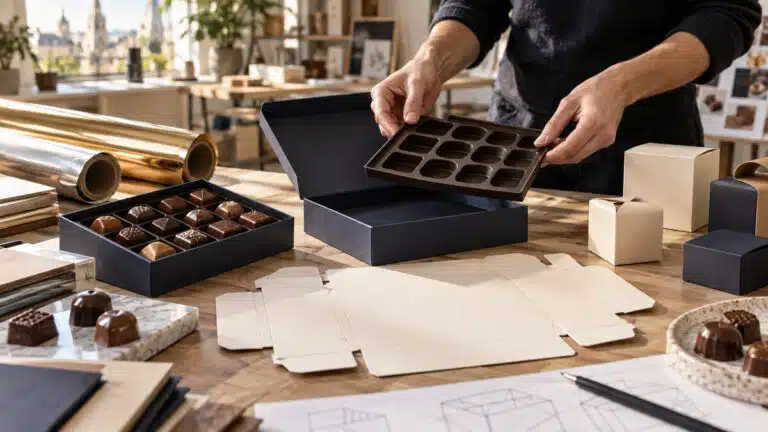

Confectionery packaging is a system of components. A chocolate assortment may need an insert, a printed carton, an inner wrap and a transport case, each produced by a different specialist. For supermarket own-brand teams and confectionery manufacturers sourcing in France, selecting the right capability matters more than choosing the largest packaging group.
This guide compares four France-based packaging businesses by the part of the project they can help address: Autajon for printed cartons and seasonal presentation, Velfor for shaped trays and inserts, LGR Packaging for secondary cardboard packaging, and Gascogne Flexible for flexible food-packaging materials.
Autajon and Velfor explicitly identify chocolate or confectionery applications in their official material. LGR and Gascogne are included as adjacent technical candidates with verified food-packaging capabilities, while final suitability depends on the specific confectionery product. The companies represent different parts of France’s confectionery packaging market rather than a market-share ranking.
For the wider industry, see our overview of French packaging companies. The focus here is the practical specification and sourcing of confectionery packs, rather than another general list of packaging businesses.
French confectionery packaging suppliers: compare by format
| Business | Verified capability | Evidence of scale | Qualification priority |
|---|---|---|---|
| Autajon | Chocolate and confectionery cartons, rigid boxes, promotional packs and Advent calendars | 42 global production sites and over 4,600 employees stated by the group | Identify the production site, construction and seasonal capacity |
| Velfor | Trays, moulds and supports for pastries, biscuits and chocolates | €34 million 2024 sales; website states 280 employees and seven subsidiaries | Validate cavities, material and food-contact use |
| LGR Packaging | Printed secondary cardboard packaging, rigid boxes and displays | Website states 12 European sites, 885 employees and €200 million turnover, without a financial year | Confirm confectionery application and factory allocation |
| Gascogne Flexible | Plain and printed flexible food-packaging laminates | Two specialised food-packaging sites identified in France and Germany | Test barrier and sealing performance for the actual product |
1. Autajon: printed cartons, gift boxes and seasonal formats
History and group footprint
Alain and Suzanne Autajon founded the business in Montélimar in 1964, initially making pharmaceutical folding cartons. Its history records the addition of Haubtmann in 1995, bringing further experience in cardboard packaging and point-of-sale materials, including confectionery applications.
The group now states that it operates 42 production sites worldwide and employs more than 4,600 people. These are group-wide figures across multiple markets. They are not French confectionery headcount or a measure of chocolate-packaging market share.
Autajon’s food and beverage offer explicitly covers chocolate and confectionery, with folding cartons, rigid boxes, labels and promotional packaging. Its separate Advent-calendar page describes several constructions, including rigid, folding, book-style and drawer formats.
When to shortlist Autajon
Autajon is relevant where the outer pack carries a substantial part of the product’s retail positioning: a premium assortment, seasonal gift box or structured calendar. Projects can involve only outer packaging or the coordination of several components, depending on the product format.
Ask for a physical prototype using the intended materials. A digitally rendered box can conceal practical problems with opening, insert fit, closure strength and assembly. For calendars, test every opening and the stability of the contents after transport.
The quotation should separate structural development, artwork preparation, tooling, production and any assembly work. Confirm where each activity takes place. A group’s international network can provide options, but commercial execution still depends on a named factory and an agreed contingency route.
For a seasonal launch, reserve time for retailer review and production trials before approving the final design. An elaborate finish has little commercial value if it introduces a bottleneck that prevents the pack reaching stores during its selling window.
2. Velfor: trays and inserts that protect the product
History, scale and capabilities
Velfor dates its experience to 1973 and describes itself as a family business principally based in the Auvergne-Rhône-Alpes region. Its headquarters contact is in Saint-Pal-de-Chalencon. The group’s website reports €34 million in sales for 2024 and lists 280 employees and seven subsidiaries; the latter two figures are presented without a separate reporting date.
Its food-industry page specifically identifies trays, moulds and supports for pastries, biscuits and chocolates. The wider group offers thermoforming, injection moulding, tooling and prototype development. Those capabilities make it relevant to the component that locates and protects individual confectionery pieces.
What to test before committing to tooling
Begin with product dimensions and tolerances. A chocolate piece is not always perfectly identical from batch to batch, and the insert must accommodate the agreed range without allowing excessive movement. Use production samples rather than an idealised model alone.
Assess loading and removal. The pack should be workable for the manufacturer and usable by the customer. An insert that grips too tightly may slow packing or damage a delicate surface; one that is too loose may fail in transit.
For a tray or insert intended to contact food, request the documentation appropriate to the exact material and intended conditions of use. A broad statement about recyclable or recycled materials does not establish suitability for every chocolate recipe, contact duration or storage condition.
Ask who owns the tooling, where it will be stored and what happens if the pack is discontinued. For repeat seasonal ranges, retaining usable tooling can be commercially important, but only if the product shape and packaging specification remain compatible.
3. LGR Packaging: secondary cartons and retail presentation
Operating scale and food-packaging role
LGR is a family-owned European printed-cardboard packaging business with a French base in Oyonnax. Its website lists 12 production sites across France, Belgium, Spain, Turkey and Poland. It also displays 885 employees and €200 million turnover without identifying a financial year, so these should be treated as company profile figures rather than dated annual results.
The company offers solidboard folding cartons, litho-laminated boxes, rigid boxes and displays. Its food-market material focuses on secondary packaging and design support, including compatibility with customers’ packing lines. That establishes relevant technical capability, while the proposed confectionery application still needs to be supported with suitable examples and evidence.
Where the commercial value may sit
LGR is a candidate for projects where the outer carton must balance print quality, physical protection and industrial handling. The brief should distinguish the consumer-facing box from the case used to move it through a retailer’s distribution network.
Specify how the pack will be filled, closed and displayed. A structure designed for manual assembly may behave differently on an automated line. Agree tolerances and run a trial at the intended speed before treating a sample approval as production approval.
For supermarket seasonal displays, include the finished case dimensions and shelf constraints from the outset. Changes made late to fit a retail fixture can alter board use, pallet quantities and unit cost.
Do not assume every group site produces every construction. LGR’s location directory distinguishes sites and capabilities. Ask the supplier to nominate the facility responsible for the order and explain how repeat colour and structural performance will be controlled.
4. Gascogne Flexible: materials for the inner packaging brief
Food-packaging footprint
Gascogne Flexible supplies multilayer packaging materials. Its official food page identifies two specialised sites: Dax in France for unprinted flexible packaging and a German site specialising in rotogravure printing on paper and film. It describes applications for dry, dehydrated and fatty foods, using plain or printed materials for formats such as sachets and lids.
The published laminate range includes paper, films and aluminium combinations, with different barrier and sealing layers. These are material capabilities, not an assurance that every listed laminate is suitable for confectionery. A chocolate, sugar confectionery or filled-product brief requires its own assessment.
How to qualify a flexible construction
Define the product and packing process before choosing a material. Tell the converter the product’s composition, intended shelf life, storage conditions, packing equipment and the current pack’s performance. If a barrier requirement is not yet known, agree a testing programme rather than specifying an attractive material by appearance.
Ask for trial reels that represent the proposed commercial construction. Record sealing performance, print behaviour, handling and the rate of rejects on the actual line. A laboratory sample cannot establish how a reel will perform through a full production shift.
Keep responsibility for shelf-life validation explicit. The material supplier can provide technical information, but the finished food, pack and distribution conditions must be considered together. A change that improves one packaging attribute may require other adjustments to maintain product quality.
For projects requiring French manufacture, confirm the origin of each operation. The company’s own description assigns different specialisms to France and Germany, which is relevant to lead times and sourcing claims.
Packaging formats reflect different confectionery needs
| Project | Components to define | Trial that should inform approval |
|---|---|---|
| Boxed chocolate assortment | Outer box, cavities, inner protection and transport case | Fit, movement, surface damage and opening experience |
| Wrapped bar or portion | Flexible material, seal and printed information | Line performance and finished-pack shelf-life validation |
| Advent calendar | Structure, individual compartments, retention and outer case | Transport, repeated opening and component assembly |
| Seasonal gift range | Decoration, common structural parts and SKU differences | Colour consistency, assembly time and delivery sequencing |
| Retail display pack | Shipping protection, opening features and shelf dimensions | Distribution handling and store replenishment trial |
Cost pressure extends beyond the printed box
A useful tender separates recurring unit cost from one-off development costs. Include tooling, printing preparation, samples, testing, assembly, storage and transport. Record minimum order quantities for each component: a low minimum for a carton does not resolve a much larger minimum for its custom insert.
Compare quotations at the same annual and batch volumes. Ask how price changes when a range is split across flavours, languages or seasonal designs. A shared structure may reduce complexity, while frequent artwork changes can add preparation and stock-management costs.
Include expected packing losses and assembly time in the trial evaluation. A slightly cheaper component can be more expensive in use if it causes stoppages or needs additional manual handling. Conversely, a premium finish should earn its place through the product’s commercial brief, not simply because it is available.
Food contact and environmental claims need precise evidence
Keep the bill of materials for the final pack. Identify which surfaces touch the food, which are separated by another layer and which are purely decorative. Ask the packaging and food technical teams to agree the documentation and validation needed for that exact construction.
Environmental language should be equally specific. Request evidence for the finished combination of board, films, inks, coatings, adhesives and inserts. Avoid transferring a claim about one component to the entire pack without checking the assumptions.
For French-market artwork, assign responsibility for reviewing the applicable sorting information and other packaging obligations. Agree who approves the final file and how changes are controlled. This is particularly important where the brand owner, converter and contract packer are different organisations.
Plan seasonal packs backwards from store delivery
Set the required retailer delivery date first. Work backwards through finished-goods packing, component delivery, production, artwork approval, trials and tooling. Ask each supplier to identify the point after which a change will affect cost or delivery.
Maintain a version-controlled specification that all component suppliers use. If the chocolate assortment changes, update the insert and outer pack together. If the pack size changes, recheck the transport case and pallet layout.
Agree a final quantity decision date and a policy for spare or obsolete components. Seasonal packaging can become unusable quickly once its selling window passes. The contract should state who owns residual stock and whether any elements can be reused for the next edition.
Key questions shaping packaging contracts
How does France’s confectionery packaging market differ by supplier?
The answer depends on the format. A printed gift box, a shaped chocolate insert and a flexible inner wrap require different capabilities. This shortlist is designed to support format-specific qualification, not declare one universal winner.
Are the revenue and employee figures confectionery-specific?
No. The figures in this guide describe the companies or groups at the stated scope. Comparable French confectionery-packaging revenue and market shares were not verified.
Can one supplier manage the complete pack?
Ask for an explicit scope of supply. A broad catalogue does not prove that tooling, inserts, filling, assembly and distribution are all included. Name the responsible party for each handover before placing the order.
Editor’s note: Official company capability pages and company figures were reviewed in September 2026. Undated profile figures are labelled accordingly. Final material suitability, food-contact evidence and performance require validation against the product and production process.