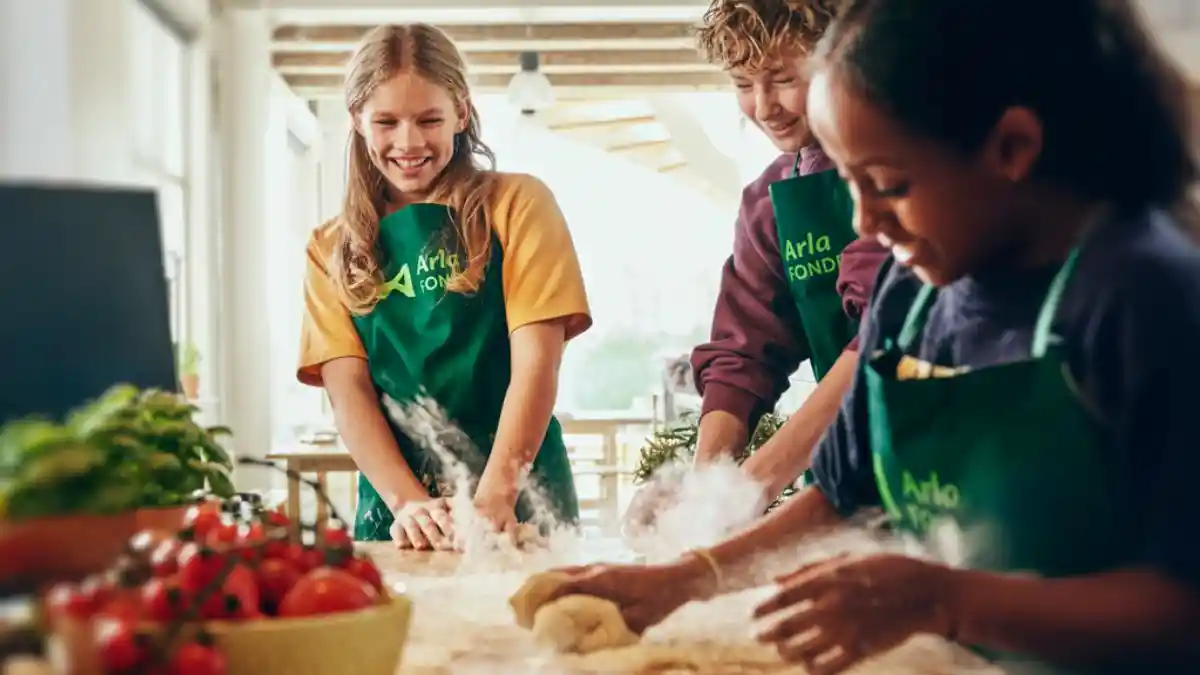

Arla Foods 2025 results show record revenue of €15.1 billion, the highest milk intake in its history at 14.3 billion kg, and a net profit of €415 million, as the farmer-owned cooperative navigated extreme dairy market volatility across Europe.
The Danish-headquartered dairy group delivered a performance price of 56.4 eurocent per kg of milk and proposed a supplementary payment of 2.2 eurocent per kg to its 7,600 farmer-owners.
What Are The Arla Foods 2025 Results?
The Arla Foods 2025 results refer to the company’s full-year financial and operational performance, including revenue, profit, milk intake, sustainability metrics and outlook guidance for 2026.
The cooperative achieved:
-
Revenue: €15.1bn (2024: €13.8bn)
-
Net profit: €415m
-
Milk intake: 14.3bn kg
-
Efficiency gains: €158m
-
Branded revenue growth: +6.9%
Why Did Arla Post Record Revenue In 2025?
Revenue growth was driven by three core factors:
First, strong commodity prices in early 2025 supported dairy value across Europe.
Second, record milk volumes increased total intake.
Third, the ingredients business delivered exceptional growth, particularly in value-added protein.
Arla Foods Ingredients increased revenue by 43.1% to €1.45 billion following strong demand and the integration of the former Volac whey business.
How did market conditions change during the year?
The year was split in two.
Early 2025 saw tight milk supply and firm pricing. But in the second half, exceptional weather and strong feed harvests across Europe triggered a sharp rise in milk volumes.
Milk supply rose significantly in key Arla markets including the UK (+7.7%) and Denmark (+3.6%) compared with 2024.
That surplus pushed global dairy prices lower and created pressure across the sector.
Despite this, Arla maintained stability due to its diversified business mix across retail, foodservice and ingredients.
How Did Arla’s Brands Perform?
Strategic branded revenue rose 6.9% to €7.0 billion.
Key retail brands include:
-
Arla
-
Lurpak
-
Puck
-
Castello
While inflation impacted volumes early in the year, purchasing power improved in the second half. Full-year branded volume growth reached 0.2%, with 1.8% growth in H2.
This signals stabilisation in European supermarket dairy demand.
What Investments Were Made In 2025?
Arla invested €731 million during the year.
Major projects include:
-
UHT Centre of Excellence in Lockerbie, Scotland
-
Expansion of Holstebro Dairy in Denmark (+16,000 tonnes cream cheese capacity)
-
Expansion of Puck® in Bahrain
-
New Skyr production line in Sweden
These investments focus on long-life milk, cream cheese and high-growth categories.
What Is The Status Of The DMK Merger?
Arla continues progressing its planned merger with DMK Group.
The merger was approved by both cooperatives’ Boards of Representatives in June 2025 and is currently under regulatory review.
Completion is expected in the first half of 2026.
The transaction would unite two of Europe’s largest dairy cooperatives and reshape the regional milk processing landscape.
How Did Sustainability Performance Evolve?
Arla reduced Scope 1 and 2 emissions by 5.6 percentage points in 2025.
Total reduction since 2015 now stands at 43.6%.
All European production sites operate on 100% renewable electricity.
On-farm emissions intensity per kg of milk declined by 0.4 percentage points, contributing to a 9.9% reduction versus the 2020 baseline.
However, higher milk volumes resulted in a 4.4% increase in Scope 3 FLAG emissions.
What Is The 2026 Outlook?
Arla expects lower global dairy prices to continue into early 2026 due to elevated milk supply across Europe.
Group revenue is forecast between €13.3bn and €14.1bn.
Net profit share is expected within the 2.8%–3.2% target range.
Efficiency savings of €90–110 million are targeted under its “Fund our Future” programme.
Lower dairy prices are expected to support consumer purchasing power, potentially strengthening supermarket dairy demand later in the year, particularly across key markets such as Sweden FMCG retail where branded dairy remains a core traffic driver.
For the European dairy sector, the Arla Foods 2025 results reflect both the peak of the commodity cycle and the beginning of a market correction phase.