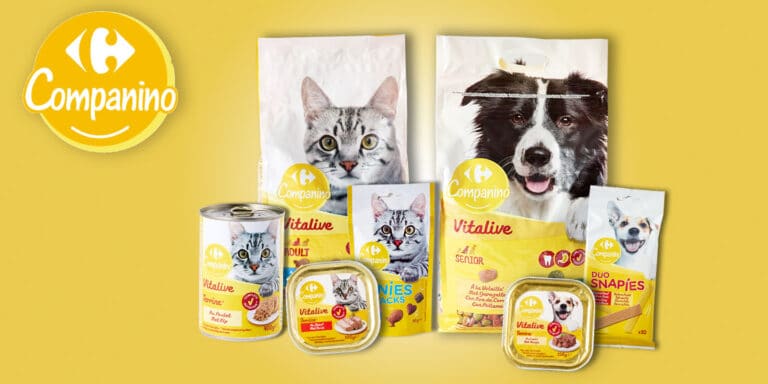

Carrefour Spain has doubled its pet-products range over two years to 1,400 items and is using predictive artificial intelligence to adapt the selection at individual supermarkets and hypermarkets.
The retailer disclosed the programme on 5 November 2026. It said its technology examines local demand to determine whether a catchment area has greater purchasing potential for dog, cat or other pet products.
The project extends beyond adding more products. Carrefour is using data-led category management to adjust the assortment offered in different locations, while expanding private-label food, specialist brands and in-store navigation.
How is Carrefour Spain using AI for pet products? Carrefour says its predictive analysis identifies a local ‘animal profile’ for the areas around its shops. The system is intended to distinguish neighbourhoods with stronger demand for dog products from areas where cat products, fish, birds or small-animal items are more relevant.
Those differences can help category teams decide which products deserve limited shelf space. The company did not identify the AI vendor, the data sources used, a rollout cost, or a measured improvement in sales or stock availability.
How many pet products does Carrefour Spain now stock? Its assortment has reached 1,400 references across own brands, exclusive ranges and third-party manufacturers. The figure represents the company’s stated overall range, not a guarantee that every store carries all 1,400 products.
| Pet-category development | Carrefour’s disclosed figure |
|---|---|
| Current pet assortment | 1,400 product references |
| Growth in range | Doubled over two years |
| New own-brand references in last year | 32 |
| Products with updated packaging or recipes | 20 |
| New specialist third-party references | More than 100 |
| Official announcement | 5 November 2026 |
What is changing in Carrefour’s own-label pet food? The retailer says it reviewed dog and cat food, wet and dry formats, snacks and hygiene products. During the previous year it launched 32 references and updated packaging or recipes for another 20 products. Carrefour said the formulations were reviewed by veterinarians and developed for different life stages.
The company has also introduced exclusive natural-positioned pet-food ranges called Miguau and Mimiau. Carrefour describes the products as made without meals or cereals and promotes their premium positioning. Such claims are the retailer’s own descriptions; they do not by themselves demonstrate that one type of pet food is nutritionally superior for every animal.
Alongside its store brands, Carrefour says it added more than 100 specialist manufacturer references. It names brands including Churu, Gentle Chef, Cocosi, Gimcat, Gruffies and Kat Kin.
For FMCG manufacturers, the new mix creates opportunities but also increases competition for shelf space. The total number of product references does not indicate how much each brand sells or how ranges will differ from store to store.
Why is this relevant to supermarket buyers? Pet food and care products are recurring-purchase categories with different consumer needs by animal type, pack size, price segment and life stage. Category planning that reflects local demand may help avoid stocking the same range everywhere.
However, the operating case remains to be proven. Carrefour has not supplied measurable conversion, margin, waste or forecast-accuracy improvements attributed to the predictive system. Those results would be necessary before claiming that the AI deployment improves profitability.
The announcement is a practical example of the changing Spanish supermarket market, where retailers combine own-brand investment, localisation and data-driven decisions. Carrefour’s use of predictive tools in pet care is a specific category application, not evidence that every department uses the same method.
What makes the AI approach commercially different? The headline assortment of 1,400 references is a group-level range. The practical question for category managers is how many of those products are allocated to each store, and how often local demand changes the planogram. Carrefour does not provide those store-level numbers or the model’s forecast accuracy.
An AI-led range decision can be tested against conventional merchandising through simple measures: sales per metre of shelf space, availability of the highest-demand packs, inventory turnover and lost sales from missing varieties. These are recommended evaluation measures, not results reported by Carrefour. Retailers would also need to separate genuine local demand from short-term promotions and seasonal changes.
The positioning of exclusive ranges matters for grocery suppliers. A manufacturer may gain distribution through a differentiated product while facing stronger competition from Carrefour’s own labels. More assortment references do not necessarily mean a larger total pet-care category in every outlet, particularly where shelf space is fixed. Carrefour has not disclosed its private-label share of pet sales or any changes to supplier commercial terms.
How large is Carrefour Spain’s store network? The company disclosed its format-level store network in the same announcement. Those figures should not be confused with the number of stores carrying a given pet-care product.
Across its formats, Carrefour reports 204 hypermarkets, 161 Carrefour Market supermarkets, 1,242 Carrefour Express stores and 71 Supeco sites. These are network figures, not the number of stores running an identical pet-care range. The release specifically identifies hypermarkets and supermarkets when describing the AI assortment process.
The retailer has also redesigned pet-product signage in its hypermarkets to help customers identify products for animals at different life stages. Its Club Mascotas loyalty offer includes benefits for eligible shoppers, including savings on some purchases and pet services.
For suppliers, the next question is how Carrefour will balance specialist national brands against growing own-label and exclusive ranges. The announcement does not specify new supplier tender dates, assortment acceptance criteria or planned category revenue.
Editor’s Note: Based on Carrefour Spain’s company announcement dated 5 November 2026, translated from Spanish. The report distinguishes declared product counts and AI capabilities from commercial outcomes that Carrefour has not publicly quantified.