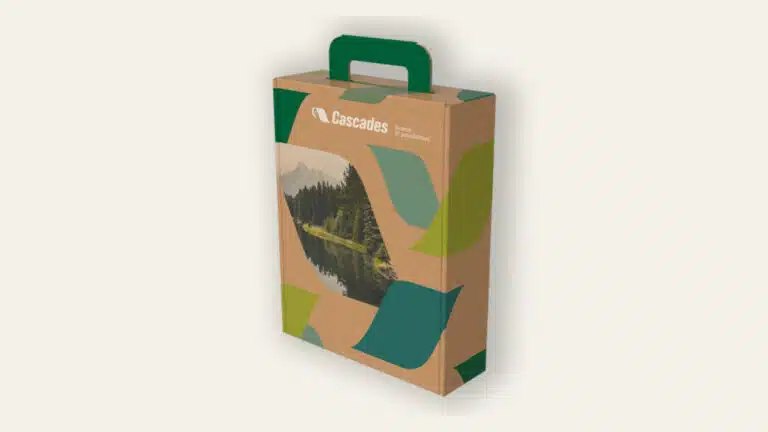

Cascades has launched lithoURB, a 100% recycled and recyclable brown paperboard developed for premium lithographic printing across corrugated and folding carton packaging.
The Canadian packaging group is positioning the material for food, beverage, fresh produce and consumer-goods suppliers that want a natural brown pack without accepting weak graphics or lower converting performance.
For supermarket and FMCG teams, that is the important commercial test. Recycled content can strengthen a pack’s environmental proposition, but the material must still reproduce brand colours, run reliably through converting equipment, protect the product and support claims that can withstand customer and regulatory scrutiny.
Cascades says lithoURB is intended to maintain print quality, mechanical performance and processing efficiency while replacing the virgin-fibre outer layers commonly used for premium litho-laminated packaging. The board is suitable for lithographic printing and lamination, where a printed sheet is bonded to corrugated material to combine shelf impact with transport strength.
Potential grocery applications include beverage multipacks, wraparound cases, bag-in-box formats, folding cartons, club-store packs and promotional packaging. The natural brown surface is designed to remain visible as part of the finished pack rather than being treated as a colour defect that needs to be hidden.
“Cascades lithoURB provides our customers with eco-friendly packaging—a key factor when choosing products in stores,” chief executive Hugues Simon said.
The claim is commercially relevant because many recycled boards force a trade-off between natural appearance and fine print reproduction. On a brown substrate, colours can appear darker or less saturated than they do on a white board, while photographic detail and small text may require tighter pre-press control.
Buyers should therefore request a production proof using the final artwork, inks, coatings and lamination structure rather than approve the change from a digital visual alone. Brand teams also need agreed colour tolerances because the tone of recycled fibre can vary between production batches.
Cascades says finished packaging made with lithoURB can qualify for FSC Mix or 100% recycled certification, is pre-qualified as recyclable under How2Recycle and can meet BRCGS food-safety requirements. Its supporting technical information also identifies FDA, Canadian Food Inspection Agency and Recycled Paperboard Technical Association credentials.
Those statements still need to be matched to the intended application. A certification held by the paper or converting site does not automatically establish that every completed pack is suitable for direct food contact. Retailers and manufacturers should obtain the food-contact declaration, migration evidence where required and a specification covering every coating, adhesive, ink, window and barrier added during conversion.
Cascades is already one of Canada’s largest packaging manufacturers, with a network of about 60 operating facilities and close to 9,000 employees across North America. That footprint gives the launch more commercial weight than a laboratory-only material announcement, although customers still need confirmation of grade availability, production sites, minimum orders and lead times.
The product enters a competitive recycled-paperboard market. Smurfit Westrock markets recycled brown grades for food and foodservice applications, while Graphic Packaging’s PaceSetter Ridgeline targets uncoated recycled-board demand. MM Group also sells recycled cartonboard with a natural brown reverse side. These are not identical specifications, but they give buyers alternatives against which to compare print finish, rigidity, fibre content, food-contact scope and total converted cost.
Procurement teams should test more than the paper price. A lower-impact board can become more expensive if it increases ink coverage, slows the folder-gluer, causes cracking on score lines or raises damage in distribution. Line speed, reject rate, adhesive cure, case compression and pallet stability should all form part of the commercial comparison.
Moisture is another category-specific risk. Produce, chilled food and refrigerated beverages can expose paperboard to condensation and changing humidity. Any coating or barrier used to manage that exposure must be evaluated for both performance and its effect on the final pack’s recyclability claim.
Retail presentation also matters. The move towards natural brown packaging can help organic, artisanal and sustainability-led ranges signal material choice at the shelf, but it can also make ranges look less consistent if only selected stock-keeping units change substrate. Category teams may need to decide whether lithoURB supports a single launch, a defined tier or a broader packaging architecture.
Cascades says the material has already received a sustainability award from The Shelby Report and was a finalist in two Retail Council of Canada sustainability categories. Awards may support market visibility, but buyers will ultimately judge the board on repeatable production data and the performance of the completed pack.
The launch gives grocery suppliers another route to raise recycled content without abandoning premium graphics. Its wider adoption will depend on whether live customer trials confirm that the visual result, packing-line efficiency and distribution performance remain strong enough to justify any price difference from established virgin-fibre and coated recycled grades.
Editor’s note: This article is based on Cascades’ product announcement published on 29 September 2026. Grocery Trade News added independent packaging-market, retail-procurement and converting analysis.