
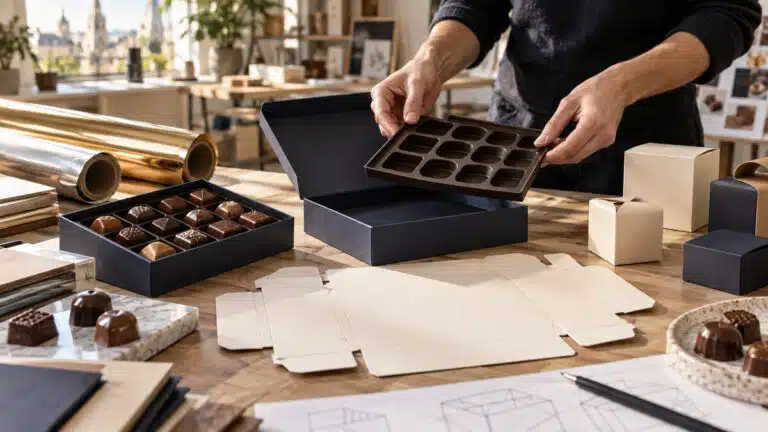

The Netherlands has a specialist confectionery packaging market that goes well beyond generic food boxes. Chocolate, pralines, bonbons, biscuits and seasonal sweets need packaging that protects delicate products, runs efficiently through production and still creates strong shelf presentation.
Five Dutch specialists stand out for direct confectionery relevance: MultiTray, Vrijdag, Kroese Exclusief, Chocoladeverpakkingen.nl and Nomi Co-Packing.
They serve different needs. MultiTray manufactures thermoformed chocolate trays and blisters. Vrijdag produces printed premium boxes and sleeves. Kroese specialises in luxury packaging for chocolatiers and pastry brands. Chocoladeverpakkingen.nl focuses on bespoke chocolate presentation packaging. Nomi is a specialist chocolate co-packer with more than 35 years of experience handling chocolate and chocolate-coated products.
: the Netherlands supports a credible Top 5 confectionery packaging shortlist without padding it with machinery-only suppliers. MultiTray is strongest in thermoformed inserts. Vrijdag and Kroese are strongest in premium printed cartons and gift packaging. Chocoladeverpakkingen.nl is a bespoke specialist. Nomi is strongest where the manufacturer needs the packing operation itself as well as the packaging format.
Top confectionery packaging suppliers in the Netherlands
| Supplier | Base | Main confectionery packaging | Scale indicator |
|---|---|---|---|
| MultiTray | Uden | Thermoformed bonbon trays, chocolate inserts and blisters | Own Dutch production and in-house mould making |
| Vrijdag | Eindhoven region | Printed chocolate boxes, sleeves and luxury cartons | Industrial production with prototype and high-volume capability |
| Kroese Exclusief | Heeze | Luxury chocolate, bonbon and pastry boxes | 60+ years; customers in 20+ countries |
| Chocoladeverpakkingen.nl | Stellendam | Bespoke chocolate boxes, sleeves and presentation packaging | 40+ years of packaging experience |
| Nomi Co-Packing | The Netherlands | Chocolate wrapping, multipacks, assortments and seasonal packs | 35+ years specialising in chocolate packing |
Why chocolate and confectionery need specialist packaging
Confectionery packaging has to do several jobs at once.
A chocolate bar needs protection from light, moisture, odours and handling. A bonbon assortment needs each piece held securely so it does not move and mark the neighbouring product. A seasonal gift pack needs to look premium without becoming too expensive to assemble.
Biscuits and wafers have another challenge: breakage.
Sugar confectionery can be less fragile but may need high-speed flow-wrap or bagging. Premium chocolates rely heavily on the opening experience and visual presentation.
This creates several technical questions:
- How much barrier does the product need?
- Does it need an insert or tray?
- Can the pack be filled automatically?
- Will the chocolate move during transport?
- Does the material tolerate the required temperature?
- Can the packaging be recycled?
- Does the box look premium enough for the price point?
- Can the supplier deliver seasonal volumes on time?
The Netherlands already has a broad packaging industry. This article narrows that market to suppliers with clear confectionery and chocolate expertise.
How we selected the five suppliers
We checked whether each business has direct, current confectionery capability.
To qualify, the supplier needed:
- clear chocolate, bonbon, sweet or pastry packaging expertise;
- a real Dutch operating base;
- current production or co-packing capability;
- more than generic packaging resale;
- enough information to verify its role.
Packaging machinery companies were excluded because that is a different buying decision.
1. MultiTray
MultiTray is one of the clearest Dutch specialists in thermoformed confectionery packaging.
The company develops and produces chocolate and bonbon packaging in the Netherlands.
What does MultiTray manufacture?
Its confectionery range includes:
- bonbon trays;
- chocolate inserts;
- blisters;
- thermoformed trays;
- custom cavities;
- premium clear presentation trays.
The main job of these packs is to hold each piece in the correct position.
That matters because premium chocolates can be damaged by movement. Decorative coatings, toppings and glossy surfaces can mark easily.
Own production and mould making
MultiTray says it has its own production and mould-making capability in the Netherlands.
This is important for custom projects.
A confectionery manufacturer may need an insert built around:
- the exact bonbon dimensions;
- the number of pieces;
- the box geometry;
- automatic loading equipment;
- the desired presentation.
In-house tooling can shorten development and reduce the number of companies involved.
Why thermoforming matters
Thermoformed trays can create precise cavities using relatively thin material.
For chocolate, that can provide:
- product separation;
- protection;
- visibility;
- consistent placement;
- fast packing.
The key is to avoid unnecessary material.
A tray should use enough plastic or other material to protect the product without becoming over-engineered.
History, employees and revenue
MultiTray’s current public confectionery pages focus on product capability rather than corporate financial disclosure.
A reliable current annual revenue figure, employee count and company valuation were not published in the primary sources reviewed.
We therefore do not estimate them.
Market share
No independently verified percentage of the Dutch chocolate-tray market is public.
Why MultiTray matters
Its strongest advantage is technical specialisation.
A general carton supplier can make the outer box. MultiTray can solve the internal presentation and protection problem.
2. Vrijdag
Vrijdag is a Dutch print and packaging specialist with a dedicated chocolate packaging offer.
The company works with chocolate brands, professional pastry businesses and premium confectionery producers.
What does Vrijdag make?
The company’s chocolate packaging includes:
- chocolate boxes;
- bonbon boxes;
- sliding boxes;
- sleeves;
- printed cartons;
- limited-edition packaging;
- Easter and seasonal formats.
The focus is heavily on printed presentation.
Minimum order and industrial scale
Vrijdag’s public product information shows that some custom formats are designed for industrial volumes.
For example, its sliding boxes have a stated minimum order of around 10,000 units.
This gives buyers a useful signal.
Vrijdag is not only an artisan gift-box supplier. It can support larger confectionery programmes.
Prototype service
The company offers prototype and sample production before the final order.
This matters because packaging should be tested physically.
A digital artwork file cannot show:
- how the product sits inside;
- whether the box closes correctly;
- how the finish looks under store lighting;
- how strong the pack feels;
- whether the pack works on the packing line.
Chocolate presentation
Vrijdag emphasises brand identity and premium presentation.
This is especially important for:
- gift chocolate;
- premium tablets;
- truffles;
- bonbons;
- seasonal ranges.
The packaging has to justify the product’s price point.
Revenue, employees and valuation
Vrijdag is privately held.
Current annual revenue, workforce and independent company valuation were not publicly disclosed in the primary product material reviewed.
Market share
No verified Dutch confectionery packaging share is available.
Why Vrijdag matters
Its strength is combining industrial print with premium presentation.
A brand can move from a prototype to a large printed production run without changing the entire packaging concept.
3. Kroese Exclusief
Kroese Exclusief is a Dutch specialist in luxury packaging for chocolate, pastry and premium food products.
The company has more than 60 years of experience.
Head office
Kroese is based in Heeze in the Netherlands.
The company works business-to-business and does not position itself as a consumer packaging shop.
International reach
Kroese says it supplies customers in more than 20 countries.
This gives the company a wider commercial footprint than a local chocolatier packaging wholesaler.
What does Kroese supply?
Its product range includes:
- luxury bonbon boxes;
- chocolate boxes;
- transparent presentation boxes;
- gift packaging;
- pastry packaging;
- bespoke boxes;
- seasonal packaging.
The business works with both artisan producers and larger production runs.
Why luxury packaging matters
Premium confectionery often competes as a gift as much as a food product.
The consumer evaluates:
- box weight;
- opening experience;
- colour;
- finish;
- window design;
- insert quality;
- reusability.
These details can change perceived value before the chocolate is tasted.
History, employees and revenue
Kroese publishes its long operating history and international reach but does not publish a current audited revenue or employee figure on the primary company pages reviewed.
Valuation and market share
The company is privately held.
No public valuation or independently verified Dutch market-share percentage is available.
Why Kroese matters
Its strongest position is premium confectionery and pastry presentation.
For chocolate brands competing in gifting, a specialist supplier can be more useful than a large generic packaging converter.
4. Chocoladeverpakkingen.nl
Chocoladeverpakkingen.nl is a Dutch specialist focused specifically on chocolate presentation packaging.
The business says its packaging experience dates back more than 40 years.
History
The company traces its packaging activity to 1985.
It began as a family business and developed into a specialist adviser and supplier for chocolate packaging.
Head office
The business operates from Stellendam in the Netherlands.
What does it offer?
Its capabilities include:
- bonbon boxes;
- window boxes;
- gift boxes;
- wrappers;
- shopping bags;
- custom printed packaging;
- bespoke chocolate presentation.
The company focuses heavily on customisation.
Why custom packaging matters
Small and mid-sized chocolate brands may not need 100,000 identical boxes.
They may need:
- shorter runs;
- brand-specific sleeves;
- seasonal artwork;
- premium materials;
- fast development.
A specialist can be more flexible than a large industrial converter.
Revenue and employees
The business does not publish current annual revenue or employee totals on the primary site reviewed.
Valuation and market share
No public valuation or market-share percentage is available.
Why it matters
The company fills the gap between stock packaging and very large industrial bespoke production.
That can be valuable for regional chocolatiers and premium brands.
5. Nomi Co-Packing
Nomi is different from the other four businesses.
It is primarily a co-packing specialist rather than a manufacturer of every packaging component.
It earns a place because chocolate packaging has been one of its core specialisms for more than 35 years.
What does Nomi do?
Nomi packs:
- chocolate;
- chocolate-coated products;
- single packs;
- multipacks;
- mixed assortments;
- bulk products;
- seasonal packs;
- promotional formats.
The company can work with the customer’s packaging or help select a suitable format and technique.
Why co-packing is a separate need
A confectionery company can have a finished chocolate product but lack:
- the right wrapping line;
- seasonal labour;
- multipack equipment;
- manual packing capacity;
- space for promotional work.
A co-packer solves the operational step between finished product and retail-ready case.
Seasonal confectionery
Chocolate has strong seasonal peaks.
Christmas, Easter, Valentine’s Day and promotional gifting can require short periods of intense packing activity.
Building permanent factory capacity for those peaks may not make economic sense.
Specialist co-packing can absorb that variation.
History, employees and revenue
Nomi’s public chocolate pages emphasise more than 35 years of chocolate packaging experience.
A current audited revenue figure, employee total and independent valuation were not disclosed on the primary material reviewed.
Market share
No Dutch chocolate co-packing share is publicly available.
Why Nomi matters
It provides a different type of supply-chain solution.
Packaging procurement is not complete until the product is actually packed, coded, checked and placed into cases.
How the five Dutch confectionery packaging specialists compare
| Supplier | Best fit | Main strength |
|---|---|---|
| MultiTray | Bonbon and chocolate inserts | In-house thermoforming and moulds |
| Vrijdag | Premium industrial cartons | Print, prototypes and larger runs |
| Kroese | Luxury chocolate and pastry packaging | 60+ years and international reach |
| Chocoladeverpakkingen.nl | Bespoke brand presentation | Custom specialist chocolate packaging |
| Nomi Co-Packing | Packing operations and seasonal projects | 35+ years in chocolate co-packing |
What should chocolate manufacturers check before choosing packaging?
Start with the product, not the box.
- Dimensions: measure the real product after production variation.
- Movement: decide whether each piece needs its own cavity.
- Barrier: check moisture, oxygen and odour protection.
- Temperature: chocolate is sensitive to heat.
- Line speed: confirm the format runs on existing equipment.
- Food contact: verify materials touching the product.
- Minimum order: seasonal ranges may need shorter runs.
- Assembly labour: complex boxes can be expensive to erect.
- Transport: test drop, vibration and stacking.
- Recycling: reduce unnecessary mixed materials.
Why inserts matter for bonbons
Bonbons are visually delicate.
If they move inside a box, they can:
- rub against each other;
- lose decoration;
- crack;
- leave chocolate marks;
- arrive misaligned.
A thermoformed insert can hold each piece separately.
MultiTray’s specialist role is particularly relevant here.
Rigid box or folding carton?
Rigid boxes create a premium feel but use more material and cost more to transport.
Folding cartons ship flat and can be more efficient.
The right choice depends on:
- retail price;
- gift positioning;
- volume;
- assembly process;
- sustainability targets.
What is the role of a co-packer?
A co-packer takes finished or semi-finished products and prepares them for retail.
Services can include:
- flow wrapping;
- cartoning;
- multipacking;
- assortment building;
- labelling;
- coding;
- case packing.
This can be especially useful for promotions and seasonal confectionery.
How important is packaging design?
Confectionery is highly visual.
A shopper may have only seconds to notice a product.
The pack needs to communicate:
- brand;
- flavour;
- product type;
- quality level;
- occasion;
- price position.
But packaging that looks good and performs badly on the packing line is still a bad design.
How should manufacturers test a new pack?
A useful test sequence includes:
- physical prototype;
- product fit;
- packing-line trial;
- seal test;
- transport test;
- shelf-life test;
- retail shelf review;
- consumer handling test.
Do not approve a pack only from a PDF artwork.
How is sustainability changing confectionery packaging?
European regulation and retailer targets are pushing packaging towards:
- less material;
- easier recycling;
- fewer unnecessary components;
- paper-based alternatives where technically suitable;
- recyclable mono-material plastics;
- lower transport volume.
GTN’s mono-material packaging supplier comparison covers companies developing more recyclable structures across Europe.
Is paper always better for chocolate packaging?
No.
Paper can be excellent for outer cartons and premium presentation.
Chocolate may still need an inner barrier or tray.
The environmental result depends on the whole system.
Replacing a light, effective plastic insert with a heavier mixed-material solution can create different trade-offs.
What is the best packaging for premium chocolates?
Premium boxes usually combine:
- strong printed outer presentation;
- precise internal trays or inserts;
- clean opening experience;
- high-quality finishing.
Kroese, Vrijdag and Chocoladeverpakkingen.nl are especially relevant for this type of project.
What is the best packaging for high-volume chocolate?
High-volume bars and pieces normally need simpler, faster formats.
Flow-wrap, cartons and automated multipacks are common.
The best supplier is the one that can meet line speed, barrier and cost requirements consistently.
Which supplier is best for bonbon trays?
MultiTray has the clearest specialist proposition for thermoformed bonbon and chocolate trays.
Which supplier is best for luxury boxes?
Kroese and Vrijdag both have strong premium box capability.
Chocoladeverpakkingen.nl is particularly relevant to bespoke chocolate presentation projects.
Which supplier is best for packing finished chocolate?
Nomi is the strongest fit in this list when the requirement is co-packing rather than only buying the packaging components.
How much does chocolate packaging cost?
There is no single useful price.
Cost depends on:
- material;
- size;
- print;
- tooling;
- finish;
- order volume;
- insert complexity;
- manual assembly;
- transport.
A standard printed folding carton can cost far less than a rigid magnetic gift box.
What information should a buyer send to a supplier?
A good packaging brief should include:
- product dimensions;
- product weight;
- annual volume;
- order quantity;
- packing line;
- desired materials;
- food-contact requirements;
- print colours;
- target cost;
- launch date;
- sustainability requirements.
The more precise the brief, the more useful the quotation.
Frequently asked questions
Does the Netherlands manufacture chocolate packaging?
Yes. Dutch companies manufacture thermoformed trays, printed cartons and other confectionery packaging, while specialist co-packers also handle chocolate packing.
Which company makes bonbon trays in the Netherlands?
MultiTray develops and produces thermoformed bonbon trays and chocolate inserts in the Netherlands.
Which Dutch company makes luxury chocolate boxes?
Kroese, Vrijdag and Chocoladeverpakkingen.nl all specialise in premium chocolate presentation packaging.
What is a chocolate co-packer?
A co-packer packages finished chocolate products on behalf of a manufacturer or brand owner.
Can Dutch suppliers make custom packaging?
Yes. All five companies in this comparison offer customisation in some form.
Do packaging suppliers provide prototypes?
Vrijdag explicitly offers prototype and sample services. Other bespoke suppliers also develop samples during the project process.
What is the minimum order?
It varies widely. Industrial printed formats can require thousands of units, while specialist stock-packaging suppliers may support much smaller quantities.
Can confectionery packaging be recyclable?
Yes, but recyclability depends on material combinations, coatings, windows, inserts and local collection systems.
Why do bonbon boxes use inserts?
Inserts stop individual chocolates moving, rubbing and losing their presentation during transport.
Should chocolate packaging be tested for shelf life?
Yes. The final package affects moisture, oxygen, odour and temperature exposure, so shelf-life testing should use the commercial packaging structure.
Editor’s Note: Packaging capability and company history were checked against current supplier information.








