
Spain has a strong confectionery packaging supply base covering flexible films, trays, rigid packs, folding cartons and premium chocolate boxes. The market serves chocolate, sweets, biscuits, nougat, bakery and snack manufacturers across Spain and export markets.
Five companies stand out for direct confectionery relevance and real packaging capability: Coverpan, Grupo Lantero, SPG, Guillin España and Evaristo Riera through its Chocobox range.
They cover very different needs. Coverpan specialises in flexible food packaging. Grupo Lantero combines rigid, flexible and cartonboard formats. SPG focuses heavily on flexible and rigid films. Guillin España supplies a broad food-packaging range with a strong confectionery specialism. Evaristo Riera and Chocobox specialise in premium boxes for chocolates and sweets.
: Spain has enough specialist suppliers for a credible Top 5 confectionery packaging list without padding it with packaging-machinery companies. The best choice depends on whether a manufacturer needs flow-wrap film, trays, rigid packs, folding cartons or premium presentation boxes.
Top confectionery packaging suppliers in Spain
| Company | Base | Main confectionery packaging | Scale indicator |
|---|---|---|---|
| Grupo Lantero | Madrid | Flexible films, trays, boxes and cartonboard | €650m+ annual revenue, 2,500+ employees, 28 industrial sites |
| SPG | Spain | Flexible and rigid films, flow-wrap, lidding, cold-seal | Five European factories; 40+ years in packaging |
| Coverpan | Spain | Flexible packaging, paper and compostable formats | Founded in 1993; international export activity |
| Guillin España | Near Barcelona | Confectionery, cake, snack and foodservice packaging | Operating since 2003; part of Groupe Guillin |
| Evaristo Riera / Chocobox | L’Hospitalet de Llobregat, Barcelona | Premium chocolate, sweet and gift boxes | Family packaging history dating to 1871 |
Why confectionery packaging needs specialist suppliers
Chocolate, sweets, biscuits and bakery products create very different packaging problems.
Chocolate can be sensitive to heat, light and odours. Biscuits need protection against breakage and moisture. Sugar confectionery often needs high-speed flexible packing. Premium chocolates may rely heavily on presentation and gifting.
This means confectionery packaging is not one product category.
A supplier may need to solve several issues at once:
- moisture barrier;
- oxygen barrier;
- grease resistance;
- heat sensitivity;
- print quality;
- high-speed sealing;
- product protection;
- retail presentation;
- recyclability;
- food-contact compliance.
Spain’s broad packaging industry already includes large paper, plastic and converting groups. Confectionery suppliers sit inside that larger market but need more specialised materials and formats.
How we selected the five suppliers
We did not include companies simply because they make packaging somewhere in Spain.
Each supplier needed clear evidence of serving chocolate, confectionery, sweets, biscuits, pastry, bakery or closely related snack categories.
We considered:
- Direct confectionery relevance.
- Spanish manufacturing or operating presence.
- Packaging material or pack production.
- Food-industry capability.
- History, scale and technical depth.
- Current product information.
Machinery-only companies were excluded from this ranking because they answer a different buying question.
1. Grupo Lantero
Grupo Lantero is the largest company in this comparison by disclosed group scale.
The Madrid-headquartered packaging group has spent more than seven decades building operations across rigid packaging, flexible packaging, cartonboard and graphic arts.
History
Grupo Lantero traces its origins to 1950, when José Lantero and his family began the business.
The group expanded through a long sequence of packaging businesses and acquisitions. Coexpan became an important rigid-packaging operation, Emsur developed flexible packaging, and Leca and other companies added folding-carton and premium packaging capability.
By 2025, the group marked 75 years of activity.
Head office, facilities and countries
Grupo Lantero’s corporate headquarters are in Madrid.
The group reports:
- more than 28 industrial sites;
- operations in more than 80 countries;
- more than 2,500 employees;
- industrial presence across more than 10 countries.
Revenue
The group’s 2025 sustainability reporting states annual revenue above €650 million.
This is group revenue, not revenue from confectionery packaging alone.
Grupo Lantero is privately held, so there is no public stock-market valuation. A current standalone valuation is not publicly disclosed.
What confectionery packaging does Grupo Lantero offer?
The group has a dedicated market segment for snacks, bakery and confectionery.
Its solutions include:
- flexible films;
- flow-wrap materials;
- trays;
- rigid food packaging;
- cartonboard boxes;
- printed packaging;
- custom formats.
This breadth makes Grupo Lantero relevant to manufacturers that need several packaging components from one group.
Why it matters to confectionery manufacturers
A chocolate or biscuit business may use flexible primary packaging and a cartonboard secondary pack.
Working with a supplier group that can cover both can simplify development and improve consistency.
However, buyers should still identify which Grupo Lantero business and factory will actually produce the pack. Group capability does not mean every plant makes every format.
Market share
Grupo Lantero does not publish a current percentage share of Spain’s confectionery packaging market.
Its scale clearly makes it one of Spain’s major packaging groups, but the confectionery market includes many formats that cannot be combined into one simple share calculation.
2. SPG
SPG is a specialist in flexible and rigid films for food packaging and has a strong technical fit with chocolate and confectionery.
The company began in 1985 as Plastienvase S.A. and celebrated its 40th anniversary in 2025.
History
SPG has developed from a Spanish flexible-packaging business into a wider European packaging group.
Its evolution has centred on extrusion, printing, lamination and converting technologies for the food industry.
Facilities
SPG says it operates five factories in Europe.
The company works with fresh, dry and frozen food manufacturers as well as selected non-food markets.
What does SPG manufacture?
Its packaging range includes:
- flexible films;
- rigid and semi-rigid films;
- flow-wrap structures;
- tray lidding;
- vertical bags;
- stand-up pouches;
- thermoforming films;
- digital, flexographic and rotogravure printing.
Chocolate and cold-seal packaging
SPG’s work with Delaviuda Confectionery Group shows why confectionery packaging needs specialist technology.
Chocolate can be damaged by excessive heat during sealing. SPG developed a cold-seal solution for Delaviuda so the packaging process could reduce heat around temperature-sensitive confectionery.
This is more useful evidence than a generic claim that the company “serves food”. It shows direct work on a confectionery production problem.
Employees and revenue
SPG does not publish a simple current group employee count or current annual revenue figure on the public corporate pages reviewed for this article.
We therefore do not estimate them.
The company is privately held, so a public stock-market valuation is not available.
Market share
A reliable percentage share of Spain’s confectionery flexible-packaging market is not publicly disclosed.
Why SPG matters
SPG is particularly relevant where line speed and sealing behaviour matter.
A wrapper that looks good but does not run consistently on a confectionery line can create waste, downtime and damaged product.
Manufacturers should test the packaging on the real line, at real speed, before committing to high volumes.
3. Coverpan
Coverpan is a Spanish manufacturer specialising in flexible food packaging.
The company was founded in 1993 by Francisco Menchén.
What does Coverpan manufacture?
Coverpan designs and manufactures flexible packaging for a wide range of food categories.
Its bakery and confectionery applications include packaging for:
- biscuits;
- sweets;
- cakes;
- pastries;
- nougat;
- shortbread;
- cereals;
- snacks;
- other bakery products.
It works with paper and film-based structures, including recyclable and compostable options.
Production technology
Coverpan lists capabilities including:
- flexographic printing up to eight colours;
- lamination;
- food-grade inks;
- paper-based packaging;
- high-barrier films;
- grease-resistant structures;
- custom packaging development.
Quality and certification
The company reports ISO 9001 certification and a Spanish sanitary registration for its food-packaging operation.
Food manufacturers should still check the exact material specification and food-contact declaration for each application.
Head office and exports
Coverpan operates from Spain and says it exports to markets across several continents.
The business has a dedicated export function and positions international expansion as part of its current strategy.
Employees and revenue
Current audited revenue, employee count and company valuation were not publicly disclosed on the primary company pages reviewed.
Market share
Coverpan does not publish a verified percentage share of Spain’s confectionery packaging market.
Why Coverpan matters
Its strength is flexibility and customisation.
Smaller confectionery and bakery manufacturers may not need the industrial scale of a multinational packaging group. They may value shorter development cycles, material flexibility and a supplier willing to customise structures.
4. Guillin España
Guillin España is a specialist food-packaging supplier operating near Barcelona.
The company was founded in 2003 and forms part of Groupe Guillin.
What does Guillin España supply?
Guillin España explicitly describes itself as a specialist in packaging for:
- confectionery;
- cakes;
- ready meals;
- snacks;
- take-away food.
It serves supermarkets, hypermarkets, commercial catering, traditional retail and the Spanish food industry.
Group support
The Spanish company benefits from the wider Guillin Group manufacturing network.
This can give it access to a larger product catalogue than a standalone local converter.
In 2020, Guillin España combined its sales team with sister company Thiolat, adding complementary cartonboard solutions to the range.
Head office and logistics
The company operates near Barcelona and emphasises fast logistics and distribution support for Spanish customers.
This can matter for packaging because empty packs occupy significant warehouse space. Reliable replenishment can reduce the amount of packaging inventory a manufacturer needs to hold.
Employees and revenue
The Spanish subsidiary does not publish a current standalone employee count, revenue figure or valuation on the public page reviewed.
Using Groupe Guillin’s total group figures as Spanish confectionery-packaging figures would be misleading, so we do not do that.
Market share
No reliable Spanish confectionery-packaging share is publicly disclosed.
Why Guillin España matters
Its value is the combination of specialist Spanish commercial support with a large group product range.
Confectionery businesses may need clear trays, hinged packs, bakery containers, cartonboard or mixed material solutions depending on the product.
5. Evaristo Riera / Chocobox
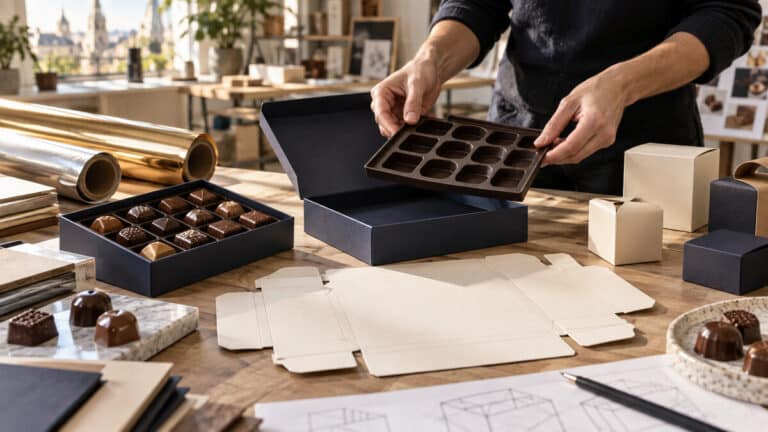
Evaristo Riera represents the premium end of Spain’s confectionery packaging market.
The Barcelona family business has manufactured lined cardboard boxes for chocolates and sweets since 1871.
History
The business began in Barcelona in 1871 and has passed through multiple generations of the same family.
Its long history is unusual in modern packaging.
Over time, the company developed premium presentation boxes and later expanded through brands including Chocobox and Encaja Packaging.
Head office
Evaristo Riera is based at Carretera del Mig in L’Hospitalet de Llobregat, Barcelona.
What is Chocobox?
Chocobox focuses specifically on packaging for:
- chocolates;
- bombons;
- sweets;
- pastry;
- gifts.
The range includes:
- folding cartons;
- clear-window boxes;
- rigid premium boxes;
- magnetic-close boxes;
- small-run formats;
- different colours and finishes.
Why premium boxes are different
Premium chocolate packaging does more than protect the product.
It can determine whether an item is positioned as everyday confectionery, seasonal gifting or luxury food.
Materials, opening experience, inserts, colour and finish all affect perceived value.
Employees, revenue and valuation
Evaristo Riera is privately held and does not publish current revenue, employee totals or company valuation on the public sources reviewed.
Market share
No verified percentage of the Spanish premium chocolate-box market is public.
Why Evaristo Riera matters
The company has a very clear specialist niche.
A manufacturer launching premium chocolates may get more value from a dedicated presentation-box specialist than from a high-volume flexible-film supplier.
How do the five Spanish confectionery packaging suppliers compare?
| Supplier | Best fit | Main strength |
|---|---|---|
| Grupo Lantero | Large multi-format confectionery businesses | Rigid, flexible and cartonboard capability |
| SPG | High-speed flexible packaging | Films, printing and cold-seal technology |
| Coverpan | Flexible food packaging and custom projects | Paper, film and sustainable structures |
| Guillin España | Retail confectionery, cakes and snacks | Broad food-packaging catalogue and logistics |
| Evaristo Riera / Chocobox | Premium chocolates and gifting | Specialist presentation boxes |
What packaging formats are used for confectionery?
Confectionery uses several different packaging formats.
- Flow-wrap: bars, biscuits and individually wrapped products.
- Pouches: sweets, chocolate pieces and sharing formats.
- Trays: chocolates, pastries and delicate products.
- Folding cartons: boxed chocolates, biscuits and seasonal gifts.
- Rigid boxes: premium confectionery.
- Twist wraps: individual sweets.
- Lidding films: trays and formed packs.
- Paper bags: bakery, sweets and specialist retail.
The correct format depends on the product, shelf life, line speed and price point.
What should confectionery manufacturers check before choosing a supplier?
- Product sensitivity: heat, moisture, oxygen and grease all matter.
- Line compatibility: the material must run at the required speed.
- Seal performance: weak seals create waste and shelf-life risk.
- Barrier: choose only the barrier level the product actually needs.
- Print quality: confectionery relies heavily on shelf impact.
- Food-contact compliance: verify the exact structure.
- Pack size: dimensions affect logistics and shelf efficiency.
- Recyclability: European packaging rules are tightening.
- Minimum order: especially important for seasonal products.
- Lead time: Christmas and Easter ranges have hard deadlines.
Why chocolate needs careful sealing
Chocolate is temperature sensitive.
Excess heat during packaging can damage appearance or leave residue around sealing areas.
This is why cold-seal technology can be valuable for certain products. It allows a film to seal without applying the same level of heat used in conventional heat sealing.
SPG’s work with Delaviuda is a practical example of packaging being adapted to the production process rather than forcing the product to fit a generic material.
What barrier properties does confectionery need?
Barrier requirements depend on the recipe.
Chocolate may need protection against moisture, oxygen, light and odours. Biscuits need moisture control to preserve crispness. Nuts can require oxygen protection because fats can become rancid.
Higher barrier is not always better.
Extra layers can add cost and make recycling more difficult. The goal is the minimum structure that reliably protects the product through its real shelf life.
How important is packaging design?
Very important.
Confectionery is often bought on impulse or as a gift.
Colour, shape, finish and visibility can influence whether shoppers notice a product.
But design has to work with production.
A premium box that is slow to assemble can create labour cost. A beautiful wrapper that jams on the line can destroy efficiency.
What is changing under European packaging rules?
European packaging rules are pushing manufacturers towards lower material use, better recyclability and clearer design for recycling.
Confectionery faces particular challenges because small packs, multilayer structures, metallised films and decorative elements can make recycling harder.
Suppliers are therefore developing:
- mono-material films;
- paper-based structures;
- lighter packs;
- recyclable trays;
- reduced plastic windows;
- alternative coatings;
- reusable or refill concepts in selected categories.
GTN’s wider mono-material food packaging supplier comparison looks at some of the companies developing those structures across Europe.
Paper or plastic for confectionery?
Neither is automatically better.
Paper can offer strong consumer acceptance and good print quality. Flexible plastic can provide excellent barrier with very low material weight.
The environmental result depends on:
- material weight;
- barrier requirement;
- recyclability;
- food waste;
- transport;
- manufacturing;
- local recycling systems.
A heavier paper structure can sometimes use more material than a thin film. A difficult-to-recycle laminate can create problems even when it is light.
How does packaging affect shelf life?
Packaging slows the movement of moisture, oxygen and aromas.
It also protects against physical damage and contamination.
For confectionery, shelf-life testing should use the final packaging structure, not only the unpacked product.
Changing a film thickness or barrier layer can change product performance.
How much does confectionery packaging cost?
There is no useful single price.
Cost depends on:
- material;
- dimensions;
- barrier;
- print colours;
- volume;
- finishes;
- tooling;
- lamination;
- delivery frequency;
- customisation.
Premium rigid boxes can cost many times more per unit than printed flexible film.
The right comparison is not simply cost per pack. Manufacturers should also consider line speed, waste, transport, shelf life and product value.
Which Spanish supplier is the largest?
Grupo Lantero is the largest company in this comparison by disclosed group revenue and employment.
It reports more than €650 million in annual revenue and more than 2,500 employees.
That does not mean it has the largest share of Spain’s confectionery packaging market. The group works across many packaging categories and countries.
Which supplier is best for premium chocolate boxes?
Evaristo Riera and Chocobox have the clearest specialist position in premium chocolate, sweet and gift boxes.
For large-scale flexible wrapping, other suppliers on this list may be more suitable.
Which supplier is best for flexible packaging?
SPG and Coverpan both have strong flexible-packaging capability.
Grupo Lantero also has significant flexible operations through its wider group structure.
The final decision should be based on the exact film structure, line trial and required volumes.
Which supplier works with supermarkets?
Guillin España explicitly supplies packaging used across supermarkets, hypermarkets and other food-retail channels.
The other suppliers also serve food manufacturers whose products ultimately sell through grocery retail.
How should manufacturers compare suppliers?
The simplest useful comparison is:
| Question | Why it matters |
|---|---|
| Can the supplier make the exact format? | A broad product catalogue does not guarantee the required specification |
| Has it packed similar confectionery? | Category experience reduces development risk |
| Can it support a line trial? | Real production is more important than a lab sample |
| What is the minimum order? | Seasonal confectionery often has shorter runs |
| What is the lead time? | Promotional deadlines cannot move easily |
| What certifications apply? | Food-contact and quality systems need evidence |
| How recyclable is the structure? | Regulation and retailer targets are changing |
Spain’s confectionery packaging market is deep enough to offer very different supplier types. The strongest procurement result comes from matching the supplier to the product, production line and retail positioning rather than choosing the largest name automatically.
Editor’s Note: Supplier capabilities and scale were checked against current company information.