
Serbia has a serious retail technology base. It includes global retail platforms with large engineering teams in Belgrade, Serbian fiscalisation specialists, regional ERP and point-of-sale providers and smaller local software companies building approved retail systems.
Five companies stand out for direct retail relevance and a genuine Serbian operating presence: NCR Voyix, Fiscal Solutions, Datalab SR, DignetSoftware and Boka Group.
They serve different parts of the retail stack. NCR Voyix operates at global enterprise scale. Fiscal Solutions specialises in fiscal compliance. Datalab and Dignet connect point of sale with ERP, stock and finance. Boka Group is a smaller Serbian engineering company with approved fiscal POS products.
: Serbia has enough real retail technology companies for a credible Top 5. The best supplier depends on whether a retailer needs enterprise checkout, fiscalisation, ERP, inventory, omnichannel software or a smaller local POS platform.
Top retail technology companies in Serbia
| Company | Serbian base | Main retail technology | Scale |
|---|---|---|---|
| NCR Voyix | Belgrade | POS, self-checkout, payments, commerce software | Global enterprise with a major Belgrade campus |
| Fiscal Solutions | Novi Sad | Fiscalisation software and retail compliance | 70+ fiscalisation projects in 26 countries |
| Datalab SR | Belgrade | PANTHEON Retail, ERP, POS, inventory | Serbian subsidiary of regional software group |
| DignetSoftware | Belgrade | LS Central, Dynamics 365, POS and e-commerce | Projects in 40+ countries through regional group |
| Boka Group | Belgrade | Cloud POS and fiscal receipt processing | Small Serbian engineering company |
Why retail technology matters in Serbia
Serbian grocery retailers operate in a market where checkout speed, fiscal compliance, stock control and promotions all need to work together.
A supermarket transaction looks simple to the shopper. Behind it, several systems may be working at the same time:
- point of sale;
- barcode scanning;
- weighing scales;
- fiscalisation;
- card payments;
- loyalty;
- promotions;
- inventory;
- ERP;
- e-commerce;
- analytics.
If those systems do not integrate well, stores create manual work and errors.
Retail technology also has to fit Serbia’s tax and fiscal rules. That makes local implementation expertise important even when the underlying software comes from an international vendor.
The country’s food and retail technology events also show how software, payment, store equipment and automation are increasingly part of the same grocery conversation.
How we selected the five companies
We did not simply search for Serbian software developers.
A company had to show direct retail capability in areas such as POS, fiscalisation, inventory, commerce or store systems.
We considered:
- Retail focus: the technology must solve a real store or retail-head-office problem.
- Serbian presence: local office, engineering team or company registration.
- Product depth: not just generic custom development.
- Current relevance: products and local operations must be active in 2026.
- Evidence: official company or regulator information where available.
That excludes many strong Serbian IT companies whose core work is not retail.
1. NCR Voyix
NCR Voyix is the largest company in this comparison by global retail technology scale.
The business develops technology used by retailers and restaurants around the world. Its portfolio includes point-of-sale software, self-checkout, payments and commerce systems.
History
NCR’s history stretches back to the nineteenth century, when the original National Cash Register business helped mechanise retail transactions.
The modern NCR business was later separated into two companies, with NCR Voyix focused on digital commerce and NCR Atleos focused on ATM-related operations.
That history matters because NCR has been connected to checkout technology for far longer than most modern software vendors.
Serbian headquarters and facilities
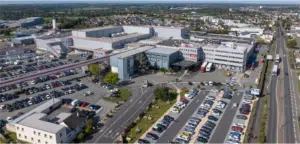
NCR Voyix operates a major campus in Belgrade at 1-3 Španskih Boraca Street.
The company describes the site as including:
- office space;
- customer demonstration space;
- engineering or product laboratory space;
- call-centre and centre-of-excellence functions.
This is more than a sales office. Serbia is part of NCR Voyix’s engineering and support footprint.
What does NCR Voyix provide to retailers?
NCR Voyix works across:
- point of sale;
- self-checkout;
- store software;
- payments;
- digital ordering;
- commerce platforms;
- retail services.
For supermarkets, the strongest relevance is front-end technology and store operations.
Employees
NCR Voyix does not publish a simple current employee number for the Belgrade campus on its public location page.
The global company has thousands of employees. Using a global workforce figure as a Serbian headcount would be misleading, so this article does not estimate local employment.
Revenue and valuation
NCR Voyix is publicly listed in the United States, so its market capitalisation changes daily.
Global company revenue is reported through public filings, but the Serbian campus does not publish standalone revenue. We therefore do not treat parent-company revenue as Serbian retail technology revenue.
Market share
NCR is a major global checkout and retail-technology provider, but a verified percentage share of Serbia’s supermarket technology market is not publicly disclosed.
Why NCR Voyix matters to Serbian grocery
Large supermarket chains need technology that can support thousands of transactions, many stores and complex integrations.
NCR’s advantage is enterprise depth. Its systems are designed for retailers with demanding uptime, integration and service requirements.
2. Fiscal Solutions
Fiscal Solutions is one of Serbia’s most specialised retail technology companies.
The Novi Sad business focuses on fiscalisation software and related technical services for retailers operating in countries with regulated electronic receipt and tax-reporting systems.
What does Fiscal Solutions do?
The company builds technology that helps retailers comply with fiscal rules.
Its work includes:
- fiscal middleware;
- country localisation;
- fiscal device integration;
- retail software compliance;
- technical support;
- fiscal regulation monitoring.
Fiscal compliance is easy to underestimate. A multinational retailer may run one global POS platform but face different receipt, signature, tax and reporting rules in every country.
History and scale
Fiscal Solutions says it has completed more than 70 fiscalisation projects across 26 fiscal countries.
That gives the Serbian company an international role far beyond its home market.
Head office
Fiscal Solutions is based at Temerinski put 50 in Novi Sad.
The company also holds ISO 9001 and ISO/IEC 27001 certifications, reflecting quality and information-security management.
Employees, revenue and valuation
The company does not publish current employee totals, revenue or a standalone valuation on the public materials reviewed for this article.
It is privately held, so there is no public market capitalisation.
Market share
No reliable percentage of Serbia’s fiscalisation-software market is publicly disclosed.
Why it matters to retailers
Fiscal Solutions solves a problem that can stop a checkout from legally trading.
A retailer can have good inventory and payment technology but still fail if fiscal receipts are not issued in the required format.
For cross-border retailers, a specialist that understands multiple national fiscal regimes can reduce localisation work.
3. Datalab SR
Datalab SR is the Serbian subsidiary of Datalab, the company behind PANTHEON business software.
PANTHEON is used for accounting, ERP, inventory, retail and other business processes across several countries in Southeast Europe.
History
Datalab has developed PANTHEON for more than two decades.
The group expanded through local subsidiaries, including Datalab SR in Serbia.
The Serbian company is led by managing director Borko Ristić.
Head office
Datalab SR is based at Bulevar Arsenija Čarnojevića 99V in New Belgrade.
What is PANTHEON Retail?
PANTHEON Retail connects checkout with wider business management.
Features include:
- POS receipts;
- inventory;
- customer records;
- price management;
- multiple tills;
- barcode scanners;
- fiscal printers;
- stock control;
- accounting integration;
- branch reporting.
Advanced versions can connect multiple retail locations and give managers a more centralised view of stock and sales.
Employees and users
Datalab states that PANTHEON is used by thousands of businesses across multiple countries.
A current employee count for the Serbian subsidiary was not clearly published in the official materials reviewed. We therefore do not estimate it.
Revenue and valuation
Datalab’s parent company is publicly listed, but Datalab SR’s current standalone revenue is not published on the product pages used for this article.
Parent group valuation should not be presented as the value of the Serbian subsidiary.
Market share
No independently verified current percentage share of Serbia’s retail ERP or POS market is publicly available.
Why Datalab matters to supermarkets
PANTHEON can suit retailers that want checkout, stock and accounting to work inside one broader business system.
This is especially relevant to small and mid-sized chains where maintaining separate enterprise platforms can create unnecessary complexity.
4. DignetSoftware
DignetSoftware operates a Serbian company in Belgrade and specialises in Microsoft-based ERP and retail technology.
The wider DignetSoftware group has companies in Croatia, Serbia, Bosnia and Herzegovina and Germany.
History
DignetSoftware was founded in 2010 and has expanded from regional Microsoft implementations into a wider European business-applications operation.
In 2025, DignetSoftware joined the DIGMATIX Group, expanding its reach within the Microsoft business-applications ecosystem.
Head office in Serbia
The Serbian operation is based at Mladena Mitrića 12 in Belgrade.
The broader group is headquartered in Zagreb, so it is important to distinguish the Serbian office from the parent operation.
What retail technology does Dignet provide?
Dignet implements:
- Microsoft Dynamics 365 Business Central;
- LS Central;
- LS One;
- e-commerce systems;
- business intelligence;
- retail and hospitality software.
LS Central is especially relevant to supermarkets because it can combine purchasing, warehouse management, CRM, store sales, promotions and financials.
International scale
Dignet says its wider group has delivered projects in more than 40 countries.
That international experience can matter for retail chains operating across the Adriatic and wider European region.
Employees, revenue and valuation
Current Serbian-subsidiary employee numbers and revenue were not publicly disclosed in the official materials reviewed.
A standalone valuation is also not public.
Market share
No verified Serbian retail-software market-share figure is available.
Why Dignet matters to grocery
Dignet is relevant where retailers want a Microsoft-centred technology stack.
The key question for a supermarket is integration. POS, ERP, promotions, purchasing and e-commerce need consistent product and price data.
5. Boka Group
Boka Group is much smaller than the other companies in this ranking, but it earns a place because its retail fiscal technology is current, Serbian and regulator-approved.
The Belgrade engineering company develops software products alongside wider IT services.
History and ownership
Boka Group is a privately owned Belgrade company led by owner and director Boris Jovanetić.
The company describes itself as a small engineering business where the people agreeing the work are close to the people writing the code.
Head office
Boka Group is based in Rakovica, Belgrade.
BokaPOS
In September 2026, Boka Group received Serbian Tax Administration approval for BokaPOS.
BokaPOS is a cloud ESIR designed for distance selling, including web shops, marketplaces and SaaS businesses.
It can connect through an API and also offers a WooCommerce plugin.
BokaLPFR
The company also received approval for BokaLPFR versions for Windows and macOS.
The product acts as a local fiscal receipt processor and can work offline before synchronising data when connectivity returns.
Employees, revenue and valuation
Boka Group does not publish current revenue, employee totals or valuation. It presents itself explicitly as a small company, and we do not attempt to turn that qualitative description into an invented headcount.
Market share
No market-share data is publicly available. The company is included because it represents a current generation of smaller Serbian fiscal-tech suppliers rather than because of national scale.
Why it matters to retail
Not every retailer needs enterprise software.
Smaller e-commerce businesses and specialist retailers may value simpler local fiscal tools that integrate with existing web platforms.
How do Serbia’s retail technology companies compare?
| Company | Best fit | Main strength |
|---|---|---|
| NCR Voyix | Large supermarket chains | Enterprise POS and checkout depth |
| Fiscal Solutions | Multi-country retailers | Fiscalisation expertise |
| Datalab SR | SME and mid-market retail | Integrated POS, inventory and accounting |
| DignetSoftware | Microsoft-based retail estates | LS Central and ERP integration |
| Boka Group | Smaller and online retailers | Local approved fiscal software |
What should supermarkets check before choosing retail technology?
Start with the business process, not the software demo.
- Checkout speed: how many transactions can the system handle?
- Offline operation: can stores keep trading if connectivity fails?
- Fiscal compliance: does the exact setup meet Serbian rules?
- Inventory accuracy: how quickly does stock update?
- Promotion logic: can the system handle complex offers?
- Scale integration: does weighing data flow correctly into POS?
- Loyalty: can customer offers work across store and online?
- ERP connection: are sales, purchasing and finance linked?
- Cybersecurity: how are credentials and payment data protected?
- Support: who answers when the system fails on a Saturday?
Why fiscalisation is central to Serbian retail technology
Serbia operates an electronic fiscalisation system.
Retail technology therefore has to do more than calculate a basket total. Transactions need to meet the tax authority’s technical requirements.
This creates a specialist market for fiscal processors, ESIR systems and integration software.
It also explains why Serbian companies such as Fiscal Solutions and Boka Group can compete around compliance rather than trying to build an entire supermarket ERP.
How important is self-checkout?
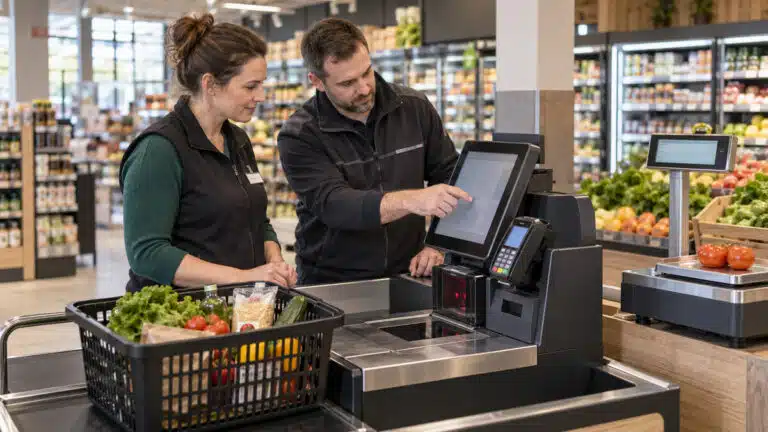
Self-checkout remains one of the most visible retail-technology changes in grocery.
It can increase front-end capacity without adding a conventional staffed till for every queue position.
But it creates other issues:
- shrink;
- age-restricted products;
- produce lookup;
- customer frustration;
- staff supervision;
- payment exceptions;
- basket verification.
The best self-checkout project is therefore not simply a hardware purchase. It needs software, loss-prevention controls and store-process redesign.
What role does AI play?
AI is moving into demand forecasting, computer vision, personalisation, fraud detection and customer service.
GTN’s comparison of AI demand forecasting platforms shows how forecasting technology is becoming a separate buying category within grocery retail.
Serbian retailers can use international AI platforms while relying on local integrators for ERP, fiscalisation and data connections.
Electronic shelf labels
Electronic shelf labels can reduce manual price changes and improve price accuracy.
The technology becomes more valuable when connected directly to the retailer’s central product and promotion system.
GTN’s electronic shelf label company comparison covers the major international providers.
For Serbian retailers, the local implementation partner still matters because network design, installation and system integration need support on the ground.
POS vs ERP: what is the difference?
The POS manages the transaction at the point of sale.
The ERP manages wider business processes such as purchasing, finance, inventory and reporting.
Modern retail platforms increasingly connect both.
A retailer can buy them from one vendor or integrate separate specialist products.
What is the best retail technology for a Serbian supermarket?
There is no single best platform.
A national chain may need enterprise checkout, central promotions and thousands of devices. A five-store regional retailer may need a much simpler POS and inventory system.
The correct decision depends on:
- store count;
- transaction volume;
- existing ERP;
- e-commerce;
- loyalty programme;
- IT team size;
- budget;
- growth plan.
Which company is the largest?
NCR Voyix is clearly the largest company in this ranking by global enterprise scale.
That does not mean it has the largest Serbian retail-software market share. Local revenue by retail segment is not publicly disclosed across all five companies, so a Serbian market-share ranking would be speculative.
Which company is most focused on fiscalisation?
Fiscal Solutions is the clearest specialist at international scale.
Boka Group also focuses strongly on Serbian fiscal software, particularly with its approved BokaPOS and BokaLPFR products.
Which companies provide full retail management?
Datalab SR and DignetSoftware provide broader retail management platforms that can connect POS with inventory, finance and other business processes.
NCR Voyix also provides broad enterprise retail technology, especially for large store estates.
What is changing next?
Retail technology in Serbia is moving towards more cloud software, more integration and more automation.
The key shift is not one device. It is the move from isolated systems to connected retail operations.
Checkout, e-commerce, inventory, promotions, forecasting and fiscalisation increasingly need to share the same data.
Retailers that solve that integration problem can make faster decisions and reduce manual work.
Editor’s Note: Company products and Serbian operations were checked against current official information.