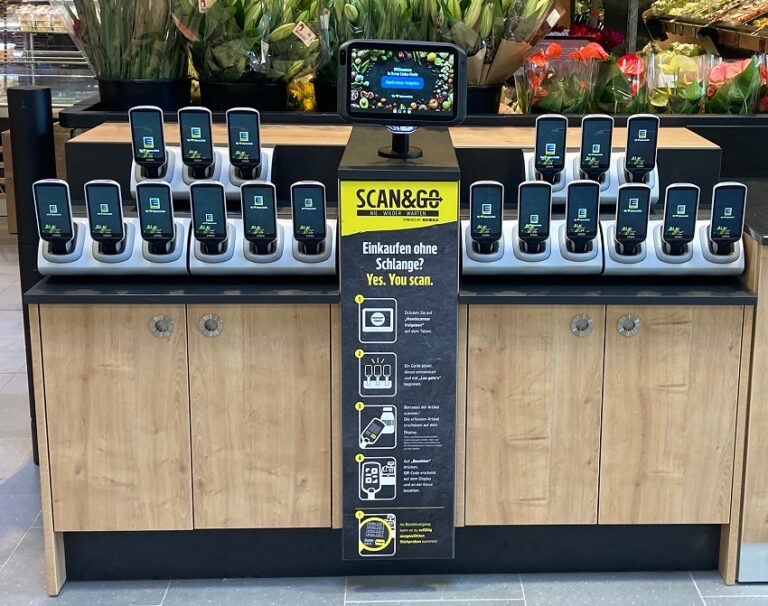

German supermarket operator EDEKA is introducing handheld Scan&Go shopping at EDEKA Center No. 1 in Berlin on Monday, 16 November 2026, allowing customers to scan products while they shop and complete payment without unloading every item onto a conventional checkout belt.
The service is being introduced at the Forum Steglitz shopping centre on Schloßstraße 1. EDEKA Minden-Hannover announced the launch on 13 November, presenting the system as an option for customers who want a quicker checkout process.
Shoppers first activate a handheld scanner using the tablet at its charging station. They can then scan each product before putting it into a trolley, basket or their own bag. The handset shows a running digital basket, enabling customers to monitor spending as they shop.
When shopping is complete, the handset generates a QR code. Customers present it at a staffed checkout or scan it at a self-service checkout before paying. EDEKA says common payment methods are supported, while the EDEKA app and PAYBACK card can still be used.
Unlike some mobile shopping systems, this setup does not require shoppers to register or install a separate app. That could make it easier for infrequent customers to try, although EDEKA has not released usage projections or customer adoption targets.
The launch is a practical retail-technology development rather than evidence of a checkout-free store. Payment still takes place at a checkout point, and the process depends on customers scanning their purchases correctly. Nor has EDEKA announced staffing reductions, a chain-wide rollout, measured queue-time savings or shrinkage data for this installation.
The operational distinction matters for buyers and store managers evaluating self-scanning: the technology shifts item-by-item scanning away from the end of the trip but does not remove the need for payment, store supervision and customer assistance. EDEKA said staff will be available to explain the handsets.
Market manager Christian Harting described the purpose as making shopping more convenient and reducing the need to unpack goods again at the checkout. His comments focus on the customer experience rather than a quantified productivity gain.
EDEKA is already one of the central forces in the German supermarket market, where regional structures and independently operated stores influence how new formats and services reach shoppers. Its scale also makes local trials relevant to wider discussions about the adoption of retail technology.
EDEKA Minden-Hannover reported external sales of about €12.43 billion and around 76,400 employees across its organisation, including independent retail. It says more than three-quarters of almost 1,500 stores are run by independent EDEKA merchants. The Berlin introduction should therefore be understood as a specific store launch, not a group-wide commitment.
The group’s purchasing relationships and operating model are covered more widely in GTN’s guide to European grocery buying alliances. For the Berlin location, the immediate next measure will be how comfortably customers adopt the new checkout journey after launch.
Editor’s note: Verified against EDEKA Minden-Hannover’s German-language announcement of 13 November 2026. GTN has translated the operational details into English and added context on checkout flow and the limits of the disclosed information.