
For years, FMCG negotiations in Ireland followed a familiar rhythm.
Annual meetings.
Trade terms.
Promotional pressure.
Volume promises traded for margin pain.
It was tense, but predictable.
That model is now breaking down.
Not because relationships have become hostile.
And not because retailers have suddenly become more aggressive.
It is changing because the economics underneath Irish grocery have shifted — quietly, structurally, and in ways that promotions alone can no longer fix.
Brands operating in Ireland are not renegotiating because they want to.
They are doing it because the old levers no longer work.
This article explains what is actually changing in Irish FMCG negotiations, why the centre of gravity has moved away from promotions, and what buyers now really want when they sit across the table.
The Irish FMCG context that most commentary skips
Ireland looks small on paper.
A compact population.
High supermarket concentration.
Strong private label presence.
Tight price competition.
But that simplicity hides a cost structure that has become unusually unforgiving.
Irish grocery sits at the intersection of several pressures that compound each other:
-
High labour costs by European standards
-
Island logistics and import dependency
-
Rising packaging compliance costs
-
Aggressive price sensitivity among shoppers
-
Limited room for margin recovery at shelf
This matters because negotiation behaviour always follows cost pressure.
When margins are elastic, negotiation is theatrical.
When margins are tight, negotiation becomes operational.
That is exactly what is happening now.
Why promotions stopped being the solution in Ireland
Promotions used to be the fastest way to resolve tension.
Retailers pushed for deeper discounts.
Brands complied to protect shelf space.
Both sides accepted the margin hit as temporary.
In Ireland, that logic has frayed.
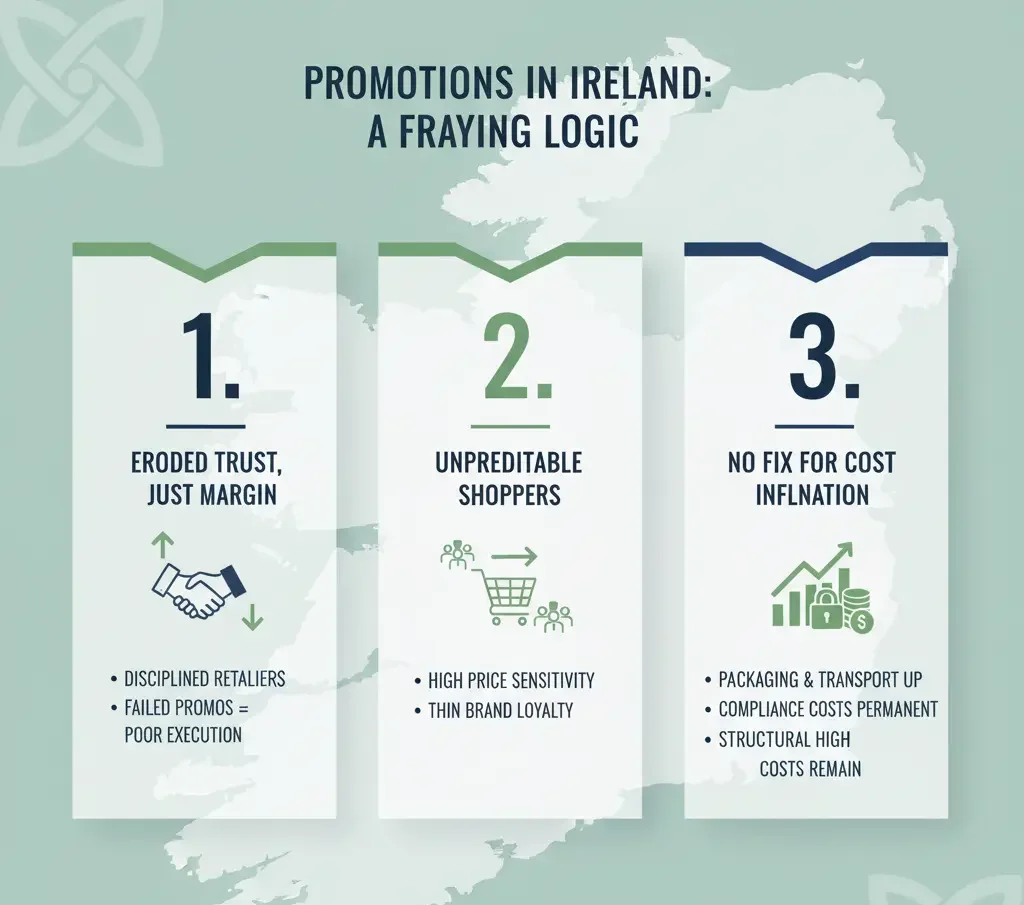
1. Promotions now erode trust, not just margin
Irish retailers have become far more disciplined about promo effectiveness.
Shorter runs.
Clearer volume expectations.
Less tolerance for underperforming mechanics.
A failed promotion no longer looks like “bad luck.”
It looks like poor execution or weak demand forecasting.
That changes the tone of negotiation.
2. Shoppers no longer behave predictably under discount
Price sensitivity is high, but loyalty is thin.
Irish shoppers will chase value — but they will not necessarily stay with the brand after the deal ends.
That makes deep promotions risky.
Retailers know this.
Brands feel it.
So both sides are more cautious about using promotions as a blunt tool.
3. Promotions don’t fix structural cost inflation
Packaging costs have risen.
Transport costs remain elevated.
Compliance has become permanent, not cyclical.
No amount of promotional activity offsets a structurally higher cost base.
That reality has forced negotiations to move upstream.
The quiet power shift in Irish supermarkets
Much of the public conversation frames negotiation as “retailer dominance.”
That misses the point.
The real shift is not about power — it is about control of execution.
Irish supermarkets now prioritise:
-
Shelf availability
-
Range clarity
-
Price accuracy
-
Supply reliability
These are operational concerns, not commercial theatre.
Retailers are less interested in how hard a brand can discount and more interested in whether it can execute consistently in a tight system.
That changes who has leverage.
The new centre of negotiation: execution, not discounts
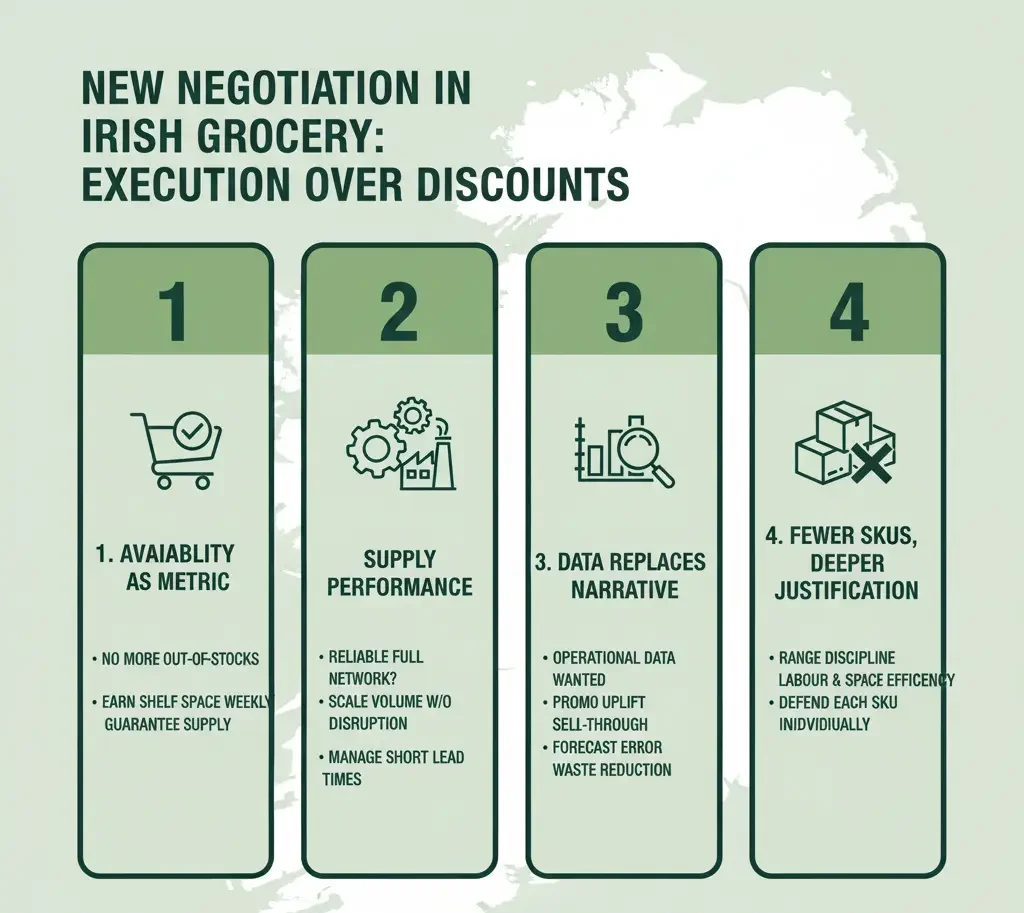
Across Irish grocery, the strongest negotiations now revolve around four areas.
Availability as a commercial metric
Out-of-stocks used to be tolerated as “operational noise.”
They are now treated as commercial failure.
Irish retailers operate lean ranges.
When a SKU is listed, it must earn its place every week.
Brands that cannot guarantee availability — especially during seasonal or promotional spikes — lose credibility fast.
Availability is no longer a hygiene factor.
It is a negotiation lever.
Supply performance beats historic brand strength
Heritage still matters in Ireland.
But it no longer protects weak execution.
Retail buyers increasingly ask:
-
Can you service the full network reliably?
-
Can you scale volume without last-minute disruption?
-
Can you manage short lead times without margin renegotiation?
Brands that answer “yes” gain flexibility elsewhere.
Those that cannot find negotiations narrowing quickly.
Data replaces narrative
Storytelling used to dominate negotiation decks.
Market share slides.
Brand equity arguments.
Long-term consumer loyalty claims.
Today, Irish buyers want operational data:
-
Promo uplift accuracy
-
Store-level sell-through
-
Forecast error rates
-
Waste reduction evidence
The tone is practical, not adversarial.
If the data holds, the discussion moves forward.
If it does not, sentiment no longer saves the brand.
Fewer SKUs, deeper justification
Range discipline has become a defining feature of Irish grocery.
Retailers are under pressure to simplify.
Labour efficiency and space productivity demand it.
That means brands are no longer defending entire portfolios.
They are defending each SKU individually.
Negotiation now happens line by line, not brand by brand.
Why Ireland’s cost base forced this shift first
Many of these trends exist elsewhere in Europe.
They are sharper in Ireland for structural reasons.
Island logistics amplify every mistake
Forecast errors cost more.
Emergency transport costs more.
Supply interruptions have fewer alternatives.
Retailers cannot absorb this volatility indefinitely.
They now push that responsibility back to brands.
Packaging and compliance are permanent costs
Ireland’s alignment with EU packaging rules has turned compliance into a baseline cost, not a project.
Retailers increasingly ask brands to prove:
-
Packaging efficiency
-
Waste reduction
-
Readiness for future changes
This is not about sustainability messaging.
It is about risk management.
Labour pressure shifts focus to simplicity
With labour tight and expensive, Irish supermarkets value:
-
Easier handling
-
Cleaner ranges
-
Faster shelf replenishment
Brands that complicate store operations weaken their negotiating position, regardless of brand strength.
The end of “brand vs retailer” drama
Trade press often frames negotiation as conflict.
That framing is outdated.
What is happening in Ireland is more pragmatic.
Retailers are not trying to squeeze brands for sport.
Brands are not fighting to protect old privileges.
Both sides are adapting to a tighter system.
Negotiations feel different because expectations have changed.
Less emotion.
More metrics.
Fewer grand promises.
What buyers now ask for in Irish negotiations
This is where the shift becomes concrete.
Across categories, Irish buyers are asking more consistent questions than ever before.
Pack formats that match Irish households
Smaller households.
Higher price sensitivity.
Lower tolerance for waste.
Buyers increasingly challenge:
-
Oversized packs with poor rotation
-
Multipacks that distort pricing logic
-
Formats that increase shrink
Pack design is no longer a marketing decision alone.
It is a negotiation topic.
Clear price architecture
Irish retailers want ranges that make sense at shelf.
That means:
-
Fewer overlapping SKUs
-
Clear step-ups between tiers
-
No internal price cannibalisation
Brands that cannot explain their price ladder struggle to defend space.
ESG proof, not positioning
Sustainability claims are no longer enough.
Buyers want evidence:
-
Packaging reductions achieved
-
Measurable waste cuts
-
Real supply-chain changes
This is not about awards or campaigns.
It is about operational credibility.
Service levels under pressure
Delivery windows.
Order accuracy.
Responsiveness during disruption.
These factors now sit alongside price and margin in negotiation outcomes.
Service failures are no longer “operational issues.”
They have commercial consequences.
Retailer media: the quiet new pressure point
Another shift rarely discussed openly is retailer media.
Irish supermarkets increasingly view retail media as a margin lever.
That changes negotiations in subtle ways.
Brands may face:
-
Pressure to support media activity
-
Tighter links between promo visibility and spend
-
Expectations of data-driven campaign planning
This does not replace trade terms.
But it adds a new layer to negotiation dynamics.
Brands that ignore this risk misreading buyer priorities.
Why fewer, deeper promotions are replacing constant deals
Promotions are not disappearing.
They are becoming more selective.
Irish retailers now favour:
-
Fewer events
-
Clear objectives
-
Better execution
This suits brands that can plan properly.
It punishes those reliant on constant discounting to maintain volume.
Negotiations increasingly focus on when to promote, not how often.
The real negotiation skill brands now need
The skills that win Irish FMCG negotiations today look different from five years ago.
They include:
-
Supply chain literacy
-
Data fluency
-
Operational honesty
-
Willingness to walk away from unviable SKUs
Aggressive trading tactics matter less than credibility.
Buyers respond to realism.
What this means for FMCG brands operating in Ireland
This shift is not temporary.
It reflects how Irish grocery now works.
Brands that adapt gain stability, even if margins remain tight.
Brands that cling to old models face:
-
Range erosion
-
Reduced promo support
-
Shorter negotiation windows
The new Irish FMCG negotiation playbook is quieter, tougher, and more disciplined.
And once brands adjust, many find the relationship actually improves.
Clear expectations.
Fewer surprises.
Better long-term planning.
Conclusion: negotiation in Ireland has grown up
FMCG brands are not changing how they negotiate in Ireland because retailers demanded it.
They are doing it because the system forced maturity.
Promotions stopped solving problems.
Cost pressures became permanent.
Execution replaced rhetoric.
The negotiation table has not disappeared.
It has simply moved.
Away from drama.
Away from volume games.
Toward clarity, discipline, and shared realism.
For brands willing to adapt, Ireland remains a demanding — but fair — market.
For those waiting for the old playbook to return, it won’t.
And that is not a threat.
It is the new operating reality.