
The past two years have reshaped how French retailers manage their private label strategies. Inflation may be easing, but its effects remain visible in store aisles. Consumers are still cautious, looking for products that meet the same standards as national brands but at a lower price.
Retailers in France — from Carrefour and Leclerc to Intermarché and Système U — have adapted quickly.
They’ve restructured their own-brand ranges, improved quality control, and highlighted local sourcing.
The result is a market that feels both more mature and more complex.
Private labels now account for around one-third of all grocery sales in France. That share has held steady even as branded products launched new discounts and loyalty incentives. The change isn’t just about price anymore — it’s about trust and long-term value.
Note: Before we start, we remind you that all information in this article is based on verified data from INSEE (2024 Retail Statistics), NielsenIQ France (2024 Market Report), and trade analysis by LSA Commerce & Consommation and PLMA Europe.
A New Consumer Reality
French households continue to adapt to tighter budgets. According to NielsenIQ, the average French shopper bought fewer products in 2024 but spent more overall. Price increases changed priorities. So did product perception.
Private labels benefited directly. Consumers learned that store brands often matched branded products in both quality and reliability. Retailers strengthened that perception by improving packaging design, sourcing transparency, and ingredient lists.
This shift has moved store brands from the “budget choice” category into a respected middle ground — reliable, consistent, and local.
Retailers At The Center Of The Shift
The major French retail groups have become the driving force behind this transformation.
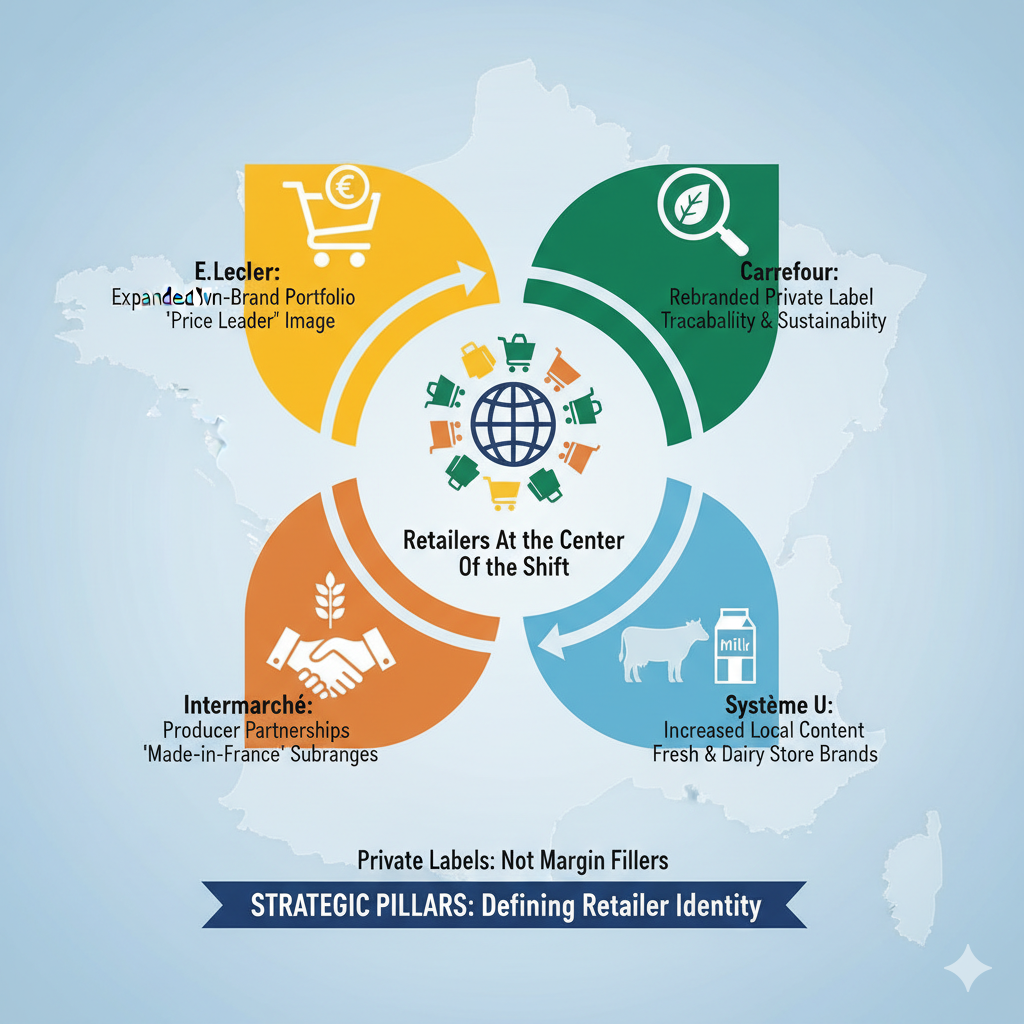
E.Leclerc expanded its own-brand portfolio to reinforce its image as the “price leader.”
Carrefour focused on rebranding its main private label line to highlight traceability and sustainability.
Intermarché, with its strong producer partnerships, deepened ties with regional suppliers to create new “made-in-France” subranges.
Meanwhile, Système U quietly increased the local content of its store brands, particularly in fresh and dairy.
These changes are not just competitive tactics. They reflect how French retailers now view private labels — not as margin fillers but as strategic pillars that define the retailer’s identity.
Tiered Store Brand Strategies
Most French supermarkets now operate with three levels of private label:
-
Entry-level economy lines, aimed at value-conscious households.
-
Core mid-tier brands, representing the bulk of assortment.
-
Premium private labels, designed to compete with national brands directly.
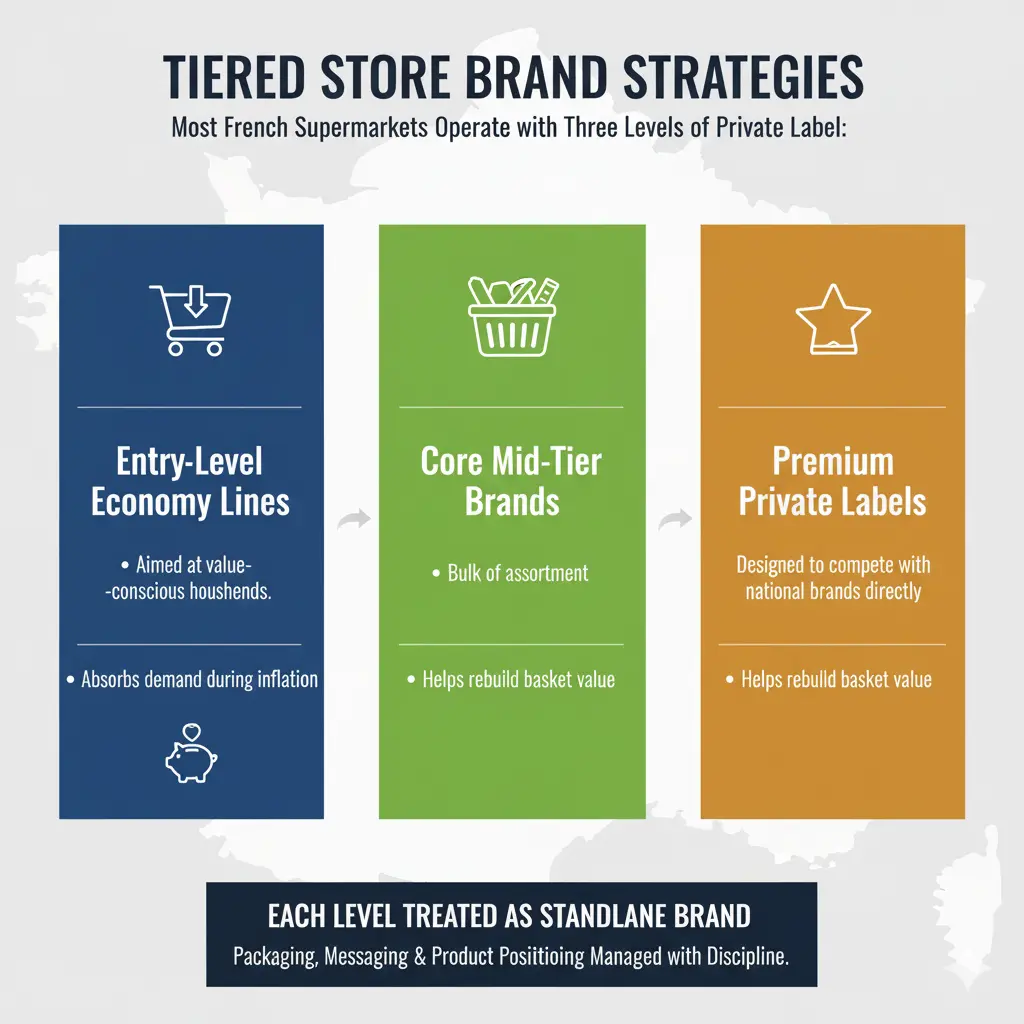
This structure allows flexibility. When inflation pressures rise, the economy tier absorbs demand.
When confidence returns, the mid and premium tiers help rebuild basket value.
Retailers treat each level as a standalone brand. Packaging, messaging, and product positioning are managed with the same discipline as external suppliers.
Local Partnerships Gain Momentum
One of the most visible trends in the French private label market is local sourcing.
Retailers are signing more contracts with regional cooperatives and family-owned producers.
For example, Intermarché’s long-standing connection with dairy cooperatives has helped secure stable prices and reliable supply through volatile periods.
Leclerc and Carrefour have also signed supplier charters promoting “Origine France” labeling.
It’s not just a marketing move — it’s a risk-control strategy.
Shorter supply chains mean faster reaction to cost fluctuations, fresher product delivery, and a narrative that resonates with consumers.
The French shopper cares deeply about provenance.
Retailers know that every “produit français” label carries emotional weight — especially in categories like dairy, bakery, and charcuterie.
The Role Of Sustainability
Sustainability remains central to private label development. Retailers have invested in recyclable packaging, simplified material use, and local logistics. However, this remains a balancing act between environmental ambition and cost management.
France’s 2024 environmental labeling regulations have pushed retailers to publish more details about product impact.
This transparency, though resource-intensive, adds long-term credibility to private label lines. Consumers increasingly link sustainability with brand responsibility — and store brands are now part of that expectation.
Suppliers Take On A Larger Role
Private label growth has opened new opportunities for French and European manufacturers.
Unlike a decade ago, private label producers today are long-term partners, not low-cost subcontractors.
They are involved early in product development, quality control, and packaging innovation.
Some manufacturers even operate under multi-retailer agreements, ensuring stable production volumes across markets.
This model benefits both sides:
Retailers get reliability, and manufacturers secure predictability in demand.
In return, many suppliers gain visibility and influence within the category they produce for.
The French private label network now feels more like a connected ecosystem than a price-driven market.
Innovation Without The Hype
Innovation in private label once meant copying national brands at a lower price.
That era is over.
Today, innovation comes from rethinking existing products — improving recipes, cutting additives, or developing seasonal SKUs that match real demand.
Retailers are focusing on “useful innovation” rather than flashy launches.
This pragmatic approach aligns with consumer expectations during a cost-conscious period.
Prepared meals, frozen foods, and fresh bakery products are among the most active innovation areas.
Retailers adjust recipes quarterly, guided by feedback from their in-house testing programs and consumer data platforms.
Private Label In Fresh Categories
Fresh categories are the heartbeat of France’s grocery trade.
Retailers treat them as brand-defining spaces where quality perception starts.
Private label performance in fresh produce, meat, and dairy has grown faster than in ambient or beverage categories.
This growth reflects consumer trust in the retailer’s supply chain rather than the individual product logo.
In-store visibility also helps.
French retailers use private label branding on signage, shelf talkers, and packaging displays — creating a cohesive visual identity that reinforces quality perception.
Discounters Keep Pressure High
Hard-discounter chains such as Lidl and Aldi continue to influence the overall direction of the French private label market.
Their model — single-tier, high-turnover, minimal SKU complexity — has forced traditional retailers to streamline their assortments.
The difference now is that full-range retailers have adapted that simplicity into their mid-tier brands.
They aim for consistent quality, fast replenishment, and low shrink.
The line between “discounter” and “mainstream supermarket” is becoming less defined.
National Brands Push Back
National brands are not standing still.
They’ve responded with temporary price freezes, promotional bundles, and loyalty-driven incentives.
But the deeper challenge is maintaining differentiation in a market where private labels already meet 90% of essential needs.
Some manufacturers are exploring co-branding or producing for retailer lines to maintain production volumes.
Others focus on category leadership through innovation or packaging refreshes.
In every case, the message is clear: the balance of power in French grocery has shifted permanently.
Data-Led Retail Decisions
Retailers are relying more heavily on consumer data to guide their private label strategies.
Loyalty programs and digital receipts provide a continuous feedback loop.
This information helps identify which SKUs to retain, reformulate, or relaunch.
French retailers also track how price elasticity behaves across regions — urban vs rural, north vs south — and tailor assortments accordingly.
This level of precision was once reserved for national brand teams.
Now, it defines how private label decisions are made week to week.
Category-by-Category Strength
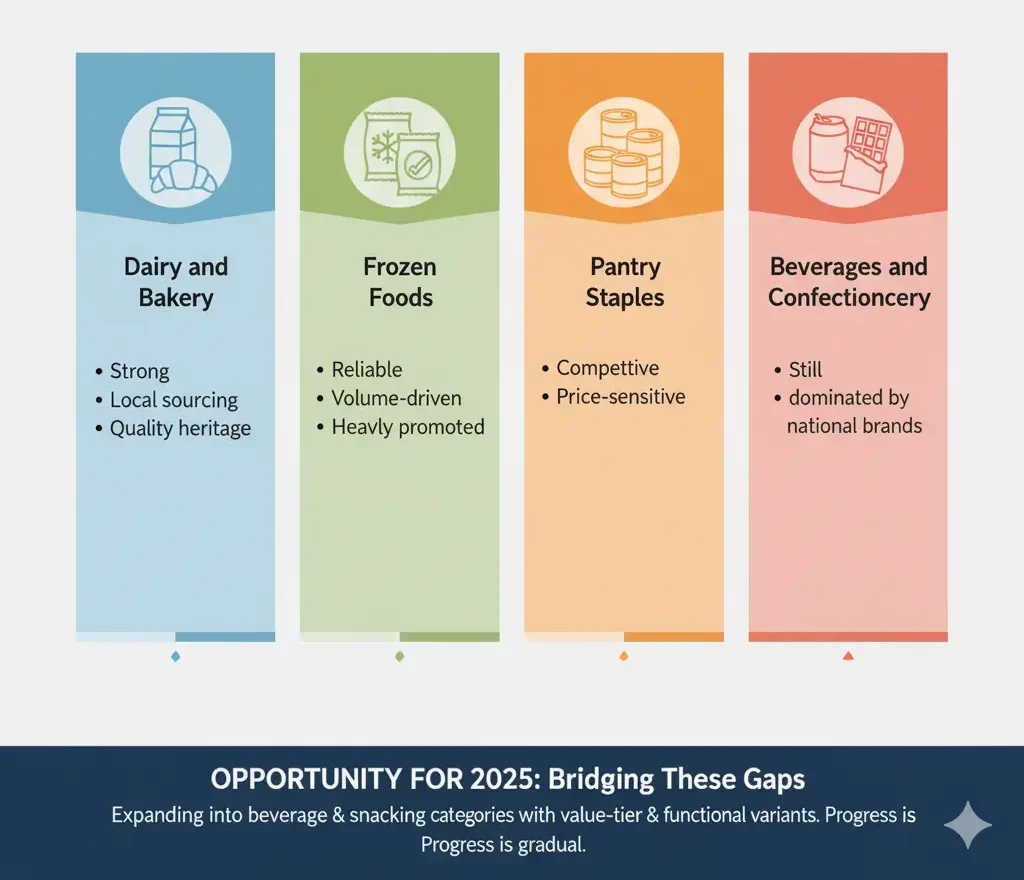
Private label penetration varies widely by department:
-
Dairy and bakery – strong, built on local sourcing and quality heritage.
-
Frozen foods – reliable, volume-driven, and heavily promoted.
-
Pantry staples – competitive, but price-sensitive.
-
Beverages and confectionery – still dominated by national brands.
The opportunity for 2025 lies in bridging these gaps.
Retailers are expanding into beverage and snacking categories with value-tier and functional variants, but progress is gradual.
Margin And Cost Balance
Retailers depend on private labels for stable margins.
However, raw material inflation and logistics costs remain volatile.
This has led to careful assortment pruning — removing underperforming SKUs and simplifying packaging formats.
Leclerc, for instance, has cut nearly 10% of its redundant private label SKUs since early 2024.
Other chains are following suit, prioritizing fewer but stronger subranges.
The goal is not just to cut costs — it’s to ensure efficiency without losing shelf presence.
What Comes Next
As inflation slows, competition will refocus on differentiation.
The French private label market in 2025 will likely stabilize rather than shrink.
Growth will depend more on consumer loyalty and product innovation than simple price advantage.
Retailers may introduce new themes — regional products, nutritional transparency, or even retailer “collections” highlighting French craftsmanship.
The boundaries between premium private label and national brands will continue to blur.
Ultimately, France’s food retail identity is tied to its producers.
Store brands are simply the latest reflection of that connection — modern, structured, and proudly French.
Closing View
Private labels in France have grown beyond their historical role.
They are now part of the national retail story — built on local trust, operational control, and long-term brand building.
Retailers aren’t just adapting to inflation.
They’re redefining what it means to own a brand in one of the world’s most competitive grocery markets.