
Frost, Kælitækni, Rými, AJ Vörulistinn, Boðtækni, Vöruvernd, LS Retail and StrongPoint provide equipment or technology relevant to grocery stores in Iceland. Their offers cover refrigeration, shelving, baskets, scales, barcode equipment, loss prevention and checkout systems.
For supermarket refrigerators and cold rooms, start with Frost and Kælitækni. For shelving, checkout counters and trolleys, assess Rými. AJ Vörulistinn lists shopping baskets, while Boðtækni supplies retail weighing and labelling equipment.
Vöruvernd covers store protection and shelf technology. LS Retail and StrongPoint have documented Icelandic grocery checkout references. Each supplier serves a different part of the store.
The selection is organised by buying category. It includes Icelandic suppliers and an overseas technology company with a named deployment in Iceland. The numbering is not a ranking by revenue or market share.
Grocery equipment suppliers in Iceland at a glance
| Supplier | Primary buying category | Icelandic presence or reference | Best starting enquiry |
|---|---|---|---|
| Frost | Supermarket refrigeration | Akureyri, Garðabær and Selfoss | Match the cabinet temperature range to the actual food category. |
| Kælitækni | Display refrigeration and cold rooms | Reykjavík | Separate the sales-floor cabinet specification from back-room storage requirements. |
| Rými | Supermarket shelving and shopfitting | Reykjavík | Supply a scaled floor plan and product category list. |
| AJ Vörulistinn | Shopping baskets and store handling equipment | Reykjavík | Check loaded weight, handle comfort and wheel performance. |
| Boðtækni | Retail scales, label printers and scanners | Hafnarfjörður | Check weighing capacity, accuracy and suitability for the intended sales use. |
| Vöruvernd | Loss prevention and shelf technology | Hafnarfjörður | Trial tags on the intended packaging and product categories. |
| LS Retail | Grocery POS and store software | Iceland-headquartered | Run weighted produce, promotions, returns and reduced-price items. |
| StrongPoint | Supermarket self-checkouts | Documented Prís deployment | Test produce recognition, interventions and POS links |
Which equipment does a grocery store need?
A grocery equipment order normally combines several specialist contracts. Refrigeration must protect the food. Fixtures must carry the assortment. Checkout systems must charge the correct price and record the sale.
- Chilled and frozen food: display fridges, freezers, cold rooms and temperature monitoring.
- Ambient groceries: shelving, gondolas, shelf-edge strips and promotional displays.
- Customer handling: baskets, trolleys, entrance gates and checkout counters.
- Loose and packed food: weighing scales, label printers and barcode scanners.
- Checkout: POS software, terminals, payment devices and self-service equipment.
- Store protection: product tags, deactivators and appropriate loss-prevention systems.
A new store needs an integrated layout. A refurbishment may need only one category. Define the scope before asking a general equipment supplier and a specialist installer to quote for different work.
1. Frost — supermarket refrigeration
- Company: Kælismiðjan Frost ehf..
- Head office: Fjölnisgata 4b, Akureyri.
- Other listed Icelandic locations: Garðabær and Selfoss.
- History: Refrigeration operations under Frost since 1993.
- Grocery reference: FREOR equipment installation at Krónan in Akranes.
Frost designs, installs and services refrigeration systems. Its offer explicitly includes supermarkets, wholesalers and distribution businesses.
The company supplies FREOR commercial refrigeration equipment. The manufacturer’s Krónan Akranes case identifies Frost as the Icelandic installation partner.
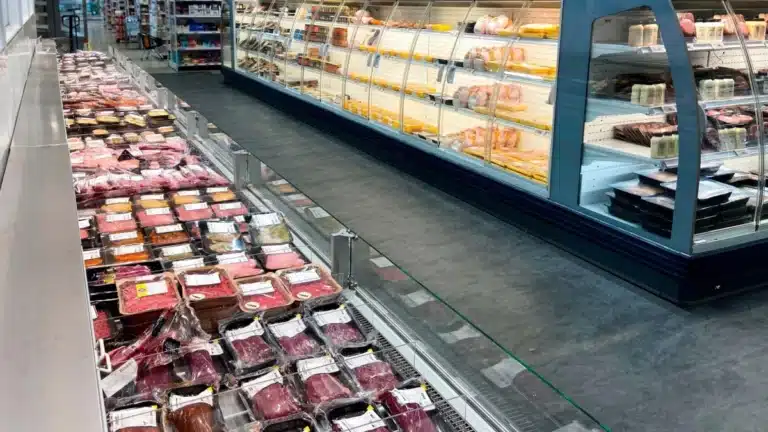
The documented project includes multideck chillers, self-service meat displays, freezer islands and upright freezers. This provides a concrete supermarket reference.
Frost also advertises system monitoring. Buyers should obtain a contract specifying which alarms are monitored and who responds outside normal working hours.
What to check before ordering
- Match the cabinet temperature range to the actual food category.
- Request measured or declared energy data for the proposed model and operating conditions.
- Confirm local spare parts, call-out arrangements and maintenance costs.
- Agree commissioning tests and temperature-alarm escalation.
Commercial consideration: For a store refurbishment, coordinate cabinet dimensions, power, drainage and heat rejection before approving the shop layout.
2. Kælitækni — display refrigeration and cold rooms
- Base: Járnháls 2, Reykjavík.
- Business history: The company traces its operations to 1962.
- Grocery offer: Display cabinets, refrigeration systems and cold rooms.
- Services: Design, installation, monitoring and maintenance.
- Ownership development: Its history records a new employee-led ownership structure in 2025.
Kælitækni has a dedicated supermarket and shop offer. Its published range separates display cabinets, refrigeration plant, cold rooms and monitoring.
The business began as a refrigeration service company and wholesaler. Its history describes a stronger wholesale focus from 1997 and renewed emphasis on service alongside wholesale from 2015.
For 2025, the company records 65% employee ownership and a 35% holding by Sjávarsýn. This is an ownership statement, not a measure of grocery-market share.
The supplier is relevant when a retailer needs a coordinated cold-chain project rather than a standalone display fridge.
What to check before ordering
- Separate the sales-floor cabinet specification from back-room storage requirements.
- Confirm the proposed refrigerant and the service capability for that system.
- Request controls, monitoring and maintenance as priced items.
- Check access, delivery route and installation responsibilities.
Commercial consideration: Compare the installed and maintained cost. A low cabinet price can be offset by unsuitable plant, commissioning work or slow repairs.
3. Rými — supermarket shelving and shopfitting
- Company: Rými Ofnasmiðjan ehf..
- Base: Gylfaflöt 4, Reykjavík.
- History: Roots in HF Ofnasmiðjan, established in 1936.
- Ownership milestone: Current owners entered the business in 2012.
- Grocery equipment: Shelving, checkout counters, trolleys, baskets and entrance gates.
Rými publishes a dedicated grocery-store fitting offer. It covers wall shelving, central gondolas, checkout areas and product presentation.
The company names Umdasch, Wanzl, Marsanz and HL Display among its partners. It describes store planning, manufacturer coordination, delivery and installation.
Rými’s history begins with a metalworking predecessor. The 1936 date should therefore be understood as business heritage, rather than the registration date of every current legal entity.
HL Display identifies Rými as its Icelandic partner and lists a Reykjavík showroom. Its undated partner profile describes a 16-person team; this is not a confirmed current-year payroll figure.
What to check before ordering
- Supply a scaled floor plan and product category list.
- Confirm shelf loads, bay widths and replacement-part availability.
- Test trolley movement, checkout queues and replenishment routes.
- Agree who coordinates fixtures with refrigeration and other contractors.
Commercial consideration: Ask for an itemised layout quotation. Separate shelving, counters, baskets, transport and installation so later changes can be priced clearly.
4. AJ Vörulistinn — shopping baskets and store handling equipment
- Local contact location: Barðastaðir 1–5, Reykjavík.
- Local business identified: Bender ehf..
- Range: Shopping baskets, basket trolleys and workplace handling equipment.
- Basket sizes listed: 10, 27 and 55 litres.
- Group context: The AJ website dates the Swedish group’s origins to 1975.
AJ Vörulistinn has an Icelandic catalogue for shopping baskets and related handling equipment. It is a practical option for smaller replacement orders and store accessories.
The catalogue includes hand baskets and wheeled formats. Buyers should check the precise product rather than assume that every basket size uses the same handles or wheels.
The local contact details identify Bender. AJ’s Swedish group history and international catalogue should not be presented as the age or manufacturing capacity of the Icelandic operation.
For grocery stores, the useful comparison is durability, manoeuvrability and replenishment availability. A product listing does not establish local stock for a large chain order.
What to check before ordering
- Check loaded weight, handle comfort and wheel performance.
- Measure nesting height and the storage area at the entrance.
- Confirm cleaning guidance and replacement components.
- Obtain delivered prices and availability for the required quantity.
Commercial consideration: For a chain-wide basket change, trial the proposed format in one store before ordering the full quantity.
5. Boðtækni — retail scales, label printers and scanners
- Company: Boðtækni ehf..
- Base: Selhella 13, Hafnarfjörður.
- History: The company dates its activities to 2002.
- Grocery equipment: Retail scales, printers, labels and barcode scanners.
- Support: Workshop, spare parts and technical service.
Boðtækni’s published product categories include retail weighing, label printing, handheld computers and barcode scanning. Its project examples specifically mention scales and printing for retail.
These products connect physical food handling with product information. A deli scale, shelf label and receiving scanner perform different jobs and need separate specifications.
The supplier also offers labels for cold environments and other applications. Buyers should test the complete combination of printer, label material, adhesive and packaging.
Workshop support is relevant where a failed device interrupts receiving, packing or checkout. Obtain replacement and repair arrangements for the exact equipment ordered.
What to check before ordering
- Check weighing capacity, accuracy and suitability for the intended sales use.
- Test printed barcodes at the actual checkout.
- Test labels on chilled, frozen or damp packs as appropriate.
- Confirm compatibility with the product database and existing POS.
Commercial consideration: Use real products in the demonstration. Include variable-weight items, reduced-price labels and damaged or partially obscured barcodes.
6. Vöruvernd — loss prevention and shelf technology
- Base: Straumhella 17, Hafnarfjörður.
- Grocery offer: Product protection, shelf labels and merchandising equipment.
- Other systems: Cameras, RFID, entrance controls and people counting.
- Manufacturers named: Century, MTC and SENS Retail.
- Service model: The company describes advice, installation and continuing support.
Vöruvernd has a dedicated supermarket, food and beverage offer. It covers product protection, electronic shelf labels and shelf-presentation equipment.
Its published range includes security tags, deactivation equipment, shelf pushers and beverage merchandising. This makes it relevant to store operations beyond general building security.
The company’s grocery material discusses the difficulties of applying tags near moisture and metal shelving. Those conditions need testing with the actual products and fixtures.
An RFID demonstration for clothing should not be treated as proof that the same setup works across a food store. Ask for grocery-specific tests and an installation plan.
What to check before ordering
- Trial tags on the intended packaging and product categories.
- Test deactivation at staffed and self-service checkouts.
- Check shelf-label price updates against the POS record.
- Measure nuisance alarms and the staff response required.
Commercial consideration: Set a baseline for shrink and false alarms. Evaluate the system against measured losses and operating effort rather than a generic prevention claim.
7. LS Retail — grocery pos and store software
- Core platform: LS Central.
- Underlying business platform: Microsoft Dynamics 365 Business Central.
- Named Icelandic grocery reference: Bónus.
- Documented customer history: The Bónus case dates its use of LS Retail systems to 1996.
- Recent corporate development: A restructuring announcement dated 24 September 2026.
LS Retail belongs in this equipment-and-technology selection because its software runs grocery checkout and related store processes. It is the software layer, rather than a supplier of shelving or refrigeration.
Its Bónus case describes mobile inventory, self-checkout, self-scanning, payments and links to electronic shelf labels. It also describes expiry-linked discounting.
The case lists 33 stores. That is a customer figure in the case study, not LS Retail’s branch count or a current supermarket census.
On 24 September 2026, LS Retail announced plans to reduce its workforce by about 40 positions. Buyers should use dated workforce information and confirm the support arrangements for the proposed implementation.
What to check before ordering
- Run weighted produce, promotions, returns and reduced-price items.
- Test offline selling and reconciliation after reconnection.
- Check shelf prices against checkout prices.
- Identify the implementation partner and its support obligations.
Commercial consideration: Compare the complete checkout project. Include terminals, scanners, scales, software, migration and partner services rather than the licence alone.
8. StrongPoint — supermarket self-checkouts
- Icelandic grocery reference: Prís.
- Documented project: StrongPoint self-checkouts combined with Focalpay POS.
- Store opening in the case: 17 August 2024.
- 2025 group revenue: NOK 1,358.9 million in its Q4 and full-year report.
- 2025 group workforce: 500 employees at year-end; 497 average full-time equivalents.
StrongPoint’s Prís case provides a specific Icelandic supermarket reference. It describes a store operating with self-checkouts and highlights produce recognition and loss-prevention functions.
The project combines checkout hardware and software from more than one supplier. Buyers need to establish which company owns each component and integration.
StrongPoint’s reported revenue and workforce are international group figures. They are not Icelandic sales, local staff totals or the size of the Prís project.
The company’s wider portfolio includes grocery picking, cash handling and shelf technology. Availability and local support for any additional product should be confirmed separately.
What to check before ordering
- Trial produce recognition with the actual assortment.
- Test age-restricted products and staff interventions.
- Measure throughput alongside mis-scans and exceptions.
- Identify who supports the kiosk, scale, payment device and POS connection.
Commercial consideration: Evaluate completed baskets and staff workload. A fast demonstration transaction does not establish the result during a busy grocery trading period.
Company history, revenue, employees and branches
The companies in this selection sell different products and operate at different scales. International group revenue cannot establish an Icelandic supplier’s grocery-market share.
| Supplier | History or scale evidence | Scope of the information |
|---|---|---|
| Frost | Refrigeration operations since 1993; three Icelandic locations listed | Company history and contact locations, not a verified national branch census |
| Kælitækni | Business history from 1962; ownership change recorded for 2025 | Operating history and ownership, not the registration age of every current entity |
| Rými | Ofnasmiðjan heritage from 1936; HL Display’s undated profile lists 16 employees | Historical origin and partner-reported team size |
| AJ Vörulistinn | AJ group origins in Sweden in 1975; Reykjavík contact location | Group history must be separated from the local business |
| Boðtækni | Activities dated to 2002; Hafnarfjörður base | Company history and operating address |
| Vöruvernd | Hafnarfjörður base and named equipment partners | Local supplier offer; no comparable revenue or payroll figure established |
| LS Retail | Bónus relationship dated to 1996; workforce reduction announced in September 2026 | Customer history and a dated corporate announcement |
| StrongPoint | 2025 revenue NOK 1,358.9m; 500 year-end employees; 497 average FTEs | International group totals from its Q4/full-year report |
Comparable current revenue and employee figures were not available for every local business in the accessible material reviewed. Those gaps are not filled with estimates or figures belonging to unrelated companies.
For a major equipment contract, request accounts for the legal entity issuing the quotation. Establish who provides warranties, holds spare parts and remains responsible if an overseas manufacturer changes its distributor.
How to compare supermarket refrigeration quotations
Start with the food, cabinet type and operating conditions. A drinks cooler, fresh-meat display and frozen-food island are not interchangeable.
| Requirement | What the quotation should state |
|---|---|
| Food and temperature | Intended product category, operating range and monitoring requirements |
| Cabinet layout | External dimensions, usable display area, doors and loading limits |
| System type | Plug-in, remote or another proposed configuration, with installation responsibilities |
| Energy comparison | Model-specific consumption data and the conditions behind it |
| Building requirements | Power, drainage, ventilation, plant location and heat rejection |
| Service | Call-out coverage, spare parts, monitoring and preventive maintenance |
Ask for the total project cost. Include transport, unloading, installation, commissioning and removal of old equipment where required.
Compare energy claims on a consistent basis. Different loading patterns, room conditions and door use can change the result. A manufacturer’s example saving should not be treated as a guaranteed saving in another store.
Choosing shelving, baskets and trolleys
Store fixtures affect how much product can be displayed and how easily customers and staff move. Plan the assortment and replenishment process together.
- Shelving: specify loads, shelf depths, bay widths and adjustability.
- Produce displays: test crate access, cleaning and replenishment.
- Baskets: compare carrying comfort, nesting and loaded weight.
- Trolleys: test wheels, turning space, entrance storage and replacement parts.
- Checkout counters: coordinate scanners, scales, payment devices and staff working positions.
Trial bulky grocery packs as well as small items. A trolley or basket that works for a short convenience trip may not suit a large weekly shop.
Agree which fixtures are standard catalogue items and which are made to order. Replacement bays, wheels and handles can matter more than a small difference in the initial price.
Choosing grocery POS, self-checkouts and retail scales
The equipment needs to handle the store’s actual products. Test loose produce, variable-weight packs, promotions, refunds and reduced-price food.
- Product records: check barcodes, weights, tax settings and prices.
- Payments: test declined transactions, partial refunds and reconciliation.
- Self-checkout: test staff intervention, mis-scans and produce recognition.
- Scales: confirm suitability for the intended retail use and the required checks.
- Labels: scan a printed label at the till after realistic storage.
- Continuity: test connectivity loss, device replacement and recovery.
Name one lead contractor for the full checkout. Hardware, payment processing and POS software may come from different companies. The retailer needs a clear route to support.
Local supplier or direct equipment import?
A local supplier may coordinate installation, repairs and parts. Direct importing may widen the model choice. Neither route establishes the lowest lifetime cost without a full quotation.
For imported equipment, confirm freight, delivery terms, unloading, warranty handling and the destination installation requirements. Ask who will repair the exact model in Iceland.
Separate sales coverage from service coverage. A company accepting an order for a remote store does not automatically promise an engineer on site within a particular time.
What to put in a grocery equipment tender
- Store information: address, floor plan, access dimensions and trading hours.
- Assortment: food categories, pack formats and expected volumes.
- Equipment schedule: quantities, sizes, models and permitted alternatives.
- Installation: building works, utilities, commissioning and contractor responsibilities.
- Support: service region, response times, parts and escalation contacts.
- Commercial terms: currency, payment stages, transport, warranties and maintenance.
- Acceptance: the tests required before final payment.
Use the same schedule for every bidder. A cabinet-only price is not comparable with a quotation that includes installation and continuing service.
Grocery equipment suppliers: common questions
Who supplies supermarket refrigerators in Iceland?
Frost and Kælitækni publish commercial refrigeration offers relevant to supermarkets. Frost also has a manufacturer-documented Krónan installation reference in Akranes. Compare cabinet specifications and local service before ordering.
Where can a grocery store buy shelving, trolleys and baskets?
Rými advertises grocery shelving, checkout counters, shopping trolleys and baskets. AJ Vörulistinn lists hand baskets and wheeled basket formats. Confirm the precise model, availability and delivered cost.
Who supplies retail weighing and barcode equipment?
Boðtækni lists retail scales, label printers, handheld computers and scanners. The final choice should match the products, labels and POS connection used by the store.
Which checkout suppliers have Icelandic supermarket references?
LS Retail publishes a Bónus customer case. StrongPoint publishes a Prís self-checkout case involving Focalpay POS. These references demonstrate specific deployments, rather than every product’s suitability for every store.
Can one company fit out an entire supermarket?
A shopfitter may coordinate several equipment manufacturers. Confirm the written scope. Refrigeration engineering, checkout software and loss prevention may still require separate specialist contracts.
Connecting equipment purchases to the grocery range
The formats used by Iceland’s supermarket chains help define equipment needs. A compact convenience shop and a larger discount store require different basket capacity, cabinet layouts and checkout arrangements.
Ranges sourced from Icelandic private-label manufacturers also affect equipment specifications. Case sizes, barcodes, shelf life and storage requirements need to work across receiving, display and checkout.
For online fulfilment, grocery order-picking productivity adds another layout consideration. Picking routes should be assessed alongside replenishment and customer movement.
Editor’s note: This article draws on company websites, equipment catalogues, manufacturer partner references, customer case studies and corporate financial reports, with additional analysis by Grocery Trade News. The eight suppliers are selected for relevance to Icelandic grocery stores, not ranked by revenue. Group figures, historical team sizes and customer references are identified by scope. Research was reviewed on 26 November 2026.