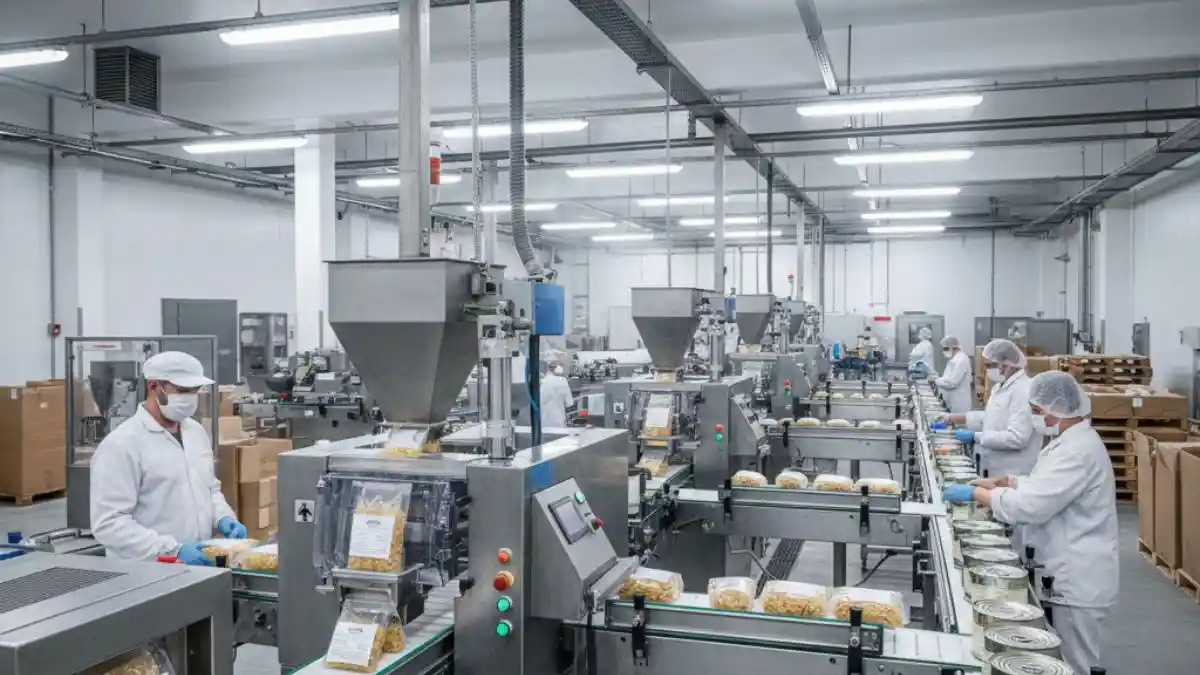

Private label now accounts for a structurally significant share of Italian grocery turnover, particularly in dry grocery, dairy and frozen foods. In many national chains and cooperative GDO groups, store brands exceed one-third of category volume.
Because private label functions as owned brand equity, manufacturer selection is governed by compliance thresholds, industrial scalability metrics and regulatory alignment.
In 2026, qualification standards have tightened due to EU consumer protection updates, ESG reporting expectations and digital traceability requirements.
At-a-Glance: 2026 Qualification Benchmarks
| Metric | 2026 Benchmark | Impact on Selection |
|---|---|---|
| Certification | IFS Food v8 / BRCGS v9 | Mandatory entry gate |
| Traceability | < 4 hours (recall simulation) | High risk mitigation |
| ESG Compliance | Verified Scope 1–3 disclosure | Renewal requirement |
| Financial Stability | Debt/EBITDA < 3.5x (typical threshold) | Long-term reliability |
| Energy Intensity | CO2e per unit disclosed | Pricing variable |
| Sustainability Claims | Evidence file required (Directive 2024/825) | Regulatory compliance |
These benchmarks reflect 2026 procurement practices among major Italian GDO groups.
How do Italian retailers select private label manufacturers?
Italian retailers select private label food manufacturers through a 6–12 month qualification process prioritizing industrial scalability, IFS/BRCGS certification, and cost transparency. Selection follows a multi-tier category strategy (Entry, Core, Premium) where suppliers are vetted for batch consistency, real-time recall simulation under four hours, and compliance with the 2026 Italian Greenwashing Decree implementing EU Directive 2024/825.
What are the mandatory supplier requirements for Italian retail in 2026?
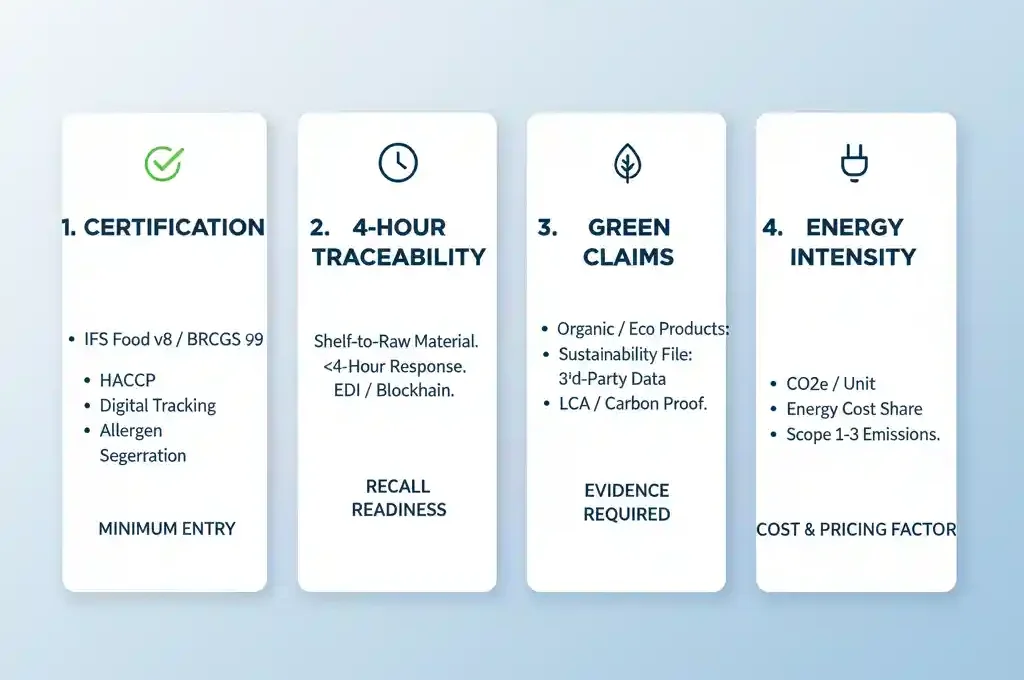
1. Certification Thresholds
Baseline compliance now includes:
-
IFS Food v8 or BRCGS Food Safety v9
-
HACCP implementation
-
Digitised batch tracking
-
Allergen segregation systems
Certification is not a differentiator. It is the minimum entry barrier.
2. The 4-Hour Traceability Rule
Italian retailers increasingly conduct recall simulations requiring:
-
Full shelf-to-raw material traceability
-
Response time under four hours
-
Integration via EDI systems or blockchain traceability tools
This “Real-Time Traceability” expectation reduces brand exposure during recall scenarios.
Suppliers unable to demonstrate this capability face significant procurement resistance.
3. Compliance with the Italian Greenwashing Decree (2026)
Following implementation of EU Directive 2024/825 on empowering consumers for the green transition, Italy now enforces stricter sustainability claim validation.
Private label suppliers providing:
-
Organic lines
-
“Eco” or “Low impact” products
-
Carbon-neutral claims
Must supply a Sustainability Evidence File including:
-
Third-party verification
-
Life-cycle data
-
Carbon accounting methodology
Unsupported environmental claims create retailer liability risk.
4. Energy Intensity as a Cost Variable
Energy exposure is no longer a background metric.
Retailers now request:
-
CO2e per unit produced
-
Energy cost share in total cost structure
-
Scope 1–3 emission transparency
Energy intensity increasingly influences long-term pricing negotiations.
Manufacturers with lower production energy intensity improve margin resilience during volatility.
Category Strategy Defines Supplier Fit
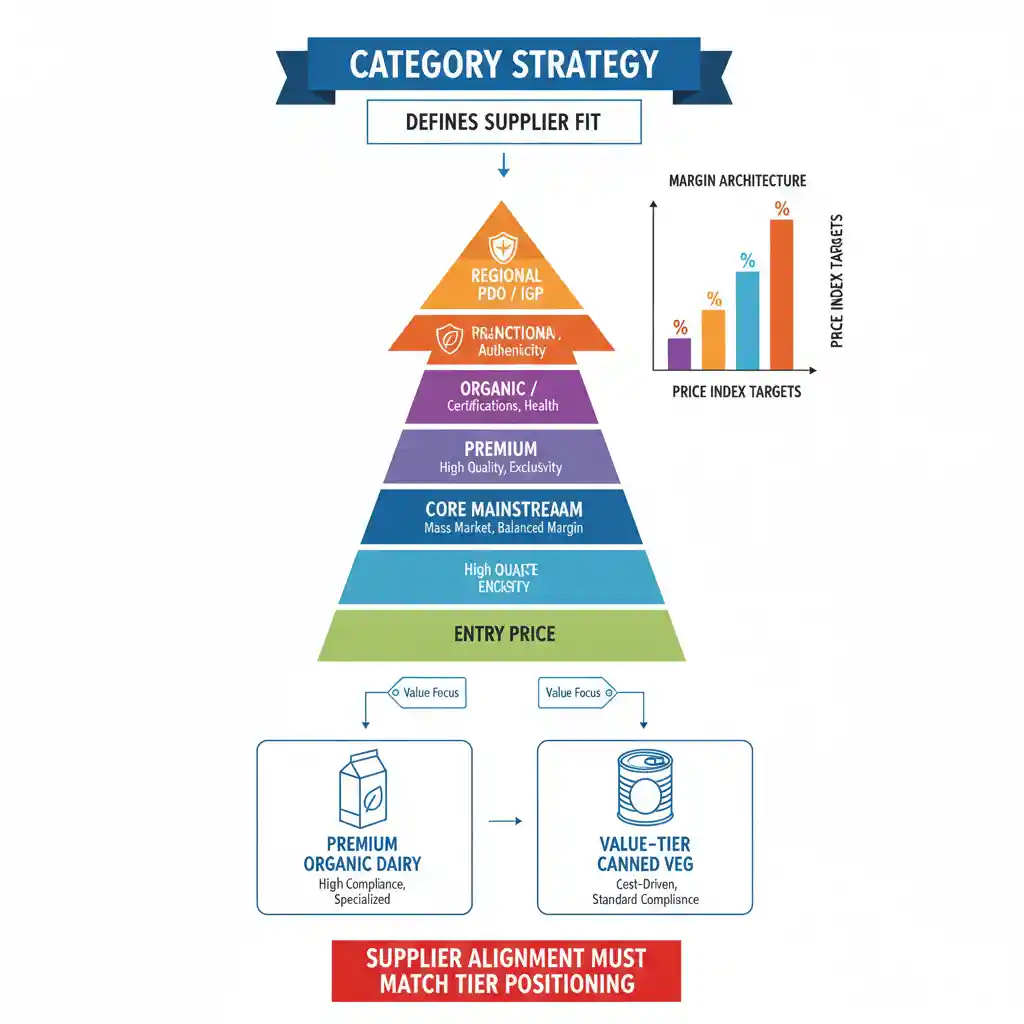
Retailers operate private label through structured tiers:
-
Entry price
-
Core mainstream
-
Premium
-
Organic / functional
-
Regional PDO / IGP lines
Each tier carries defined margin architecture and price index targets.
Supplier alignment must match tier positioning.
A premium organic dairy line requires a different compliance profile than a value-tier canned vegetable SKU.
Supplier Onboarding Timeline (2026 Model)
| Phase | Duration | Primary Objective |
|---|---|---|
| Commercial Feasibility | 1–2 months | Margin alignment |
| Regulatory & Audit Review | 1–3 months | Certification validation |
| Recall Simulation Testing | 1 month | 4-hour traceability confirmation |
| Pilot Production | 2–3 months | Batch reproducibility |
| Contract & ESG Review | 1–2 months | Risk integration |
Average onboarding time remains 6–12 months.
Why retailers replace private label suppliers
Supplier replacement in 2026 most often occurs due to:
-
Margin compression
-
ESG non-compliance
-
Failure in recall simulation benchmarks
-
Energy intensity volatility
-
Inconsistent quality replication
Environmental compliance now ranks alongside cost in renewal decisions.
Risk Scoring Framework
Retail procurement systems now evaluate:
-
Multi-site production redundancy
-
Geographic risk concentration
-
Ingredient sourcing diversification
-
Insurance coverage adequacy
-
Financial leverage stability
Manufacturers with diversified operational footprints have lower perceived supply risk.
Structural Shifts Influencing 2026 Selection
1. ESG Scorecards Embedded in Procurement
Retailers increasingly embed sustainability metrics into supplier scorecards.
Scope 3 transparency is gaining importance, particularly in packaging-heavy categories.
2. Digitalisation of Audit Systems
Retail audit results are increasingly digitised and integrated into supplier performance dashboards tracking:
-
Complaint frequency
-
Return rates
-
Margin deviation
-
On-time delivery
Supplier scorecards influence renewal probability annually.
3. Financial Resilience Screening
Financial stress testing is applied more frequently.
Debt leverage, liquidity profile and investment capacity are assessed to prevent mid-contract operational instability.
Information Gain: What Changed Since 2020?
Three developments distinguish 2026 procurement standards:
-
Recall traceability is measured in hours, not days.
-
Sustainability claims must withstand legal scrutiny under Directive 2024/825.
-
Energy intensity disclosure is integrated into pricing negotiations.
These shifts reflect broader EU regulatory tightening and consumer protection expansion.
Industry Perspective & Methodology
This framework reflects 2026 procurement standards observed among major Italian GDO (Grande Distribuzione Organizzata) groups, incorporating recent shifts in EU consumer protection law, sustainability regulation and digital traceability systems.
The analysis is based on publicly available certification standards, EU regulatory documentation, and retailer procurement disclosures for FY2024–FY2025.
No confidential procurement data has been used.
Conclusion
Italian retailers select private label food manufacturers through a structured qualification framework combining commercial architecture, industrial scalability, certification compliance, real-time traceability and regulatory alignment.
The onboarding process typically spans 6–12 months and incorporates recall simulation, ESG verification and financial risk evaluation.
For Italy supermarkets, private label supplier selection remains a core margin protection strategy and a risk management tool embedded within category planning.
For Italian FMCG brands, the expansion of retailer-owned ranges continues to reshape competitive dynamics, influencing pricing architecture, shelf positioning and long-term manufacturing partnerships.
Editor’s Note: This article is based on publicly available EU regulatory texts, certification frameworks (IFS/BRCGS), and procurement standards disclosed by Italian GDO groups for FY2024–FY2025. References include implementation of EU Directive 2024/825 within Italian consumer protection law. No proprietary or confidential supplier information has been used.