

Shelf space in an Italian supermarkets is not decoration.
It is capital.
Every centimetre of shelf must produce cash flow, protect margin, and support category strategy. From the buyer’s desk, the decision is rarely emotional. It is financial, operational and data-driven.
Italian retailers operate in one of Europe’s most competitive grocery markets. Chains like Conad, Coop Italia, Esselunga, Eurospin and Lidl Italia balance private label expansion with national brand demand. That balance determines who gets eye-level space, who gets bottom shelf, and who disappears entirely.
From inside the buying office, the logic is clear.
The Shelf Is a Financial Asset
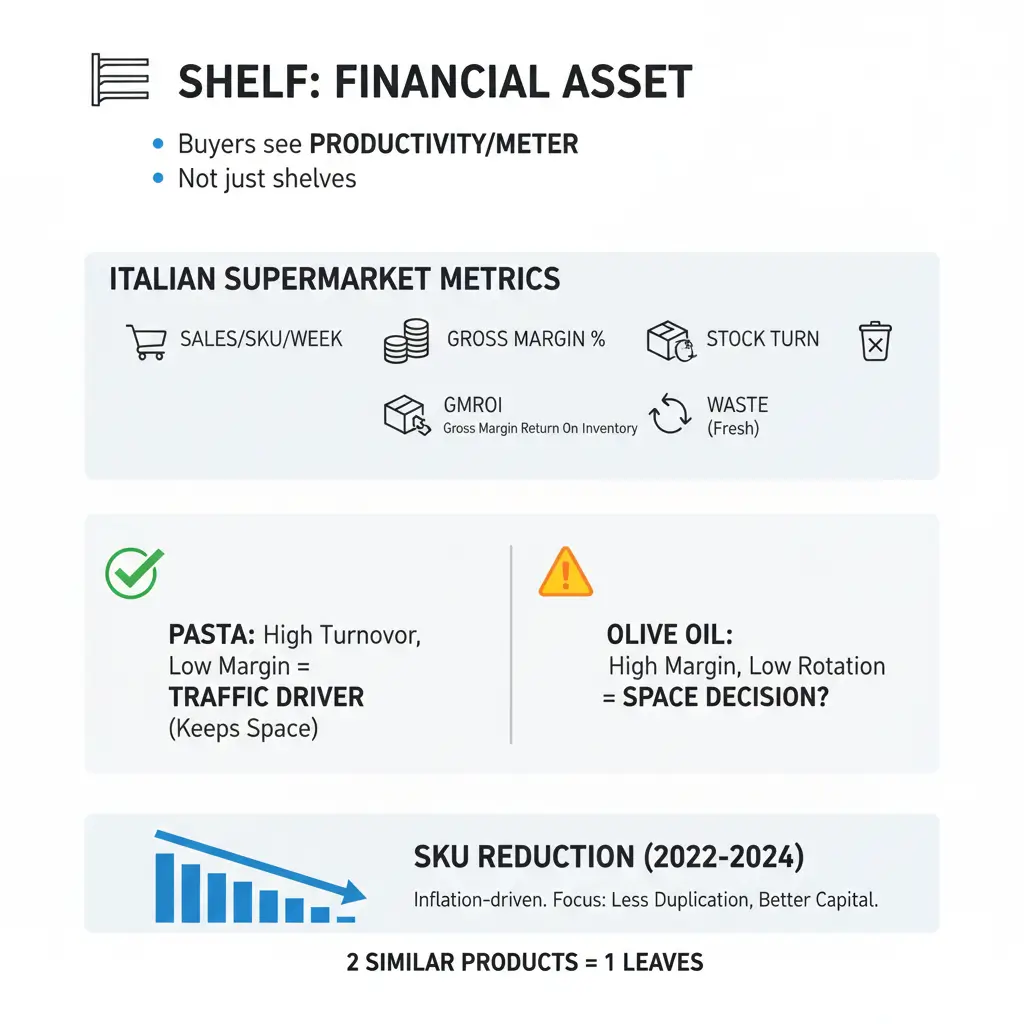
Buyers do not see shelves.
They see productivity per linear metre.
Italian supermarkets typically evaluate:
-
Sales per SKU per week
-
Gross margin percentage
-
Gross margin return on inventory (GMROI)
-
Stock turn
-
Waste (especially in fresh categories)
If a pasta brand generates strong turnover but low margin, it may still earn space because it drives traffic. If a premium olive oil offers margin but weak rotation, the buyer must decide whether it justifies the real estate.
In a medium-size Italian supermarket (1,500–2,500 m²), ambient grocery can carry 12,000–18,000 SKUs. But that number has been tightening. Range rationalisation accelerated after inflation pressures in 2022–2024, when retailers focused on reducing duplication and improving working capital.
If two tomato sauce brands deliver similar velocity, one will eventually leave.
The Category Review Process
Shelf decisions are rarely made daily. They happen in structured cycles.
Most Italian retailers conduct:
-
Annual full category reviews
-
Bi-annual assortment adjustments
-
Quarterly performance reviews
Data sources include internal POS systems, panel data from NielsenIQ or Circana, and loyalty card analytics.
Buyers study:
-
Category growth or decline
-
Price elasticity
-
Private label penetration
-
Regional variation
Planograms are built centrally in many chains, but regional flexibility exists — especially in cooperatives.
For example, in northern regions like Lombardy and Emilia-Romagna, premium SKUs may justify broader assortment. In southern regions, price sensitivity can drive higher private label share.
If a brand underperforms during two consecutive review cycles, delisting risk increases sharply.
Margin vs Rotation: The Core Tension
From the buyer’s desk, the hardest decision is rarely about brand recognition. It is about balance.
High-margin niche product
or
Lower-margin volume driver?
In categories like biscuits, soft drinks or dairy, large FMCG brands often deliver consistent turnover. That stability reduces risk. But retailers increasingly push private label to improve gross margin.
Private label penetration in Italy varies by category but remains significant in staples such as pasta, milk, frozen vegetables and canned goods.
The buyer asks:
-
Does this brand increase basket size?
-
Does it bring incremental shoppers?
-
Does it justify promotional investment?
If the answer is no, space shrinks.
Brand Power vs Private Label Pressure
Italian consumers show strong loyalty to certain national brands, particularly in categories like coffee, pasta and confectionery. However, retailers have strengthened their own brands significantly over the past decade.
Private label now competes in three layers:
-
Entry price
-
Core quality
-
Premium / organic
When a national brand fails to differentiate beyond price, buyers shift more space to private label.
In discount chains like Eurospin, assortment is tightly controlled and private label dominates. National brands are selective and must justify inclusion with traffic value.
In more premium retailers such as Esselunga, strong branded assortments remain important, but shelf positioning reflects performance data, not heritage.
Brand history does not guarantee space.
National vs Regional Brands
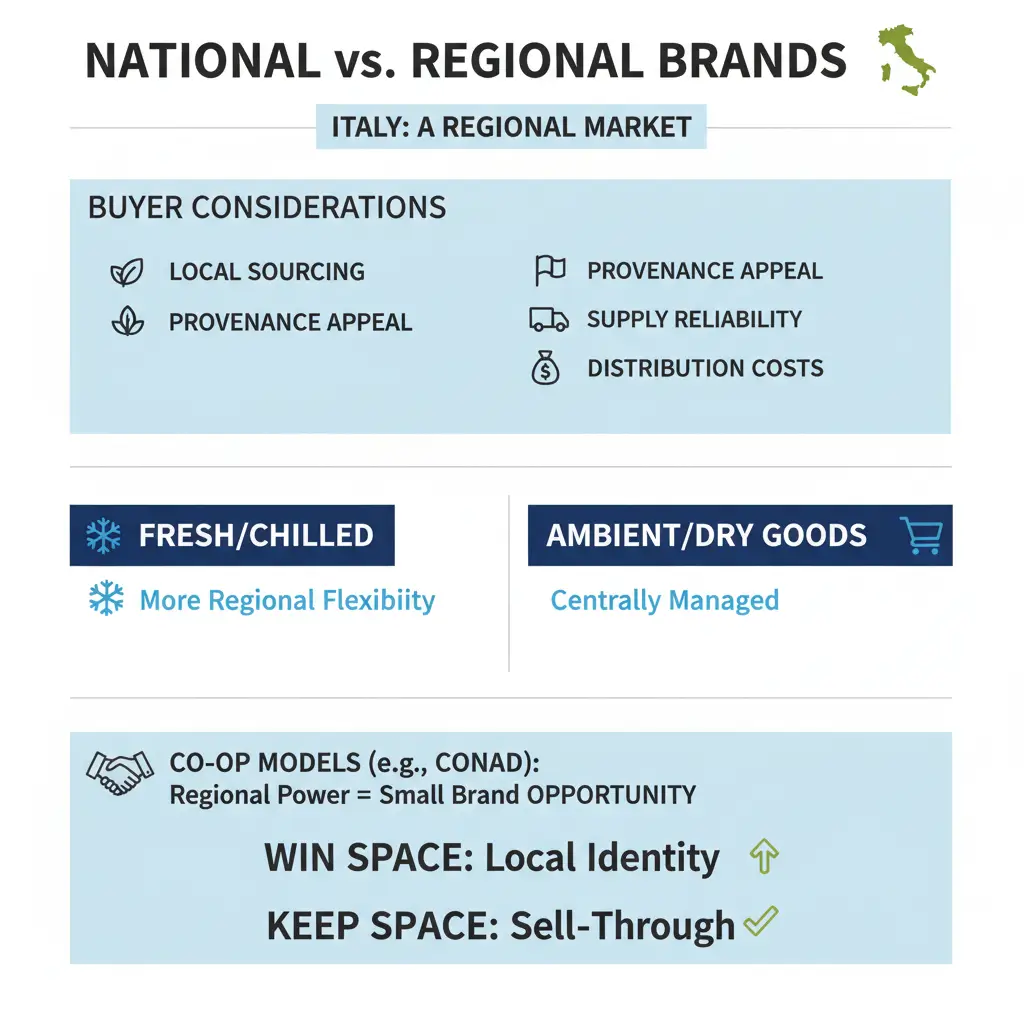
Italy is not a single market. It is regional.
A regional olive oil producer from Puglia may secure strong distribution in the South but struggle in the North unless supported by strong data and logistics.
Buyers consider:
-
Local sourcing relevance
-
Provenance appeal
-
Supply reliability
-
Distribution costs
Fresh and chilled categories often allow more regional flexibility. Ambient categories are more centrally managed.
In cooperative models like Conad, regional purchasing power can influence assortment. That creates opportunity for smaller brands — but performance metrics still apply.
A regional brand may win space initially through local identity. It keeps space only through sell-through.
Promotional Leverage and Visibility
Shelf space is not static.
Temporary displays, gondola ends and secondary placements are negotiated.
Suppliers contribute through:
-
Promotional funding
-
In-store marketing
-
Price discounts
-
Seasonal campaigns
Buyers assess promotional uplift carefully. If a brand requires constant discounting to maintain volume, long-term shelf allocation becomes fragile.
Italian retailers increasingly measure promotion ROI rather than simply accepting trade spend.
Visibility must convert.
What Gets You Delisted
From the buyer’s perspective, delisting is rarely dramatic. It is data-driven.
Common reasons include:
-
Low sell-through rate
-
Frequent stock-outs
-
Poor case fill
-
Margin erosion
-
Excessive duplication within the category
Supply chain reliability matters. If a supplier cannot maintain consistent service levels, risk increases. Retailers aim to protect shelf continuity.
Space is competitive. When a new product launches, something must exit.
The Hidden Factor: Operational Simplicity
Shelf decisions are not only commercial.
They are operational.
Fewer SKUs reduce:
-
Inventory complexity
-
Replenishment errors
-
Warehouse congestion
-
Store labour pressure
Italian retailers, particularly in urban proximity formats, are optimising for smaller footprints. That forces tighter range control.
If a SKU adds complexity without adding profit, it loses support internally.
What Matters Most to Buyers
From inside the office, buyers consistently prioritise:
-
Consistent weekly sales
-
Margin contribution
-
Reliable supply
-
Promotional effectiveness
-
Clear differentiation
Brand awareness helps.
But performance keeps you.
Italian supermarkets operate in a market where consumers compare prices carefully and promotions are highly visible. Buyers track weekly data intensely.
If your product does not move, it does not stay.
What This Means for FMCG Suppliers
For suppliers entering Italy or expanding distribution, the lesson is clear.
Bring data.
Bring margin clarity.
Bring operational reliability.
Italian buyers expect:
-
Evidence of rotation in comparable markets
-
Clear positioning versus private label
-
Realistic pricing strategy
-
Supply chain consistency
Listing is not the end. It is the beginning of scrutiny.
Shelf space is reviewed. Measured. Justified.
And replaced when necessary.
Final Perspective from the Buyer’s Desk
From the buyer’s desk, deciding which FMCG brands receive shelf space in Italy has little to do with prestige or reputation. It comes down to measurable contribution. A product must earn its position through performance — it needs to outperform alternatives and demonstrate that it strengthens the overall category.
In a competitive and regionally diverse retail market, shelf space is never permanent. It is reviewed, adjusted and optimised constantly. The logic is simple: if the numbers support the listing, the product remains. If they do not, the space is reallocated.