
Australia’s grocery sector is entering 2025 with more scrutiny, rising competition and sharper pricing pressure than any time in the last decade. The largest supermarkets in Australia still shape most of the market, but the balance between full-line retailers, discounters and independents is shifting faster than suppliers expected.
Australia remains one of the most concentrated grocery markets in the world. Woolworths and Coles continue to lead in sales, loyalty reach and network scale. ALDI keeps expanding its footprint and forcing price competition. Metcash’s IGA network holds ground across regional communities. New players such as Costco and Amazon are changing shopper expectations. And the ACCC inquiry has pushed the entire industry into a new level of transparency.
This article explains how the market works, who the major retailers are, and what suppliers and private-label manufacturers must prepare for in 2025.
How Australia’s Grocery Market Works in 2025
The Australian grocery market is defined by high concentration, long supply chains and a reliance on both national brands and strong private-label lines. Most sales run through four major supermarket groups. Independent stores also play a significant role outside metropolitan areas, but the majority of volume still flows through the top chains.
The current debate about competition has intensified because of the ACCC supermarket inquiry. The inquiry reviewed pricing behaviour, promotions, supplier relationships and loyalty data use. The discussion continues into 2025, shaping retailer strategies in value, transparency and contract terms.
Despite strong competition concerns, consumer behaviour remains stable: shoppers look for value, promotions and convenience. Full baskets still go to Woolworths and Coles. Discount missions continue to grow at ALDI. And independents capture local missions, especially in small towns and regional centres.
A market with few big retailers means every shift — a price freeze, a loyalty upgrade, a category review — has a nationwide impact.
The Big Four: Market Share And Positioning
Below is a simplified view of how the main supermarket groups compare in estimated market share for 2024/25.
Table: Major Australian retailers by estimated grocery market share (2024/25)
(Sources: ACCC inquiry documents, industry analysts, retailer reports — consolidated and interpreted)
| Retailer | Estimated Grocery Share | Notes |
|---|---|---|
| Woolworths | ~37% | Largest network, strong online, leading loyalty reach |
| Coles | ~27% | Strong promotions and fresh strategy |
| ALDI | ~10–11% | Discounters reshaping value expectations |
| Metcash / IGA | ~7% | Independent network with strong regional reach |
| Costco | ~2% | Limited stores, high-volume baskets |
| Amazon | <1% | Growing in metro areas |
These figures vary slightly across different reports, but they show the same picture: four major groups shape the national grocery economy.
Woolworths
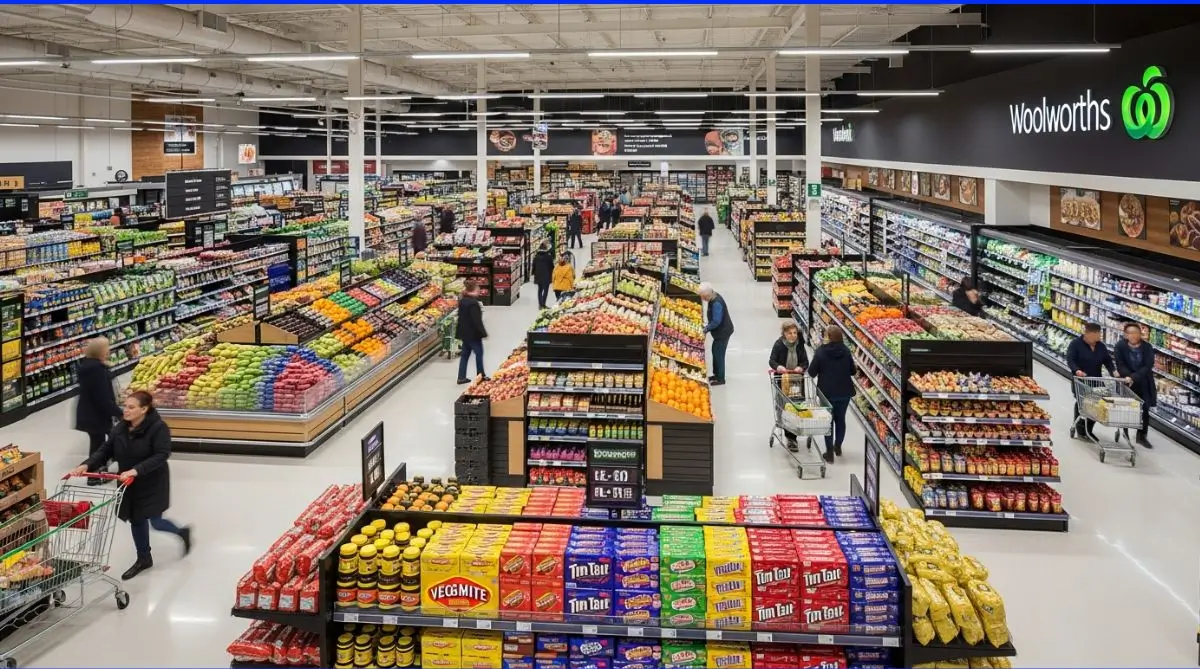
Woolworths remains the top supermarket chain by sales. It operates one of the largest retail networks in the country and leads the industry in digital adoption, store format upgrades and loyalty scale.
Its online service, particularly home delivery and rapid delivery partnerships, helps maintain customer retention. Woolworths’ Australian business continues to refine fresh produce quality, bakery standards and local sourcing. In pricing, Woolworths has lifted promotions and matched more lines against its closest rival.
Private label remains a central part of its strategy. The Woolworths brand and its premium and value tiers contribute strongly to category margins. Woolworths also invests heavily in automation and distribution upgrades, aiming for faster picking and better on-shelf availability.
From an industry perspective, Woolworths often sets the tone for promotional calendars, category resets and shelf strategies. Suppliers track its decisions closely because even small changes influence national volumes.
Coles
Coles stays close behind Woolworths and competes directly in price, service and fresh positioning. Its strategy revolves around strong promotional cycles, fresh produce investment and digital engagement through Flybuys.
Coles continues to highlight value through price-locked items and bundled promotions. Its online service remains one of the most consistent in the market, with improved slot availability in metro areas.
Private-label growth has accelerated, especially in value-tier essentials and ready meals. Coles also updates packaging more often than many competitors, focusing on clarity and sustainability benefits.
From a supplier’s point of view, Coles is known for its structured category reviews and detailed data insights. Many manufacturers see Coles as predictable but demanding — especially in cost negotiations.
The company has publicly said that “more value and more predictable pricing” will remain a core offer for customers going into 2025. This aligns with industry commentary that shoppers are simplifying decisions and focusing more on essentials.
ALDI
ALDI continues to reshape Australia’s value landscape. With 602 stores and annual sales above $13.3 billion, ALDI has grown from a niche challenger to one of the country’s most influential grocery retailers.
Its limited-range model keeps operations simple and builds high loyalty among value-seeking shoppers. Private label dominates the assortment, supported by a strong quality promise. ALDI’s entry into new suburbs puts additional pressure on Woolworths and Coles, especially where households are more price-sensitive.
ALDI also impacts national brands by reducing their negotiating power. When ALDI grows in a suburb, major brands often face lower volumes and tighter promotions across neighbouring stores.
The retailer’s straightforward merchandising, high stock rotation and efficient supply chain keep costs low. For suppliers, ALDI offers fewer listings but larger volumes per SKU. Its category teams operate with clear standards, fixed timelines and long planning cycles.
ALDI’s presence remains one of the biggest structural pressures in the Australian grocery market.
Metcash / IGA
Metcash operates a wholesale supply model, supporting thousands of independent stores under the IGA, Supa IGA, Foodland, and regional banners. While each store is independently owned, collective buying and brand frameworks create consistency across the network.
Independents remain essential in rural and regional Australia. They typically win on local service, community engagement and quick range decisions. But operating costs are higher than for major chains, and pricing tends to be less competitive in some areas.
The IGA model provides suppliers with varied opportunities. Some categories — fresh meat, local bakery, niche grocery — perform strongly in independents. Other categories face smaller volumes and slower rotation.
Metcash continues to defend its position by strengthening logistics, expanding private-label options and supporting localised assortments. It remains a stable part of the market and a critical partner for regional manufacturers.
Discount vs Full-Line: ALDI’s Disruption Story
ALDI is the only true discount chain in Australia. Its influence goes beyond prices — it sets new rules for quality, packaging and product lifecycle.
The arrival of ALDI forced Woolworths and Coles to revisit their value strategies. Price matching, stable everyday pricing, simpler promotions and clearer private-label tiers all gained more importance because of ALDI’s growth.
Discount loyalists remain consistent. Even when inflation eases, households keep returning to ALDI for core items such as dairy, bakery, household essentials and pantry lines.
Seasonal products also play a major role. The retailer’s weekly limited-time items bring significant traffic and help broaden the brand’s image beyond pure value.
Australia’s discount share is still lower than Germany, the UK or Spain, meaning long-term growth potential remains high. ALDI’s expansion into outer suburbs and regional corridors suggests several years of continued store openings.
Emerging Players: Costco, Amazon and Independents
Costco
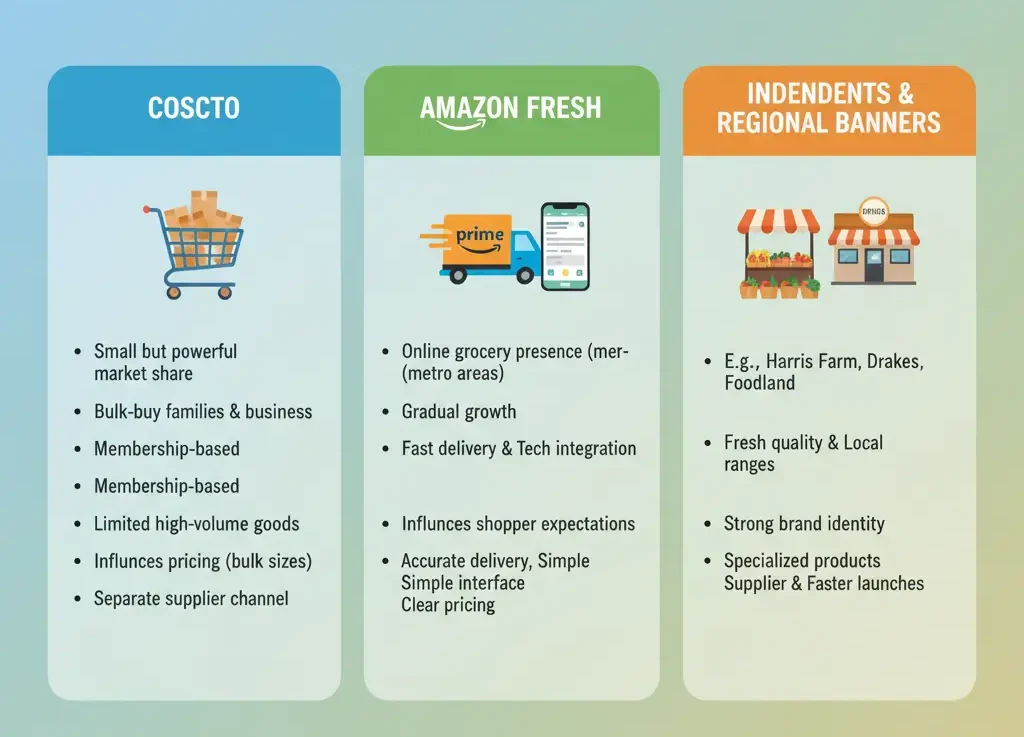
Costco holds a small but powerful share of the market. With limited store numbers, it targets bulk-buy families and business customers. Its model is membership-based with a limited selection of high-volume goods.
Costco influences pricing strategies across beverages, snacks, fresh meat, and household categories. Suppliers often treat Costco as a separate channel due to its pack sizes and margin structure.
Amazon Fresh
Amazon continues to build its online grocery presence, mainly in metropolitan areas. Growth remains gradual, but the combination of fast delivery, strong tech integration and Prime membership adds pressure to traditional retailers.
Amazon influences shopper expectations more than raw market share. Consumers increasingly expect accurate delivery windows, simple interfaces and clear pricing online.
Independents and Regional Banners
Smaller chains such as Harris Farm Markets, Drakes and Foodland remain influential within their regions. These retailers compete through fresh quality, local ranges and strong brand identity. Their role continues to expand as consumers look for specialised products and alternative shopping experiences.
Independents also attract suppliers who want flexibility, faster launches and more control over promotional timing.
What This Means for Suppliers and Private-Label Manufacturers
The structure of the market creates challenges and opportunities for suppliers.
The ACCC inquiry highlighted issues such as bargaining power, wholesale pricing and delays in passing through cost increases. Suppliers must navigate centralised buying teams, strict category review cycles and tighter promotional budgets.
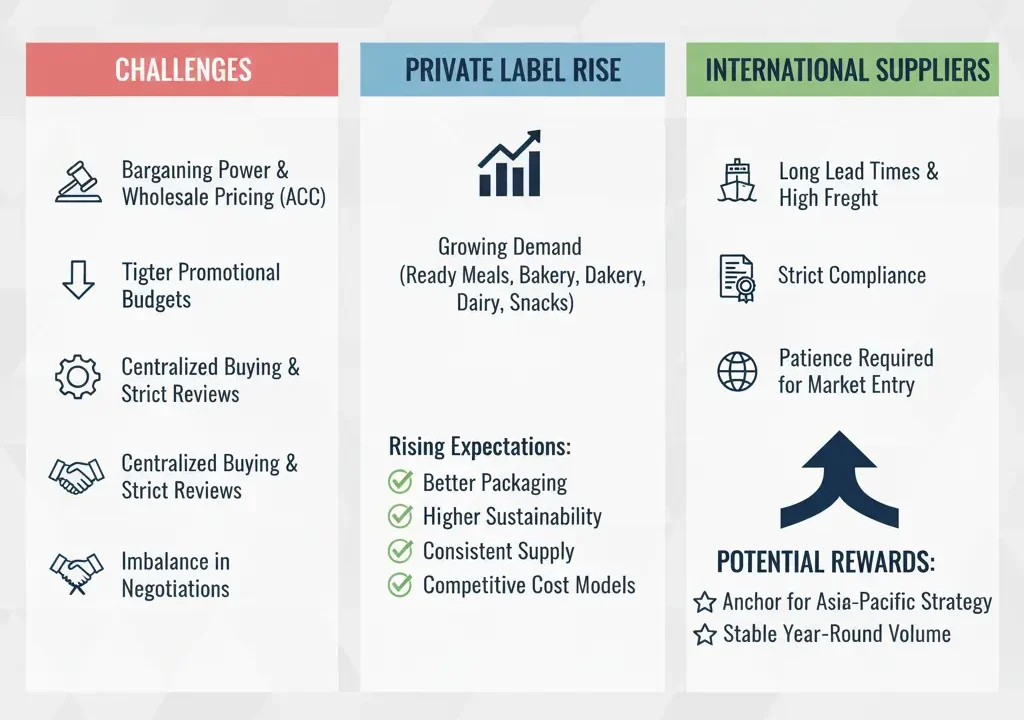
Industry commentary from the inquiry noted that “the imbalance in negotiations limits the ability of smaller suppliers to secure sustainable agreements.” This remains a core issue across many categories.
Private label continues to rise across all top retailers. Manufacturers with strong capabilities in ready meals, bakery, dairy, household chemicals and snacking report higher demand for proposal submissions.
However, expectations are rising:
-
Better packaging quality
-
Higher sustainability standards
-
Consistent supply
-
Competitive cost models
For international suppliers, entering the Australian market requires patience. Lead times are long, freight costs remain high, and compliance requirements are strict.
Despite this, the rewards can be significant. A listing with one of the major chains can anchor a supplier’s Asia-Pacific strategy and provide stable year-round volume.
Shopper Behaviour: Value, Promotions and Loyalty
Australian shoppers remain highly value-focused heading into 2025. Promotions, loyalty benefits and price-locked items guide weekly decisions.
Households continue to feel cost-of-living pressure. This has pushed more shoppers toward private label and has strengthened retailer loyalty ecosystems. Woolworths Everyday Rewards and Coles Flybuys shape promotions and influence category performance.
E-commerce remains strong across metropolitan areas. Both major chains report growth in delivery subscriptions, faster picking and more predictable slots. Convenience missions — small top-ups, last-minute items — also shift online.
Shoppers expect stable pricing, consistent quality and clear pack sizes. Retailers continue to simplify ranges and remove less productive SKUs to reduce operational costs and improve clarity.
Fresh categories remain a key battleground. Australian consumers expect high standards for fruit, vegetables, meat and bakery. Investment in cool-chain logistics and category quality testing remains essential for competitiveness.
Outlook: What’s Likely to Change by 2026
Competition pressure will rise further. ALDI will keep expanding. Independents will modernise more stores. Amazon will push selected categories harder. Costco could open additional sites.
There is ongoing industry discussion about whether new international entrants — such as Lulu Group — could enter the market. While nothing is confirmed, the possibility shapes internal planning across suppliers.
Regulatory pressure will continue. The outcomes of the ACCC inquiry will likely influence promotional behaviour, supplier negotiations and reporting transparency.
Private label will gain more share, especially in chilled meals, frozen foods, snacks and household essentials. Suppliers who can deliver consistent quality at competitive cost will be well positioned.
E-commerce will become more embedded in weekly routines. Consumers will expect tighter delivery windows, better substitutions and more personalised promotions.
By 2026, the balance between full-line retailers, discounters and independents could shift again — but the main chains will continue to direct most industry volume.
Conclusion
Australia’s grocery sector is concentrated, fast-moving and increasingly shaped by value. The largest supermarkets in Australia — Woolworths, Coles, ALDI and Metcash’s IGA network — continue to define the national market. Discount penetration is growing. E-commerce is expanding. Supplier negotiations are tightening. And shoppers expect more value without compromising on quality.
For manufacturers, this market rewards strong partnerships, operational discipline and flexible private-label solutions. For retailers, the next year will test how well they balance price, range and service.
The Australian supermarket landscape in 2025 remains one of the most competitive and closely watched grocery markets in the world.