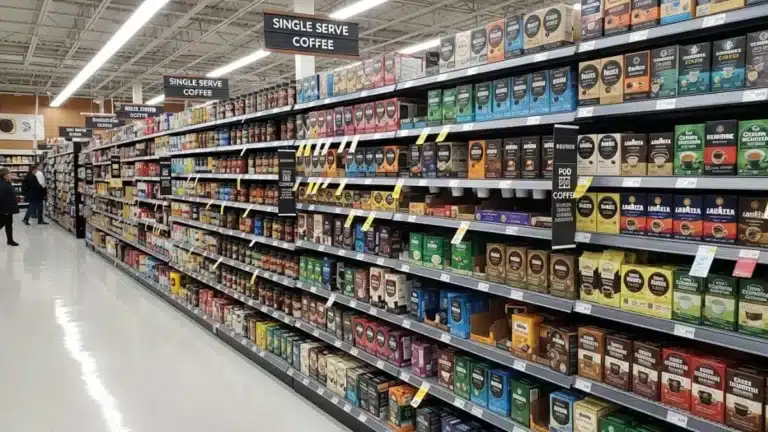

European retailers sourcing private-label coffee can consider manufacturers including UCC Coffee Europe, Beyers Koffie, Coind, Masteroast, Lincoln & York, Pelican Rouge Coffee Roasters, Massimo Zanetti Beverage Group, Gimoka Group, Caféa Group and Tchibo Coffee Service/private-label manufacturing operations. Buyers should compare roasting capacity, origin sourcing, capsule technology, certification, pack formats, minimum runs and product-development support rather than choosing on roast price alone.
Coffee is one of the most technically demanding private-label grocery categories. Buyers are managing two pressures at once: volatile green-coffee costs and tighter sourcing compliance. The International Coffee Organization reported its composite price averaging 287.29 US cents/lb in August 2026, while the EU Deforestation Regulation will begin applying to large and medium operators on 30 December 2026 and covers coffee. That makes traceability, origin data and due-diligence readiness increasingly important alongside roast quality and price.
Green-bean cost moves quickly, consumers notice taste variation, and a retailer may need several formats at once: whole bean, ground, pads, aluminium or plastic capsules, instant coffee and ready-to-drink extensions.
This guide focuses on manufacturers with clear European roasting or private-label relevance. Capabilities vary by country and plant, so the final supplier shortlist should be confirmed against the exact format and market required.
Private label coffee manufacturers at a glance
| Manufacturer | Base / European strength | Main capabilities | Best fit |
|---|---|---|---|
| UCC Coffee Europe | Pan-European | Roast & ground, beans, capsules, sourcing | Large multi-market retail programmes |
| Beyers Koffie | Belgium | Private label, beans, ground, pads, capsules | Benelux and European supermarket ranges |
| Coind | Italy | Espresso, beans, ground, capsules | Italian-style private-label coffee |
| Masteroast | United Kingdom | Bespoke roasting and private label | UK retail, foodservice and specialist briefs |
| Lincoln & York | United Kingdom | Private-label coffee roasting | Retail and out-of-home programmes |
| Pelican Rouge | Netherlands / Europe | Roasting, private label and vending formats | Multi-channel coffee programmes |
| Massimo Zanetti Beverage Group | Italy / global | Large-scale roasting and branded/private-label capacity | High-volume international programmes |
| Gimoka Group | Italy | Beans, ground and capsule systems | Retailers seeking broad espresso-format choice |
| Caféa Group | Germany / Europe | Roast coffee and soluble coffee | Large European private-label programmes |
| Tchibo-linked manufacturing | Germany / Europe | Large-scale roasting and coffee expertise | Selected industrial and retail programmes |
1. UCC Coffee Europe
UCC is one of Europe’s largest coffee businesses and works across retail, foodservice and private label. Its scale gives buyers access to sourcing expertise, roasting, blending, packaging and multiple European production locations.
For multinational retailers, the main advantage is the ability to discuss several formats and markets within one supplier relationship. Buyers should still establish which plant will make each SKU and whether taste matching can be controlled consistently across factories.
2. Beyers Koffie
Belgian roaster Beyers is strongly focused on private-label coffee and supplies a range of beans, ground coffee, pads and capsules. Its location and experience make it particularly relevant to Benelux and wider European supermarket sourcing.
A retailer should use sensory benchmarking during the tender. Coffee can look identical on specification sheets while producing very different cup quality.
3. Coind
Italy-based Coind is a major private-label coffee producer with experience across espresso-style products, beans, ground coffee and compatible capsule formats. It is particularly useful for retailers seeking Italian positioning without creating a vertically integrated roasting operation of their own.
4. Masteroast
Masteroast is a UK contract and private-label roaster serving retail and foodservice customers. Its strength is bespoke development and the ability to work with customers on blend, roast profile and packaging.
That can suit premium supermarket ranges where differentiation matters more than simply matching an entry-price product.
5. Lincoln & York
Lincoln & York is another established UK private-label coffee manufacturer. It offers roasting, sourcing and packing services and has experience producing coffee behind retailer and hospitality brands.
UK buyers should compare it with pan-European suppliers on flexibility, lead time, minimum production run and service rather than factory scale alone.
6. Pelican Rouge Coffee Roasters
Pelican Rouge has deep European coffee-roasting experience and works across retail and out-of-home channels. The business can be relevant where a customer needs several consumption formats or wants a supplier familiar with both supermarket and workplace coffee.
7. Massimo Zanetti Beverage Group
Massimo Zanetti is a large international coffee group headquartered in Italy. Its manufacturing scale, sourcing reach and coffee-brand portfolio give it significant industrial capability.
Retail buyers should confirm private-label availability by market and plant because a large branded group may operate different commercial models across Europe.
8. Gimoka Group
Gimoka is an Italian coffee manufacturer with broad experience in beans, ground coffee and single-serve systems. Capsule compatibility and format breadth can make it useful to retailers rationalising several coffee technologies through one supplier.
9. Caféa Group
Germany-based Caféa Group is a major industrial coffee business with roasted and soluble coffee capability. Soluble coffee is a specialist manufacturing discipline, so retailers requiring both roast-and-ground and instant formats should check whether a supplier can genuinely support both.
10. Tchibo-linked manufacturing
Tchibo is one of Europe’s largest coffee roasters and has deep sourcing and manufacturing expertise. Depending on country and commercial route, its industrial capabilities can be relevant to customer-specific programmes. Buyers should confirm current third-party/private-label availability directly rather than assume branded scale automatically means open contract capacity.
What buyers should compare in a coffee tender
- Green-bean strategy: origin mix, hedging approach and substitution rules.
- Cup profile: objective sensory specification plus approved reference sample.
- Roast consistency: batch controls and tolerance limits.
- Formats: whole bean, ground, pads, capsules and instant.
- Certification: retailer food-safety requirements plus organic, Fairtrade or Rainforest Alliance where specified.
- Packaging: valve bags, vacuum packs, capsules and recyclability requirements.
- MOQ: minimum production run by blend and format.
- Commodity risk: how price resets are calculated when green coffee markets move.
How should retailers compare coffee prices?
Do not compare only cost per kilogram. Capsule count, extraction strength, yield per cup, packaging weight and promotional funding can materially change the consumer economics. A cheaper roast can also perform poorly if shoppers reject the taste and repeat purchase falls.
Frequently asked questions
Who makes private-label coffee in Europe?
Specialist manufacturers include UCC Coffee Europe, Beyers Koffie, Coind, Masteroast, Lincoln & York, Pelican Rouge, Gimoka and Caféa, alongside larger coffee groups with selected contract-manufacturing capability.
Can private-label coffee manufacturers make capsules?
Many can, but compatibility differs by system and material. Buyers must specify machine compatibility, capsule construction, oxygen barrier and packing format before tendering.
How long does a private-label coffee launch take?
Timing depends on product development, artwork, packaging procurement, certification and production slots. A simple existing blend can move quickly; a new capsule system or bespoke certified origin range requires much longer planning.
What makes a strong supermarket own-label coffee range?
A clear price ladder, distinct taste profiles and limited duplication. Entry, core and premium tiers should each have a reason to exist, with formats chosen around how shoppers actually brew coffee in that market.
How to compare private-label coffee manufacturers
Coffee buyers should separate roasting scale from format capability. A manufacturer may be excellent at whole bean and ground coffee but weaker in aluminium capsules, compatible pods or soluble formats. The tender should identify annual tonnes, roasting sites, capsule lines, coffee origins, certification, decaffeination route, packaging capability and minimum production run by SKU.
What revenue and factory scale tell buyers
Large groups can offer commodity buying leverage and multiple production sites, but smaller specialist roasters can be more flexible on blends, premium origins and MOQs. Where a company does not publicly disclose private-label turnover, GTN does not estimate it. Factory capacity, number of roasting sites, customer markets and disclosed group revenue provide a safer view of scale.
What should be in a supermarket coffee tender?
| Requirement | Buyer check |
|---|---|
| Green coffee | Origins, traceability, certified options and hedging approach |
| Roasting | Batch/continuous capability and profile consistency |
| Formats | Beans, ground, pods, capsules and soluble where required |
| Packaging | Valve, barrier, capsule material and recyclability |
| MOQ | Per blend, format and artwork |
| Quality | Cupping protocol, sensory specification and complaint process |
Sources and verification
Capabilities were checked against current manufacturer information from UCC Coffee Europe, Beyers, Coind, Masteroast and other companies listed. Buyers should verify current plant certifications, capsule systems and available contract capacity during the RFP.