
Belgium’s position as a private-label-led market is structural, not cyclical.
In 2025, private label value share in Belgium rose by around 0.2 percentage points, reaching approximately 39% of total grocery sales. That places Belgium slightly above the European average and firmly among the continent’s most mature private label markets.
This strength is reinforced by category performance. Health-focused private label ranges — including supplements, wellness products, and functional foods — are currently the fastest-growing segment, expanding by around 1.6% year on year. By contrast, frozen food private label has seen a modest decline, reflecting changing consumption patterns rather than reduced retailer commitment.
Retail concentration remains a key driver. A small number of supermarket groups control most national grocery sales, allowing private label strategies to be executed consistently across formats and regions. This scale advantage supports faster range resets, clearer pricing ladders, and stronger supplier discipline.
Taken together, these factors explain why private label growth in Belgium continues even as inflation eases. It is not a temporary response to cost pressure, but a core operating model.
Why Belgium Is A Private-Label-Led Market
Private label in Belgium is driven by structure, not fashion.
The market is highly concentrated. A small number of supermarket groups control most grocery sales, giving retailers strong leverage over shelf space, pricing, and assortment decisions. This concentration makes it easier to roll out private-label strategies consistently and at scale.
Belgian shoppers are also comfortable with retailer brands.
Private label is widely seen as reliable and good value, especially in everyday categories. For many households, store brands are the default choice rather than a compromise.
Discounters reinforce this mindset. Their strong presence anchors price expectations across the market, even for shoppers who mainly use full-service supermarkets. As a result, traditional retailers must continuously justify price differences — and private label is one of the most effective tools to do so.
Together, these factors explain why private label remains structurally strong across supermarkets in Belgium.
How Big Supermarket Groups Are Reshaping Private Label
Belgian retailers are not growing private label by adding more products.
They are growing it by simplifying and clarifying their ranges.
At Colruyt, the structure is easy to read. Everyday covers entry-price needs, while Boni Selection forms the core of the assortment across ambient, chilled, and frozen categories. Premium and specialised ranges sit above this core, but overlap is limited.
This clearer architecture helps shoppers make faster decisions.
It also helps buyers manage margins and allows suppliers to work with larger, more stable volumes.
At Delhaize, private label has taken on added strategic weight following the shift to a largely franchised store model. With more independent operators running stores, private label provides consistency across the network. It allows Delhaize to maintain price positioning, quality standards, and brand identity, even with decentralised ownership.
Across Belgian supermarket groups, the direction is the same.
Private label is being treated as a system, not a collection of disconnected sub-brands. Each range has a defined role on shelf, and underperforming overlaps are being removed.
Discounters Set The Baseline For Price And Quality
Aldi and Lidl play a defining role in Belgium’s private-label landscape.
Their assortments are built almost entirely around private label, with limited SKUs and clear quality benchmarks. These products are designed to meet mainstream needs efficiently, not to feel like stripped-down alternatives.
This model sets expectations for the entire market.
Even shoppers who rarely visit discounters compare prices and quality mentally. Full-service supermarkets must respond, either by matching value directly or by offering a clear reason for trading up.
As a result, private label in traditional supermarkets is no longer positioned only as “cheaper than brands”. It is positioned as a smart, reliable choice that meets or exceeds discounter standards while offering broader choice.
Discounters also influence operational discipline. Their focus on limited ranges and supply chain efficiency has pushed the wider market toward leaner assortments and higher supplier performance expectations.
Innovation And Quality Signals In Belgian Private Label
In 2025, sustainability is no longer a soft differentiator for Belgian retailers. It is a reporting obligation.
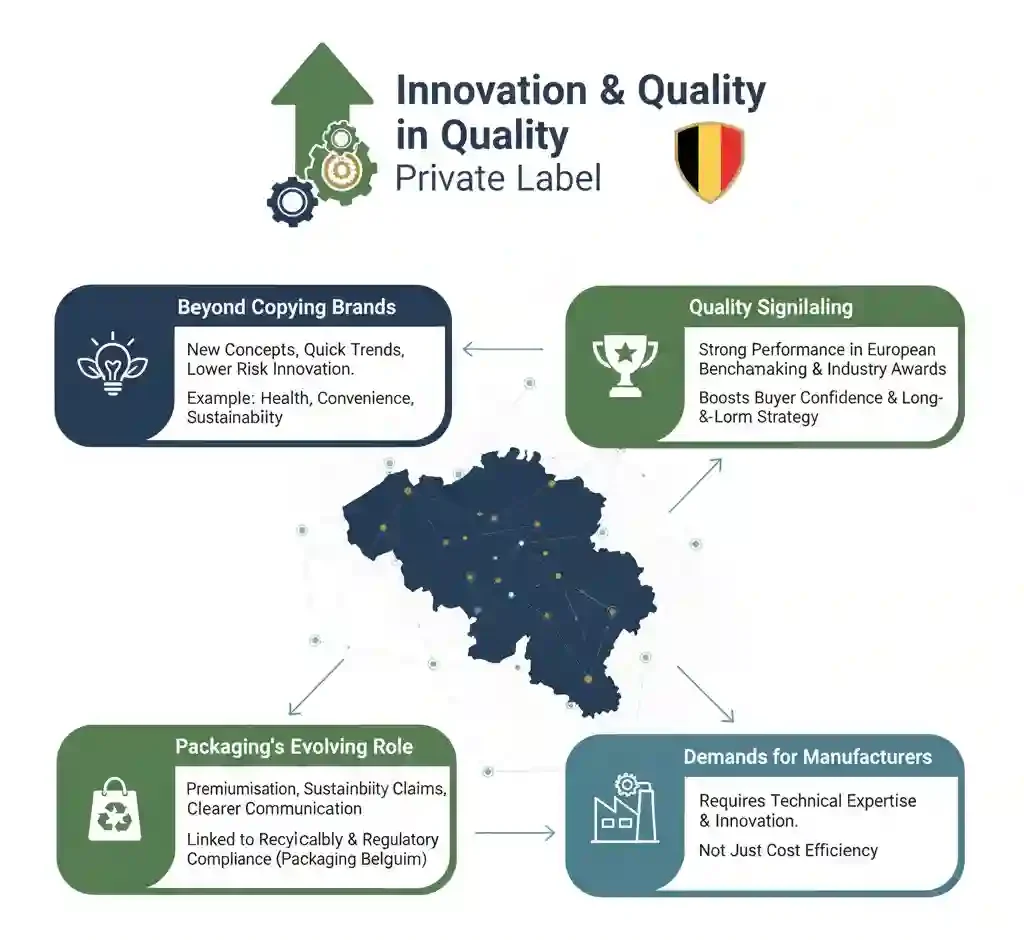
The EU Corporate Sustainability Reporting Directive (CSRD) has increased pressure on retailers to account for Scope 3 emissions, which include upstream supplier impacts such as packaging materials and product formulation. Private label plays a central role here. Because retailers control specifications for ranges like Boni Selection or Delhaize private label, they can implement packaging changes and recyclability improvements faster than is typically possible with national brands.
Nutrition policy is also shaping strategy. Nutri-Score visibility has encouraged retailers to reformulate private label products proactively, particularly in core food categories. This has strengthened private label’s role not just as a value option, but as a compliance and risk-management tool.
Impact On A-Brands In Belgium
The competitive dynamic in Belgium is also evolving.
Recent market analysis increasingly frames the discussion as “value versus premium”, rather than private label versus A-brand. Retailers rely on strong branded products to drive footfall and category credibility, while private label delivers margin stability and price architecture.
This balance — often described as “finding harmony” — explains why Belgian retailers continue to support selected A-brands even as private label share grows. The objective is not replacement, but optimisation: brands build traffic, private label protects profitability.
Opportunities For Manufacturers And Co-Packers
Belgium’s private-label strength creates real opportunities for manufacturers — with conditions attached.
Retailers increasingly look for long-term partners rather than transactional suppliers. Co-packing relationships are becoming more strategic, offering stable volumes in exchange for reliability, flexibility, and innovation support.
Manufacturers that can contribute to category development, improve sustainability performance, or optimise packaging and logistics are more likely to secure lasting partnerships.
Flexibility matters. Belgian retailers expect suppliers to respond quickly to changes in range structure, regulation, or consumer demand.
For manufacturers willing to align closely with retailer strategy, private label can offer more predictable growth than competing directly with established brands.
What Comes Next For Private Label In Belgium
Looking ahead, private label growth in Belgium is expected to remain structural, driven by retailer strategy, sustainability obligations, and range discipline rather than short-term price shocks.
Private label will remain central to the Belgian grocery market.
Retailers are likely to continue simplifying ranges, strengthening core brands, and using private label to drive sustainability and value perception. Health, transparency, and compliance will shape the next phase.
For brands and manufacturers, the message is clear.
Success in Belgium depends on understanding retailer logic and adapting to it.
Private label is not a secondary channel.
In Belgium, it is the operating system.