

Greece’s supermarket technology market has moved quietly but decisively in the past five years. What was once dominated by basic point-of-sale software and local accounting tools has shifted toward integrated retail platforms, real-time inventory systems, cloud-based ERP, digital payments infrastructure, and data-driven store operations.
Rising labour costs, tighter tax reporting rules, digital invoicing mandates, and pressure on margins have forced Greek food retailers to modernise faster than in previous cycles. Large chains are investing in automation and analytics. Regional supermarkets are upgrading store systems. Independent operators are migrating away from legacy tills to cloud POS and integrated back-office platforms.
Unlike larger European markets, Greece’s retail technology ecosystem is relatively compact. A small group of suppliers now carry most large-scale supermarket deployments. Scale of rollout, system stability, and long-term support capability matter more than product variety.
This ranking focuses on companies with proven supermarket and grocery retail deployment, evaluated by real operational footprint, platform breadth, and adoption across physical retail environments.
Top 5 Retail Technology Companies in Greece
| Rank | Company | Founded | Core Technology | Retail Strength | Deployment Scale |
|---|---|---|---|---|---|
| 1 | Epsilon Net Group | 2000 | POS, retail software, accounting platforms | National SME and retail footprint | High |
| 2 | Entersoft Group | 2002 | ERP, WMS, retail systems, EDI | Enterprise retail and wholesale integration | High |
| 3 | OSS | 1990s | Supermarket POS and store systems | Grocery-focused retail stack | Medium-High |
| 4 | Printec Group | 1988 | Payments, checkout systems, retail hardware software | In-store transaction technology | Medium-High |
| 5 | Simply POS | 2016 | Cloud POS and store automation | Convenience and small supermarket chains | Medium |
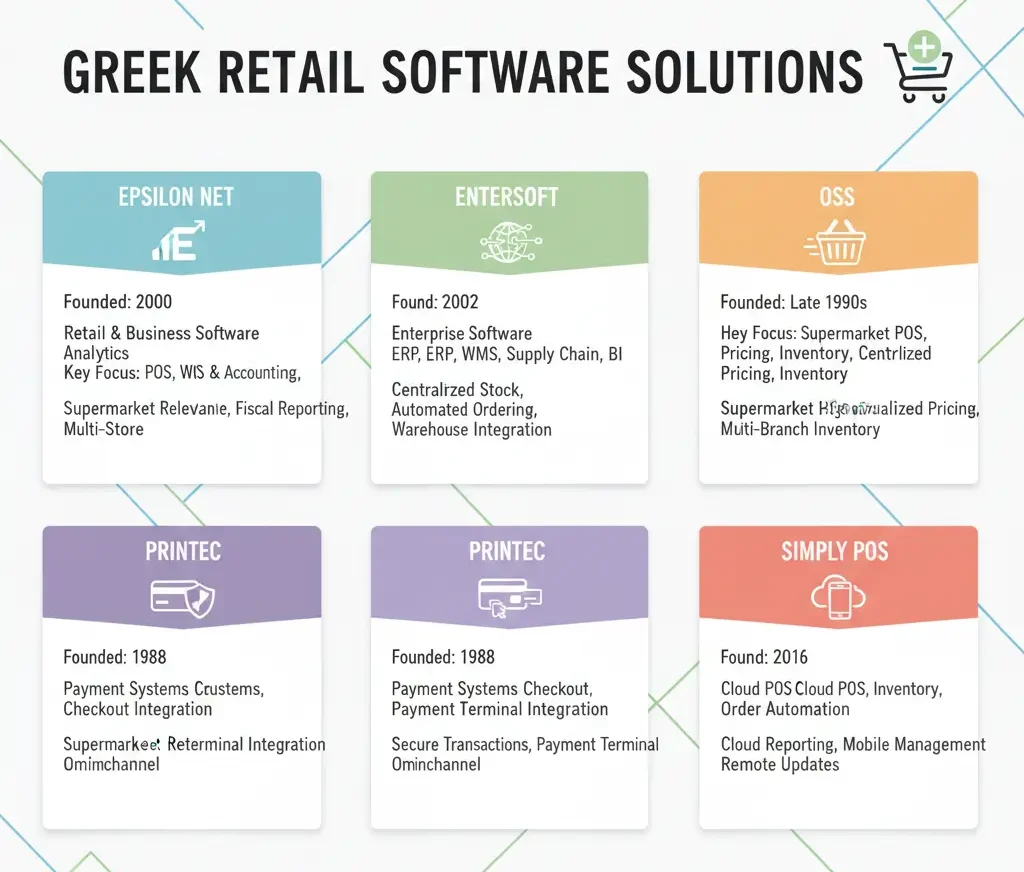
1. Epsilon Net Group
Founded: 2000
Headquarters: Athens
Epsilon Net has grown into Greece’s largest domestic provider of retail and business software through steady expansion and acquisitions. The group operates across accounting platforms, payroll systems, retail POS software, electronic invoicing tools, and business compliance solutions.
Its retail portfolio is deployed across grocery, convenience, and specialty retail formats. The company’s core strength lies in linking front-of-store transactions with regulatory reporting, invoicing workflows, loyalty functionality, and back-office management systems.
Core product categories
-
Retail POS platforms
-
Back-office retail software
-
Electronic invoicing and compliance tools
-
Payroll and HR integration
-
Business analytics modules
Market position and scale
Epsilon Net supports a broad national customer base through direct sales operations and an extended reseller network. Adoption is particularly strong among small and mid-sized supermarket operators, especially in regional markets where regulatory integration and local support remain critical.
The group’s scale enables continuous system updates, regulatory adaptation, and long-term platform maintenance.
Operational relevance for supermarkets
Epsilon Net deployments typically support:
-
Integrated POS and accounting environments
-
Automated fiscal reporting
-
Real-time sales monitoring
-
Multi-store operational management
This positions the company as a core retail infrastructure provider rather than a single-function software supplier.
Strategic direction
The group continues expanding cloud-based retail platforms and subscription software models, with increasing emphasis on automation, unified data environments, and interoperability between retail and financial systems.
2. Entersoft Group
Founded: 2002
Headquarters: Athens
Entersoft operates one of Greece’s broadest enterprise software portfolios. The company supplies retail chains, wholesalers, logistics operators, and distributors with ERP platforms, warehouse management systems, analytics tools, and sector-specific retail software.
Its retail solutions focus on connecting store operations with central management systems, inventory control platforms, and supply chain workflows.
Core product categories
-
Retail ERP platforms
-
Warehouse management systems
-
Supply chain software
-
Business intelligence dashboards
-
Digital document processing tools
Market position and scale
Entersoft maintains a large enterprise customer base across Greece and selected international markets. Its platforms are commonly deployed by larger retail organisations that require centralised inventory control, automated replenishment workflows, and unified operational reporting.
The company’s long-standing presence in the Greek market has positioned it as a core systems provider for organised retail and wholesale operators.
Operational relevance for supermarkets
Entersoft systems support:
-
Centralised stock management
-
Automated supplier ordering
-
Warehouse integration
-
Performance reporting across store networks
-
Digital invoicing and document workflows
This makes Entersoft particularly relevant for multi-store supermarket groups and wholesalers operating distribution centres.
Strategic direction
Entersoft continues expanding analytics capabilities and cloud infrastructure while strengthening system interoperability across retail, logistics, and financial operations.
3. OSS — Open Retail Suite
Founded: Late 1990s
Headquarters: Greece
OSS focuses almost exclusively on high-volume retail environments, including supermarkets and grocery chains. Its retail platform was developed specifically to manage store-level operational complexity rather than general enterprise workflows.
Core product categories
-
Supermarket POS systems
-
In-store management software
-
Pricing and promotion tools
-
Inventory tracking platforms
-
Back-office retail modules
Market position and scale
OSS has demonstrated deployment across large multi-store supermarket environments. The company has shown the ability to support more than one hundred store locations under unified retail platforms, placing it among Greece’s most specialised supermarket technology providers.
Operational relevance for supermarkets
OSS platforms support:
-
High-throughput checkout operations
-
Centralised price management
-
Multi-branch inventory control
-
Promotion execution
-
Store performance monitoring
This operational focus makes OSS attractive to grocery retailers prioritising transaction stability and operational efficiency.
Strategic direction
OSS continues strengthening cloud connectivity and analytics capabilities while maintaining compatibility with existing on-premise retail infrastructure.
4. Printec Group
Founded: 1988
Headquarters: Athens
Printec operates across retail transaction technology, payment systems, and in-store digital infrastructure. While the company has diversified into financial technology, retail remains a core business segment.
Printec supplies checkout integration platforms, transaction processing systems, and payment infrastructure used across grocery retail environments.
Core product categories
-
POS payment systems
-
Checkout hardware and software integration
-
Transaction security platforms
-
Click-and-collect infrastructure
-
Digital payment services
Market position and scale
Printec maintains operations across multiple European and international markets, providing scale advantages in platform development, technical support, and transaction security infrastructure.
Within Greece, its retail footprint is closely tied to payment modernisation and checkout technology upgrades.
Operational relevance for supermarkets
Printec technology supports:
-
Secure transaction processing
-
Payment terminal integration
-
Checkout modernisation
-
Omnichannel payment acceptance
As consumer payment behaviour continues shifting toward contactless and digital wallets, Printec remains central to supermarket transaction infrastructure.
Strategic direction
The company is investing in unified commerce platforms that connect in-store payments with online transaction flows and loyalty integration.
5. Simply POS
Founded: 2016
Headquarters: Athens
Simply POS represents a newer generation of cloud-based retail software providers focused on independent retailers and smaller supermarket chains. The platform is built around fast deployment, subscription pricing, and remote system management.
Core product categories
-
Cloud POS systems
-
Inventory management tools
-
Order automation modules
-
Reporting dashboards
-
Digital product integration
Market position and scale
Simply POS has established a strong presence in the convenience and small grocery segment. Its cloud architecture enables rapid rollout across multiple locations without large hardware investment.
Operational relevance for supermarkets
The platform supports:
-
Centralised cloud reporting
-
Mobile-enabled store management
-
Multi-store performance monitoring
-
Remote system updates and maintenance
This deployment model appeals to retailers seeking cost-efficient digital upgrades without enterprise-level complexity.
Strategic direction
Simply POS continues expanding fintech integrations and third-party service connectivity while strengthening automation features for inventory and supplier workflows.
Market Structure: Why Deployment Scale Matters More Than Innovation Claims
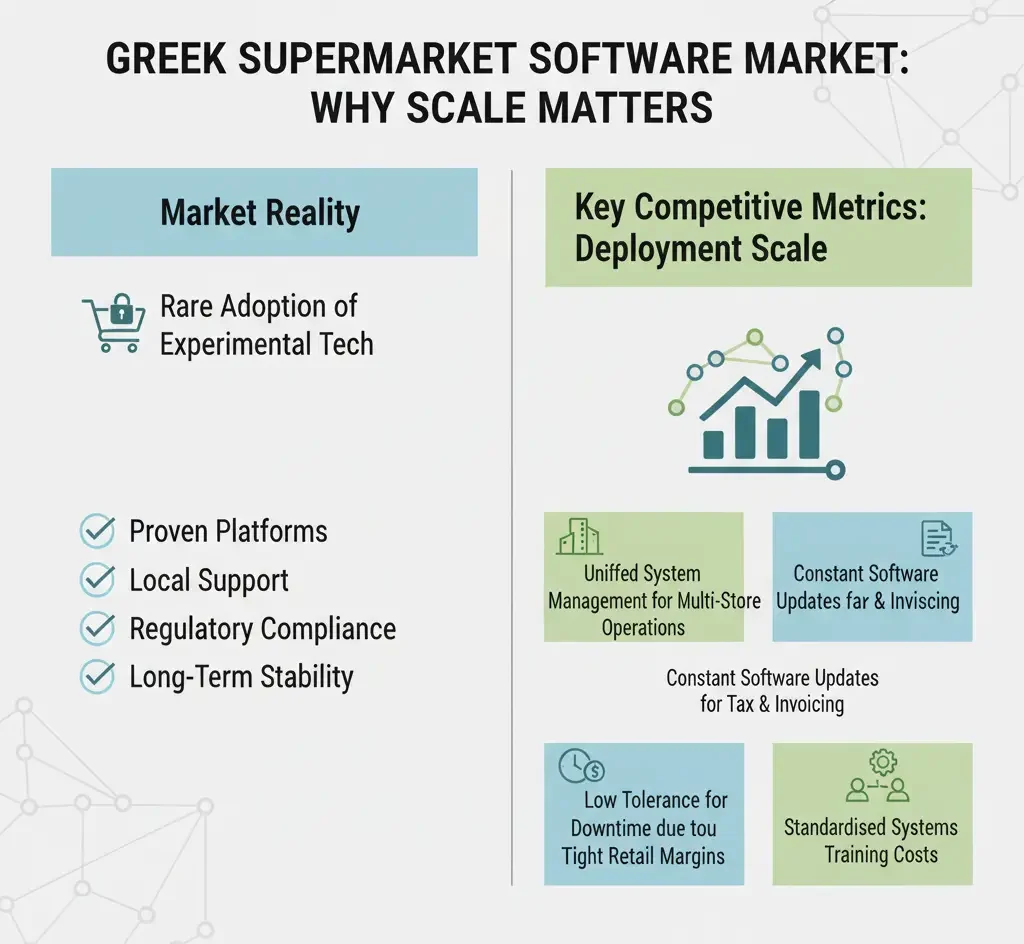
Greek supermarkets rarely adopt experimental retail technology. The market favours proven platforms with local support capacity, regulatory compliance integration, and long-term stability.
Deployment scale has become the key competitive metric because:
-
Multi-store operations require unified system management
-
Tax and invoicing regulations demand constant software updates
-
Retail margins leave little tolerance for downtime
-
Training costs favour standardised systems
Vendors with national partner networks and established support operations outperform niche innovators with limited rollout experience.
Technology Adoption Trends in Greek Supermarkets
Automation at store level
Automation investment focuses on:
-
Price management
-
Inventory replenishment
-
Staff scheduling
-
Checkout efficiency
Retailers aim to reduce manual data entry and labour-intensive processes.
POS modernisation
POS upgrades remain the most visible investment area. Cloud connectivity, mobile payment integration, and faster checkout performance dominate upgrade priorities.
Analytics and reporting
Supermarket operators increasingly rely on:
-
Real-time sales dashboards
-
Product performance tracking
-
Shrinkage monitoring
-
Promotion effectiveness analysis
This has increased demand for integrated BI tools within retail platforms.
Structural Outlook to 2028
The Greek retail technology market is expected to consolidate further.
Key trends include:
-
Platform consolidation into fewer large providers
-
Increased cloud migration
-
Stronger integration between retailers and suppliers
-
Expansion of data-driven store management
Smaller independent vendors may struggle to maintain compliance and infrastructure investment requirements.
At the same time, supermarkets will demand tighter integration between checkout systems, warehouse platforms, and supplier networks.
Conclusion
Retail technology in Greece has moved beyond simple point-of-sale systems. Supermarkets now operate interconnected digital platforms linking transactions, inventory, compliance, and supplier communication.
The companies ranked in this report represent the core infrastructure providers shaping supermarket operations in 2026. Their influence is defined not by marketing presence but by real deployment scale, operational reliability, and long-term platform stability.
As cost pressure and digital reporting requirements continue to rise, technology providers with strong local support networks and scalable platforms will play an increasingly central role in Greece’s grocery retail ecosystem.
Editor’s Note: This article is based on publicly available company disclosures, corporate websites, and financial communications available as of 2025–2026. Currency references reflect reported figures where applicable. No private or non-public data was used.