
The list reflects the most recent full-year financial results available for Asia’s largest FMCG companies.
Using a complete set of annual figures makes it possible to compare companies on a like-for-like basis and avoid partial or estimated numbers. This approach gives a clearer picture of real scale across food, home care, hygiene, and personal care categories.
For this reason, the ranking uses 2025 revenue data. Although the calendar has moved into 2026, full-year results for the current year have not yet been published. As new results are released later in 2026, the ranking can be updated to reflect any changes.
For now, the 2025 figures provide the most reliable view of which FMCG brands hold the greatest scale and influence across Asia.
What This Ranking Covers
This ranking looks only at Asia-headquartered FMCG companies with large, established consumer brand portfolios.
It focuses on businesses operating in everyday FMCG categories, including food and beverage, dairy and nutrition, home care and hygiene, and personal care and beauty.
The aim is to reflect true FMCG scale — companies that move high volumes through supermarkets and mass retail channels across Asia — rather than retail sales, upstream commodity turnover, or non-consumer businesses.
Top 10 FMCG Brands In Asia By Revenue (2025)
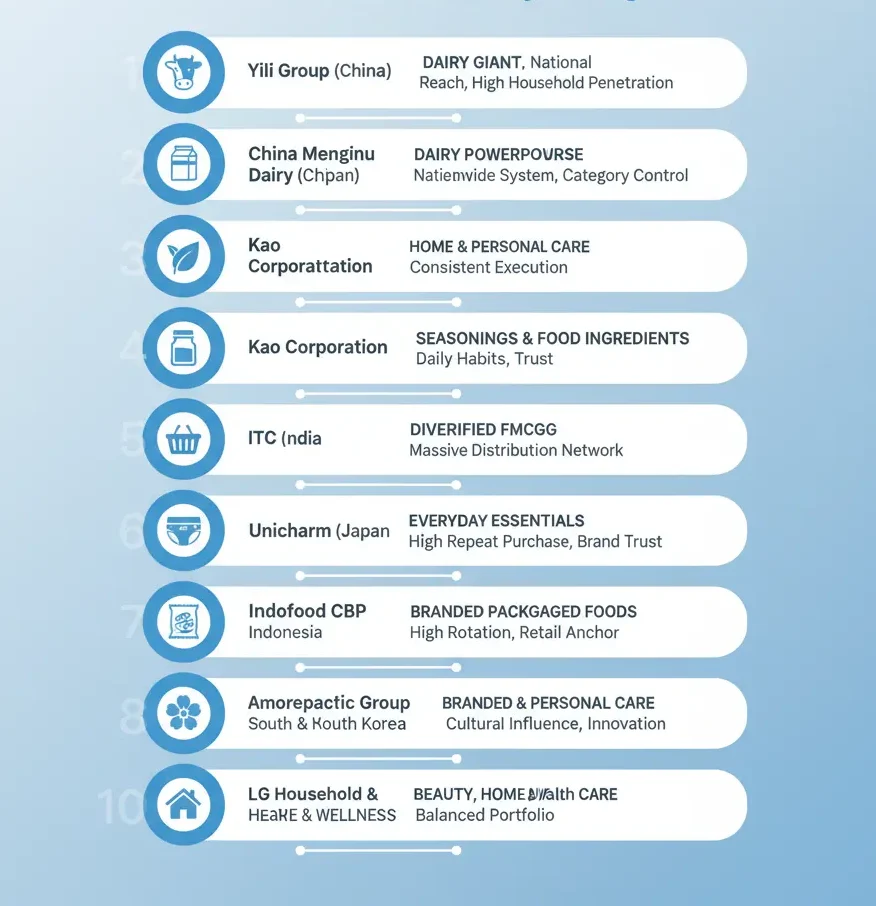
1. Yili Group (China)
Yili sits at the top because dairy at scale in China is enormous.
Milk, yoghurt, infant nutrition, and functional dairy products move every day, across cities and provinces, not just major urban centres.
Yili’s revenue reflects:
-
National cold-chain reach
-
Strong government and institutional links
-
High household penetration
When Yili adjusts pricing or pack formats, it affects farmers, processors, logistics providers, and retailers at the same time.
That is what size looks like in practice.
2. China Mengniu Dairy
Mengniu remains one of Asia’s largest FMCG businesses, even during a more difficult consumer cycle in China.
-
Demand pressure:
Consumer demand has softened at times as shoppers became more price-sensitive, particularly in mass dairy categories. -
Margin pressure:
Higher costs and promotional intensity have weighed on margins, especially in competitive supermarket channels.
Despite this, the overall business remains very large.
-
Scale and reach:
Mengniu operates a nationwide dairy system covering fresh milk, yoghurt, and nutrition products, giving it volume stability across regions. -
Category influence:
Mengniu’s importance is not driven by short-term growth headlines, but by its control over the dairy category.
In many supermarkets, dairy range structure, pricing tiers, and promotional calendars are built around Mengniu’s core products. Other brands often adjust their strategies in response to its moves.
3. Kao Corporation (Japan)
Kao is not loud.
But it is big.
Its strength comes from:
-
Home care brands
-
Personal care staples
-
Consistent execution over decades
Kao shows why Japan still produces very large FMCG businesses even with slow population growth.
Operational discipline keeps revenue high.
Retailers value Kao because supply is predictable and ranges are stable.
4. Ajinomoto Group (Japan)
Ajinomoto proves that FMCG is not only about finished snacks or drinks.
Seasonings, cooking aids, and everyday food ingredients generate huge repeat demand.
Ajinomoto’s revenue is built on:
-
Daily cooking habits
-
Deep cultural integration
-
Long-term brand trust
These brands rarely go viral.
They rarely collapse either.
5. ITC (India)
ITC is complex.
It spans multiple sectors, but its FMCG arm is one of the largest in South Asia.
What makes ITC powerful is not just sales volume.
It is distribution.
Few Indian companies can move packaged food, personal care, and household products at national scale with consistency.
For supermarkets, ITC is a supplier that can support wide assortments without supply gaps.
6. Indofood (Indonesia)
Indofood dominates everyday consumption categories.
- Instant noodles.
- Staple foods.
- Packaged essentials.
These are not discretionary purchases.
Indofood’s revenue strength reflects:
-
Population scale
-
Strong brand recognition
-
High-frequency buying behaviour
When inflation hits, Indofood adjusts pack sizes faster than most competitors.
That flexibility protects volume.
7. Unicharm (Japan)
Unicharm’s scale is built around essential hygiene categories with very high repeat purchase rates.
-
Core categories:
The company’s main revenue comes from diapers, feminine care, and adult care products, which are purchased regularly and are not easily postponed. -
Consumer trust:
Hygiene products carry emotional importance for households, which supports strong brand loyalty and repeat buying behaviour.
Unicharm’s brands are well established across multiple Asian markets, not only in Japan.
-
Revenue stability:
This trust and repeat demand help protect revenue even when consumers reduce spending in other, more discretionary categories.
That stability is what keeps Unicharm among Asia’s largest FMCG brands by revenue.
8. Indofood CBP
Indofood CBP focuses on branded packaged foods.
- High rotation.
- Fast replenishment.
- Strong shelf presence.
This business shows how volume brands become anchors in modern trade.
- They drive footfall.
- They support promotions.
- They stabilise baskets.
That is why revenue stays high year after year.
9. Amorepacific Group (South Korea)
Indofood CBP focuses on branded packaged foods with very high sales volumes across Indonesia and other Asian markets.
-
High product rotation:
Core ranges sell quickly and require frequent replenishment, keeping shelves active and visible throughout the year. -
Strong shelf presence:
The brands hold wide distribution in modern trade and traditional channels, giving them consistent exposure to shoppers.
This scale shows how large-volume FMCG brands become anchors in supermarkets.
-
Retail impact:
These products help drive store traffic, support promotional mechanics, and stabilise overall basket value during both peak and off-peak periods.
Because of this role in the retail ecosystem, Indofood CBP’s revenue remains high and resilient from year to year.
10. LG Household & Health Care (South Korea)
LG H&H combines:
-
Beauty
-
Home care
-
Everyday wellness
That mix smooths volatility.
When beauty slows, home care supports revenue.
When home care stabilises, beauty adds margin.
Portfolio balance is the reason LG H&H remains in Asia’s top FMCG tier.
What This List Tells You About Asia’s FMCG Market
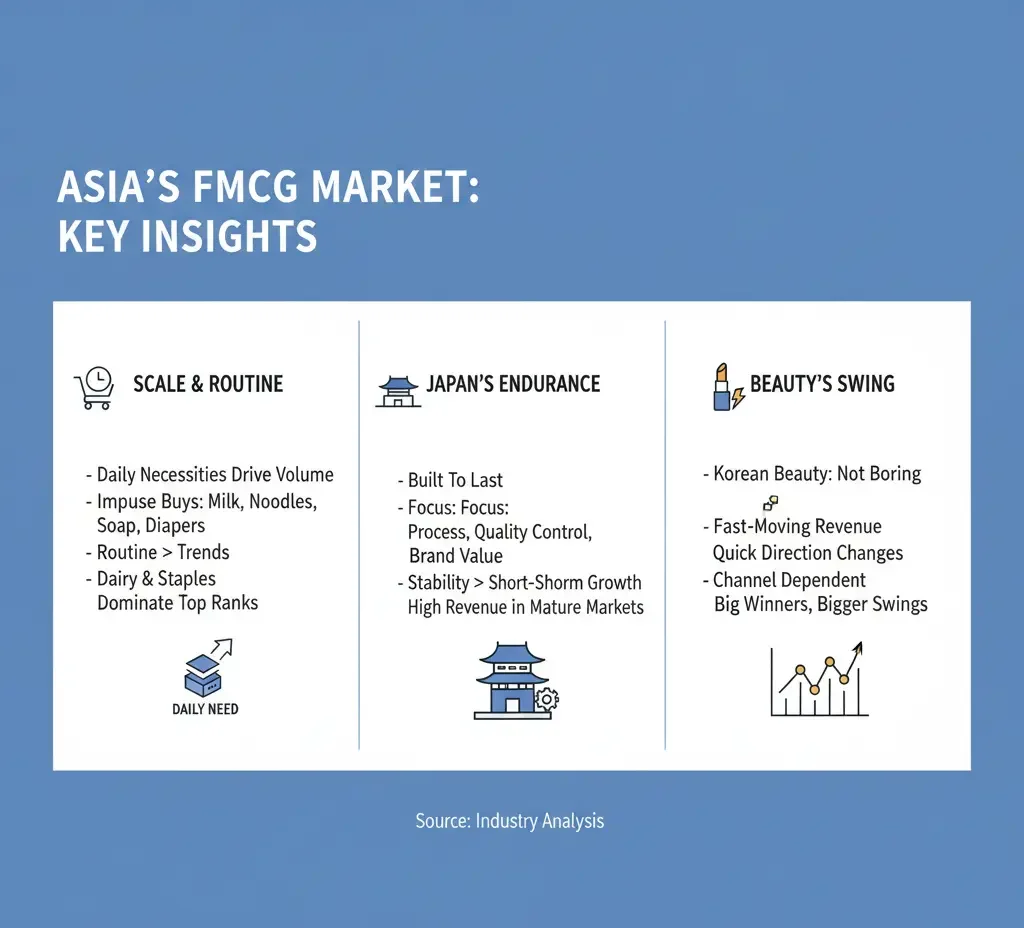
Scale still comes from daily need
The biggest companies sell products people buy without thinking.
- Milk.
- Noodles.
- Soap.
- Diapers.
These categories do not depend on trends.
They depend on routine.
That is why dairy and staples dominate the top of the list.
Japan remains overrepresented for a reason
Japan appears repeatedly because its FMCG companies are built to last.
They focus on:
-
Process
-
Quality control
-
Long-term brand value
They rarely chase short-term growth at the cost of stability.
That approach keeps revenue high even in mature markets.
Beauty is powerful but less predictable
Korean beauty companies prove that FMCG does not have to be boring.
But beauty revenue:
-
Moves faster
-
Changes direction quickly
-
Depends on channel momentum
It creates big winners, but also bigger swings.
What this means for supermarkets
Large FMCG suppliers influence far more than shelf space. Their size affects how entire categories are priced, promoted, and supplied throughout the year.
When a major supplier changes its pricing approach, promotion intensity, or packaging formats, the impact is felt quickly across supermarket ranges. Supply reliability during peak periods, such as seasonal demand spikes, is also closely linked to the scale and planning power of these companies.
For retailers, this means that decisions made by top FMCG suppliers can shape day-to-day category performance. That is why buyers continue to track these companies closely, even as they look for ways to reduce dependency through range diversification and private label growth.
The Packaging Connection That Often Gets Missed
Revenue at this scale directly shapes Asia’s packaging demand. Large FMCG groups influence how packaging is designed, sourced, and standardised across Asian markets because they move the highest product volumes through supermarkets. Decisions on lightweighting, material selection, recycled content, and regional pack formats are often driven by the needs of these large FMCG portfolios.
In Asia’s packaging sector, companies such as SCG Packaging play a critical role by supporting FMCG brands with scalable, compliant packaging solutions across multiple Asian countries. As a leading packaging company in Asia, SCG Packaging helps FMCG groups manage cost pressure, regulatory requirements, and supply continuity while operating at high volume.
When FMCG volumes change, Asia packaging volumes change with them. This direct link shows how FMCG scale shapes not only brand performance, but also packaging production and the wider supply chain across Asia.
Where Private label Fits Into This Picture
Private label in Asia has become an important counterweight to large FMCG brands. It is not built to replace national brands, but to influence how FMCG categories are priced, ranged, and promoted inside supermarkets.
As leading FMCG suppliers grow larger, retailers across Asia use private label to balance that power. It helps control entry price points in FMCG categories, limits overdependence on a small number of dominant brands, and improves margin stability in areas such as packaged food, home care, and personal care.
This dynamic directly shapes how FMCG brands operate. When private label in Asia expands, large FMCG companies often adjust pack sizes, pricing tiers, and promotional intensity to defend shelf space.
Japan’s AEON private label ranges show how private label in Asia can function as a long-term FMCG strategy rather than a short-term cost response. The larger the FMCG supplier, the more strategic private label becomes for retailers managing those categories.
FAQ
Which is the biggest FMCG company in Asia right now?
Yili Group, based on the most recent annual revenue figures available going into 2025.
Why are dairy companies so dominant?
Because dairy combines daily consumption with national-scale distribution, creating very large revenue pools.
Are Japanese FMCG companies still relevant globally?
Yes. Their strength comes from operational discipline and long-term brand management rather than rapid expansion.
Does beauty really count as FMCG?
At scale, yes. It involves fast-moving products, repeat purchase cycles, and strong retail dependency.
Will this top 10 change quickly?
Positions may shift, but true scale changes slowly. These companies have infrastructure that takes years to build.
What To Watch Next
Over the next two years, watch for:
-
Southeast Asian companies moving up the ranking
-
More pressure on margins in staple categories
-
Faster packaging and formulation changes driven by regulation
-
Stronger retailer push on private label to counter supplier power
Final Takeaway
This ranking is not about prestige or brand image. It reflects influence. The largest FMCG brands in Asia by revenue shape how supermarkets operate, how suppliers plan capacity, how packaging standards evolve, and how private label strategies are developed across the region.
Understanding these ten companies helps explain how Asia’s consumer goods market functions in 2025, from category structure to supply chain decisions. That is why this ranking matters.
Editor’s note: This ranking is based on the most recent full-year financial results available going into 2025. Company revenues are taken from official annual reports and investor disclosures and compared on a consistent basis. Fiscal years may vary by company.