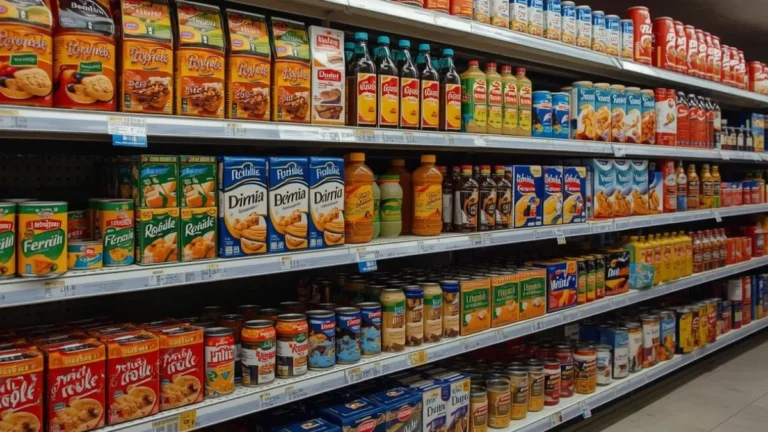

Hungary’s FMCG sector is shaped by a combination of large domestic food groups and multinational producers with strong manufacturing and distribution footprints in the country. This ranking of the top FMCG brands Hungary uses a hybrid methodology, combining available FY2024–FY2025 revenue data with structural market relevance. Including production scale, retail penetration, and supply chain integration. The five leading players are Bonafarm Group, Coca-Cola HBC Hungary, Nestlé Hungária, Mondelez Hungária, and Unilever Magyarország. Each playing a distinct role in supplying supermarkets, private label production, and national distribution networks.
Ranking Overview
| Rank | Company | HQ | FY Revenue | Core Role | Supermarket Relevance |
|---|---|---|---|---|---|
| 1 | Bonafarm Group | Hungary | ~€2.5–3.0B (FY2024 est.) | Integrated food producer | Meat, dairy, processed foods |
| 2 | Coca-Cola HBC Hungary | Hungary (subsidiary of Greece HQ) | ~€1.2B (FY2024 est.) | Beverage bottling & distribution | Soft drinks, retail distribution |
| 3 | Nestlé Hungária | Switzerland (local ops Hungary) | Not disclosed (Hungary ops) | Food & nutrition manufacturing | Coffee, pet food, confectionery |
| 4 | Mondelez Hungária | USA (local ops Hungary) | Not disclosed (Hungary ops) | Confectionery manufacturing | Biscuits, chocolate |
| 5 | Unilever Magyarország | UK (local ops Hungary) | Not disclosed (regional allocation) | FMCG multi-category supplier | Food, home care, personal care |
Note: Revenue reflects local operations where available or estimated structural scale where company-level segmentation is not disclosed.
1. Bonafarm Group
- Founded: 2009
- Headquarters: Budapest, Hungary
- FY Revenue: about €2.5–3.0 billion (FY2024 estimate)
- Employees: ~8,000
Core Segments:
Meat processing (Pick Szeged, Mizo)
Dairy production
Animal feed and agriculture
Processed food manufacturing
Integrated supply chain operations
Operational Relevance
Bonafarm Group operates one of the most vertically integrated food production systems in Hungary, covering agriculture, feed production, livestock, and finished FMCG goods.
This level of integration allows it to maintain control over cost structures and supply consistency, which is increasingly important in a market facing input volatility and regulatory pressure.
Its brands are widely distributed across Hungarian supermarkets, forming a stable domestic supply base for core food categories.
Market Position
As the largest Hungarian-owned FMCG producer, Bonafarm holds a central position in the domestic food system.
Its scale allows it to compete with multinational suppliers, particularly in meat and dairy categories where local sourcing remains critical.
The company also plays a role in supporting national food security and export activity within Central and Eastern Europe.
Strategic Direction
Bonafarm continues to invest in processing efficiency, automation, and product development. The focus remains on strengthening domestic production while improving export competitiveness.
Sustainability and traceability are becoming more prominent, particularly in response to retailer requirements and EU regulatory frameworks.
2. Coca-Cola HBC Hungary
- Founded: 1968 (local operations)
- Headquarters: Budapest, Hungary
- FY Revenue: about €1.2 billion (FY2024 estimate)
- Employees: ~2,500
Core Segments:
Carbonated soft drinks
Bottled water
Ready-to-drink beverages
Juice and energy drinks
Distribution and logistics
Operational Relevance
Coca-Cola HBC Hungary operates as a key bottling and distribution hub within the regional Coca-Cola system.
Its infrastructure supports nationwide distribution, ensuring consistent product availability across retail channels.
The company’s logistics network is particularly relevant for supermarkets, as it enables high-frequency replenishment and promotional execution.
Market Position
The company maintains a leading position in the Hungarian beverage market, supported by strong brand recognition and a diversified product portfolio.
Its ability to operate at scale while adapting to local demand patterns reinforces its role as a core FMCG supplier.
Strategic Direction
Investment is focused on sustainability, packaging innovation, and portfolio diversification, including low-sugar and functional beverages.
Operational efficiency and energy use reduction are also key priorities, aligning with broader industry trends.
3. Nestlé Hungária
- Founded: 1991 (modern Hungarian operations)
- Headquarters: Budapest, Hungary
- FY Revenue: Not disclosed (part of Nestlé global revenue €93B+, FY2024)
- Employees: ~2,400
Core Segments:
Coffee (Nescafé, Dolce Gusto)
Pet food (Purina)
Confectionery
Culinary products
Nutrition
Operational Relevance
Nestlé operates several production facilities in Hungary, including major coffee and pet food plants that serve both domestic and export markets.
Its presence goes beyond distribution, contributing to manufacturing output and supply chain stability within the country.
Market Position
Nestlé holds a strong position across multiple FMCG categories, particularly in coffee and pet care.
Its broad portfolio allows it to maintain shelf presence across different price segments, including premium and mass-market products.
Strategic Direction
The company is prioritising sustainability, including packaging reduction and responsible sourcing. Investment in manufacturing capacity and digitalisation supports long-term competitiveness in both domestic and export markets.
4. Mondelez Hungária
- Founded: 1993 (local operations)
- Headquarters: Budapest, Hungary
- FY Revenue: Not disclosed (part of Mondelez global revenue ~$36B, FY2024)
- Employees: ~1,500
Core Segments:
Biscuits (Oreo, TUC)
Chocolate (Milka)
Seasonal confectionery
Snack products
Export-oriented production
Operational Relevance
Mondelez operates a major production facility in Hungary, particularly focused on biscuits and snacks for European markets.
This manufacturing base strengthens Hungary’s role within regional FMCG supply chains while ensuring consistent supply for domestic retailers.
Market Position
The company maintains strong shelf visibility in supermarkets, particularly in confectionery and snacks.
Its portfolio is aligned with impulse and seasonal purchasing patterns, which are important drivers in FMCG retail.
Strategic Direction
Mondelez continues to optimise its manufacturing network and invest in product innovation. Sustainability and packaging reduction remain key areas of focus, alongside expansion in healthier snacking categories.
5. Unilever Magyarország
- Founded: 1991 (local operations)
- Headquarters: Budapest, Hungary
- FY Revenue: Not disclosed (part of Unilever global revenue €59B+, FY2024)
- Employees: ~1,000
Core Segments:
Food (Knorr, Hellmann’s)
Home care
Personal care
Ice cream
Hygiene products
Operational Relevance
Unilever operates primarily through distribution and regional supply chains rather than large-scale manufacturing in Hungary. Its strength lies in brand portfolio breadth and consistent supply to retail networks.
Market Position
The company maintains a stable presence across multiple FMCG categories, allowing it to capture a wide share of supermarket shelf space.
Its diversified offering supports both essential goods and discretionary purchases.
Strategic Direction
Unilever is focusing on portfolio optimisation, sustainability targets, and supply chain resilience.
The company continues to adapt its product mix to changing consumer preferences, including health and environmental considerations.
Structural Analysis: Hungary FMCG Market Dynamics
Hungary’s FMCG market is characterised by a dual structure combining strong domestic producers and multinational corporations.
Local companies such as Bonafarm provide depth in core food categories, particularly meat and dairy, where local sourcing remains essential.
At the same time, multinational firms dominate processed food, beverages, and branded consumer goods.
Supermarkets play a central role in shaping demand and supplier relationships. Retailers such as Tesco, Lidl, Spar and Auchan operate extensive networks that require consistent supply across multiple categories.
This creates a high level of dependence on large-scale FMCG suppliers capable of maintaining volume, quality and pricing stability.
Private label is also an important factor. While multinational brands retain strong positions, retailers continue to expand their own-brand ranges, increasing competition for shelf space.
This trend places pressure on FMCG producers to differentiate through innovation, pricing strategies and supply reliability.
Supply Chain and Manufacturing Integration
Hungary’s position within Central Europe makes it a strategic location for FMCG manufacturing and distribution.
Companies such as Nestlé and Mondelez use Hungarian facilities to serve both domestic and export markets, benefiting from established infrastructure and proximity to key markets.
Local production remains critical in categories such as fresh food and dairy, where transportation costs and shelf life constraints limit import dependency.
This reinforces the importance of domestic players like Bonafarm within the overall supply chain.
Logistics networks are becoming increasingly sophisticated, with investments in automation, warehousing and distribution technology.
These developments support higher efficiency and enable suppliers to respond more quickly to changing retail demand patterns.
Retail Integration and Category Influence
The relationship between FMCG producers and supermarkets in Hungary is becoming more structured and data-driven.
Retailers are placing greater emphasis on category management, requiring suppliers to provide insights, promotional support and consistent product availability.
Large FMCG companies benefit from their ability to operate across multiple categories, giving them leverage in negotiations and shelf positioning.
However, smaller and local producers can compete effectively in specific segments, particularly where local sourcing and authenticity are valued.
Promotional activity remains a key driver of sales, with price sensitivity continuing to influence consumer behaviour.
This creates a dynamic environment where both global and local FMCG brands must continuously adapt their strategies.
Conclusion
The top FMCG brands Hungary reflect a balanced ecosystem where domestic production and multinational scale operate alongside each other. Companies such as Bonafarm anchor the local food system, while global players like Nestlé, Coca-Cola HBC, Mondelez and Unilever provide category breadth and manufacturing investment, supporting supply across theHungarian supermarket network.
As cost pressures, sustainability requirements and retail consolidation continue to shape the market, the sector is likely to evolve further. Packaging efficiency, material innovation and compliance with EU standards are becoming increasingly important across the Hungarian packaging landscape, influencing how FMCG products are produced and distributed.
Hungary’s combination of local supply strength and international integration will remain central to how FMCG goods move through supermarket channels.
With both domestic producers and global suppliers adapting to changing retail and supply chain demands.
Editor’s Note: This article is based on publicly available company reports, industry disclosures and structural market analysis. Revenue figures are stated using the latest available fiscal data (FY2024 or FY2025 where applicable). Estimated values are clearly indicated. Currency references are primarily in euros for consistency.