

Poland’s grocery retail sector in early 2026 is valued at about PLN 280 billion. This reflects sustained food inflation, store expansion and format diversification across the past two years.
Multinational discount groups dominate total market share. Yet Polish-headquartered supermarket operators still control a significant share of domestic turnover. They do so through proximity formats, franchise aggregation and cooperative retail structures.
This ranking includes Polish-headquartered supermarket operators generating the majority of their sales within Poland. Foreign multinational chains operating locally are excluded.
Where applicable, system-wide sales (network turnover at store level) are used instead of central entity revenue to reflect real retail scale.
All figures are based on FY2024 actuals and 2025 trading performance where publicly confirmed.
Revenue Ranking
| Rank | Company | 2026 Sales (PLN) | Stores | Structure |
|---|---|---|---|---|
| 1 | Dino Polska | 35–37 bn | 3,033 | Founder-controlled, GPW |
| 2 | Żabka Group | 27–30 bn | 10,000+ | GPW, institutional |
| 3 | Lewiatan | 16–17 bn | 3,200+ | Franchise network |
| 4 | Społem (Combined) | 7.5–8.5 bn | 2,000+ | Cooperative federation |
| 5 | Polomarket | 3+ bn | 280+ | Private Polish |
| 6 | Chata Polska | 1–1.5 bn | 200+ | Private Polish |
| 7 | Top Market | 1+ bn | 300+ | Polish network |
| 8 | Arhelan | 1+ bn | 120+ | Eurocash Group partner |
| 9 | Livio | ~1 bn | 200+ | Regional Polish |
| 10 | Major Społem Groups | City-scale | 50–200 | Independent co-ops |
Short headers and clean numeric columns are used to maintain readability across desktop and mobile.
Company Profiles
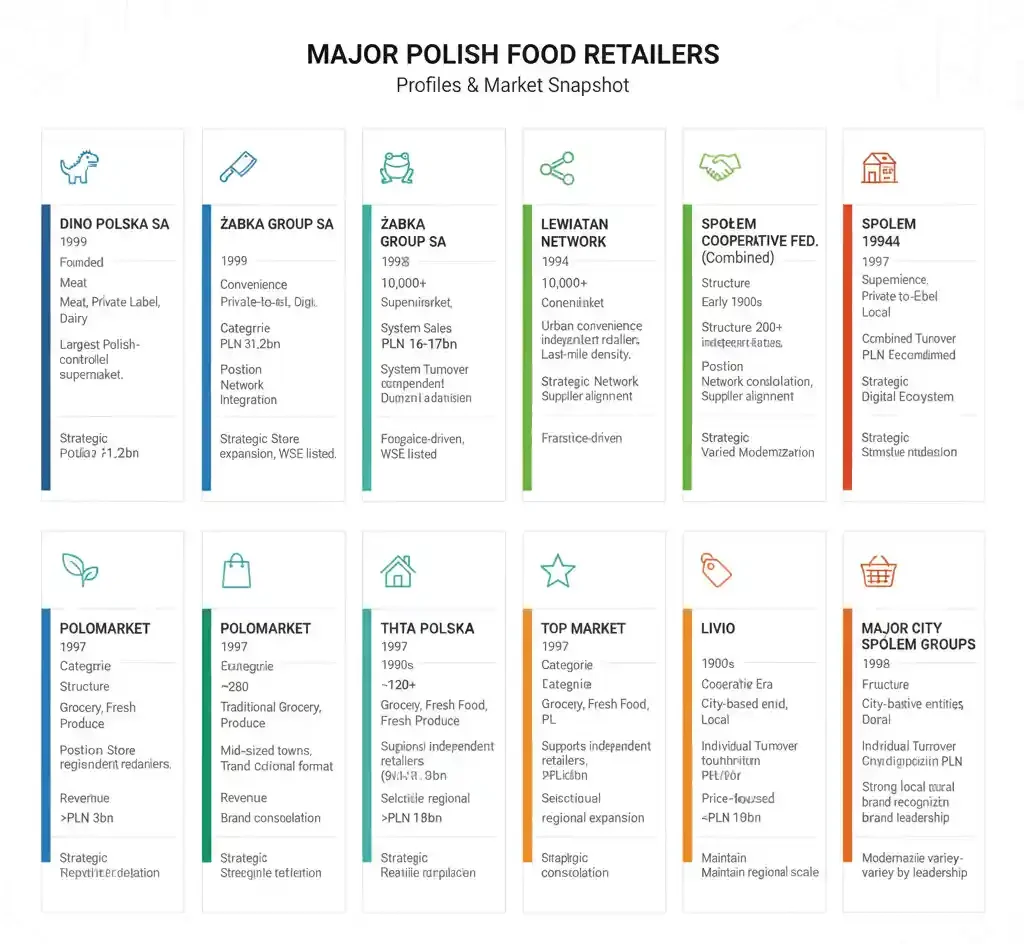
All profiles follow the same structural framework for consistency.
1. Dino Polska SA
- Founded: 1999
- Headquarters: Krotoszyn
Core categories:
- Fresh meat (vertical integration)
- Private label grocery
- Dairy and chilled
- Core FMCG staples
Market Position: Dino is the largest Polish-controlled supermarket operator by turnover. FY2024 revenue reached PLN 31.2 billion. Based on 2025 performance trends, its 2026 operating scale is tracking toward PLN 35–37 billion.
Operational Relevance: Dino controls distribution centres and owns meat processing operations. This vertical integration strengthens pricing control and margin stability. As of the end of 2025, Dino operated 3,033 stores.
Strategic Direction: Expansion continues through disciplined store rollout and logistics investment. The company remains founder-controlled and listed on the Warsaw Stock Exchange.
2. Żabka Group SA
- Founded: 1998
- Headquarters: Poznań
Core categories:
- Convenience grocery
- Ready-to-eat products
- Private label
- Digital services and parcel integration
Market Position: Żabka reported FY2024 revenue of PLN 23.8 billion. However, system sales to end customers reached PLN 27.3 billion. This places its 2026 operating scale between PLN 27–30 billion.
Operational Relevance: Żabka operates over 10,000 convenience stores nationwide. Its density in urban environments makes it structurally important in last-mile FMCG distribution.
Strategic Direction: Growth remains franchise-driven, supported by digital ecosystem integration. The company is publicly listed with international institutional investors.
3. Lewiatan Network
- Founded: 1994
- Headquarters: Poland
Core categories:
- Grocery supermarket
- Private label
- Regional sourcing partnerships
Market Position: System-wide turnover across Lewiatan’s franchise network exceeds PLN 16–17 billion annually. Central entity revenue is lower but not representative of retail scale.
Operational Relevance: Lewiatan aggregates independent retailers, providing procurement leverage and marketing coordination.
Strategic Direction: Focus remains on network consolidation and strengthening supplier alignment.
4. Społem Cooperative Federation (Combined)
- Founded: Early 20th century origins
- Structure: 200+ independent cooperatives
Core categories:
- Grocery retail
- Fresh bakery
- Local sourcing
- Cooperative private label
Market Position: Combined national turnover across major cooperatives is estimated between PLN 7.5–8.5 billion annually.
Operational Relevance: Społem maintains strong regional dominance in specific cities. However, decentralised governance limits national scale efficiencies.
Strategic Direction: Modernisation efforts vary by cooperative. Format updates continue gradually.
5. Polomarket
- Founded: 1997
- Headquarters: Giebnia
Core categories:
- Traditional grocery
- Fresh produce
- Private label ranges
Market Position: Revenue exceeds PLN 3 billion. Polomarket operates about 280 supermarkets.
Operational Relevance: It competes in mid-sized towns through a traditional supermarket format rather than discount positioning.
Strategic Direction: Investment continues in store renovation and brand consolidation.
6. Chata Polska
- Founded: 1997
- Headquarters: Greater Poland
Core categories:
- Grocery supermarket
- Regional private label
- Fresh categories
Market Position: Annual turnover is estimated between PLN 1–1.5 billion.
Operational Relevance: Regional concentration supports logistics efficiency and supplier relationships.
Strategic Direction: Growth strategy remains focused on strengthening regional footprint.
7. Top Market
- Founded: 1990s
- Headquarters: Poland
Core categories:
- Grocery retail
- Fresh produce
- Household FMCG
Market Position: Network turnover exceeds PLN 1 billion.
Operational Relevance: Top Market supports independent retailers through shared branding and procurement systems.
Strategic Direction: Selective regional expansion continues.
8. Arhelan
- Founded: 1992
- Headquarters: Podlaskie
Core categories:
- Grocery retail
- Fresh food
- Private label
Market Position: Revenue exceeds PLN 1 billion annually.
Operational Relevance: Arhelan operates more than 120 stores. It is aligned with the Eurocash Group, which holds a 50% ownership stake. This links it to a broader wholesale infrastructure.
Strategic Direction: Regional consolidation continues under Eurocash-linked operational alignment.
9. Livio
- Founded: 2000s
- Headquarters: Southern Poland
Core categories:
- Discount grocery
- Core FMCG
Market Position: Regional turnover approaches PLN 1 billion.
Operational Relevance: Livio operates as a price-focused competitor in southern markets.
Strategic Direction: It maintains regional scale rather than pursuing national expansion.
10. Major City Społem Groups
- Founded: Cooperative era
- Structure: Independent city-based entities
Core categories:
- Grocery retail
- Fresh bakery
- Local sourcing
Market Position: Individual city cooperatives often generate several hundred million PLN annually.
Operational Relevance: In cities such as Kielce and Białystok, certain Społem entities maintain strong local brand recognition.
Strategic Direction: Modernisation pace depends on cooperative leadership and investment capacity.
Market Structure Impact
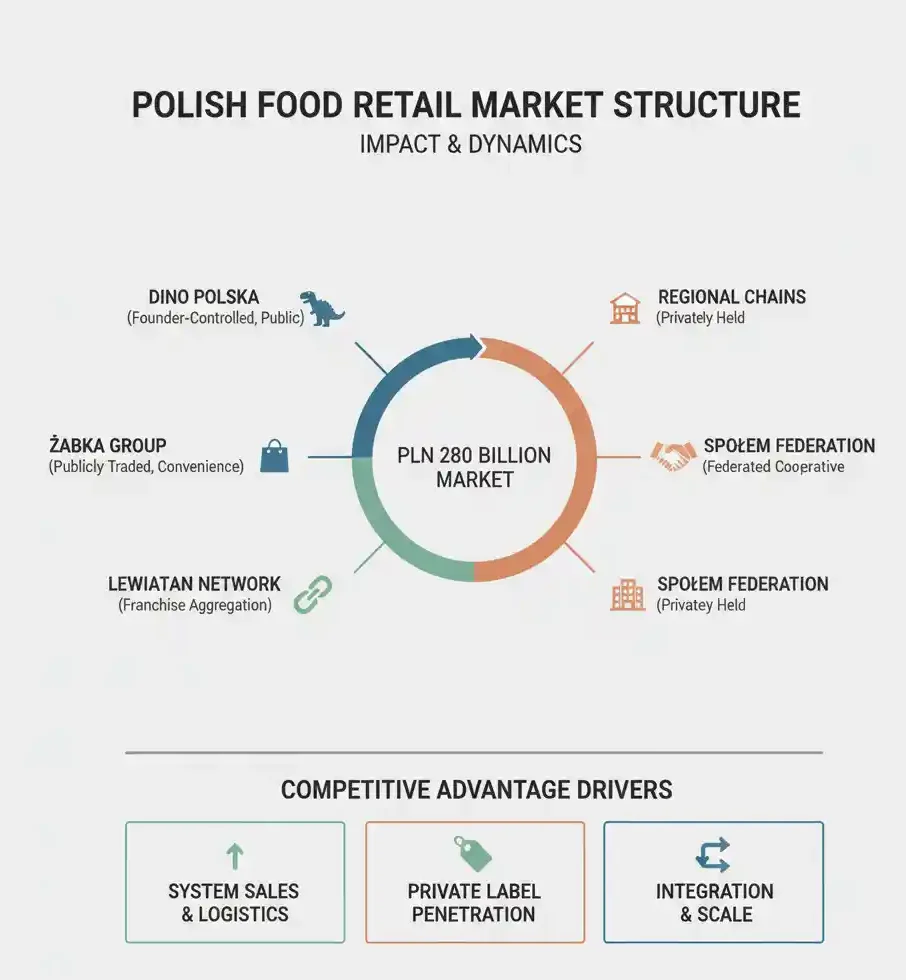
Polish-headquartered supermarket operators collectively represent a structurally significant segment within a PLN 280 billion market. However, ownership models differ:
- Founder-controlled public company (Dino)
- Publicly traded convenience group (Żabka)
- Franchise aggregation network (Lewiatan)
- Federated cooperative model (Społem)
- Regional privately held chains
System sales, logistics integration and private label penetration increasingly define competitive advantage.
Category and Format Trends (2026)
Key structural developments include:
- Continued proximity format expansion
- Franchise network scaling
- Private label growth
- Distribution centre automation
- Margin pressure from discount pricing
Domestic operators compete through flexibility and regional alignment rather than hypermarket scale.
Structural Outlook
The future of Polish supermarket ownership will depend on:
- Access to capital
- Supply chain integration
- Format efficiency
- Strategic alliances with wholesalers
Consolidation pressure is likely to increase, particularly among regional operators facing cost inflation and margin compression.
Frequently Asked Questions
Which is the largest Polish-controlled supermarket operator?
Dino Polska is the largest Polish-controlled supermarket operator by turnover. FY2024 revenue reached PLN 31.2 billion, and its 2026 operating scale is tracking toward PLN 35–37 billion.
Why does this ranking use system-wide sales?
System-wide sales reflect real retail scale. They are used where franchise or cooperative structures apply, because central entity revenue is lower and not representative.
How big is the Polish grocery retail market?
Poland’s grocery retail sector in early 2026 is valued at about PLN 280 billion. Multinational discount groups dominate total market share, while Polish-headquartered operators still control a significant share of domestic turnover.
Conclusion
In 2026, Polish-headquartered supermarket operators remain structurally embedded within a rapidly evolving grocery market valued at about PLN 280 billion.
The competitive landscape reflects broader shifts across the Poland FMCG sector. Scale, procurement leverage and cost discipline increasingly shape retailer performance there.
Dino leads among domestically controlled operators in expansion momentum and logistics integration. Żabka dominates convenience density through franchise acceleration.
Lewiatan and Społem represent aggregation alternatives. Regional chains maintain localised influence within the Poland private label ecosystem, where retailer-controlled brands are gaining structural importance.
Ownership structure, supply chain depth and format efficiency will determine which domestic operators strengthen their market position in the coming cycle.
Editor’s Note: Revenue figures are based on publicly available FY2024 financial disclosures and system-wide sales reporting. 2025–2026 revenue scale reflects reported quarterly performance trends. All figures are reported in PLN. System sales are used where franchise or cooperative structures apply to reflect retail turnover.








